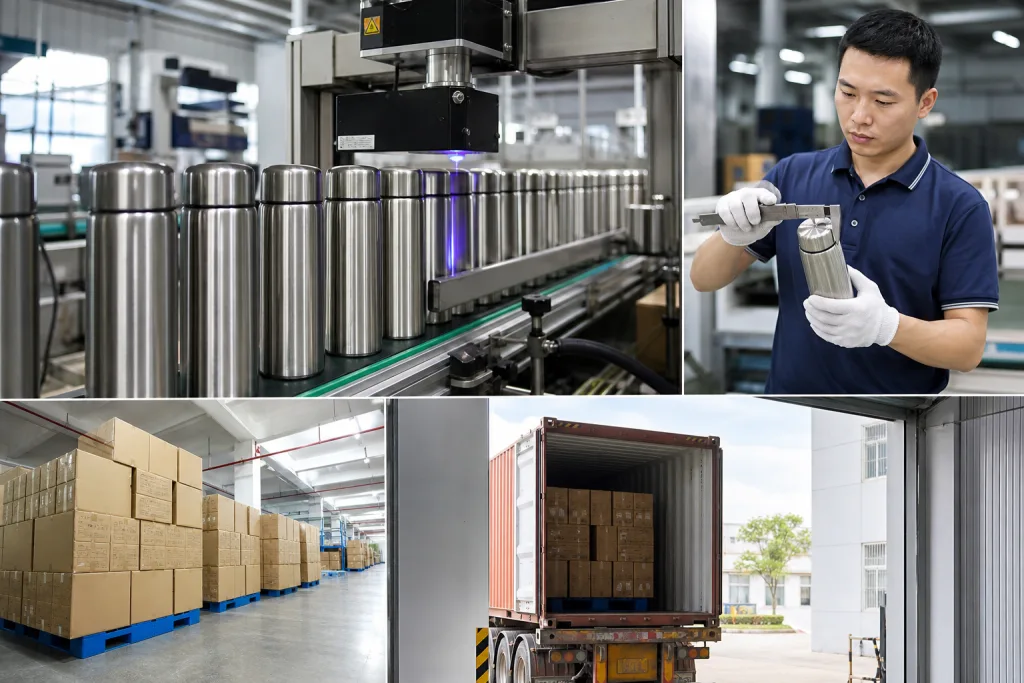
Key Takeaways
- A usable RFQ should state capacity, 304/316 steel, MOQ, logo process, packaging, and target FOB price within USD 0.20 tolerance
- For most custom made thermal bottle projects, realistic production MOQ is 1,000-3,000 pcs per color
- Pre-production samples normally take 7-12 days; bulk production is usually 30-45 days after deposit and sample approval
- Use AQL 2.5 for major defects and AQL 4.0 for minor defects before balance payment
A custom made thermal bottle order usually fails before production starts. The bottle is not the problem. The RFQ is. We see missing items on 6 out of 10 quote sheets: 304 stainless or 316, capacity tolerance in ml, powder coating or spray paint, PP or Tritan lid material, 1.2 m carton drop test, logo position in mm, and who pays when the pre-production sample misses the approved artwork.
If you are buying custom drinkware for retail, promotion, or distributor drinkware programs, use a sourcing process that is boring, documented, and easy to check. Our Hangzhou, Zhejiang team quotes these projects every week for Europe and North America, from 1,000-piece canteen promotional runs to 30,000-piece distributor canteen programs shipped FOB Ningbo or Shanghai. QC pulled one sample last month because the logo sat 4 mm lower than the PO drawing. Small miss. Big argument.
Start With A Useful RFQ
Your RFQ is not a formality. It decides whether a canteen supplier prices the real job or throws out a low number to catch your eye. For a custom made thermal bottle, send the basics in one place: capacity, fixed height or diameter in mm, lid style with material, steel grade, insulation target after 6 or 12 hours, color and finish, logo method with artwork size, packaging, test standard, order quantity, delivery term, and destination market. Simple works. On our line, a missing lid drawing has delayed sampling by 4 days because the silicone ring groove was 0.6 mm off after tooling review.
For example, a clear PO-style RFQ line could read: 500 ml double wall vacuum bottle, inner 304 stainless steel, outer 201 or 304 stainless steel, powder coating, laser logo 35 x 20 mm, PP lid with silicone seal, individual kraft box, 3,000 pcs, FOB Ningbo, EU market, REACH compliant. That gives a canteen manufacturer enough information to quote without hiding cost in later emails. QC can also check it against the first sample with a caliper, a coating thickness gauge, and a carton drop test record instead of guessing what the buyer meant.
Do not ask five canteen vendors for “best price for customized drinkware” and expect comparable replies. This is the wrong question to ask. One canteen factory may quote 201 outer wall at 0.45 mm. Another may quote 304 outer wall at 0.50 mm with a stronger powder coat and a tighter lid seal. The second quote may be USD 0.35 higher and still be the better buy. We have seen buyers flag that gap, then find out the cheaper sample failed after 300 dishwasher cycles and the black coating chipped at the shoulder radius.
At BottleForge Industrial in Zhejiang, China, we usually ask for the target retail channel before quoting. A promotional bottle for a bank campaign is not built the same way as a custom canteen for outdoor retail. If you are a canteen distributor selling into multiple accounts, say so early. It affects carton marks, barcode labels, spare lids, and whether we reserve material for repeat orders. We run repeat programs differently: for a 3,000 pcs launch order, we often hold matching powder for 30 days so the second batch does not come out half a shade different under a D65 light box.
Lock The Product Specification
After the RFQ, turn the bottle into a written specification sheet. This is where 7 out of 10 custom drinkware cost problems start. Capacity is one line only. A workable spec should state inner wall material, outer wall material, wall thickness in mm, vacuum performance, coating, lid construction, gasket material, mouth diameter, leak test method, and allowable tolerance. On our line, QC checks the first sample with a digital caliper before mass production; if the drawing says 0.5 mm wall thickness and the sample reads 0.42 mm, the math doesn't work.
For most custom made thermal bottle orders, we recommend 304 stainless steel for the inner wall. For EU food-contact programs, ask your canteen supplier for LFGB or relevant food-contact documentation where required. For North America, buyers often request FDA food-contact conformity and ASTM-related packaging checks. If the bottle targets hot drinks, lid plastic should be stated clearly, usually food-grade PP, Tritan, or stainless steel depending on design. We have seen a PO say “plastic lid” with no resin grade; the buyer flagged it only after pre-shipment photos, and changing the lid mold insert cost 12 days, not 2.
A practical PO line item looks like this: Insulation: hot water 95°C, retained above 55°C after 12 hours at 20°C ambient; leak test: inverted 30 minutes; coating adhesion: 3M tape cross-hatch check; capacity tolerance: ±5%. These are not decorative words. They give the QC team something to inspect. QC pulled the sample, filled it to the neck, logged room temperature at 20°C, then used 3M tape after the cross-hatch cut; without that line in the PO, both sides argue by email instead of checking the bottle.
If you are sourcing a customizable canteen, customizable growler, or custom growler, pay extra attention to mouth diameter and cap structure. A 64 oz customized growler with a weak handle can pass a desk review and still fail in real use. For heavier bottles, we often suggest thicker handle ribs, stainless reinforcement, or a separate load test at 8-10 kg for 30 seconds. We run that test with a hanging weight, not a hand pull. This small engineering change costs less than replacing a shipment, and we have seen it go sideways when a handle crack showed up after cartons had already passed AQL 2.5 inspection.
Choose Branding Before Sampling
Branding changes the bottle more than buyers expect; we see it on roughly 6 out of 10 first RFQs. A canteen customizable for a one-color logo is not always right for full-wrap artwork, especially on a tapered body where the print stretches near the shoulder. Before sample making, choose the logo method and mark the position on a dieline or a front/side photo with size in mm. The usual choices are laser engraving, silk screen printing, heat-transfer printing, water-transfer print, UV print, and embossed or debossed components on silicone or plastic parts. QC needs a target.
Laser engraving is durable and clean on powder-coated stainless steel, but it cuts through the coating and shows the metal color underneath. Silk screen is cheaper for simple one- or two-color canteen promotional orders, often with lower setup cost and faster line changeover; our print room can usually change a screen in about 20 minutes. Heat transfer or UV print gives more color, but check scratch resistance and dishwasher claims with test data, not sales wording. “Dishwasher safe” is not a sentence we like to print unless the coating, print, and lid have been tested together; we have seen this go sideways after a buyer ran 50 cycles and flagged peeling around the logo edge.
Your PO should separate product cost and branding cost. A clean line might be: Logo: laser engraving on front, 40 x 25 mm, artwork file AI format, included in FOB unit price; setup charge USD 50 waived after 3,000 pcs. For a customized canteen with retail packaging, state each logo position: bottle body, gift box, master carton, instruction sheet, barcode label. One buyer once wrote “logo on packing” on the PO, then expected both color box and carton printing; the math did not work at USD 0.03 packing cost.
For canteen distributors, consistency across repeat orders matters more than a dramatic first sample. Ask the canteen manufacturer to record Pantone color, coating supplier, logo jig position, and approved artwork version; we normally keep the jig photo beside the production file with a ruler showing the top distance in mm. At our China facility network, a small jig mark or photo reference stays with the order file, because “same as last time” is not precise enough six months later. The line forgets. Paper does not.
Approve Samples Like A Buyer
Sampling is not for admiring the bottle. It is for catching what will fail in bulk. A first sample for a custom made thermal bottle normally takes 7-12 days if we use an existing mold and standard color. New mold parts, special lids, or a customized growler body can add 20-35 days. If a canteen vendor promises a complex new sample in three days, ask what step they skipped on the line.
Check the sample against the spec sheet, not against memory. We use a simple approval table: capacity, weight, lid fit, logo size, color, coating surface, leak test, insulation test, packaging, barcode, and carton label. Put a digital caliper on the mouth. Weigh the bottle to the gram. Fill it with hot water, then test after 6 and 12 hours. Turn it upside down on paper for 30 minutes. QC pulled the sample, and that paper test still catches more issues than a phone photo ever will.
A good sample PO line item is: 2 pcs pre-production samples, 500 ml, matte black powder coating, laser logo, kraft box, DHL freight collect, sample fee USD 80 refundable after bulk order above 3,000 pcs. State whether you want a functional sample, color sample, logo sample, or final pre-production sample. We have seen POs that write 500ml in one line and 500 ml in another; the buyer thinks it is harmless, the merchandiser books it as two different items.
At BottleForge Industrial in Hangzhou, Zhejiang, our monthly capacity for stainless thermal bottles is about 450,000 units across standard models, but sample capacity is still limited by coating line schedules and logo room workload. A 12-minute delay on the sample approval can still move bulk by a full week when the spray booth is backed up. That is the wrong question to ask if you are trying to save time. In March-April or September-October, when export orders pile up, one late sample can push your slot behind two full cartons of other buyers' jobs.
Build The Bulk PO Correctly
The bulk purchase order should be dull and exact, so production, QC, finance, and logistics can read it without calling your sales contact for translation. Put the model number, capacity, color split, material spec, logo method, packaging, certification, inspection standard, payment term, shipment term, delivery date, and any non-conformance remedy you need. We once had QC pull a pre-production sample because the PO said “black lid,” while the approved sample had a black flip cap with a grey push button. Two words caused a half-day stop.
For MOQ, use factory math. For existing molds, canteen suppliers often start at 1,000 pcs per color, but the better price usually starts at 3,000-5,000 pcs because the line spends less time on color change and carton setup. For custom colors, powder coating plants usually want 1,000 pcs per color minimum; below that, the setup loss on the spray booth and curing oven is hard to absorb. For a new lid, new body mold, or distributor growler project, MOQ may be 3,000-10,000 pcs because tooling, trial shots, and line setup take more labor. Asking for 300 pcs with a new PP lid mold is the wrong question to ask. The math does not work.
A clean PO line could read: Item BF-TB750, 750 ml custom made thermal bottle, matte navy Pantone 296C, 304 inner/304 outer, laser logo, retail color box, 12 pcs/master carton, 3,600 pcs, FOB Ningbo, unit price USD 4.85, 30% deposit, 70% after passed inspection before shipment. If you need Amazon FNSKU labels, carton routing labels, or retail barcode stickers, add them as separate packaging lines, not loose email notes. We have seen a buyer flag cartons at inspection because the PO listed “color box,” but the barcode artwork was only sent in a WeChat thread.
If you are a canteen distributor or distributor drinkware buyer, add a spare parts line: extra lids 1%, silicone gaskets 1%, plus replacement straws if the model uses them. On a 3,600-piece order, that means 36 spare lids and 36 gaskets packed in a marked inner carton, usually less than 6 kg total. It is cheaper to ship them inside the main order than to send them by air later. A reliable canteen manufacturer should remind you before the PO is signed; if they do not, ask directly.
Inspect Before You Pay Balance
Final inspection is where you protect the margin you negotiated. We book it when production is 100% finished and at least 80% packed; on a 3,000 pcs bottle order, QC usually pulls 125 pcs under general inspection level II. Use AQL, not opinion. A common standard for custom drinkware is AQL 0 for critical defects, AQL 2.5 for major defects, and AQL 4.0 for minor defects. Critical means unsafe material, sharp edges, severe leakage, wrong food-contact material, or contamination. Major means failed insulation, wrong logo, serious dents, or coating peel. Minor means small cosmetic marks inside the approved limit, checked under a light box at about 60 cm.
Your inspection checklist should cover carton count and SKU mix first, because one PO typo can put black lids into a navy bottle carton. Then check color match, logo position, barcode scan, capacity, weight, lid torque, leak test, vacuum performance, coating adhesion, odor, packaging drop condition. We run the lid torque check with a torque meter, not by hand feel. For EU orders, keep REACH and food-contact documents in the shipment file. For North America, keep CPSIA only when children’s products apply; asking for random certificates because another buyer mentioned them just burns time.
For a canteen customized with retail packaging, inspect packaging as seriously as the bottle. We have seen this go sideways: the bottle passed, but the buyer flagged a wrong FNSKU on 48 cartons and Amazon receiving stalled for 12 days. Wrong FNSKU, weak carton board, or missing country-of-origin mark can delay receiving even when the bottle is perfect. Our usual export cartons use 5-ply corrugated board for heavier thermal bottles, with carton gross weight kept under 15 kg where possible to reduce handling damage.
Do not release the 70% balance because the factory says the container is booked. That is the wrong question to ask. Release it because the inspection passed or because a written rework plan is complete, with photos, quantities, and a recheck date before the ETD. Good canteen manufacturers in China are used to this. The weak ones get defensive.
Plan Reorders And Market Fit
A custom made thermal bottle program should not be treated as a one-time bet if you are building a product line. After the first shipment, collect hard feedback: lid complaints, dent rate, coating scratches, return reasons, carton damage, and sell-through by color. Send that sheet back to the canteen factory before the reorder. We check it against the retained PP sample and the final AQL 2.5 report. A 2% lid complaint rate may point to gasket hardness. A 4% dent issue may mean the carton insert needs revision, not a bad bottle body.
For canteen distributors and distributor canteen programs, we suggest keeping the body model stable for at least two seasons. Change color, logo, packaging, or bundle accessories first. Swapping the steel body every PO burns money on samples, new photos, and leftover stock. We see it on the line: one buyer changed a 68 mm mouth to 72 mm, then found the old tea infuser no longer fit. If you want a custom growler, custom canteen, and travel tumbler in one range, match the coating colors and lid accents so the shelf looks planned.
Reorder planning also affects price. If your first PO is 3,000 pcs and your forecast is 18,000 pcs over six months, tell the canteen supplier. We may quote a sharper price if material and coating batches can be booked together. At our Zhejiang export operation, repeat orders using approved components can often move 5-7 days faster than a new customized drinkware project because artwork, cartons, and inspection standards are already locked. For example, a repeat color with approved Pantone and carton mark can pass pre-production review in 1 day, while a new coating trial often needs 3 drawdown panels before the buyer signs off.
The best buyer-supplier relationship is not romantic. It is documented, repeatable, and honest about defects. If your market needs a lower price, say which feature can move: outer steel grade, box type, coating, accessory set, or carton quantity. Asking every canteen vendor to cut USD 0.40 without changing anything is the wrong question to ask. The math does not work. We have seen this go sideways when QC pulled the sample and found thinner cartons, looser lids, or a missing polybag that nobody approved on the PO.
Send Your Thermal Bottle RFQ For Review
Share capacity, quantity, logo, market, and target price. Our Zhejiang team will return a practical quote and sample plan.
Frequently asked questions
What MOQ should I expect for a custom made thermal bottle?
For an existing stainless steel thermal bottle mold, a practical MOQ is usually 1,000 pcs per color. Better FOB pricing normally starts at 3,000-5,000 pcs because coating, logo setup, carton printing, and production line changeover are spread across more units. If you need a new lid, new body shape, or a fully customized growler, MOQ can rise to 3,000-10,000 pcs. For a simple canteen promotional order with laser logo on a standard color, some canteen suppliers may accept 500 pcs, but the unit price and inland handling cost will be higher.
How long does production take after sample approval?
For a standard custom made thermal bottle using an existing mold, plan 30-45 days for bulk production after deposit, artwork approval, and pre-production sample approval. Pre-production samples usually take 7-12 days. Add 20-35 days if tooling is needed for a new cap, handle, or customized canteen body. Peak export periods in China, especially before summer promotions and Q4 retail shipments, can add another 7-10 days if material is not booked early. Ocean freight is separate and may take 25-40 days to Europe or North America depending on port.
Which logo method is best for customized drinkware?
For powder-coated thermal bottles, laser engraving is the most durable choice and works well for corporate, outdoor, and distributor drinkware orders. Silk screen printing is cost-effective for one- or two-color logos, especially on canteen promotional projects above 1,000 pcs. Heat transfer and UV printing allow more color, but scratch resistance should be tested before bulk approval. For retail packaging, ask for one final sample with the exact logo size, Pantone color, and box print. Put the method, logo dimensions, and artwork version into the PO so the canteen manufacturer cannot guess.
What should be included in a thermal bottle inspection?
Use AQL inspection with AQL 0 for critical defects, 2.5 for major defects, and 4.0 for minor defects. Check carton quantity, color, logo position, barcode scan, bottle weight, actual capacity, coating surface, lid fit, gasket assembly, leakage, odor, and insulation performance. For thermal testing, many buyers use 95°C hot water and measure temperature after 6 or 12 hours at about 20°C ambient. Packaging should also be checked with carton marks, retail box print, FNSKU where needed, and drop resistance. Inspection should happen before the 70% balance payment.
Can I get one supplier for bottles, growlers, and canteens?
Yes, if the canteen supplier has access to the right stainless steel forming, vacuum, coating, and assembly lines. A factory strong in 500 ml thermal bottles may not automatically be strong in a 64 oz custom growler, because larger bodies need different welding control, handle strength, and carton protection. Ask for current production photos, capacity by model type, and samples from the same line. For a distributor growler or customizable canteen range, it is better to keep coating colors, logo standards, and packaging structure consistent across items.