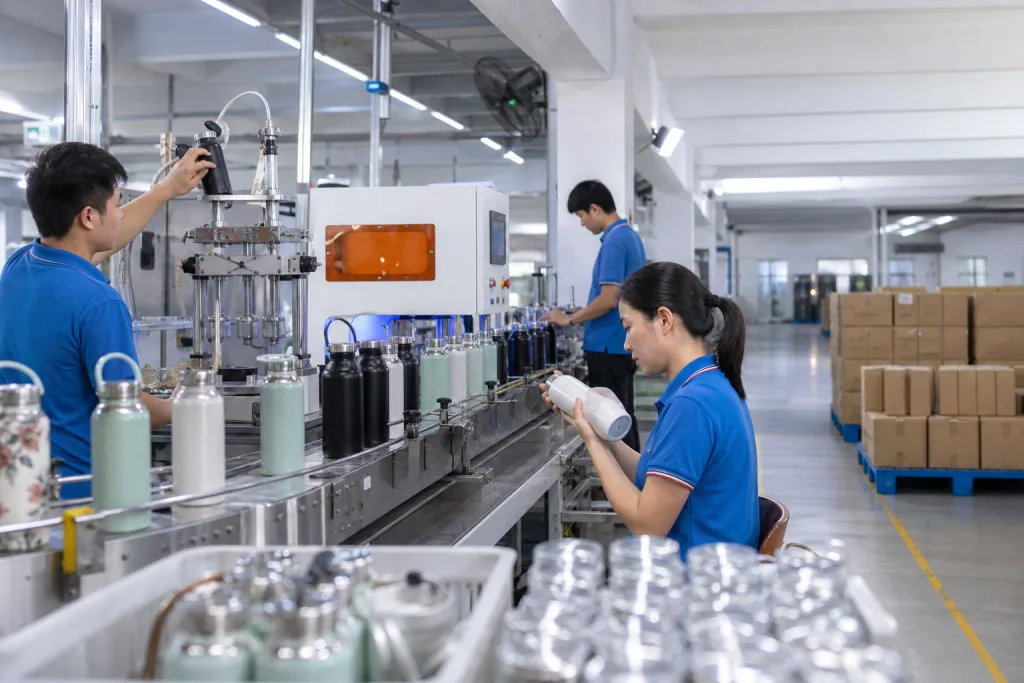
Key Takeaways
- Start with use case first: office tea, outdoor canteen, retail gift set, or promotional order
- For stainless steel tea bottles, 304 inner steel and 201 or 304 outer steel are the usual B2B choices
- Plan 3,000 units MOQ per color for most custom made tea bottle projects in Zhejiang, China
- Confirm leak testing, AQL level, logo method, carton drop test, and packaging before deposit
A custom made tea bottle looks simple until you start buying 3,000 or 30,000 units. Then small choices get expensive fast: the wrong 0.5 mm infuser mesh clogs with loose tea, a lid leaks when QC tilts it at 45 degrees for 60 seconds, the logo scratches after carton vibration testing, or the bottle passes your sample review but fails retail inspection. We’ve seen this go sideways.
If you source custom drinkware from China, get the product details fixed before you ask for a quotation. At our Zhejiang factory, tea bottle projects usually run from 3,000 units per SKU, 25-35 days for mass production after sample approval, and up to 600,000 units per month across stainless steel and plastic drinkware lines. The line will ask for things buyers often skip on the first RFQ: lid material, gasket hardness, logo position in mm, carton drop-test requirement, and whether the PO says matte black or “mate black.”
Start With The Use Case
The first decision is not color, capacity, or logo size. It is how the buyer’s customer will use the bottle. A custom made tea bottle for office desks is a different job from a canteen custom project for hiking retailers, or a distributor drinkware line going onto supermarket shelves. We had one PO last month that called it a “tea cup” in the item line and a “sports bottle” in the carton mark; QC caught it before the barcode file went to print.
For office and corporate gifting, we run more clean shapes in 350-500 ml, with a removable stainless infuser and gift-box packaging. For outdoor use, 600-1,000 ml sells better, and the lid needs a stronger carry handle or loop; the buyer will pull on it in the sample room. For retail shelves, the shape has to ship in a tight master carton, stand straight in display, and keep landed cost under control. A 2 mm wider base can mean 12 pcs fewer per carton.
Here is the practical trade-off: more parts mean more failure points. A tea bottle with body, lid, silicone ring, infuser, handle, strainer cap, and bottom bumper can look premium, but each part needs tooling tolerance and assembly control. On the line, QC checks the silicone ring with a simple water-leak test after assembly. If you are a canteen distributor selling into promotion channels, simple construction often wins because complaint rates stay lower. We’ve seen this go sideways when a nice-looking handle passed the photo sample but cracked after the drop test.
For a first order, we recommend one main use case and one capacity. Do not launch 350 ml, 500 ml, 750 ml, and 1,000 ml together unless you already have stable sell-through data. The math doesn't work for most new programs. A mixed order looks efficient on the spreadsheet, but each SKU needs its own color approval, carton mark, barcode, inspection sample, and spare-part check. Even at 1,000 pcs per SKU, that is 4 sets of pre-production samples sitting on the QC table before bulk packing starts.
Choose Material Before Decoration
Material sets cost, durability, compliance, and how the bottle reads on shelf. For a custom made tea bottle, stainless steel is still the safest route for B2B buyers in Europe and North America. We usually run a double-wall vacuum build with 304 stainless steel inside and 201 or 304 stainless steel outside. On a 500 pcs pilot run, the buyer flagged 201 on the outer shell as too basic for a tea gift set. If the target is a higher-end retail line, 304/304 looks cleaner, but the unit price moves up.
Wall thickness matters. A lot of export bottles start at 0.4-0.5 mm stainless steel sheet before forming. We have seen the math on a USD 0.08 steel saving, and the math does not work if the bottle dents in transit or the polish shows roller marks. On the line, thinner stock gives QC more rejects after the body forming step. If you are selling premium customized drinkware, this is the wrong place to save pennies.
Plastic tea bottles are possible, especially Tritan-style clear bottles with infusers, but the food-contact file has to match the market exactly. For the EU, buyers often ask for LFGB, REACH-related material declarations, and migration reports. For the US, FDA food-contact compliance and sometimes California Proposition 65 review come up. QC pulled one sample for a 70°C hot-fill check and the lid gasket passed, but the buyer still asked for the full resin traceability sheet before booking.
Glass tea bottles look elegant but raise breakage risk fast. If you are a canteen vendor shipping to e-commerce warehouses, glass needs stronger inner packing and tighter carton drop testing, usually 1.0 m with 6-sided drops. We once saw a PO typo turn 12 mm dividers into 2 mm dividers; the buyer caught it before loading. A stainless bottle handles rough parcel networks better, especially for distributor stock tied to winter or outdoor campaigns.
Decide The Infuser And Lid System
The infuser is where 7 out of 10 tea bottle problems start. Buyers focus on wall shape and color, but the user touches the lid and basket first thing in the morning. A poor mesh size lets tea particles pass. A loose thread feels cheap. A silicone ring sitting 0.3 mm proud can leak after three uses; QC pulled one like that on the line last April.
For loose-leaf tea, a 304 stainless steel infuser with fine perforation is still the safest choice. Woven mesh catches smaller leaves, but cleaning takes longer, and it deforms if the buyer’s warehouse repacks it without a divider tray. Laser-perforated or punched stainless baskets hold shape better after repeated washing, but 0.5 mm tea dust can still pass through. For fruit tea, choose a deeper basket, not a tiny capsule-style strainer. The math does not work if the customer wants orange slices in a 28 mm capsule.
Lid design usually goes two ways first: screw lid or push-button lid. A screw lid gives better leakage control, and we run thread fit with a simple torque gauge before packing. A push-button lid feels easier for commuters, but the spring, latch, and sealing face need tighter tooling; one buyer flagged a 0.2 mm latch gap because it clicked unevenly. Bamboo-top lids sell well for sustainable drinkware programs, but bamboo color shifts by batch, and storage humidity needs control at about 45%–60% RH.
Ask your canteen manufacturer for the actual test conditions, not the words “leak proof.” At BottleForge in Zhejiang, China, we normally run inverted leak checks and random vacuum performance checks during production, then final inspection by AQL. For tea bottles, we also recommend hot-water fit testing because silicone can behave differently at 95°C than at room temperature. We have seen this go sideways: a lid passed cold water for 24 hours, then leaked after 6 minutes with near-boiling tea.
Do not approve a lid from photos. Ask for pre-production samples using the final silicone ring and mass-production thread, with the final infuser installed. Prototype parts often feel smoother than parts from the production mold.
Set A Realistic Customization Scope
Customization is not one decision. It is a BOM issue. For a custom made tea bottle, we normally split the scope into body color, logo method, surface finish, packaging, accessories, barcode, instruction sheet, and any mold change. On our line, even a 0.3 mm change to the silicone seal can affect leak testing and lid assembly speed. A lightly branded stock bottle is a different job from a fully engineered retail item, and the difference shows up in MOQ, lead time, and failure risk.
For most canteen promotional orders, the cleanest route is an existing mold with your Pantone color and logo. We run powder coating, spray painting, and metallic finishes often, but each finish needs its own color limit board under a D65 light box. Laser engraving lasts well and suits corporate orders; the tradeoff is low color impact, so the buyer sometimes flags it as “too quiet” after seeing the PPS sample. Silk screen printing is cheaper for a simple one-color logo. Heat transfer and UV printing are better for full-color artwork, but approve them only after tape test and abrasion test, not from a JPG mockup.
If you need a custom canteen shape, new tooling can range from a few thousand USD to much more depending on the stainless body, lid structure, and plastic parts. Tooling also adds 25-45 days before production. The math works for a long-term retail line with repeat POs, say 10,000 pcs per batch and stable shelf space. For a one-season promotional campaign, this is usually the wrong question to ask; we have seen projects lose two weeks because the buyer wanted a 5 mm taller shoulder that no end customer noticed.
Packaging is where buyers often underestimate cost. A plain white box may cost around USD 0.12-0.25 depending on size and board quality. A printed gift box can move higher, especially after lamination, spot UV, or an inner tray is added. Inserts, kraft sleeves, instruction cards, FNSKU labels, and master carton customization all add labor; QC once pulled a packed carton because the PO had “FNSKU on right side” while the artwork showed left side. If you sell through Amazon FBA or another e-commerce channel, confirm carton weight, barcode placement, polybag rules, and drop-test expectations before the factory packs goods.
Understand MOQ, Price, And Lead Time
MOQ is not a factory preference. It comes from four real bottlenecks: coating line setup, logo fixture setup, packaging print minimums, and component purchasing. For standard customizable drinkware in our Zhejiang factory, 3,000 units per color is a typical starting point. We run the powder coating line with color-change loss counted in kg, and one bad Pantone match can eat half a shift. Some stock-shape orders can be lower, but special colors, custom boxes, or uncommon lids push the minimum higher.
FOB pricing depends on capacity, steel grade, surface finish, lid complexity, and order quantity. A basic stainless steel tea bottle will not price like a premium customized growler or insulated custom growler with a large handle and heavy cap. The math changes. For planning, B2B buyers should expect clear price movement between 3,000, 5,000, and 10,000 units because component purchasing and line efficiency improve; on one 500ml tea bottle project, the buyer flagged a USD 0.18 gap, and it disappeared only after we moved the order from 3,000 to 10,000 units.
Lead time has layers. A normal sequence is 5-10 days for logo sample or pre-production sample, 25-35 days for mass production after approval, plus time for booking, customs, and ocean freight. Before peak seasons, especially August to November, coating and packing capacity fills quickly in China. We've seen this go sideways when a PO arrived with the logo file named “final_final2.ai” and the carton mark still missing. If you need delivery for a holiday campaign, do not treat a quotation lead time as a guaranteed ship date until deposit, artwork, and sample approval are complete.
For canteen suppliers and canteen manufacturers, unclear specifications create slow quotations. Send capacity, material requirement, lid type, logo method, Pantone color, packaging, target quantity, destination port, and required compliance tests. QC pulled the sample faster when the buyer gave us 0.5mm engraving depth and matte black finish up front. You will get a better answer than asking, “Please quote your best customized canteen.”
Control Quality Before Shipment
Set quality rules before the first stainless sheet is cut, not after QC finds rejects on the packing table. A custom made tea bottle carries cosmetic risk, sealing risk, vacuum risk, and food-contact risk. Put the accept/reject samples in writing, with photos, Pantone numbers, logo position in mm, and lid torque targets if the cap design needs them. “Good quality” is the wrong wording on a PO.
Use AQL inspection terms. In our export orders, about 8 out of 10 B2B buyers use general inspection level II, with critical defects at 0, major defects around 2.5, and minor defects around 4.0. Critical defects include leakage, unsafe sharp edges, wrong material contact parts, or contamination. Major defects include wrong logo position, deep coating scratches, loose lid fit, failed barcode scans, or wrong carton quantity. Minor defects include small dust points or slight color variation within approved tolerance. Last month QC pulled 200 samples from the line and the buyer flagged a 3 mm logo drift, so we now mark the jig before mass printing.
For insulated stainless tea bottles, vacuum performance testing matters. We run a hot-water check with a digital thermometer, then record temperature retention after the agreed hours. You do not need full 12-hour testing on every unit; the math does not work on a 20,000 pcs order. Random checks during production and final inspection catch vacuum failure earlier, especially after copper plating or bottom welding. Leak testing should include inverted and 45-degree angled positions. Carton drop testing makes sense if goods will pass through parcel networks; a 1.2 m drop test can expose weak dividers before we ship.
Compliance documents should match your sales market. EU buyers may request LFGB or EU 1935/2004 food-contact testing, REACH declarations, and sometimes packaging recycling marks. US buyers may request FDA food-contact compliance, CPSIA only if the product is for children, and Prop 65 review depending on distribution. If you are a canteen distributor, file these documents by PO and SKU, not just by product name. Retailers often ask months after shipment, and we have seen this go sideways when one PO had a typo in the SKU code.
Pick The Right Supplier Type
Not every canteen supplier fits the same buyer. A trading company is usually faster when you need 20 mixed styles from different workshops. A canteen factory gives tighter control on wall thickness, coating, lid fit, and leak testing, but the catalog can be narrow. A hybrid export manufacturer sits between those two: we run design review, compliance files, packing specs, and factory communication under one sales engineer. Pick based on order complexity and the control you need, not just the lowest line on the quote sheet.
If you are buying a simple canteen customizable item for a 10,000-piece short campaign, speed and price usually drive the decision. If you are building a retail line of customizable canteen products, repeatability matters more: coating gloss within the approved range after six months, lid torque checked with a torque meter, carton burst strength matched to your warehouse handling, inspection held to the same AQL 2.5 plan. Small differences show up fast. Distributor growler and distributor drinkware buyers usually need stable reorder performance more than the cheapest first PO, because the math does not work if the second shipment has 3% leaking lids.
Ask direct questions. How many units per month can the line produce? What is the MOQ per color? Which parts are made in-house and which are outsourced? Can the factory provide BSCI audit records, ISO-style process controls, or third-party inspection support? Who owns the tooling if you pay for it? How long are golden samples stored? We have seen buyers skip this and then argue over a 0.3 mm mouth-size change after QC pulled the sample. Get the answers before the deposit, and ask who signs off the pre-production sample.
At BottleForge Industrial in Hangzhou, Zhejiang, we prefer buyers who define the commercial target clearly: retail, promotional, hospitality, outdoor, or e-commerce. That lets us steer you toward a practical custom canteen or tea bottle structure instead of overbuilding a product nobody wants to pay for. We once had a buyer request a heavy double-wall tea bottle for a budget gift order, and freight jumped by 18% after the carton weight hit 14 kg. A good canteen vendor should challenge weak specifications before production, not after the goods are packed.
Send Your Tea Bottle Specification For Review
Share capacity, quantity, logo method, market, and target price. We will check feasibility, MOQ, lead time, and practical factory options.
Frequently asked questions
What is the normal MOQ for a custom made tea bottle?
For most stainless steel custom made tea bottle orders, a realistic MOQ is 3,000 units per color when using an existing mold. If you need a special Pantone coating, printed gift box, or non-standard lid, the practical MOQ may move to 5,000 units. Small trial runs are sometimes possible with stock colors and simple laser logos, but the unit price will be higher because coating, packing, and inspection setup costs are spread across fewer units.
Which logo method is best for customized drinkware?
It depends on the surface and brand look you want. Laser engraving is the most durable for stainless steel and works well for corporate or premium retail orders. Silk screen printing is cost-effective for one-color artwork, usually on powder-coated bottles. UV printing or heat transfer is better for full-color graphics, but you should request tape testing, abrasion testing, and dishwasher-related guidance. For a tea bottle handled daily, durability matters more than a slightly lower decoration cost.
Can one supplier produce tea bottles, canteens, and growlers?
Yes, but confirm the actual production scope. Some canteen vendors mainly assemble outsourced parts, while others control forming, polishing, coating, and packing. Tea bottles, custom canteen items, and customizable growler products share some processes, but lids, handles, vacuum performance, and capacity testing can differ. If you plan to build a distributor drinkware range, ask whether the factory can maintain consistent colors and packaging across different product families.
How long does production take after sample approval?
For an existing mold with standard components, mass production is usually 25-35 days after deposit, artwork confirmation, and sample approval. Add 5-10 days for pre-production samples. Custom tooling can add 25-45 days before mass production starts. China holiday periods, especially Chinese New Year, can add several weeks of risk. If you need goods in a North American or European warehouse by a fixed date, work backward from vessel booking and customs clearance, not only factory completion.
What tests should I request before shipment?
At minimum, request leak testing, visual inspection under AQL, carton quantity check, logo position check, barcode scan check, and packaging drop test if the goods are for e-commerce. For stainless insulated tea bottles, include random vacuum performance checks. For EU sales, ask for food-contact documents such as LFGB or EU 1935/2004 where applicable. For US sales, confirm FDA food-contact suitability and any retailer-specific requirements. Put these requirements on the purchase order, not only in email.