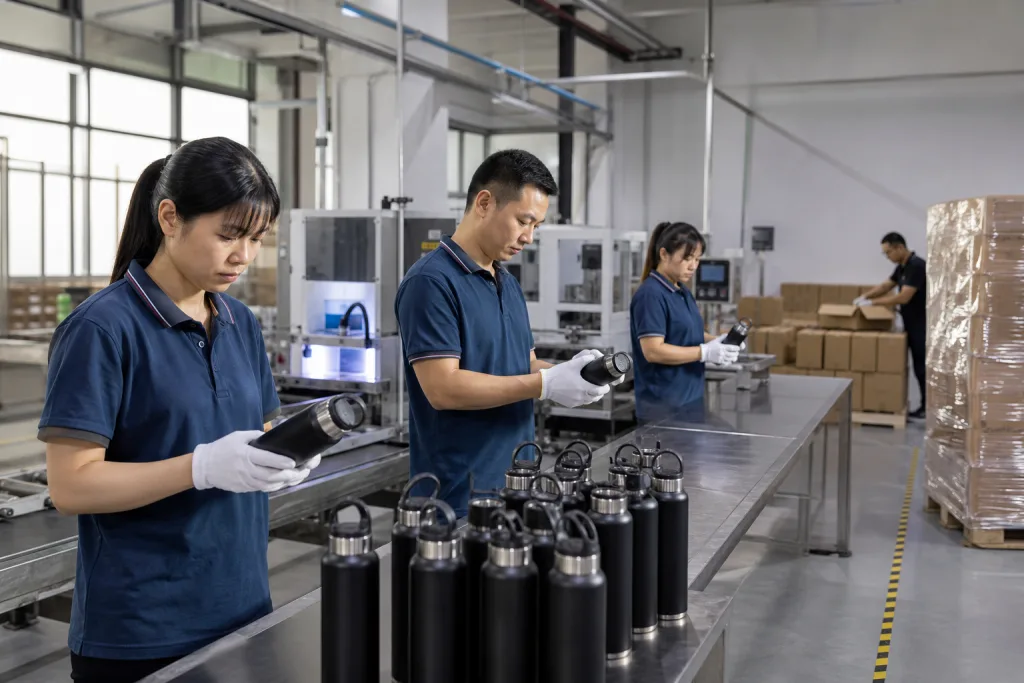
Key Takeaways
- Start your RFQ with capacity, material grade, wall thickness, lid type, logo method, packing, MOQ, and target FOB port.
- For a custom made sport bottle, realistic MOQ is usually 1,000-3,000 pcs per color for factory production.
- Pre-production samples should confirm coating adhesion, lid sealing, logo position, carton drop strength, and barcode readability.
- Use AQL 2.5/4.0 inspection and list every PO line item, including spare lids, inner cartons, FNSKU labels, and test reports.
A custom made sport bottle looks simple until you buy it in cartons of 5,000. Capacity, lid fit, coating, logo method, inner box, FDA or LFGB test cost, and FOB vs DDP terms all move the landed cost. If your RFQ only says “750 ml bottle with logo,” you will get prices that do not match: one supplier quotes 0.45 mm body steel, another runs 0.50 mm, and QC will see the difference with a micrometer.
From our factory in Zhejiang, China, we see this every week. Buyers ask three canteen suppliers for quotes, then find each canteen manufacturer priced a different wall thickness, PP or Tritan cap, 1-piece brown box or color box, AQL 2.5 or no final inspection. The cheapest quote is often the wrong question to ask. We had one buyer flag a PO that said “matte black” while the artwork called for “sand black,” and that small wording gap changed the coating line, scratch test result, and ship date by 6 days.
Start With A Useful RFQ
The RFQ is where most custom made sport bottle projects either stay under control or turn messy by day 2. A canteen vendor cannot quote cleanly if the request leaves out construction details we need on the costing sheet. “Stainless bottle, 750 ml, matte black” can come back at USD 2.10, USD 3.20, or USD 4.60 FOB Ningbo, and all three quotes can be right once the line checks wall thickness, lid tooling, coating spec, and packing. We see this go sideways when the buyer flags the price gap after samples are already cut.
For a sport bottle, state the use case first: gym retail, outdoor promotional campaign, school program, corporate wellness, or distributor drinkware catalog. That use case decides whether we quote single-wall stainless steel, double-wall vacuum insulation, Tritan plastic, aluminum, or a custom canteen shape with a carry loop. Wrong question first. Asking “what is your best price?” before the bottle type is fixed wastes 24-48 hours, because our engineer still has to check the 2D drawing, lid thread, gasket size, and carton drop-test requirement.
Put these PO-style details in the RFQ, even before the PO exists:
- Capacity: 500 ml, 650 ml, 750 ml, 1,000 ml, or US ounce equivalent. Tell us if the fill line must match the label claim after lid assembly.
- Material: 18/8 stainless steel, food-grade PP lid, silicone gasket, Tritan body, or aluminum body. QC will check this against the material declaration, not the catalog photo.
- Wall thickness: for stainless sport bottles, common outer wall thickness is 0.4-0.5 mm; cheaper versions may go thinner. At 0.35 mm, dent complaints start showing up after transit.
- Finish: powder coating, spray paint, raw brushed steel, UV print, or electroplated finish. A matte powder coat needs a different scratch test than spray paint; we run the 3M tape test on pre-production samples.
- Logo: silkscreen, laser engraving, heat transfer, 360-degree UV print, or embossed mold logo. Send AI or PDF artwork, because one “final_logo_v3” PNG at 72 dpi can hold the line for half a day.
- Packing: egg-crate bulk pack, white box, color box, kraft box, or retail gift box. Give carton strength if you sell to warehouse clubs; 5-ply cartons cost more than the thin export carton some suppliers quote by default.
- Compliance: LFGB, REACH, FDA food contact, California Prop 65, or ASTM where relevant. If the test report must show your importer name, say it before the lab booking.
If you are comparing a canteen factory in Zhejiang with another China supplier, use the same RFQ sheet for each. Do not let one quote include individual boxes while another uses bulk packing. That small line item can move cost by USD 0.18-0.45 per unit, and on a 10,000 pcs order the math is no longer small. We had one PO where “color box” was typed as “color bag”; QC pulled the sample pack before mass packing, but the buyer still lost 3 days approving the correction.
Lock The Bottle Specification
Once the first price range looks workable, slow down and lock the product specification. This is where a custom made sport bottle turns into a SKU the line can actually run. Ask for a technical specification sheet with drawings, or at minimum dimensioned photos marked in mm. For distributor canteen programs, we often run the same body in 3 colors and 2 lid options, but only when the thread pitch, silicone gasket, and carton layout stay the same. One buyer once changed the lid after PO release; the math didn’t work, and the ship date moved from 12 days to 18 days.
A serious canteen manufacturer will confirm mouth diameter, bottle height, base diameter, lid material, gasket type, handle pull strength, and powder coating code. For stainless vacuum models, ask for insulation performance: for example, hot water above 50°C after 6 hours, tested from 95°C starting temperature at 20°C room temperature. Do not accept “keeps hot 12 hours” without a test method. QC should record the test with a thermometer probe, timer, and room temperature note, not just a sales sheet claim.
The specification should also define tolerances. Capacity may vary by plus or minus 3 percent depending on fill line and internal shape. Color tolerance should reference a Pantone code, but powder coating is not paper printing. A Delta E target or approved physical sample is better for repeat orders. We’ve seen this go sideways when a buyer approved a screen image, then flagged the bulk because the matte black felt rougher than the sample.
If your range includes related custom drinkware, such as a custom growler, customizable growler, or customized growler, keep those SKUs separate in the RFQ. Growlers usually need wider mouths and stronger handles, with a different sealing test at the lid. Mixing them into a sport bottle quote creates confusion, especially for canteen distributors managing 4 or 5 end customers on one shipment. The wrong question is “can you quote all together?” The better question is whether each item shares the same tooling, carton size, and inspection standard.
Practical rule: approve one physical “golden sample” per SKU, per color, per logo method. Photos help, but they do not prove coating texture or lid torque. QC pulled the sample for that reason.
Price MOQ And Tooling Clearly
MOQ is not a punishment. It is the break point where sheet or resin purchasing, color changeover, logo setup, and packing labor start to make sense. At BottleForge Industrial in Hangzhou, Zhejiang, a typical MOQ for a custom made sport bottle is 1,000 pcs per color for existing molds and 3,000 pcs per color when the finish or lid combination needs dedicated setup. We run around 600,000 units per month across stainless bottles, tumblers, and canteen customized programs, and the line planner will push back fast if a 300 pcs order needs its own Pantone powder and separate carton mark.
For an existing stainless sport bottle mold, FOB China pricing often falls into these rough ranges: USD 2.20-3.80 for single-wall stainless, USD 3.80-6.50 for double-wall vacuum, and USD 1.60-3.20 for Tritan or PP sport bottles. These are not quotes. They are guardrails. A heavy powder coating can add curing time, a retail color box adds paper cost, a 360-degree print needs better fixture control, and a spare straw lid changes both BOM and packing. Last month QC pulled a sample because the lid torque was 1.8 N·m instead of the buyer’s requested 2.2 N·m, and that small detail changed the final cost.
Ask the canteen supplier to split visible cost items instead of burying everything inside one unit price. Your commercial sheet should show unit price, mold charge if any, logo setup, sample fee, carton packing, testing cost, inspection cost, and FOB port. Ningbo and Shanghai are common ports for Zhejiang and eastern China factories. This is the wrong place to accept a one-line quote; we have seen buyers compare USD 4.10 against USD 4.25, then miss that one quote excluded LFGB testing and export carton upgrades.
For the provisional PO or cost comparison, list:
- SKU code and product name, such as “750 ml stainless sport bottle, matte navy.” Add the Pantone or finish code if the color is fixed.
- Unit price by quantity break: 1,000 / 3,000 / 5,000 pcs, with the same logo process on each line.
- Tooling charge for custom lid, body mold, silicone part, or embossing, including expected mold life if the factory has that data.
- Sample fee and whether it is refundable after bulk order. State if courier cost is included.
- Lead time: sample 7-12 days; bulk production 30-45 days after deposit and sample approval. Confirm whether that means after artwork approval or after golden sample sign-off.
- Payment terms: commonly 30 percent deposit, 70 percent before shipment or against copy BL. If your PO says “B/L” in one place and “BL copy” in another, fix the typo before deposit.
This detail lets you compare canteen vendors on the same basis. It also helps your finance team see why the cheapest quote is not always the lowest landed cost. We ship enough mixed cartons to know the math does not work when a low unit price hides a weak carton, a missing drop test, or a late inspection booking.
Approve Samples Before Deposit
Sampling is not a formality. It is the last cheap place to catch a mistake. A custom made sport bottle sample should prove the hand feel, lid seal, coating wear, logo position, and packing method for your sales channel. On our line, QC pulled a 750 ml trial bottle last month and found the silicone ring sitting 0.6 mm proud in the groove. That is exactly the kind of small issue you want before deposit.
We run three sample stages on most OEM bottle jobs. First is the reference sample, often a stock bottle with no custom logo, used to confirm size and hand feel. Second is the logo or finish sample, where you check Pantone color, screen print, laser engraving, or powder coating. Third is the pre-production sample, made with final materials, final logo, final packing, and final carton marks. Do not skip it. For a serious customized drinkware order, skipping the third stage is the wrong place to save 3 days, because the line will copy whatever was approved.
Ask your canteen factory for sample tests that match real use. Fill the bottle with water and invert it for 2 hours. Shake it 30 times. Put it in a backpack pocket and check whether the cap opens by accident. For powder coating, use a cross-hatch adhesion test if available; we use a 1 mm cutter and 3M tape on coated bodies before release. For printing, do an alcohol rub test, commonly 50 cycles with 95 percent alcohol for UV or screen print durability. For vacuum bottles, request a basic insulation test and vacuum defect rate report, not just a nice photo from the sample room.
Your sample approval record should read like a future inspection checklist. Include SKU number, color code, logo artwork file name, approved sample photos, weight, dimensions, packing layout, carton size, gross weight, and barcode position. If your order is for marketplace fulfillment, include FNSKU placement, suffocation warning on polybags if used, and master carton label format. We have seen a PO with “matte black” typed in the item line while the artwork sheet said “black sand texture”; the buyer flagged it only after cartons were printed.
When a canteen promotional project has a fixed event date, build in time for failure. A 7-day sample plan can become 14 days if the first logo print is wrong. The math does not work if you approve late and still expect sea freight. It is better to lose one week in sampling than receive 5,000 bottles with the logo 12 mm too low, which QC can measure in 10 seconds with a caliper.
Write The PO Like A Checklist
The purchase order is not just a buying note. It is the stop line for changes. If the factory swaps a 1.8 mm gasket for a softer one, or drops the carton board from 350 gsm to 300 gsm, you will not catch it from a tidy email chain. We have seen that go sideways on the line.
For a custom made sport bottle, put commercial terms and product control terms in the same PO. Do not bury approval notes in WeChat. If the PO says “as approved sample,” attach the signed sample sheet and photos. If artwork is version 6, write version 6. If the bottle must pass REACH or LFGB, name the report and the lab: SGS, Intertek, TÜV, or whichever one your buyer accepted. A PO typo on the lid color can trigger a new batch, so this is the wrong place to be loose.
A strong PO line structure looks like this:
- Line 1: 3,000 pcs, 750 ml double-wall stainless sport bottle, Pantone 296C matte powder coating, laser logo one position, same lid as approved sample.
- Line 2: 3,000 pcs individual kraft box with barcode sticker, E-flute, 350 gsm outer paper, print file version 6.
- Line 3: 150 pcs spare lids, packed separately, same gasket and color as approved sample, no mixed batch.
- Line 4: 60 master cartons, 50 pcs per carton, carton size and gross weight stated, outer mark in black.
- Line 5: Third-party inspection before shipment, AQL 2.5 major / 4.0 minor, paid by buyer or seller as agreed, QC to pull random sample from finished goods.
- Line 6: Required test reports and shipping marks, with report number and issue date shown on the PO.
State incoterms on the PO too. FOB Ningbo is common for Zhejiang production. EXW looks cheaper on paper, then you carry local trucking, export declaration, and port handling yourself or through your forwarder. If you do not have a solid logistics partner, FOB China is usually the cleaner call. We ship a lot under FOB, and the buyer usually gets fewer arguments when the handoff point is clear.
If you are a canteen distributor selling to several accounts, put the customer code or project code on every carton mark. One warehouse crew, 12 cartons, three SKUs, and a missing code is enough to mix the lot. The buyer flagged that on one order because the label said only “blue bottle,” which tells you nothing when two distributors are shipping the same week.
Control Bulk Production Risk
After deposit, the factory buys steel or resin, books the coating line, prepares the logo jig, and orders cartons, inserts, polybags, and barcode labels. This is the stage where buyers disappear for 30 days and then ask for shipment photos. Too late. We run better orders with checkpoints tied to the actual risk: material arrival date, line start date, and first-piece signoff before the full batch moves.
For a standard existing mold order, ask for three updates: raw material and accessory confirmation with photos of the 304 stainless coil or Tritan resin label, first mass-production pieces with logo and color checked against the approved sample, and packing-line photos showing carton marks and inner packing. For a new custom lid or customized canteen body, add a pilot run before full production. A pilot run of 50-100 pcs can catch thread fit, leakage, coating scratch risk, or lid assembly trouble before 8,000 units are sitting on pallets. QC pulled one sample last month where the lid needed 0.4 mm more clearance; without the pilot, the math doesn’t work.
Quality control should be locked before production starts, not argued about after cartons are sealed. A normal pre-shipment inspection for custom drinkware uses AQL 2.5 for major defects and AQL 4.0 for minor defects. Critical defects, such as sharp edges, contamination, broken glass liners, or severe leakage, should be zero tolerance. For food-contact products, keep material declarations and test reports tied to the production batch number, and make sure the PO name matches the test report; we have seen shipments held because one buyer wrote “sport bottle” on the PO and “water flask” on the report.
Inspection points should cover capacity check by scale or measuring cup, visual defects under normal light, color consistency against the approved swatch, logo position in mm, adhesion by tape test, leakage after inversion, lid torque, odor, carton drop condition, barcode scan, quantity count, and master carton marks. For vacuum sport bottles, add insulation sampling and check for rattling or vacuum failure. For plastic sport bottles, check odor, transparency, injection marks, and cap thread smoothness. Small misses hurt. A 3 mm logo shift looks minor in the workshop but gets flagged fast on an Amazon detail page.
Factories in China can produce fast, but speed without checkpoints is the wrong question to ask. Our usual bulk lead time in Zhejiang is 30-45 days after deposit and approved pre-production sample; a plain powder-coated bottle may ship in 32 days, while a new lid tool plus custom carton often pushes closer to 45 days. If your launch date is fixed, share it early and ask for a backward schedule showing sample approval, material arrival, coating, printing, assembly, inspection, and vessel closing date. We ship cleaner when the buyer tells us the hard deadline before the line is booked.
Plan Freight And Reorders Early
Freight planning starts before we print cartons. A 750 ml sport bottle is light, but it eats space in a container; the caliper on the retail box and the insert design change the CBM fast. On one 12,000 pcs run, a single color box cut carton density by 18 percent versus bulk egg-crate packing, based on 58 × 39 × 42 cm export cartons. Retail buyers may need that shelf box. Event buyers usually do not. If the bottles are canteen promotional stock for a 3-day race or school program, bulk packing often protects the margin better.
Ask for carton dimensions and gross weight during sampling, not after production. Your forwarder needs the 3 measurements and kg per carton to quote sea freight, air freight, rail where available, plus warehouse receiving fees. We have seen this go sideways: QC pulled the sample, production was ready, then the buyer flagged freight after seeing 9.8 kg cartons instead of the 12 kg estimate on the PO. For urgent replenishment, air freight can cost more than the bottle itself. Saving USD 0.12 on unit price means nothing if a missed vessel adds USD 1.40 per unit.
Reorders need the same control as first orders. Keep the approved sample, artwork file, Pantone code, carton mark, test report, and PO history in one folder; we usually ask buyers to name it by SKU and order number, such as SB750-BLK-PO2486. A good canteen supplier can repeat a canteen customizable SKU closely, but raw material lots and powder coating batches still shift a little. Before mass production, ask the factory to compare the new production sample against the retained golden sample under a light box, not just by phone photo.
If you are building a broader range with custom canteen, customizable canteen, customized canteen, sport bottle, and distributor growler SKUs, standardize the parts that cause trouble: lids, coating finish, gasket size, and carton size. Shared components reduce MOQ pressure, cut lead time from 18 days to 12 days on common lids, and make after-sales service less messy. The math does not work when every SKU has a private lid color and a one-off carton. It sounds boring. We ship better lines that way.
Send Your Sport Bottle RFQ For Review
Share capacity, logo, quantity, packaging, and target market. We will return a practical quote sheet with MOQ, lead time, and options.
Frequently asked questions
What is a realistic MOQ for a custom made sport bottle?
For existing molds, expect 1,000-3,000 pcs per color for a custom made sport bottle. If you need a custom lid, special body shape, embossed logo, or exclusive silicone part, MOQ often moves to 3,000-5,000 pcs because tooling and setup costs need volume. Some canteen manufacturers will accept 500 pcs, but the unit price is usually higher and color options may be limited to stock. For distributor canteen programs, combining several colors into one production run may help, but only if the bottle body, lid, and logo process stay the same.
How long does sampling and bulk production usually take?
A stock reference sample can ship in 3-5 days if the bottle is available. A logo or color sample usually takes 7-12 days. A full pre-production sample with final box, barcode, and carton marks may take 12-18 days. Bulk production for customized drinkware is normally 30-45 days after deposit and sample approval. If testing is required, add 5-10 working days depending on the lab and standard. For China export orders, also allow time for vessel booking, especially before long holidays.
Which logo method is best for sport bottles?
It depends on the finish and order purpose. Laser engraving is durable and clean on stainless steel, but it is usually one-color by nature. Silkscreen is cost-effective for simple one or two-color logos, often with a setup charge of USD 40-80 per color. UV print allows more colors and gradients, but adhesion must be tested on powder coating. Heat transfer works for larger artwork, including wrap designs. For canteen promotional orders, ask for an alcohol rub test and tape test before bulk production.
What quality defects should we reject during inspection?
Reject critical defects such as leakage, sharp edges, contamination, broken parts, unsafe odor, or failed food-contact material requirements. Major defects include wrong color, wrong logo position, poor coating adhesion, dented body, loose lid, non-scanning barcode, or incorrect packing. Minor defects include small scratches, light dust marks, or tiny print specks within the approved AQL limit. A common inspection plan is AQL 2.5 major and 4.0 minor, with zero tolerance for critical defects. For vacuum bottles, include insulation failure as a major defect.
Should we buy FOB China or EXW from the factory?
FOB is usually better for buyers who are still learning custom drinkware sourcing. With FOB Ningbo or FOB Shanghai, the canteen factory handles local trucking to port, export declaration, and port delivery under the agreed terms. EXW can look cheaper on the product invoice, but your forwarder must handle pickup, export paperwork, and local charges. If you already have a China logistics agent, EXW can work. For newer B2B buyers, FOB gives cleaner landed-cost comparison and fewer handoff mistakes.