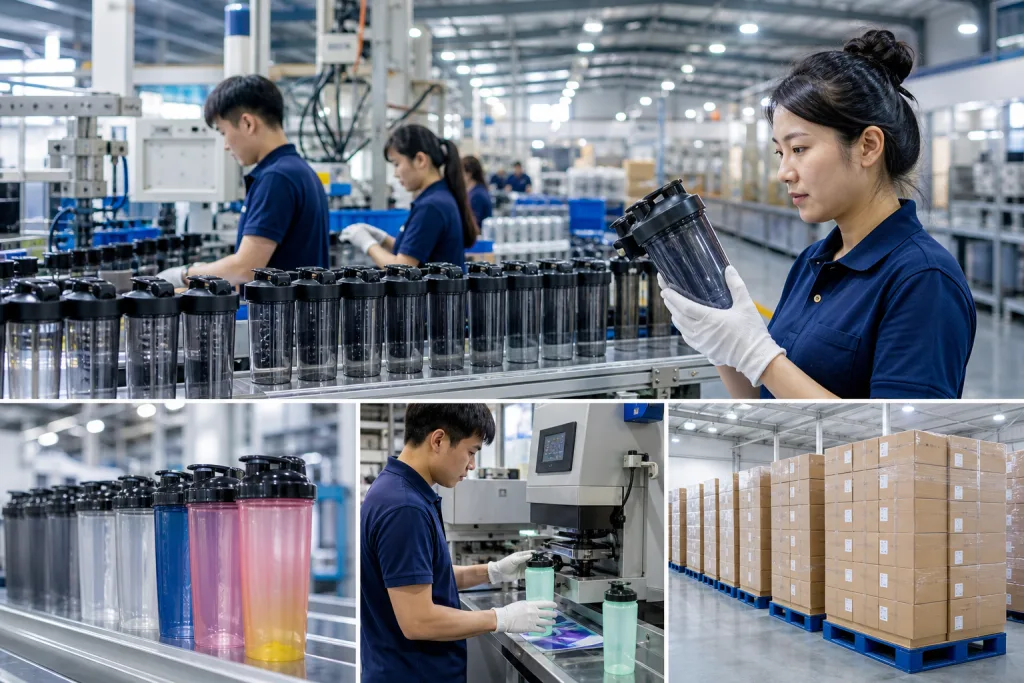
Key Takeaways
- A practical MOQ for a custom logo shaker bottle is usually 3,000-5,000 pcs per color for existing molds
- Sample lead time is commonly 7-12 days for logo samples and 25-35 days for new mold prototypes
- Use AQL 2.5 for major defects and AQL 4.0 for minor defects on bulk shaker bottle inspections
- A complete PO should list material grade, capacity, lid type, logo method, carton marks, barcode rules, and Incoterms
A custom made shaker bottle looks simple until the first carton lands with a lid that weeps in transit, a logo that peels after one wash, mixed case marks, or a steel ball that spots rust after two cleanings. We run these on the line every week, and the problems show up fast. QC pulled one sample from the bench last month and it failed a 30-second shake test because the cap thread was off by 0.5 mm. For a gym chain or sports brand, this is not just packaging. It sits in a locker, in a car cup holder, and on a retail shelf with your name on it.
Most sourcing mistakes start before the mold is cut or the screen is set. The RFQ is too loose, the buyer approves a sample by feel, and the PO skips the inspection points. We see the same thing in Zhejiang every month. The wrong question is “can you make it?” The better one is “can you hold 3,000 pcs to the same seal, print, and carton spec?” If the artwork file is off by 1 mm or the packing list says 24 pcs when the carton should carry 12, the buyer flags it late and the math stops working. A clean project needs the material callout, test standard, artwork file, packing rule, and payment term locked before bulk starts.
Start With Usage, Not Catalog Photos
Before you ask for pricing, define how the bottle will be used. A gym chain selling at reception carries different risk than a supplement brand bundling a custom made shaker bottle with a 2 kg protein tub. One buyer worries about retail display, EAN barcode control, and carton scuffing after 18 days on the water. The other gets complaints about powder stuck under the grid, cap leakage in gym bags, and dishwasher warping after 70°C cycles. QC pulled a sample last month where the flip cap passed the first shake test but leaked after the hinge pin shifted 0.4 mm. Small detail. Big complaint.
Your first RFQ should not say only “500 ml shaker with logo.” That is the wrong question to ask. It creates 6 random quotes from 6 factories, and none of them match your shelf plan. Send a short product brief with capacity, market, expected retail price, and use case. Example: 700 ml PP shaker, screw lid, flip cap, mixing ball, matte black body, one-color logo, retail carton, for EU gym chain launch in September. We can quote that properly because the line knows the mold, the printing jig, and the carton spec. Last week a buyer wrote “black lid” on the PO but attached a gray lid mockup; production stopped for 4 hours while sales confirmed the Pantone.
For sports and fitness buyers, common capacities are 500 ml, 600 ml, 700 ml, and 800 ml. Wall thickness for a PP body is often around 1.2-1.8 mm depending on mold design; we check it with a digital caliper at the waist and near the base because thin spots show up there first. Tritan bodies are clearer and feel more premium, but the cost can be 25-45% higher than PP. Stainless steel shaker bottles are heavier and better for premium members’ gifts, but they need careful lid matching because the body and cap materials expand differently under heat. We have seen this go sideways when a buyer chose a low-cost PP lid for a steel body, then flagged loose sealing after hot-water testing.
RFQ line items to include at this stage:
- Target product: bulk fitness water bottle, bulk gym water bottle, or bulk shaker bottle
- Capacity in ml and fill line requirement
- Material: PP, PE, Tritan, stainless steel 304, or mixed material
- Market compliance: LFGB, FDA, REACH, BPA-free declaration, or Prop 65 where needed
- Target order quantity by color, not just total quantity
- Delivery term: FOB Ningbo, FOB Shanghai, EXW Zhejiang, or DDP if you need landed costing
If you are a distributor sports water bottle buyer, say whether you will resell to multiple gyms or one chain account. That changes the packing call. We may suggest neutral master cartons, spare barcode stickers, and a more universal mold with no raised logo plate. On the packing table, this means 12 barcode rolls instead of one pre-labeled carton run, and it saves rework when the buyer flags a SKU change two days before shipment.
Choose The Bottle Platform Carefully
The biggest cost decision is existing mold versus new mold. Start with an existing mold unless your cap geometry or volume is non-standard. In Zhejiang, China, our standard shaker and sports bottle lines run about 450,000 units/month across PP shakers, Tritan sports bottles, and stainless steel vacuum bottles. For existing molds, MOQ normally starts at 3,000 pcs per color for plastic and 1,000-2,000 pcs per color for selected stainless steel models. New mold projects usually need 10,000-30,000 pcs commitment, because a cap and body tool can tie up CNC time, EDM work, and trial injection for 25-35 days before mass production.
A customizable shaker bottle can still look proprietary without cutting a new mold. We change body color, lid color, flip cap color, mixing ball spec, sleeve artwork, carton design, and retail insert; each part gets checked against a Pantone book under the light box before approval. For 7 out of 10 gym chain orders we ship, that is enough to sell it as a custom gym water bottle while keeping tooling risk low. New mold first is often the wrong question to ask. The buyer flagged this once after paying for tooling, then found the shelf height in their vending machine was 6 mm too short.
Plastic shaker bottles are common because they are light and cost-efficient. A simple 700 ml PP shaker with one-color print usually falls around USD 0.85-1.60 FOB China, depending on resin price, cap structure, and packing method. Tritan versions often sit around USD 1.60-2.80. Stainless steel custom sports water bottle or shaker models run around USD 3.20-6.50 when double-wall vacuum construction is needed; QC pulled one sample last month with a 0.4 mm rim burr, and that small edge is enough to stop approval.
Sample request line items:
- Existing mold code or reference drawing, plus target volume in ml
- Body material and lid material, listed separately, so PP is not mixed with Tritan on the PO
- Color references using Pantone C or U codes, with one approved color chip per part
- Leakproof structure: screw lid, snap lid, silicone gasket, or threaded cap
- Mixing component: 304 stainless ball, plastic grid, or no mixer
- Surface: glossy, frosted, matte texture, powder coating, or spray paint, with scratch test requirement stated
Do not approve a platform from a 3D rendering alone. Ask for a physical blank sample first. Open the lid 30 times, shake it with water for 60 seconds, put it sideways for 30 minutes, and check whether the cap feels good on the mouth. Simple test. A customized sports water bottle fails in the hand before it fails in the lab, and we have seen this go sideways when the rendering looked clean but the real hinge pin sat 1 mm proud.
Lock Decoration Before Sampling
Logo decoration looks like a design topic, but on the factory side it is a production risk. A custom logo shaker bottle with poor artwork preparation can push sampling from 7 days to 14 days, and we have seen a PO held because the buyer sent a 72 dpi PNG copied from a website. Send vector artwork in AI, EPS, or editable PDF. PNG files are not production artwork. If you need a wraparound print, ask for the dieline, seam line, and 3 mm safe area before your designer starts.
For plastic shaker bottles, silk screen printing is still the workhorse. It is economical, clean, and a good fit for one to three colors when the logo sits on a straight wall. A one-color logo setup charge is usually modest, but each added color means another film, another screen, and more registration risk on the line. Heat transfer and in-mold label can give stronger retail graphics, but they need higher MOQ and tighter control; the math doesn't work for a 500 pcs trial order. For stainless steel, laser engraving is durable and premium, while powder-coated bottles can use screen print, UV print, or laser depending on coating thickness and curing result.
If your gym has 40 locations and each location wants its own name, plan that before sampling. Variable logo production is possible, but every version adds setup time, film control, and carton marking work; QC pulled a sample last year where the bottle was right but the outer carton label had the wrong branch name. For distributors shaker bottle programs, we usually suggest one master body design with location-specific belly bands or barcode labels. Fewer changeovers. Cleaner packing.
Artwork approval line items:
- Logo file name and version number, such as “GYM-Logo-V3.ai,” not “final-final.ai”
- Pantone color code for print and bottle body, checked against a coated Pantone book under D65 light
- Print size in mm, such as 55 mm wide, not “large” or “small”
- Logo position measured from base or seam line, for example 38 mm above the base
- Decoration method: silk screen, UV print, laser, heat transfer, embossing, or debossing, matched to the bottle material
- Durability test: tape test, alcohol rub, dishwasher claim, or hand-wash-only label, with the test written on the sample report
Be careful with dishwasher-safe claims. Some plastics can handle the heat, but printed logos may fail after 5 wash cycles at 65°C, which is exactly the kind of complaint that comes back through Amazon reviews. If you want to state dishwasher-safe on packaging, ask for a test plan and approve the exact print method. Otherwise, print “hand wash recommended” and avoid customer service pain later.
Read Samples Like A Buyer
Sampling is not a beauty contest. Treat it as your first controlled inspection. For an existing mold custom made shaker bottle, a logo sample normally takes 7-12 days after artwork and color approval. A new mold prototype can take 25-35 days; with a tricky flip lid or silicone seal groove, we have seen it stretch to 38-42 days after the CNC insert comes back.
When the sample arrives, inspect it the same way every time. Fill it to the marked capacity and check the real usable volume with a measuring jug. Some bottles marked 700 ml hold 700 ml to the brim but only 620 ml when shaken without spillover. Supplement buyers care about that. Check body weight on a 0.1 g digital scale. A 5-8% variation can be normal across batches, but a light sample often means thin walls or someone shaved resin cost.
Run a basic leak test. Fill with room-temperature water, close the lid, shake hard for 30 seconds, place upside down for 10 minutes, then lay sideways on tissue for another 20 minutes. Test the flip cap by itself; on shaker bottles, that is where we see 6 out of 10 leak complaints start. If you are buying a bulk sports water bottle for paid retail, do not accept “small leakage is normal.” The math doesn't work when cartons come back from Amazon or a gym chain buyer flags wet packaging.
Sample approval line items:
- Approved sample quantity and date
- Signed physical sample or sealed golden sample
- Approved weight tolerance, such as ±5%
- Approved capacity tolerance, such as ±3%
- Leak test method and pass criteria
- Logo color tolerance and print position tolerance, such as ±2 mm
Keep one approved sample in your office and ask the factory to keep one in the QC room. At our Hangzhou-area partner lines in Zhejiang, the golden sample is photographed under the light box, labeled with the PO number, and attached to the production order. This stops the line supervisor and QC from reading your custom fitness water bottle spec two different ways.
Build A Purchase Order That Works
A weak PO is one of the most expensive papers in sourcing. If it only says “customizable gym water bottle, 10,000 pcs, black, logo printed,” you have left too much open. The factory will run the PO as production instructions, and if the bottle size is missing, QC will stop the line. We once saw a PO typo on carton mark code turn into a one-day delay. Cheap mistake. Expensive fix.
Start with SKU-level clarity. If you order 12,000 pcs split across black, white, and blue, put each color on its own PO line. List spare parts and packing rules too. If the order is for Amazon, retail, or gym chain distribution, specify barcode placement and whether FNSKU, EAN, UPC, or internal SKU labels are required. The buyer flagged a case where the label was 8 mm too low, and the cartons had to be reworked at the packing table. Wrong labels cost more than the bottle.
For a distributor gym water bottle order, carton planning matters. A common pack is 50 pcs per master carton for simple plastic shakers, while retail boxed stainless models are often 24 pcs per carton. Confirm carton size, gross weight, and pallet loading before production if your warehouse has weight limits. We ship a lot of European cartons under 15 kg, and the buyer pushed back hard when one sample box came in at 16.4 kg. North American distributors usually care more about cube efficiency. That is the right question to ask.
PO line items to include:
- Product name: customized shaker bottle or customized gym water bottle
- Mold number, capacity, material grade, and body color
- Logo method, artwork version, print size in mm, and position
- Accessory list: mixing ball, carry loop, straw, spare gasket, instruction leaflet
- Individual packing: polybag, retail box, belly band, or no single packing
- Master carton quantity, carton mark, barcode file, and label placement
- Inspection standard: AQL 2.5 major / 4.0 minor unless agreed otherwise
- Payment terms, Incoterms, shipment port, and latest delivery date
For payment, 30% deposit and 70% before shipment is standard for new buyers. Bigger gym chains with repeat programs get better terms after 2 or 3 clean orders. FOB Ningbo is common for Zhejiang factories; FOB Shanghai works too, but inland trucking must sit in the quote. We once had a 40HQ held up because the PO said FOB Shanghai after the buyer had approved Ningbo pricing. The math does not work if the port is wrong.
Control Bulk Production Early
Bulk production is the wrong time to find a loose lid gasket or a blue body that reads purple under warehouse lights. Control it before mass assembly. Ask for pre-production photos or a 30-second line video showing resin color chips, printed logo position, lid assembly, and carton marks. For larger orders above 20,000 pcs, approve a pre-production sample made from bulk PP/Tritan and the actual silicone gasket before the full run starts; we run the cap torque check with a simple torque meter, and QC pulled samples last month where 3 lids failed because the gasket groove was 0.4 mm too shallow.
Typical production lead time for an existing mold bulk shaker bottle is 25-35 days after deposit and final sample approval. Peak season before summer promotions can push this to 40-50 days, especially for custom sports water bottle orders with 3 or more body colors. Dates matter. If you need delivery before a new club opening, work backward from the arrival date, not from the order date. Sea freight to Europe or North America can add 25-45 days port-to-port, plus customs and inland trucking; we have seen buyers miss a launch because they counted 35 production days but forgot the 6 days needed for booking and container loading.
Quality control should be written into the project at PO stage, not requested after the cartons are sealed. Use an inline check when the first 10-20% is finished if the order has mixed colors, shaker balls, printed ounce marks, or separate gift boxes. Final random inspection should happen when 80-100% of goods are produced and at least 80% packed. Standard AQL for drinkware is often 2.5 for major defects and 4.0 for minor defects, but critical defects like sharp edges, foreign matter, wrong material, or serious leakage should be zero tolerance. We ship by the carton, not by excuses; one buyer once flagged a PO typo where “matte black lid” became “black body,” and catching it inline saved 6,000 pcs from rework.
Bulk control line items:
- Production start date and expected finish date, with a 2-day buffer for color changeover on the injection line
- Inline inspection requirement for multi-SKU orders, especially when logos or lid colors differ by SKU
- Final inspection date and third-party inspector contact, confirmed before at least 80% packed
- Leakage test sampling quantity, such as 125 pcs from different cartons for a 10,000 pcs run
- Drop test for export carton, such as ISTA-style carton handling check with 1 corner, 3 edges, and 6 faces
- Compliance documents: FDA, LFGB, REACH, BPA-free, or heavy metal test report, matched to the actual material batch
Do not rely only on factory photos for a first order. Photos hide too much. For a customized fitness water bottle launch, a USD 250-350 third-party inspection is cheap compared with reworking 10,000 leaking caps in your warehouse; the math does not work once you add repacking labor, return labels, and angry gym members posting photos online.
Plan Reorders And Distribution SKUs
The first order proves the product. The second order proves your sourcing system. If reorders are likely, keep the SKU structure stable. Changing a Pantone lid color, moving from 24 pcs to 36 pcs per carton, or resizing a logo from 55 mm to 62 mm every order creates avoidable mistakes, and the old AQL 2.5 defect record becomes less useful. We see it on the line: QC pulled the sample, the logo position was 4 mm off, and nobody knew which last-approved version the buyer meant.
Fitness brands and gym chains miss spare parts more than they admit. For shaker bottles, confirm whether spare silicone gaskets, flip caps, or mixing balls are available as separate items with their own SKU codes. We usually suggest a 1-2% spare gasket pack; on a 10,000 pc order, that is only 100-200 pcs, and it fixes customer service tickets faster than sending a full replacement bottle. For distributors sports water bottle programs, holding 500-1,000 neutral bottles and printing later works only when the decoration method accepts small-batch finishing. If the logo needs heat transfer film with a 3,000 pc MOQ, the math does not work.
For repeat orders, check sell-through before touching the bottle. If the 700 ml black customizable fitness water bottle outsells the white version 3:1, do not split the next PO evenly because the spreadsheet looks tidy. MOQ applies by color because each color change needs hopper cleaning, material prep, and a QC reset for weight, lid fit, and color match under the light box. A 12,000 pc order split into six colors is not the same production efficiency as 12,000 pcs in two colors. We have seen this go sideways when a buyer added two slow colors and then pushed us for the same 18-day lead time.
Reorder PO line items:
- Previous PO number and approved sample reference
- Any approved engineering change, listed clearly
- Repeat artwork version or new artwork version
- Updated barcode list and carton marks
- Spare parts quantity
- Requested production slot and target vessel date
If you are building a distributor fitness water bottle range for several gym accounts, standardize the core bottle and change only decoration and packing. Same mold, same lid, same carton size. That gives the factory cleaner scheduling, the inspector a tighter checklist, and your buyer fewer complaint emails. A custom made shaker bottle program should get more predictable after every shipment, not more complicated; the wrong question is “How many SKUs can we add?” The better question is “Which SKUs can we repeat without rework?”
Send Your Shaker Bottle RFQ For Review
Share capacity, quantity, artwork, market, and target delivery date. We will return practical options, MOQ, lead time, and FOB China pricing.
Frequently asked questions
What is the normal MOQ for a custom made shaker bottle?
For existing molds, a realistic MOQ is 3,000-5,000 pcs per color for plastic shaker bottles and around 1,000-2,000 pcs per color for selected stainless steel models. If you need a fully new body shape or lid mold, the commercial MOQ is usually 10,000-30,000 pcs because tooling, testing, and line setup must be recovered. For a first gym chain launch, we usually suggest 2-3 colors maximum. A 9,000 pc order split into black, white, and blue will run more smoothly than the same order split into nine colors.
How long does sampling and bulk production take?
For an existing mold custom shaker bottle, blank samples can often ship in 3-5 days if stock is available. Logo samples usually take 7-12 days after artwork, Pantone color, and decoration method are confirmed. Bulk production is commonly 25-35 days after deposit and final sample approval. New mold projects are slower: allow 25-35 days for prototype tooling and another 35-50 days for mass production after the mold is approved. Add freight time separately: ocean freight to Europe or North America often needs 25-45 days port-to-port.
Which material is best for a gym or fitness shaker bottle?
PP is the most common choice for a bulk gym water bottle or shaker because it is light, cost-effective, and suitable for large promotions. Tritan looks clearer and more premium, with better perceived value, but it can cost 25-45% more than PP. Stainless steel 304 is best for premium retail, member gifts, or higher-price fitness merchandise, but the FOB cost may be USD 3.20-6.50 depending on structure. For protein shaker use, focus on lid sealing, odor control, and cleaning access as much as the body material.
Can each gym location have a different logo?
Yes, but it must be planned before quotation. Each logo version may require separate print films, machine setup, artwork checking, and carton labels. If you have 30-50 locations, printing each location directly on the bottle can become slow and expensive. A better route is often one master customized shaker bottle with a shared brand logo, then location-specific belly bands, hang tags, or barcode labels. If direct printing is required, group locations by color and artwork size to reduce line changes and keep defect risk under control.
What quality tests should we require before shipment?
At minimum, require visual inspection under AQL 2.5 major and 4.0 minor, plus zero tolerance for critical defects such as sharp edges, foreign matter, wrong material, or serious leakage. For shaker bottles, add a leakage test with water, upside-down and side-position checks, cap opening/closing function, print adhesion test, and carton drop check. If you sell in the EU or North America, request food-contact documents such as LFGB, FDA, BPA-free declaration, REACH where applicable, and material test reports. First orders should use third-party inspection before final payment.