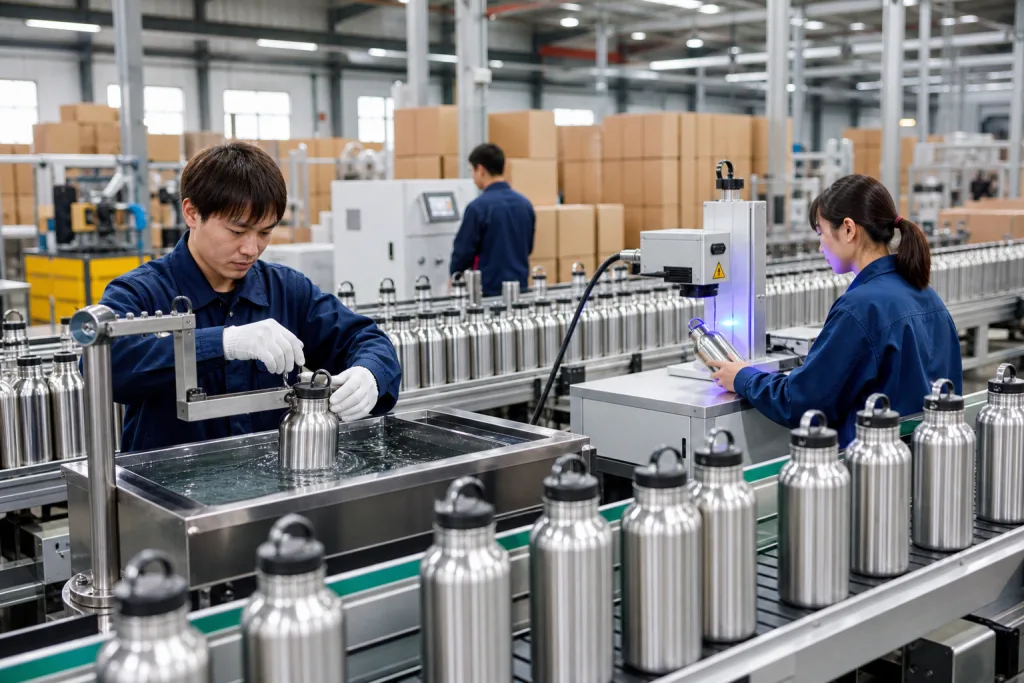
Key Takeaways
- For most outdoor programs, 304 stainless at 0.4 mm wall thickness is the safest baseline for a customized canteen.
- A 500 ml or 750 ml canteen usually sells better than 1 L for retail; 1,000 pcs is a common MOQ in China.
- Laser engraving lasts longer than silkscreen on rough outdoor use, but screen print is cheaper by about USD 0.20-0.45 per piece.
- A Zhejiang canteen manufacturer can usually quote FOB in 24 hours and sample in 7-12 days if the artwork is final.
A custom made outdoor canteen looks simple on a screen. Then you place a 2,000-piece order for three markets and the problems show up fast. Will it dent in transit? Does the cap leak after 500 cycles on the torque tester? Will the logo hold up after a week in a field pack? If the spec is loose, returns and chargebacks land on your desk. We have seen a buyer miss a cap thread callout by 0.2 mm and lose a whole approval round.
At BottleForge in Zhejiang, we run this every week with buyers from Europe and North America. They bring a mockup, then the buyer flags REACH, outdoor wear, and FOB math in the same email. A line that ships 120,000 units per month can move quickly, but only if the material, volume, and decoration match the job from day one. QC pulled one sample last month with a typo on the PO and the logo position was off by 3 mm. That is the wrong place to gamble.
Choose the job before the spec
The first mistake we see is buyers shopping by silhouette. Wrong question. Choose the job first: retail shelf, trekking bundle, event giveaway, club merchandise, or distributor drinkware. Those 5 channels need different weight targets, surface finishes, price points, and drop resistance. Last month QC pulled a 620 ml stainless sample that looked good in photos, but the cap thread rocked 0.4 mm on the go/no-go gauge. Fine for a low-cost giveaway, not fine for an outdoor-store SKU. A canteen distributor selling through outdoor stores needs a different build from a canteen promotional program for a marathon or university. Same story for a canteen vendor shipping e-commerce cartons versus one feeding a brick-and-mortar retailer with shelf-facing gift boxes.
Run this fit check before you ask a canteen supplier for pricing:
| Use case | Best spec | Why it wins |
|---|---|---|
| Retail outdoor line | 304 stainless, 500-750 ml, laser logo | Stronger shelf value, fewer cap and finish complaints after AQL inspection |
| Promotional canteen | PP or HDPE, 500 ml, one-color print | Lowest unit cost, short print setup, workable for 3,000-5,000 pcs event runs |
| Premium club merch | 304 stainless, matte powder coat, gift box | Better margin, cleaner unboxing, less price pushback from fan shops |
| Field or camping pack-in | Lightweight single-wall metal, locking cap | Simple build, lower carry weight, fewer moving parts for the line to fail |
If you are comparing canteen custom options with a custom growler or customizable growler, ask one blunt question: does the buyer need volume retention or portability? A growler is for beverage transport. A canteen is for carry weight, basic hydration, and a shape that survives being clipped to a pack. We have seen this go sideways when a PO says “canteen” but the artwork brief shows a beer growler, then the buyer flags the carton size 2 days before mass production. That distinction matters when you sell customized drinkware into outdoor channels in China or Europe, because buyers will reject a product that looks right but fits the wrong job.
Material face-off that matters
Material decides most of the outcome. For a custom made outdoor canteen, do not just accept the stock sheet the canteen factory sends on Monday morning. Ask for the steel grade, resin code, wall thickness, and test plan. We run 304 stainless, 201 stainless, aluminum, PP, HDPE, and Tritan on different lines, and the first sample check with an XRF gun often tells the truth faster than the quotation. Price is only one line. Compliance and hand feel usually decide the reorder.
304 stainless is the safer all-around choice for Europe and North America. At 0.4 mm wall thickness, it gives you decent dent resistance without making the canteen too heavy; our QC pulled one 750 ml sample last month at 176 g before lid assembly. 201 stainless can save about USD 0.12-0.25 per piece, but it is harder to sell as premium and more sensitive to corrosion if the finish is poor. The math does not work if one retailer rejects 3 cartons for rust spots around the welded neck. Aluminum is light, but it usually needs a liner or coating system, which adds process risk and extra adhesion testing. HDPE and PP are the cheapest and lightest for canteen promotional orders, yet they feel less premium and can show odor retention if the resin quality is weak. Tritan gives a cleaner, clearer look, but it is not the cheapest route for a distributor canteen program.
Here is the blunt version: if your buyer wants a customizable canteen for outdoor retail, use 304 stainless. If your buyer wants 10,000 pieces for an event with no high-end expectation, a customized drinkware plastic version may make more sense. We have seen this go sideways when a PO says “outdoor premium canteen” but the buyer pushes for PP pricing and 18-day delivery. For a canteen manufacturer in China, the win is matching the resin or steel grade to the sales channel, not overselling a material that will fail after three camping weekends.
Volume, mouth, and cap details
Capacity looks minor until the sell-through sheet comes back. In outdoor channels, 500 ml is the easy entry SKU, 750 ml covers the widest use case, and 1 L is harder to carry but easier to defend for trekking, field kits, and scout packs. For a custom drinkware line sold through general retail, we usually quote 500 ml and 750 ml first because the carton weight stays cleaner, often under 12 kg per master carton depending on wall thickness. Big bottles look good in a catalog. The math often does not work. A custom made outdoor canteen also needs the right mouth size. Narrow mouth gives better spill control and a simpler seal. Wide mouth is easier to fill and brush clean, but the cap has more parts, and QC pulled more short-shot cap threads on one 63 mm wide-mouth trial than on the 38 mm version.
Watch the cap construction closely. A basic screw cap is fine for promotional drinkware, but it is not enough when the buyer expects outdoor use beyond a giveaway table. Add a silicone gasket, then test the seal at 1.5 bar pressure and 48-hour inverted storage. If the canteen has a carry loop or carabiner, check pull strength. We typically ask for 15-20 kg pull resistance on hardware that will ride outside a pack, and we test it with a hanging weight before final approval. If the cap design includes a tether, make sure it does not go stiff in cold conditions. A cracked tether becomes a warranty headache, and we have seen buyers reject a full shipment over a USD 0.03 tether because the sample snapped at -10°C.
For canteen customizable programs, a small change in mouth finish or cap insert can move assembly cost by USD 0.08-0.18 per unit. That matters on a 3,000-piece order. We run into this at the quotation table all the time: the drawing says “standard cap,” then the PO adds a matte insert, color-matched loop, and leakproof gasket after the price is approved. The buyer flagged it, the factory flagged it back, and nobody enjoyed that call. A good canteen supplier should show you where the price jumps happen before the mold is locked.
Branding that survives real use
Decoration is where 6 out of 10 canteen vendors overpromise. A logo can look clean in the sample photo and still look tired after 30 days in a backpack. For rough outdoor use, laser engraving is the safer choice on stainless. It will not peel, and it takes strap rub better than ink. We run a simple abrasion check with a 3M tape pull and a 1 kg rub test on the coated panel; QC pulled one sample last April where the silkscreen lost the edge of the “R” after 50 passes. Silkscreen costs less and works for simple logos, but on a canteen custom order it wears down when the bottle hits metal gear or gets scrubbed with a hard brush. Pad print sits between those two options, mainly for curved surfaces and small marks under 35 mm.
If your order is canteen promotional or distributor drinkware for a price-sensitive campaign, single-color silkscreen may be enough. If you need a retail-ready customized canteen, ask for laser engraving or a two-stage finish: powder coat plus laser reveal. That finish looks better on shelf and supports a higher retail price in most outdoor channels. The math does not work if the buyer wants a USD 0.20 decoration upcharge and expects retail-grade wear resistance. On our line, the powder coat thickness is checked around 60-80 μm before laser, and we hold logo position within about 1.5 mm on normal round bodies. For a branded outdoor line, we often quote these rough deltas:
- Silkscreen: lowest cost, usually base price plus USD 0.15-0.35
- Laser engraving: base price plus USD 0.25-0.60
- Wrap print or multi-color print: base price plus USD 0.40-0.90
The right decision depends on your channel. A canteen distributor selling to corporate buyers will push unit cost first. A retail canteen manufacturer buyer will ask about graphic life, carton presentation, barcode placement, and complaint rate after the first shipment. If your artwork has gradients, thin lines under 0.3 mm, or a full wrap, send the AI file before the PI is signed. We have seen this go sideways: one PO said “matte black laser logo,” but the artwork file showed white silkscreen, and that typo cost 12 days before mass production could start. Reworking decoration after tooling is one of the fastest ways to burn time and money in China.
Testing, compliance, and audit reality
For Europe and North America, compliance is not optional paperwork. It sits inside the product cost. If you are sourcing a customized drinkware line from China, the canteen factory should support REACH-related material declarations, food-contact documentation, plus migration testing when the coating, liner, gasket, or printed area calls for it. For the US market, 7 out of 10 import buyers we deal with ask for FDA-related material confirmation, and California Proposition 65 comes up fast when powder coating, silicone parts, or logo ink are involved. A serious canteen manufacturer in Zhejiang will match the document to the actual material: 304 stainless body, PP cap, silicone gasket, polyester powder, carton ink if needed. A weak one sends a generic statement with yesterday’s company stamp and hopes nobody checks the BOM. We have seen this go sideways.
Ask for a clear test stack before mass production:
- Material declaration by component
- Leak test on cap and gasket
- Drop test from 1.2 m onto hardwood or concrete
- Cycle test for cap opening and closing
- Carton compression and transit simulation
For stainless products, ask about weld integrity and passivation if the design includes welded loops or handles. QC should be able to show you the weld section, not just say “no problem.” For plastic canteen customizable orders, confirm the resin source and check whether the color masterbatch is food-contact suitable; one buyer flagged a blue masterbatch code on the PO because the supplier mixed up the food-grade and toy-grade versions. If you are auditing a canteen supplier in China, request AQL terms in writing. For example, AQL 2.5 major and 4.0 minor is common for general consumer drinkware, but you can tighten it if the channel is retail and the returns risk is high. The math does not work if you save USD 0.06 on inspection and then air-ship 300 replacement caps. A Zhejiang factory with a formal QA system saves money the boring way: QC pulled the sample, the line corrected the issue, and the shipment left with fewer rejections.
MOQ, pricing, and lead time by buyer
Price only makes sense after we see the order structure. A custom made outdoor canteen in 304 stainless with one-color logo usually lands around USD 1.85-3.20 FOB at 1,000-3,000 pcs, depending on body thickness, surface finish, and cap design. On our line, a 0.5 mm body and a 0.6 mm body do not cost the same once the hydraulic press starts running. If you switch to a simple plastic promotional version, you may get down to USD 0.65-1.40 FOB. Add powder coating, gift packaging, or multi-color print, and the quote moves up fast. A custom growler or customized growler sits in a higher band because the wall is thicker, the cap has more parts, and buyers expect a better shelf feel.
Lead time is where we see orders go sideways. At a capable canteen factory in Zhejiang, a clean sample cycle is often 7-12 days. Mass production is commonly 25-35 days after sample approval and deposit, assuming tooling is ready and packaging is standard. If you need custom molds, add 20-30 days. If you need a specific carton layout for retail FNSKU labeling, give the art team time; it is not “just a box.” We once had QC pull 200 cartons because the PO said matte black, but the carton mark file still read gloss black. For a canteen distributor, the smarter play is to keep the base body standard and change only the logo, cap color, or packaging. MOQ stays lower, and inventory turns do not get trapped in slow colors.
Here is the practical split:
- Promotional canteen: lowest MOQ, thin margin, fast reorder if the logo file is clean
- Retail canteen custom: higher MOQ, better margin, more QA checks on coating, printing, and carton marks
- Distributor canteen line: balanced MOQ, stable repeat orders when the same body runs across 2-4 SKUs
If you are buying from China, ask the supplier to quote both FOB Ningbo and FOB Shanghai if your logistics team needs comparison. The wrong question is saving USD 0.03 on freight while ignoring a cap that leaks at 60 kPa in the pressure test. Small freight differences matter less than a product that matches your channel and passes inspection before we ship.
Send your spec, get a real quote
Tell us capacity, material, logo method, and destination. We’ll quote FOB pricing, sample timing, and compliance options from Zhejiang within 24 hours.
Frequently asked questions
What is the usual MOQ for a custom made outdoor canteen?
For most canteen manufacturers in Zhejiang, a standard MOQ is 1,000 pcs per design and color. Some canteen suppliers will start at 500 pcs for a simple promotional canteen, but the unit price usually rises by 15-30%. If you want two logo positions, a special cap, or retail packaging, expect the MOQ to move toward 2,000 pcs. For a distributor canteen program, keeping the body standard and changing only decoration is the easiest way to protect MOQ and cash flow.
Should I choose stainless steel or plastic for outdoor use?
If you want a retail-ready custom drinkware line, 304 stainless is usually the safer choice. A 0.4 mm wall gives a good balance of weight and dent resistance, and it feels more premium in hand. If your priority is a low-cost canteen promotional program, PP or HDPE can work well, especially at 5,000 pcs and above. Plastic is lighter and cheaper, but it is easier to make look cheap. For Europe and North America, stainless also gives you a simpler compliance story when the canteen customized order uses food-contact grade components.
How much should I budget per piece FOB?
For a 304 stainless custom made outdoor canteen, a realistic FOB budget is USD 1.85-3.20 per piece at 1,000-3,000 pcs. A simple plastic version can start around USD 0.65-1.40 FOB. Laser engraving typically adds USD 0.25-0.60, while silkscreen may add USD 0.15-0.35. Packaging can add another USD 0.12-0.55 depending on whether you use a plain carton, color box, or gift box. The quote changes fastest when you add a special cap, powder coating, or a large logo area.
What tests should I ask the canteen factory for?
At minimum, ask for leak testing, drop testing, cap cycle testing, and carton compression testing. For outdoor use, a good canteen manufacturer should also confirm gasket performance and pull strength for any loop or carabiner. For export to Europe, request REACH-related material declarations and food-contact support. For the US, ask for FDA-related material confirmation and discuss any decoration chemicals early. If you buy from a China supplier without these documents, you are taking avoidable risk. A real factory will provide test photos, internal QC records, and AQL terms before mass production.
How long does production take after sample approval?
If the tooling already exists, a Zhejiang canteen factory can usually deliver samples in 7-12 days and mass production in 25-35 days after approval and deposit. If new tooling is needed, add 20-30 days. For a custom canteen with special packaging or multiple print colors, build in extra time for artwork proofing and carton confirmation. For peak seasons, leave at least one extra week. The biggest delay is usually not the machine time; it is slow artwork approval or late changes to cap color, logo size, or packaging structure.