Key Takeaways
- Start with material and capacity: 304 stainless steel at 0.5-0.6 mm wall thickness is common for export canteens
- A realistic MOQ for a custom canteen is usually 1,000-3,000 units per color or shape
- Laser engraving lasts longer than single-color screen printing, but screen printing is cheaper above 2,000 units
- Plan 35-50 days for bulk production after artwork, sample, and deposit approval
A custom made military canteen looks simple until you buy 3,000 or 30,000 pcs. Then a 0.3 mm wall-thickness change, a loose cap thread, or a 5 mm carton height difference can change cost, leakage risk, lead time, and whether your customer signs off the shipment. The shape may follow old military style, but the buyer questions are current B2B work: food-contact safety, logo durability, MOQ, AQL inspection, retail packaging, and repeatability from the first production run to the reorder.
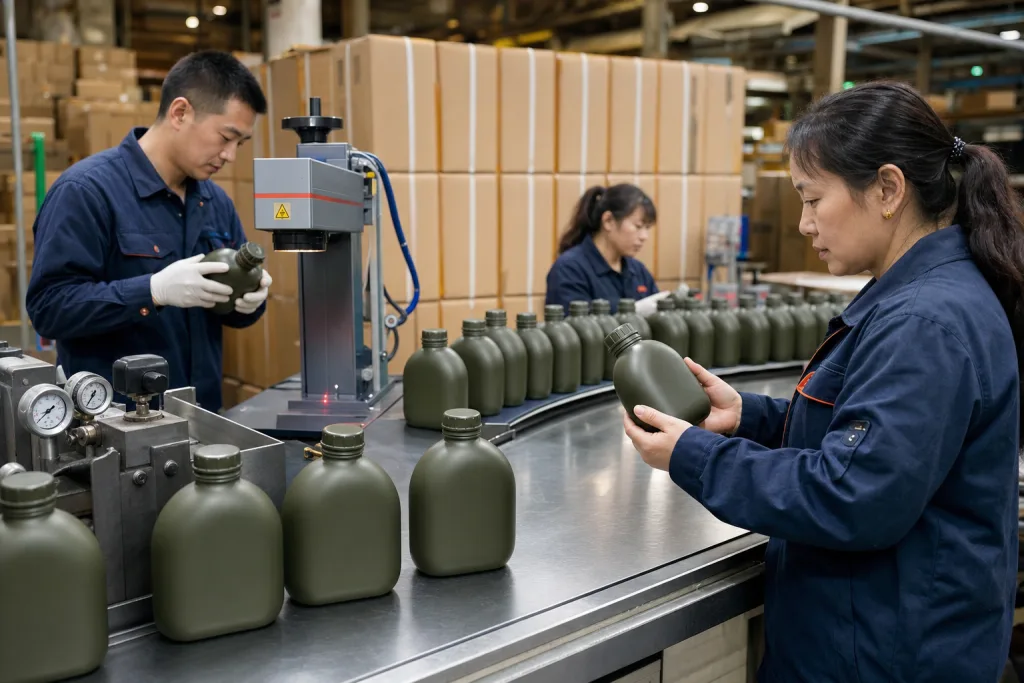
On our Zhejiang, China factory floor, the clean orders start with four locked points: material spec, capacity, closure system, and decoration method. We run the sample on a digital caliper before the quote is final; QC pulled one 750 ml sample last month because the cap gasket sat 1.2 mm off center and failed the upside-down leak test. If these points are clear, pricing is clean. If they stay vague, a canteen supplier can quote low and fill in the blanks later. That is the wrong way to buy. Your margin disappears there.
Start with the use case
Before you ask a canteen factory for price, decide what job the product must do. Start with use, not shape. A custom made military canteen for outdoor retail is not the same brief as a canteen promotional giveaway for a defense-themed event. A distributor canteen for museum shops needs barcode labels, shelf-safe cartons, and cleaner gift packaging; a rugged field-style bottle for outdoor clubs needs better drop resistance and cap torque. Last month the buyer flagged a PO typo that said “matte army green” in one line and “gloss OD green” in another, and the line stopped until we got the color chip signed.
The first decision is whether the canteen must be functional, decorative, or both. Functional means leak resistance at the cap, safe internal coating or bare food-grade steel, mouth tolerance held within about 0.20 mm, and threading that does not cross on the third turn. Decorative means the buyer is paying for the silhouette, surface finish, logo position, and gift box more than thermal performance or dent resistance. QC pulled the sample after 24 hours of inverted leak testing once because the gasket sat 0.6 mm off-center. Small part. Big problem.
For most B2B buyers, we ask for a one-page product brief with these fields: target retail price, expected order quantity, capacity, material, cap type, decoration area, packaging style, and testing market. If you sell through European or North American retail, put REACH, LFGB, FDA food-contact, or applicable ASTM expectations at the top of the brief. Do not wait until pre-shipment inspection to ask for documents. We see this go sideways when a buyer wants 3,000 pcs ready in 18 days, then adds LFGB paperwork after cartons are sealed; the lab report alone can eat 7-10 days.
A practical example: a 750 ml stainless steel custom canteen with a screw cap, matte powder coating, one-position laser logo, and individual kraft box will usually cost more than a plain aluminum canteen customized with a one-color print and polybag. The difference is often USD 0.80-1.60 per unit depending on finish, cap build, and packaging spec. That gap is not small when you order 5,000 units. On our floor, the powder-coated version also needs hanging points checked before spraying, or the fixture mark shows up right where the buyer wanted the logo.
Good canteen manufacturers ask uncomfortable questions early. This is the right sign. If a canteen vendor only says “yes, we can do” without asking about liquid type, drop height, carton strength, or compliance market, you are not getting engineering input. You are only getting a number, and sometimes the math does not work. We run compression tests on export cartons because one 12 kg master carton stacked wrong in a container can turn a clean sample approval into a crushed-delivery claim.
Choose material before decoration
Pick the material first. Decoration comes later. For a custom made military canteen, we usually quote 4 material routes: 304 stainless steel, aluminum, Tritan-style copolyester, and glass with a protective sleeve for desk use or gift sets, not field kits. Stainless steel is still the safer B2B default when the buyer wants dent resistance, a heavier hand-feel, and easier food-contact approval. On our line in Hangzhou, QC often starts by checking the raw sheet mark and wall thickness with a digital caliper before anyone talks about logo position.
For stainless models, ask your canteen manufacturer to write the grade and thickness on the PI, not just in a chat message. A typical single-wall 304 stainless body may use 0.5-0.6 mm sheet. If you move from 0.5 mm to 0.6 mm, the body feels stronger, but the carton weight and landed cost move too. For double-wall insulated canteens, set vacuum test rules clearly, such as 6-hour or 12-hour temperature retention under defined test conditions. “Keeps hot all day” is not a spec; we have seen that phrase go sideways during pre-shipment inspection when the buyer asked for a 95°C water test and the PO only said “good insulation.”
Aluminum cuts unit cost and weight, but it normally needs an internal food-safe coating. Control that coating. If your buyer sells in the EU, ask for coating migration reports, not a verbal promise from the factory sales desk. Aluminum works for canteen promotional projects where the target is price and vintage military styling, but the math does not work well for acidic drinks or rough outdoor use. One inspection finding we see: the coating looks fine under normal light, then a cross-hatch tape test near the neck shows weak adhesion after the second pull.
Plastic canteen customizable designs fit schools, outdoor youth programs, and price-sensitive campaigns. The trade-off is perceived value, and buyers flag this fast when the sample sits beside a stainless version on the same table. A plastic customized canteen at USD 1.20-2.00 FOB China can work for giveaways, while stainless versions may sit closer to USD 3.20-6.50 depending on tooling, finish, and cap design. For plastic, we run a simple drop check from about 1.2 m on a filled sample before mass production; a cheap cap crack at that stage is cheaper than 5,000 complaints after delivery.
Check the cap and connector early. A chain, tether, or strap looks authentic, but it adds failure points. For field-style custom drinkware, we prefer a wide-thread screw cap with silicone gasket and optional tether tested for at least 3,000 open-close cycles. That number is not excessive; it is basic risk control for repeat buyers. QC pulled one sample last season where the tether pin looked fine, but after 800 cycles it started walking out by 1.5 mm, which is exactly the kind of small defect that becomes a big email thread.
Capacity changes more than volume
Capacity is not just a marketing number. A 500 ml, 750 ml, 1 L, or 1.2 L custom canteen changes body curvature, mold cost, carton loading, freight efficiency, and hand feel. We see buyers copy an old army surplus sample 6 times out of 10. It can pass a quick meeting, then fail the cost sheet when the blow mold needs a deeper shoulder radius and the carton count drops.
For outdoor and tactical-style retail, 750 ml and 1 L are the safer ranges. They feel solid without turning into a brick on a belt clip. For children, events, or light promotional use, 350-500 ml is easier to carry and usually cheaper to ship. For a distributor drinkware program, two sizes should share the same cap thread, gasket spec, and print window; our line might run a 46 mm cap on both sizes so spare caps do not become a warehouse headache. Brand consistency matters, but spare-part control matters more.
Ask the canteen supplier for actual brimful capacity and recommended fill capacity. They are not the same number. A bottle advertised as 1,000 ml may hold 1,040 ml to the rim but drink better at 950-980 ml in real use. QC pulled one sample last month where the base print said 1 L, the test cylinder showed 925 ml recommended fill, and the buyer flagged it before artwork approval. If you print capacity on the base or packaging, the claim should match the test method.
Carton math matters. A rounded canteen shape wastes more space than a straight tumbler. If one carton holds 24 units and measures 56 x 42 x 38 cm, your sea freight and warehouse costs may look different from a design that packs 30 units in a similar carton. For Amazon or retail distribution, check carton drop testing and master carton weight before bulk production; we run a 76 cm drop test on packed cartons when the buyer asks for it. We usually try to keep export cartons below 15 kg gross weight for easier handling. The math does not work if the shape looks nice but ships air.
If you are also sourcing a custom growler, customizable growler, or distributor growler in the same program, do not assume the same production line, lid system, or inspection checklist applies. Growlers often need larger mouths, stronger handles, and carbonation warnings. Canteens need compact carry, leak control, and surface durability. We have seen this go sideways when a PO used the growler gasket code on a canteen order; the first leak test found seepage at 0.3 bar, and production stopped before packing.
Logo method is a cost decision
Decoration is where 6 out of 10 canteen custom projects start to wobble. The buyer sees a logo. The factory sees surface texture, body radius, ink adhesion, artwork tolerance, curing temperature, and rejection rate from the line. We had QC pull 32 samples last month because the logo passed the photo check but failed a 3M tape test after curing. A canteen customized with the wrong method can look fine in a photo and fail after 20 dishwasher cycles.
For stainless steel canteens, laser engraving is the safest choice for simple logos. It is clean and permanent, and it runs well on brushed steel or powder coating. Fast setup too. The trade-off is color: laser usually reveals the base material or leaves a tonal mark, so it will not match a Pantone 186C red or a full-color badge. If your brand guide requires exact Pantone colors, laser is the wrong tool.
Screen printing keeps the unit cost down for one- or two-color logos, especially above 2,000 units. On curved canteen bodies, the print area needs discipline; our fixture can hold a 38-55 mm wide mark cleanly on most 500 ml to 750 ml bodies, but large wraparound artwork often stretches at the shoulder. Heat transfer gives richer graphics, but it adds cost and needs adhesion testing after the oven run. For premium retail, we usually push powder coating plus laser logo because the defect rate is lower than complex multi-color printing. The math does not work if 4% of finished goods need rework before packing.
Here is the ranking we use on real B2B orders: laser engraving when the buyer cares most about durability; screen printing when the target is low-cost branding; heat transfer when the artwork has gradients or multiple colors; embossing or debossing only when the volume can absorb tooling. A dedicated embossing mold may add USD 300-800 or more, depending on the body shape and logo size. We have seen this go sideways when a buyer approves embossing on a flat PDF, then rejects the sample because the raised logo feels too shallow at 0.35 mm.
Send vector artwork in AI format if possible; EPS or PDF also works when the paths are clean. Also specify logo size in millimeters, not “same as sample photo.” A 45 mm wide logo on a 750 ml canteen may look balanced, while the same logo on a 500 ml body may dominate the product. Good canteen vendors will provide a digital mockup, but a physical pre-production sample is still worth the 7-10 days when the order is above 3,000 units. We ship fewer surprises that way.
Pricing, MOQ, and tooling reality
A serious custom made military canteen quotation should show unit price, tooling, sample cost, packaging, testing, and freight terms as separate lines. One blended number hides trouble. FOB Ningbo or FOB Shanghai is standard for Zhejiang, China exporters; EXW often looks lower because it leaves out trucking to port, terminal handling, and export paperwork. We once had a buyer compare our FOB Ningbo offer against an EXW Yiwu quote and think we were USD 0.18 high, until his forwarder added the missing local charges.
At BottleForge Industrial in Hangzhou, Zhejiang, our typical monthly drinkware output is about 450,000 units across stainless bottles, tumblers, and canteen-style products. For canteen factory orders, MOQ depends on how far you move away from our running items. Existing mold, standard color, one logo: around 1,000 units. Custom powder color usually needs 2,000-3,000 units because the spray booth and curing oven changeover are not free. New body tooling may require 5,000-10,000 units before the math works; for a 0.8 mm stainless shell, the forming dies, trimming fixture, and leak-test jig all need to be paid somewhere.
Indicative FOB China pricing for a stainless custom canteen can range from USD 3.20 to USD 6.50 for common 500-1,000 ml designs. Aluminum promotional models may be lower, sometimes USD 1.80-3.20, but this is where we push back: cheap coating on aluminum can fail a cross-hatch tape test after one bad bake cycle. Retail box packaging can add USD 0.20-0.60. A silicone boot, strap, compass-style cap decoration, or woven pouch adds cost too, and QC pulled samples before because a 2 mm strap rivet sat crooked on the neck shoulder.
Lead time should be written clearly on the PI. A normal timeline is 5-7 days for digital mockup, 7-12 days for sample after artwork approval, and 35-50 days for mass production after deposit and sample sign-off. Peak season before summer or Q4 can stretch this by 10-15 days, especially when powder coating colors queue behind sports bottle orders. If a canteen supplier promises 15-day bulk production on a fully customized order, ask what is already prepared and what risk they are taking. We have seen this go sideways when the logo film was ready, but the cap gasket mold was not.
For payment, most China canteen suppliers work on 30% deposit and 70% balance before shipment. Larger distributors sometimes negotiate different terms after 2-3 repeat orders and credit review. The lowest deposit is the wrong question to ask. Lock the approved sample, inspection standard, carton mark, and shipment date; one PO typo on “matte army green” versus “matte olive green” can cost more than the deposit argument saved.
Inspection protects your margin
QC for customized drinkware is simple only when the defect list is written like a work instruction. We run AQL inspection with fixed critical, major, and minor defects, not a loose “check quality” note on the PO. For drinkware, critical defects include leakage, sharp edges, contamination, unsafe coating, wrong material, or failed food-contact documentation. Major defects include visible dents, logo shift over 2 mm from the approved artwork, color mismatch beyond agreed tolerance, cap fit problems, and packaging errors. QC pulled one sample last month with a burr on the mouth thread; that carton failed before we even reached the logo check.
For a custom made military canteen, check these points at minimum: material certificate, capacity test, leak test, cap torque, gasket fit, coating adhesion, logo position, carton drop resistance, barcode or FNSKU accuracy if needed, and inner packaging cleanliness. If the order ships to Amazon FBA or a retail DC, label mistakes can cost more than product defects. We have seen one wrong FNSKU sticker hold 1,200 pcs at the forwarder for 9 days. The buyer flagged it. The product was fine.
A leak test should not be symbolic. Fill the canteen to recommended capacity, close the cap, invert for 30 minutes, then shake for 30 seconds. Use a torque meter on the cap, not a hand-feel judgment from the line leader. For insulated versions, add vacuum retention testing from the approved production batch. For coated bodies, cross-hatch adhesion and alcohol rub tests give better evidence than a quick fingernail scratch. Dishwasher testing should only be claimed if the exact finish and logo method passed a defined cycle count; otherwise the math doesn’t work when returns start.
Compliance depends on market. EU buyers may request LFGB, REACH, and food-contact migration testing. US buyers may ask for FDA food-contact compliance, California Proposition 65 screening, and ASTM-related checks depending on product category and user age. For kids’ canteens, requirements become stricter, and small parts must be reviewed carefully with a small-parts cylinder and pull test record. We have seen this go sideways when a buyer changed the cap charm after testing but kept the old report number on the PO.
A reliable canteen manufacturer will accept third-party inspection before shipment. If you are a canteen distributor handling multiple SKUs, book inspection when production is 80-100% complete and packaging is at least 80% finished. That timing gives a real view of final goods without waiting until the container is already late. For mixed SKU orders, ask the inspector to open cartons from each item code, not just the top-loaded cartons near the warehouse door. We ship better when problems are caught on the floor, not at the destination warehouse.
Pick suppliers by response quality
You can find 200+ canteen manufacturers and canteen vendors online before lunch. Filtering is the work. Price matters, but response quality often tells you what the line will do later. A good canteen supplier replies with 304 stainless or aluminum grade, wall thickness in mm, MOQ by color, sample timing, logo size limits, test options, and carton packing assumptions. A weak supplier sends one catalog page and asks, “How many pieces?” We see this every week; if they cannot name the material thickness before quoting, QC usually finds the surprise after polishing.
When comparing canteen suppliers in China, send the same five questions to each one: What material and thickness are quoted? What is the MOQ per color? What logo method is included? What tests are available for my destination market? What is the production lead time after sample approval? Ask for answers in writing, not voice notes. The replies show who understands export drinkware and who is only trading photos from another factory. Last month a buyer flagged a quote where “0.6 mm” became “0.5 mm” after sampling; that 0.1 mm changed the hand feel and the dent risk.
Factory audits matter if your customer requires BSCI, ISO 9001, or retailer-specific social compliance. Not every canteen factory has every certificate, and not every certificate applies to the exact workshop making your order. Ask for current documents and check the company name, address, scope, and expiry date. Sounds basic. We have seen a PO blocked because the audit file showed the sales office, while the welding workshop was 18 km away. For regulated retail, this is not paperwork decoration; it can decide whether your purchase order is accepted.
If you are building a long-term distributor canteen or customizable drinkware program, choose a partner who can support repeat production. That means keeping color records with Pantone codes, mold numbers, logo files, packaging dielines, and inspection reports tied to the order number. A one-time cheap order is easy. Repeating the same matte green customized canteen six months later with less than 5% visible color difference is harder. The math does not work if the supplier saves nothing and starts from a phone photo; QC pulled the sample, and the new batch looked like olive gray under the light box.
Our bias is simple: choose the canteen vendor who challenges weak specs before production. It feels slower during quotation, but it saves arguments at shipment. If your artwork has a 0.2 mm line and the logo method needs 0.4 mm minimum, the supplier should say so before the mold charge is paid. For B2B custom drinkware, the best factory relationship is not the one that says yes fastest. It is the one that makes your next reorder boring.
Send your canteen brief for factory review
Share capacity, material, logo, MOQ, and destination market. We will return practical options, FOB pricing, and production timing.
Frequently asked questions
What is the normal MOQ for a custom made military canteen?
For an existing mold, MOQ is usually 1,000 units with one logo and a standard finish. If you need a custom powder-coated color, many China factories require 2,000-3,000 units because coating lines need setup time and color loss allowance. A new canteen body shape may need 5,000-10,000 units to justify tooling. Small trial orders are possible, but the unit price may rise by 20-40% because sampling, setup, and QC costs are spread across fewer pieces.
Which material is best for a customized canteen?
For most B2B export orders, 304 stainless steel is the safest choice. It offers good durability, strong perceived value, and broad acceptance for food-contact drinkware. A typical single-wall stainless canteen uses about 0.5-0.6 mm wall thickness. Aluminum is lighter and cheaper, but it usually needs an internal coating, so migration testing becomes important. Plastic works for low-cost promotional canteens, but it does not feel as premium. If your canteen will be sold in Europe or North America, choose material based on compliance first, not just FOB price.
How long does production take after we approve the sample?
A realistic production lead time is 35-50 days after deposit and approved pre-production sample. Before that, allow 7-12 days for sample making and another few days for artwork confirmation. If you need custom color coating, retail box printing, or third-party lab testing, add time. Peak season can add 10-15 days. A canteen supplier promising very short timing may be using available stock, skipping certain QC steps, or assuming packaging is simple. Ask for a written timeline with sample, bulk production, inspection, and vessel booking dates.
Is laser engraving better than screen printing for canteen custom logos?
Laser engraving is usually better for durability, especially on stainless steel or powder-coated canteens. It will not peel like ink, and it handles outdoor use well. Screen printing is better when you need exact Pantone colors or lower cost on simple logos, especially above 2,000 units. The trade-off is adhesion and abrasion resistance. For curved canteen bodies, logo size also matters. A 40-50 mm wide logo is often safer than a large wraparound design. Always approve a physical sample if the logo is important to retail presentation.
What documents should a canteen distributor request from the factory?
Request material specifications, food-contact test reports for your market, factory audit documents if required, and a signed product specification sheet. EU buyers may need LFGB, REACH, and migration reports. US buyers may ask for FDA food-contact statements and Proposition 65 screening. If selling to major retailers, BSCI or ISO 9001 may be requested. You should also ask for packaging dielines, carton marks, AQL inspection criteria, and final production photos. For repeat distributor drinkware programs, keep approved samples and color records for future reorders.