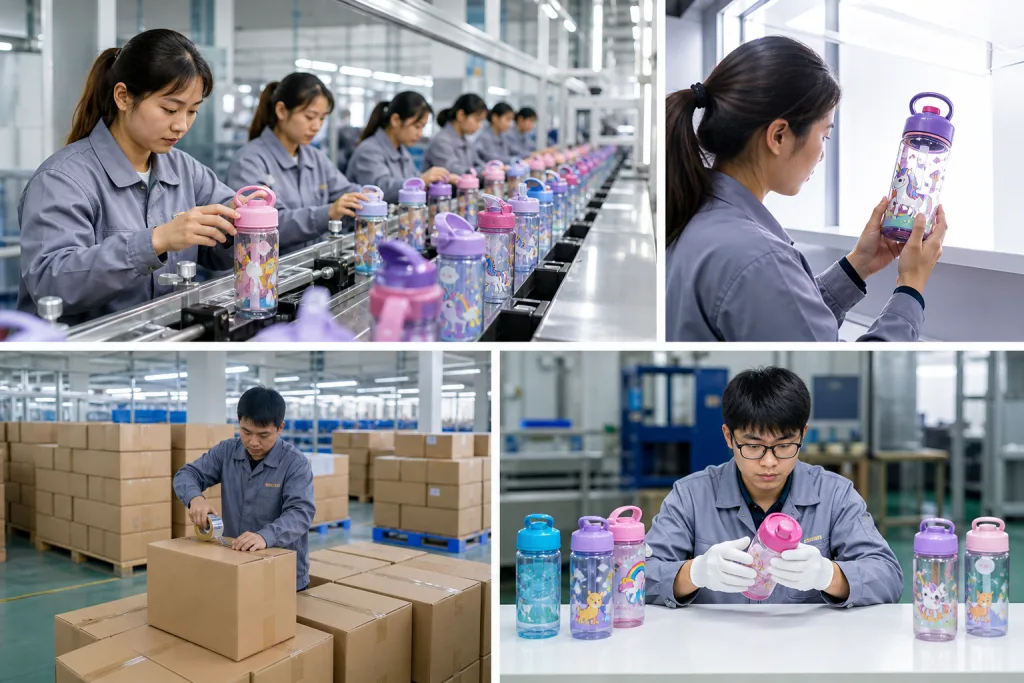
Key Takeaways
- A practical MOQ for custom logo kids bottle orders is usually 1,000-3,000 pieces per color
- For children, specify CPSIA, ASTM F963, REACH, LFGB, or FDA tests before quoting
- Stock molds cut lead time to 25-35 days after sample approval
- Straw lids need extra leakage and bite-resistance checks compared with screw caps
A custom made kids bottle looks simple until you are the one signing the purchase order. Then the questions get real fast: does the lid leak after a 1.2 m drop test? Will the paint pass REACH? Can a 6-year-old open the straw cap without help? Is 5,000 pieces enough for custom molding, or should you run a stock body with your logo? We see buyers lose 12 days just arguing over cap drawings.
For school districts, PTA programs, and kids-product importers, price is not the main risk. A failed bulk kids water bottle order can bring parent complaints, customs delays, or a full recall. On our Zhejiang, China production floor, QC pulled one sample last month because the silicone straw measured 0.6 mm off the approved drawing. Small miss. Big headache. Buyers who lock the specification early avoid 80% of the problems later.
Start With The Age Group
The first question is not color, logo, or price. It is age. A 3-year-old using a bottle in kindergarten is not buying the same product as a 12-year-old carrying a bulk school water bottle for football practice. If you mix age groups in one spec sheet, the factory will usually quote the easiest version, not the safest version. We see this on RFQs at least twice a month: one line says “kids bottle,” the next line asks for 750 ml, straw lid, and cartoon charm. QC pulled the sample last time and flagged the charm as detachable.
For ages 3-6, we run 300-450 ml most often, with body diameter under 70 mm and a one-touch or flip straw lid that opens with one hand. Small hands matter. So do backpack pockets. For ages 7-12, 500-650 ml works better in daily school use. If the bottle is 350 ml, children refill too often; if it is 750 ml, parents tell us the bottle stays on the kitchen table. On our line, a 68 mm body usually passes the common side-pocket check, while 73 mm starts causing buyer pushback.
Weight matters. A stainless steel insulated kids bottle with 0.4 mm inner wall and 0.5 mm outer wall usually feels solid without becoming too heavy. Plastic Tritan styles cut weight and cost, but importers need clean BPA-free material declarations and food-contact testing before shipment. Don’t treat this as paperwork. The math does not work if one failed lab test delays a 5,000 pcs back-to-school order by 12 days. For younger children, avoid detachable small decorative parts. They look good on a sales sample, then create choking-risk questions during inspection.
- Preschool: 300-400 ml, straw lid, silicone bumper preferred.
- Primary school: 450-550 ml, carry loop, leak-tested cap.
- Older children: 600-750 ml, wider mouth, stronger handle.
If you are buying for a school district, ask the school what bottle pocket size their common backpack suppliers use. It sounds too detailed, but 5 mm of extra diameter can turn a clean custom kids water bottle project into a complaint file. We once had a PO typo listing 75 mm instead of 70 mm; the buyer flagged it only after the pre-production sample, when the mold deposit was already paid.
Material Choices Are Not Cosmetic
A children water bottle manufacturer should not push one material before checking where the bottle will be sold, how old the child is, and what price shelf you need. We ask for this before quoting because stainless steel, Tritan, PP, and aluminum carry different test costs and different parent expectations. Last month a buyer asked us to switch from Tritan to PP to save USD 0.18; the math did not work after the added scratch complaints on a 12,000 pcs school order.
Stainless steel 304 is the standard choice for an insulated custom children water bottle. It takes school-bag abuse, holds less odor, and feels like a retail product instead of a giveaway. On our line, QC checks the inner tank with a thickness gauge before powder coating; for kids bottles we usually see buyers specify 0.4 mm to 0.5 mm body wall depending on target weight. For Europe and North America, ask for food-contact test reports on the stainless steel, silicone, plastic lid parts, and coating. Do not accept one certificate for “the bottle” unless it names each tested component clearly.
Tritan works when you need a transparent, lightweight, children water bottle customizable design. It sells well for lunch kits and summer camps because parents can see the liquid level at a glance. You still need migration testing and BPA-free documentation, and the buyer should approve the resin brand on the BOM before mold opening. PP is cheaper and fine for short promotional runs, but it scratches faster; we have seen samples fail after a simple coin-rub check on the QC table. Aluminum looks attractive on unit price, but the internal liner is the risk. If that liner is weak, taste complaints arrive fast.
For kids bottles, the cap assembly often carries more compliance risk than the body. Silicone straw, PP lid, ABS button, and stainless spring may all need review; QC pulled one sample where the spring had light rust after a 24-hour salt spray check.
At our Zhejiang facility, monthly drinkware output is about 600,000 units across stainless steel and plastic lines. That volume helps keep pricing stable, but it does not replace a written material specification. China suppliers can build 8 versions of the same-looking bottle with different lid plastics, coating, liner, and wall thickness. Your PO should state the grade, wall thickness, coating type, and required test standards, not just “safe kids bottle.” We have even seen a PO typo list “201 stainless” while the approved sample was 304 stainless, and that is exactly how orders go sideways.
How Custom Is Custom Enough
Buyers often say they want a custom made kids bottle, but on our line that can mean three different jobs. First is a stock bottle with a custom logo. That is the fastest route for school district orders, and MOQ can start around 1,000 pieces per design. We run laser engraving, silkscreen, heat transfer, and UV printing for that tier, with lead time usually 25-35 days after artwork and sample approval. If the buyer wants 12,000 pieces for a campus program, the math works. If it is a one-off promo, this is the wrong question to ask.
The second level is color customization. Think powder coating, Pantone-matched plastic, silicone boot colors, strap colors, and printed carton artwork. MOQ usually moves to 2,000-3,000 pieces per color because the coating booth, plastic injection setup, and material loss have to be covered. QC pulled a sample last week and the lid color was off by one shade from the Pantone chip, so we held the run. For a bulk children water bottle program with several school logos, we usually keep one bottle color and change only the printed logo. Cleaner. Cheaper. Faster.
The third level is custom tooling. That is when a buyer wants a new body shape, cap, handle, character form, or exclusive silhouette. Tooling cost can run from USD 1,500 for a simple silicone accessory to USD 8,000-25,000 for a new plastic lid and bottle body set. On a new lid, our caliper check starts at 1.8 mm wall thickness before the tool goes back to the mold shop. Development usually takes 45-75 days before mass production. This makes sense for an importer building a private label range, not for a one-time back-to-school tender.
Practical customization checklist
- Logo size in millimeters, not just “front center.”
- Pantone color code for body, lid, straw, and boot.
- Packaging type: white box, color box, display tray, or bulk pack.
- Barcode, FNSKU, warning text, and country-of-origin placement.
- Spare straw or cleaning brush requirement.
A good children water bottle supplier will ask you to freeze these details before the pre-production sample. We stop the line once the PP sample is signed off, because a PO that says “blue” and a buyer who later wants Pantone 2945 C will blow up the schedule. Changes after sample approval are where delays and extra cost start.
Price Questions Buyers Actually Ask
FOB price comes from capacity, material, lid structure, coating, packaging, and testing. Buyers still need a working range before they send RFQs to five children water bottle suppliers. For a 500 ml single-wall Tritan custom school water bottle, FOB China may sit around USD 1.20-2.10 at 3,000 pieces. For a 350-500 ml double-wall stainless steel insulated kids bottle, expect roughly USD 3.20-5.80 depending on cap type and finish. A silicone boot, upgraded carry strap, or retail color box can add USD 0.20-0.70 per unit. Small parts matter. On the line, a flip lid with a spring pin takes more assembly time than a plain screw cap, and QC will check the pin gap with a 0.2 mm feeler gauge.
Do not compare quotes by the top-line number only. We see this go sideways. One children water bottle vendor may include LFGB testing, 1C logo printing, and individual color boxes. Another may quote a bare bottle in polybag with no test cost. Both prices can be “correct,” but only one matches your market. Last month a buyer flagged a USD 0.38 price gap; the lower quote had no drop test, no color box, and the PO even spelled Tritan as “Titan,” which delayed artwork confirmation by 2 days.
For school district tenders, ask for a price table by quantity: 1,000, 3,000, 5,000, and 10,000 pieces. The main savings usually show between 1,000 and 3,000 pieces because logo setup, sample handling, and line preparation spread out. Above 10,000 pieces, the math gets tighter unless carton size, packing speed, or raw material purchase volume also changes. We run carton checks with a tape measure before quoting freight; moving from a loose 24 pcs carton to a tighter 36 pcs carton can cut dead space by 15-20% on some kids bottle programs.
Payment terms are usually 30% deposit and 70% balance before shipment for new buyers. For established distributors, China factories may discuss different terms after 3-5 clean orders. If a quote looks 15-25% lower than the market, ask which part changed: steel thickness, lid material, coating, QC level, or packaging. This is the wrong place to chase the last few cents. For kids products, the cheapest version is rarely the lowest-risk version; QC pulled one sample where the inner wall measured 0.28 mm instead of the agreed 0.35 mm, and the buyer would never see that from a PDF quotation.
Safety Testing And QC Checks
QC comes first. For children water bottle customized orders, we write quality control into the job file before the line starts, not as a final-inspection surprise. Standards depend on destination and material. For the United States, buyers commonly request CPSIA, ASTM F963 where applicable, FDA food-contact testing, lead and cadmium checks for coatings, and tracking label review. For the EU and UK, REACH, LFGB, EN 14350 for drinking equipment where relevant, and food-contact migration tests are common. On our line, QC pulls the first samples with a caliper and flashlight before we release the rest of the run.
Testing has to match the real material lot. A report from a similar bottle is fine for screening, but it does not cover a 5,000 pcs custom made kids bottle order, and the buyer who says “close enough” is asking for trouble. If you change coating, lid plastic, silicone color, or printed ink, check whether the old report still applies. We had one PO where the lid was typed as PP on page 1 and Tritan on page 2. That sort of typo changes the test plan fast.
Inspection usually runs to AQL. A common setting is AQL 2.5 for major defects and 4.0 for minor defects, with critical defects not accepted. For kids bottles, we treat sharp edges, loose small parts, serious leakage, wrong warning label, and strong odor as critical or major issues. A carton drop test should be added if the bottles ship in retail packaging. We once caught a loose straw cap on the bench test before loading; the buyer flagged it, and that saved a full rework.
QC checklist before shipment
- Leak test: invert and shake selected samples for at least 30 minutes.
- Cap torque and hinge cycling on flip lids, checked with a torque meter.
- Straw pull test and bite inspection.
- Coating adhesion cross-hatch test on painted bottles.
- Logo rub test with dry and wet cloth.
- Carton weight, barcode scan, and carton mark verification.
At BottleForge Industrial in Zhejiang, China, normal mass production lead time is 30-45 days after deposit and confirmed PP sample. Third-party lab testing can add 7-12 working days, so build it into your launch calendar. We run two shifts when the schedule is tight, but the line does not move until the PP sample, carton artwork, and test plan all match.
School And Distributor Logistics
A bulk kids bottle order usually fails late when logistics gets pushed into the “warehouse matters” bucket. Bad move. For school districts, we often pack by campus, grade, classroom, or event date, and one wrong carton mark can send 2nd grade bottles to the middle school office. For importers and children water bottle distributors, the job may require Amazon-ready cartons, mixed SKU pallets, or retailer carton labels with PO number, SKU, GW/NW, and carton count printed at 80 mm height. Tell the factory early, because packing style changes labor, carton dimensions, and how the line sets up the final packing table.
If you sell a bulk school water bottle program to 40 schools, do not ask the factory to guess the distribution plan after production. Send a packing matrix with school name, SKU, quantity, carton label text, and delivery address if split shipment is required. We run this in Excel, then QC pulls one sealed carton against the matrix before the cartons are strapped. For China FOB shipment, the factory normally delivers to the forwarder warehouse or port. For DDP or door delivery, clarify duties, insurance, and final-mile responsibility in writing; we have seen this go sideways when a PO says “ship to Los Angeles” but the buyer actually needs 23 campus drops.
Carton size drives freight. Kids bottles are light but bulky, especially with handles and retail boxes. A 500 ml stainless bottle in a color box may pack 24 pieces per master carton, while a simple plastic bottle can pack 48 pieces. That difference changes ocean freight per unit, and the math does not work if your landed-cost sheet assumes 48 pieces but marketing approved a large gift box. On one 304 stainless bottle order, the master carton grew from 54×36×42 cm to 61×40×48 cm after the buyer added a silicone bumper. If your target landed cost is tight, ask your children water bottle factory to quote both retail box and bulk pack options.
For importers, spare parts deserve a line on the quote. A 1-2% spare lid or straw allowance can save customer service during the first selling season, especially when kids lose straws in week one. For school districts, printed replacement stickers or blank overrun stock can cover late student additions; we normally suggest 30-50 blank pieces for a 2,000 piece campus program. Small detail. Big headache avoided. These operational calls are not glamorous, but they keep your custom logo kids bottle program from turning into daily emails about one missing lid, one wrong class label, or one student added after the cartons already shipped.
A Sensible Buying Path
If you are new to children water bottle vendors in China, do not start with a wide RFQ. That is the wrong question to ask. Send one spec sheet with capacity, material, lid type, logo method, quantity, test requirements, packaging, shipping term, and target delivery date. We like to see drawings with mouth diameter in mm, carton weight limit in kg, and the exact logo file name, because one buyer once sent “final_logo_v7.ai” on the PO and “final_logo_v8.ai” by email. Guess which one the line followed? A controlled spec gets cleaner quotes and fewer “almost the same” samples.
For a first order, a stock mold with custom logo and color is usually the safest path. It gives enough branding without tooling cost and timing risk. A typical pilot order might be 3,000 pieces of a 500 ml stainless bottle, two body colors, one lid type, one carton design, and AQL inspection before shipment. We run this kind of order often: powder coating first, then logo print, then lid assembly, with QC checking color against a Pantone card under a light box. Tooling too early can eat 25 to 35 days before mass production even starts. If sell-through is strong, move to exclusive tooling on the second or third order.
Use the sample stage seriously. Twist it. Drop it. Check how the cap opens with wet hands, whether the straw reaches the bottom, whether the handle pin feels weak, and whether the bottle stands steadily with a silicone boot. QC pulled one sample last month where the straw was 6 mm short, so the child would leave water inside and parents would call it a leak. Put the sample in a backpack and shake it for 2 minutes. Leave water inside overnight. If your team would not give that sample to a child, do not approve it just because the print color looks correct.
The best children water bottle suppliers answer uncomfortable questions directly: what material changed from the last batch, what defect rate they saw, which tests are current, and what happens if the pre-shipment inspection fails. The buyer flagged this once on a 500 ml school bottle order, and the factory admitted the silicone ring supplier had changed after Chinese New Year. That honesty is worth more than a polished sales deck. A custom kids bottle is a small product, but once it carries a school name or kids brand, your liability and reputation sit on every unit we ship.
Send Your Kids Bottle Specification For Review
Share capacity, material, logo, quantity, and destination market. We will return a practical FOB quote and compliance checklist.
Frequently asked questions
What is the normal MOQ for a custom made kids bottle?
For a stock bottle with custom logo, the practical MOQ is usually 1,000 pieces per design. If you need custom Pantone coating, colored lids, or silicone boots, expect 2,000-3,000 pieces per color. For new tooling, 5,000-10,000 pieces is more realistic because mold cost, sampling, and production setup must be spread across enough units. For school district orders with several logos, we often suggest one common bottle color and separate logo prints to keep MOQ and price under control.
Which logo method is best for a custom kids water bottle?
Laser engraving is durable on stainless steel and works well for simple school names or mascots, but it is usually single-color. Silkscreen printing is cost-effective for 1-2 color artwork on smooth surfaces. Heat transfer and UV printing are better for full-color characters, gradients, or retail branding. For kids bottles, we recommend a rub test and dishwasher expectation discussion before production. If parents will wash bottles daily, the logo method matters more than saving USD 0.08 per unit.
Can one bottle design serve both schools and retail stores?
Yes, but the packaging and labeling may need two versions. A school bulk pack can use plain cartons with bottles separated by polybags or paper sleeves. Retail stores usually need color boxes, barcodes, warning labels, and sometimes hang tags. If you plan to sell through both channels, decide this before mass production. Switching from bulk pack to retail pack after production can add 5-10 days and extra repacking cost. The bottle can be identical while the carton and compliance labels change.
How long does production take for children water bottle bulk orders?
For stock molds with approved artwork, allow 25-35 days after deposit and sample approval. Custom colors, special packaging, or multiple SKU sorting usually push this to 35-45 days. New tooling can add 45-75 days before normal production even begins. Third-party lab tests often require another 7-12 working days. If you need bottles for a September school launch, do not place the PO in August. Start sampling at least 90 days before your required delivery date.
What documents should a children water bottle distributor request?
Ask for a proforma invoice, material specification sheet, artwork proof, pre-production sample approval record, food-contact test reports, coating heavy-metal reports, and inspection report. For US children’s products, CPSIA-related documents and tracking label information may also be required. For EU sales, REACH and food-contact migration reports are common. If you use Amazon or retailer distribution, confirm barcode, FNSKU, carton mark, and country-of-origin label placement. Documentation should match the exact production batch, not only an old catalog model.