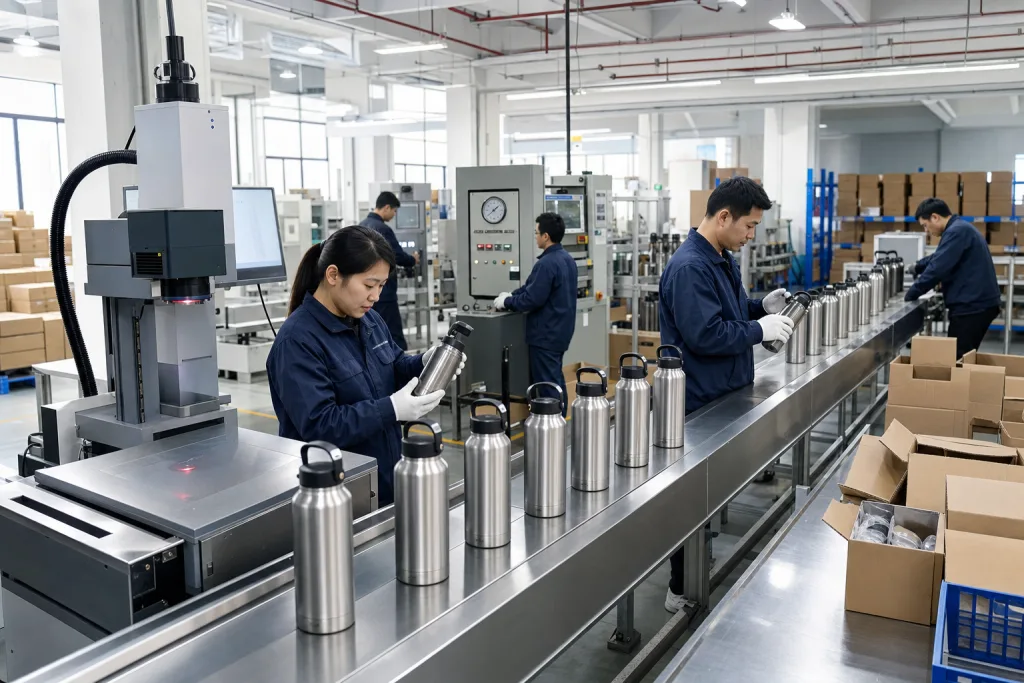
Key Takeaways
- A realistic custom made hydration flask MOQ starts at 1,000 pcs for standard shapes and 3,000-5,000 pcs for new molded parts
- 304 stainless steel at 0.45-0.55 mm wall thickness is the common B2B balance for durability and cost
- Normal production lead time is 30-45 days after deposit and artwork approval in Zhejiang, China
- Use AQL 2.5/4.0 plus coating, leak, vacuum, and carton drop checks before shipment
A custom made hydration flask sounds simple until the first three quotes land in your inbox. One canteen supplier lists 304 stainless steel, another offers 316, one includes carton drop testing at 76 cm, and another buries a USD 45 logo setup fee in the PI. Unit price is the wrong question to ask first. We’ve seen a flask pass the PDF review and still fail the buyer’s shelf test because the powder coating chipped at the bottom radius after QC pulled the sample from the line.
From our factory in Zhejiang, China, we see this buyer problem 2 or 3 times a week: procurement needs a canteen with enough customization for the brand, but stable enough for repeat distributor drinkware programs. The practical questions are not glamorous. Wall thickness should be checked with a micrometer, coating adhesion needs a cross-cut test, AQL level must be agreed before production, lead time should say 25 days or 35 days, and carton strength matters when we ship 12 kg master cartons. Color repeat is another place the math doesn’t work if the canteen manufacturer cannot match the same powder code six months later.
What should you define first?
Before asking a canteen factory for a quote, define the sales channel and the failure point you cannot accept. A custom made hydration flask for a 3,000 pcs corporate gift run is a different job from a distributor canteen going into outdoor retail. The gift order usually lives or dies on logo sharpness and a fixed delivery date. The retail order needs color repeatability, barcode control, shelf-ready packaging, spare lids, and the same finish again on the next PO. We have seen this go sideways when the buyer only sent a photo and “same as sample” in the email.
Start with capacity and lid construction, then lock the insulation target and print area in the spec sheet. A 500 ml flask with a screw cap, powder coating, and one-color logo is a low-risk customized drinkware project; the line can usually confirm it with one pre-production sample. A 950 ml flask with handle lid, silicone boot, gradient coating, gift box, and logos on both bottle and lid needs more sampling and tighter drawings, down to logo size in mm. QC pulled one sample last month where the silicone boot covered 2 mm of the printed mark. Small issue. Big argument.
For most B2B buyers, the practical baseline is:
- Material: SUS304 inner and outer body for normal food-contact use; we verify grade on incoming sheet records before drawing.
- Wall thickness: 0.45-0.55 mm for common vacuum bottles, checked by micrometer after body forming.
- Insulation: 6-12 hours hot retention depending on capacity and cap design; a wide-mouth lid loses heat faster.
- MOQ: 1,000 pcs per color for existing models; higher for custom tooling, especially if the lid mold is new.
- Lead time: 30-45 days after deposit, confirmed sample, and packaging artwork; missing barcode files can easily burn 3 days.
If a canteen vendor pushes you to choose from a catalog without asking where the product will be sold, slow down. This is the wrong question to ask first. A capable canteen manufacturer should ask about compliance market, target retail price, packaging style, barcode format, carton weight limit, and whether the order is one-off or repeat. Those answers change the quote more than most buyers expect; we ship a 12 kg master carton differently from an 18 kg one when the buyer has warehouse handling limits.
Which material and construction matter?
For stainless custom drinkware, 304 stainless steel is the normal choice. We run it for most hydration flask orders because it resists rust in daily use and forms cleanly on the drawing press without giving our tooling team too much scrap. Some buyers ask for 316 stainless steel for premium outdoor or marine-positioned products. It handles chloride corrosion better, but the math does not work for every 500 ml gym flask; on one recent RFQ, 316 added about 8-12% to the body cost before coating.
Ask your canteen supplier to confirm the grade for the inner liner, outer shell, lid components, silicone ring, and coating. A quote saying “stainless steel bottle” is not enough. We have seen POs where the buyer wrote 304 stainless in the product title, then left the lid spring and tea filter unspecified; QC pulled the sample and found a lower-grade accessory. For Europe, discuss LFGB or EU food-contact requirements before mold opening. For North America, buyers often request FDA food-contact compliance and sometimes ASTM-related checks depending on the product type and claim.
The body construction matters as much as the metal label. Vacuum insulation depends on weld consistency, the vacuuming process, and cap sealing design, so this is the wrong question to ask if the buyer only says “Is it 304?” A thin body may pass first inspection, then arrive with dents after parcel shipping; we have seen 0.40 mm shells behave much worse than 0.50 mm shells in courier cartons. A poorly designed lid can leak even when the steel body is fine.
Typical checks we recommend for a custom canteen or customizable growler include:
- 100% leak test for assembled bottles before packing, with the line checking upside-down bottles after the cap is fully torqued.
- Vacuum performance sampling after production stabilization, not only from the first 20 shiny samples off the line.
- Salt spray or cross-hatch adhesion test for powder coating when required, especially when the buyer flagged outdoor retail use.
- Torque check for screw lids and straw lids, because loose caps create complaints faster than small color variation.
- Carton drop test from 76 cm for export packaging reference, using the packed master carton, not an empty display box.
For a custom growler or customized growler, pay close attention to mouth diameter and cap gasket compression. Beer, cold brew, and carbonated use cases create different pressure and cleaning requirements; we normally check the gasket seat with a caliper and ask for the target compression before mass production. Do not approve a growler only by its look. Approve it by its seal.
How much customization is sensible?
Customization should help sell-through, not give the factory a problem on day 6 of production. A canteen customizable program can cover the logo, Pantone color, lid type, silicone boot, gift box, barcode label, and shipping carton mark; we normally treat each one as a separate checkpoint on the QC sheet. Each layer adds cost, sample time, and another place for a buyer to reject cartons under AQL 2.5. If you are testing a new market, start with an existing mold and spend the money on the parts shoppers see first, such as the front logo and retail box. We see this go sideways when a PO asks for 9 changes on a 1,000 pcs trial order. The math doesn't work.
For logos, laser engraving gives a clean, durable mark on 304 stainless or powder coating, and QC can measure placement with a 0.5 mm tolerance jig. Silkscreen works well for simple one- or two-color artwork, especially when the logo is under 70 mm wide and the curve is not too aggressive. Heat transfer or full-wrap printing can make the bottle look more retail-ready, but the coating surface, seam position, and artwork bleed need control before the line starts. For large distributor drinkware programs, we usually ask for a pre-production sample made with actual mass-production coating, not a hand-made sample from the sample room. Last year a buyer flagged a “matte navy” that looked black under warehouse light; better to catch that before 48 cartons are packed.
A new lid mold or body mold is a separate decision. Tooling can make sense when you need a unique profile or a family line that looks protected, but it usually means 3,000-5,000 pcs MOQ per first run and 25-45 days extra development time before mass production. A custom made hydration flask with a new lid also needs added leak testing, drop testing, and dishwasher-related checks if you want to print strong performance claims on the insert card. We run 100% leak testing on many sports caps, but a new flip lid still needs pressure checks and real shaking, not just a pretty 3D file. One small hinge gap of 0.3 mm can turn into 600 customer complaints after sea shipment.
Practical rule: customize what the customer sees first, then customize what improves function. Do not spend tooling budget on small design details that your buyer will not notice.
For canteen promotional orders, a stable standard model with accurate logo placement often sells better than an overdesigned bottle. Short run, fewer surprises. For a canteen distributor building a long-term line, a semi-custom range with two capacities, shared lids, and three core colors is easier to reorder and manage because the line can hold common spare parts and cartons. We ship these programs smoother when the PO code, carton mark, and barcode label match exactly; one typo in the SKU can hold a 20 ft container for two days at final inspection.
What MOQ and pricing are realistic?
MOQ follows the part that blocks the line. For an existing stainless hydration flask, 1,000 pcs per color is a common starting point at our Zhejiang facility. If you need a special Pantone powder coating, coating workshops often ask for 2,000 pcs per color because they lose powder during gun setup and booth cleaning. For a new plastic lid color, the resin order and injection machine setup may push the MOQ higher than the bottle body itself; last month QC pulled a lid color chip that was 1.5 Delta E off the approved swatch, and the buyer flagged it before mass production.
FOB China pricing for a standard 500-750 ml vacuum flask usually sits around USD 3.20 to USD 7.80, shaped by steel gauge, lid structure, coating, logo method, packaging, and inspection requirements. A custom growler or large 1.2 L bottle can move above that range because it uses more steel, needs larger cartons, and packs fewer pieces per cbm. These are working ranges, not promises. Freight, exchange rate, and raw material costs move; we have seen 304 stainless sheet quotes change within 7 days, which can wipe out a thin margin if the PO sits unsigned.
Watch for quote gaps. A canteen vendor may quote a low bottle price but leave out mold charge, logo setup, color sample fee, inner box, barcode sticker, spare gasket, or third-party inspection support. The math does not work if the buyer compares only the bottle line price. On one PO, the barcode sticker spec was missing one digit, and the packing table had to be corrected before the carton artwork went to print. A proper quote from canteen suppliers should state:
- Incoterm: FOB Ningbo or FOB Shanghai is common for Zhejiang, China factories.
- MOQ by SKU, color, and logo version.
- Sample cost and refund policy.
- Production lead time after deposit and approval.
- Packaging specification and carton quantity.
- Payment terms, usually 30% deposit and 70% before shipment for first orders.
BottleForge Industrial runs about 450,000 stainless drinkware units per month across standard and customized drinkware production. Capacity helps. It does not protect your order by itself. Clear specifications, approved samples, and inspection standards do; before we ship, the line checks vacuum retention, coating adhesion with a cross-cut tester, and carton drop results against the buyer’s AQL 2.5 plan.
How do you control quality?
Quality control for a custom made hydration flask starts before production, not after the cartons are taped. Your purchase order should lock the material grade, capacity tolerance in ml, Pantone or powder-coating color reference, logo position with mm measurements, packaging layout, testing requirements, and AQL inspection level. For most B2B export orders, AQL 2.5 for major defects and 4.0 for minor defects is a normal baseline. Critical defects such as leakage, unsafe burrs, wrong material, or severe contamination need zero tolerance. We once had QC stop a 3,000 pcs run because the PO said “matte black” but the approved sample was PMS Black 6C with a soft-touch finish. Small wording. Big argument.
Ask your canteen manufacturer for an inspection plan, not a polite sentence saying “we check quality.” At minimum, you want incoming material checks on 304 stainless coils, first-piece approval before the line runs, in-process checks after forming and coating, assembly leak testing, and final random inspection. If you use a third-party inspector, send the approved sample and specification sheet to the inspector, not just the order number. Otherwise they can only count cartons, weigh a master carton, and catch obvious defects with a flashlight and caliper. The wrong question is “Do you inspect?” Ask who signs the first-piece board.
Common defects in customized canteen orders include color deviation over 1 Delta E from the approved sample, logo misalignment by 2-3 mm, coating chips at the base, cap thread roughness, odor from silicone parts, incorrect barcode labels, and weak gift boxes that crush under a 12 kg stack test. None of these are mysterious. They happen when the buyer and canteen factory did not freeze details early enough, or when the inspection checklist says “logo OK” instead of showing the exact print size and position. We have seen this go sideways on a holiday promotion order when the buyer flagged one digit wrong in the EAN code after packing.
For Europe and North America, check compliance documents before deposit if possible. REACH, LFGB, FDA food-contact, BSCI, ISO 9001, and packaging-related documents are commonly requested depending on buyer type. A factory certificate helps, but product-specific test reports carry more weight with importers and marketplace compliance teams. If you sell through marketplaces, you may need FNSKU labeling, carton master labels, and suffocation warning text on polybags. We ship plenty of Amazon cartons, and QC pulled the sample more than once because the FNSKU sticker was 5 mm too close to the carton seam.
Can one supplier support distributors?
A distributor growler or distributor canteen program needs more than one clean shipment. You need repeat color matching, tight SKU control, spare lids and gaskets, steady carton specs, and honest capacity planning before peak season. We run into this every March when buyers ask for 20,000 pcs in the same matte black, then send last year’s sample with no Pantone or powder code. One trial order is easy. The hard part is supporting rolling forecasts, mixed container loading, and repeat orders without drifting on lid fit, coating texture, or carton dimensions by 5 mm.
If you are checking canteen distributors or building your own distributor drinkware line, ask the factory how reorders are controlled. Can they keep the same powder color code? Can they reserve lid components for six months? Can they print carton marks by customer warehouse? Can they pack by Amazon FBA requirements with FNSKU labels and carton weight under your limit? Boring questions. Until the warehouse rejects 12 pallets because the outer carton hit 16.8 kg against a 15 kg routing rule, and the buyer flagged it at receiving.
A good canteen supplier should also tell you when customization is a bad move. If your first order is only 1,000 pcs, three lid options, four colors, and two logo versions create eight SKUs with low volume per SKU. The math does not work. On the line, QC pulled the sample more than once because the operator mixed straw lids and flip lids after lunch; small SKU runs make that mistake easier. A cleaner launch is two colors, one lid, one gift box, plus a spare gasket offer.
We usually ask procurement managers to score canteen vendors on five points: engineering communication with marked drawings, sample accuracy against the approved golden sample, compliance documentation, production visibility with inline photos, and after-sales response within 24 hours. Price matters, but a USD 0.18 saving disappears fast if you airfreight replacement lids or rework 3,000 wrong barcode labels because one digit was mistyped on the PO. For long-term customized drinkware, choose the canteen manufacturer that protects your reorder, not just your first quote.
Send your flask brief for a practical quote
Share capacity, logo, target market, MOQ, and deadline. We will reply with realistic options, pricing gaps, and production risks.
Frequently asked questions
What is the normal MOQ for a custom made hydration flask?
For existing molds, a practical MOQ is usually 1,000 pcs per color and logo design. If you need a special powder coating, custom lid color, or separate retail box, the MOQ may rise to 2,000 pcs. New body or lid tooling often starts around 3,000-5,000 pcs because mold cost, testing, and setup waste must be spread across enough units. If a canteen supplier accepts 200 pcs with full customization, check whether they are using stock goods, simplified decoration, or a trading margin.
How long does sampling and production usually take?
A logo sample on an existing flask normally takes 7-12 days after artwork confirmation. A color sample may take 10-18 days because powder coating has to be matched and cured. Mass production is usually 30-45 days after deposit and approved sample. New mold projects need extra development time, commonly 25-45 days before production can start. If your delivery date is fixed, ask the canteen factory for a timeline showing artwork, sample, deposit, material purchase, production, inspection, and vessel booking.
Which logo method is best for B2B custom drinkware?
Laser engraving is the safest choice for durability because it does not peel and works well on stainless steel and most powder-coated surfaces. Silkscreen is cost-effective for simple artwork, usually one or two colors, but it needs adhesion testing on the selected coating. Heat transfer or full-wrap printing gives more visual impact for retail, but it adds setup cost and requires tighter artwork control. For canteen promotional orders under tight schedules, choose laser or simple silkscreen unless the brand guide demands full-color graphics.
What tests should I require before shipment?
At minimum, require leak testing, visual inspection, capacity check, logo position check, coating adhesion check, and carton drop testing. For vacuum flasks, include insulation performance sampling, such as hot water temperature retention after 6 hours. Use AQL 2.5 for major defects and 4.0 for minor defects unless your customer specifies stricter levels. If selling in Europe or North America, request relevant food-contact reports and material declarations before shipment. For marketplace orders, also inspect FNSKU labels and carton markings because label errors can block receiving.
Should I buy from a canteen factory or a trading vendor?
Both can work, but know what you are buying. A canteen factory gives better control over engineering details, production schedule, and defect investigation. A trading canteen vendor may be useful if you need several product categories in small quantities. For a custom made hydration flask with repeat demand, direct factory communication is usually stronger because small decisions about lid fit, coating, welding, and packing affect the final product. Ask who owns the mold, who performs QC, and whether you can receive production photos or inspection reports during the order.