Key Takeaways
- A practical custom made hip flask MOQ starts around 1,000-3,000 pcs per shape, with lower MOQ usually limiting color and packaging options
- Use 304 stainless steel at 0.45-0.55 mm wall thickness for most promotional and retail flask programs
- Laser engraving is cleaner for curved flask bodies, while silk screen needs careful artwork control below 0.2 mm line width
- Normal production lead time is 30-45 days after artwork approval, plus 7-14 days for sampling and carton drop testing
A custom made hip flask looks simple until you have to buy 5,000 units with your customer’s logo, barcode, gift box, and compliance files behind it. A leaking cap is only one headache. We also check steel grade, engraving depth, carton drop strength, and whether the supplier confirmed the mold with a caliper before saying yes. QC pulled one 6 oz sample last month after a 24-hour upside-down leak test. The cap looked fine. The silicone ring was 0.3 mm short.
From Zhejiang, China, we see this problem every week: buyers compare unit price first, then find out flask curvature, cap structure, MOQ, and surface finishing drive the real cost. Unit price first is the wrong question to ask. If you also buy custom drinkware, canteen customized lines, or distributor drinkware programs, we run the same checks on artwork, packing, and pre-shipment inspection before the line starts.
What are you actually buying?
A custom made hip flask is not one product. It is a small stainless steel vessel, usually 3 oz, 5 oz, 6 oz, or 8 oz, with a screw cap, optional captive arm, curved body, and retail or promotional packaging. For B2B buying, “can you print my logo?” is the wrong question to ask. The better question is: which body, cap, finish, and carton spec can the line repeat for 3,000 pcs without the buyer flagging leaks or color drift?
For a liquor gift set, you may need a flask plus two cups and a funnel in a rigid box, with EVA cut by mold so the pieces do not rattle in transit. For a canteen promotional campaign, a white box and one-color logo may pass if the MOQ is tight and the event date is fixed. For a distributor canteen or distributor growler catalog, we would match the brushed steel finish across hip flasks, a custom growler, and a custom canteen; otherwise the shelf looks patched together. We have seen this go sideways when a PO says “silver finish” but the approved flask sample is satin brushed and the growler is mirror polished.
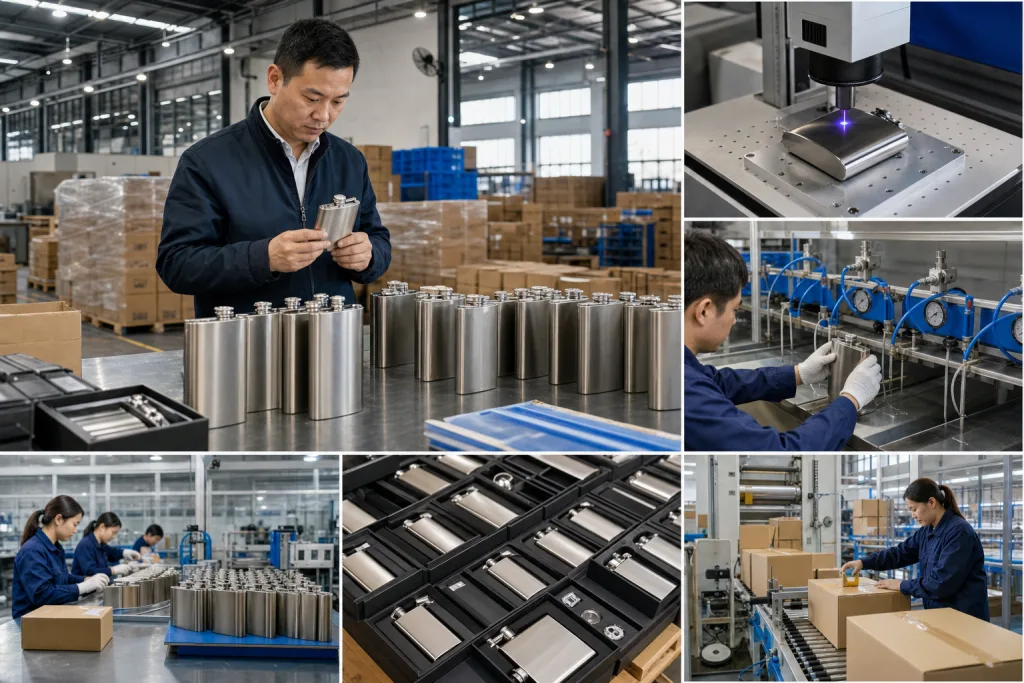
Most flask bodies are made by stamping and welding stainless steel sheets, then polishing or powder coating. The cap thread is a critical part. If the thread tolerance is loose, you get leakage. Too tight, and customers over-twist the cap. We normally check cap fit during inline QC, not only at final inspection; QC pulled one 6 oz sample last month because the go/no-go thread gauge caught a rough start on the second turn.
Ask your canteen manufacturer or flask supplier to define the base model before talking decoration. Capacity, steel grade, wall thickness in mm, cap type, surface finish, and packaging are the real specification. A logo file alone is not a purchase specification. Send the artwork, yes, but also lock the body code, carton quantity, drop-test requirement, and inspection level; the math does not work if those details change after we run the first polishing batch.
Checklist before you request pricing
Send a loose RFQ to ten canteen suppliers and you will get ten prices that do not line up. We see this every March. A USD 1.40 flask and a USD 2.20 flask can both be called “6 oz stainless steel,” but QC may pull the cheaper sample and find 0.38 mm body steel, a light cap, welding dust inside the mouth, and a 5-ply carton that crushes after one pallet stack.
Send these points in your first RFQ:
- Capacity: 3 oz, 5 oz, 6 oz, 8 oz, or custom volume; state the fill volume you expect, not just the catalog name.
- Material: 304 stainless steel for the inner contact surface; ask clearly if 201 is being quoted for the body or cap.
- Wall thickness: normally 0.45-0.55 mm for common promotional flasks; lower than this changes the hand feel fast.
- Finish: mirror polish, brushed, matte powder coat, rubber paint, or plated finish; send a Pantone code if color matters.
- Logo: laser engraving, silk screen, UV print, embossing, or metal badge; include logo size in mm and the artwork format.
- Packaging: polybag, white box, kraft box, color box, gift set, or PDQ tray; tell us if the carton must pass a drop test.
- Test requirement: LFGB, REACH, FDA food-contact, or customer-specific protocol; attach the protocol before sampling if you have one.
- Incoterm: FOB Ningbo or Shanghai, EXW Zhejiang, or DDP if you need landed costing; buyers often flag this only after the PI, which wastes 1-2 days.
For BottleForge Industrial in Zhejiang, our normal flask MOQ is 1,000 pcs for existing shapes and 3,000-5,000 pcs for special color coating or custom packaging. We run about 450,000 stainless drinkware units per month across flasks, bottles, tumblers, and canteen customizable projects. The line schedule matters. If your promotion has a fixed event date, asking for the lowest unit price first is the wrong question; the math does not work if a coating line slot pushes shipment from 12 days to 18 days.
Which material and finish matter?
Most buyers write “stainless steel” on the RFQ, but that line is too loose. For a custom made hip flask, 304 stainless steel is our safer default for food and beverage contact; we check incoming coil thickness with a digital micrometer before the line starts. Some low-cost quotes use 201 stainless steel. It can look clean in a photo, but the nickel content is lower and corrosion resistance drops. For a one-week giveaway, some buyers take that risk. For retail, hospitality, or brand merchandise, the math doesn't work. We have seen 201 flasks pass a desk review, then come back with rust spots after a salt-spray check.
Surface finish changes the defect rate fast. Mirror polish shows hairline scratches from normal handling, even when workers use cotton gloves. Brushed steel hides light marks and fits executive gifting better. Powder coating gives tighter color control, but we run a cross-hatch tape test on the coated shell before packing; if the tape lifts paint at the cut edge, QC pulls the sample. Plated finishes look premium, but fingerprint marks and color drift need approval samples from the same plating bath, not just a showroom piece.
If your range includes customizable drinkware, customizable canteen products, or a customized growler, set the finish standard before artwork approval. A matte black hip flask from one line and a matte black custom growler from another line can differ by 10-15% in gloss; our gloss meter has caught this on mixed gift programs more than once. Your end customer will notice when both items sit together in a catalog photo. Small mismatch. Big complaint.
Practical rule: approve one golden sample for color under agreed lighting, one sample marked with the exact logo position in mm, and one packed sample that has gone through normal carton handling. Do not rely on a single beauty sample that never touched mass production.
For Europe and North America, ask your canteen factory for food-contact declarations and migration test support. If the product ships in a gift set with cups and funnel, test the accessories too, not only the flask body. We had one buyer flag a funnel after inspection because the PO said “SS funnel” but the sample used plated iron; that typo cost 12 days on the delivery schedule.
How should branding be handled?
Branding on a curved flask body is less forgiving than on a straight bottle. A flat logo file can stretch once it wraps the front curve, and we catch that fast on a 2D proof before the plate is cut. A good canteen vendor should send a digital mockup with size, position, and printing method, then a physical pre-production sample before bulk production.
Laser engraving is the cleanest option for brushed or coated stainless steel. It will not peel, and it suits small MOQs because there is no screen plate cost. The trade-off is that laser color depends on the base coating and steel reaction. Silk screen works better for solid color logos, but very fine lines below 0.2 mm may fill in or break on a curved surface; on our line, QC pulled a sample with a phone number that disappeared after one rub test. UV print can handle multiple colors, but abrasion resistance needs to be checked before the flask goes to retail.
Embossing or debossing needs tooling and usually makes sense above 5,000 pcs. Metal badges can look premium, but they add adhesive risk and another inspection step. We have seen a badge shift 1.5 mm after hot-melt glue cooled, and the buyer flagged it on the spot. If you are building a long-term branded range, the tooling cost can make sense. If this is a one-off promotional run, keep the decoration simple.
For barcode, FNSKU, or retail label work, confirm whether the label goes on the unit box, master carton, or both. Many canteen vendors will print cartons, but not all handle Amazon-style carton labels cleanly. At the packing table, one typo on a PO can turn into a warehouse delay. If you ship to a distributor drinkware warehouse, carton marking accuracy affects receiving speed and chargebacks.
What price range is realistic?
For an existing 6 oz custom made hip flask from China, a realistic FOB price usually lands at USD 1.35 to USD 2.80 per unit, based on steel grade, cap build, surface finish, logo process, and packing. A plain brushed 304 flask in a white box sits near the lower-middle band. A powder-coated gift set with funnel, cups, molded insert, and color sleeve can pass USD 3.50. On our line, QC checks the body with a 0.01 mm digital caliper and weighs the bare flask; if the gauge is shaved too far, the price looks good on paper but the flask feels cheap in hand.
Be careful with quotes that come in 20-30% below the group average. We’ve seen this go sideways. The supplier may be using 201 stainless steel, thinner gauge, loose AQL, or a light export carton that collapses after one corner drop. Sometimes the quote leaves out logo setup, inner box, or inland freight to port. One buyer flagged a USD 0.18 gap last month; after we added the missing black gift box and Ningbo port trucking, the “cheap” offer was no longer cheap. China sourcing is the wrong place to chase the lowest FOB number only; the goods still need to arrive saleable.
Cost drivers you should check:
- Material grade and confirmed thickness, checked by caliper, not just written as 304 stainless on the PI.
- Cap type: standard screw cap or captive hinged cap, with thread fit checked after 20 open-close cycles.
- Decoration method and logo positions, because one laser mark is different from front-back UV print with a jig charge.
- Packaging weight, insert material, and carton strength; a 5-ply export carton costs more than a thin domestic carton for a reason.
- Inspection level: typical AQL 2.5 for major defects and 4.0 for minor defects, with leakage and scratch findings recorded by lot.
- Testing fees for LFGB, REACH, FDA, or client lab protocols, especially when the buyer’s PO has a lab name buried in the remarks line.
If you also source canteen customized bottles, custom canteen items, or distributor growler programs, consolidate packing materials where the sizes allow it. We run the same kraft board, carton size logic, and print supplier across 6-8 customized drinkware SKUs when possible, and that cuts back-and-forth on dielines. It also shortens approval time by 3-5 days. Small detail, big headache saver: one carton mark typo on a PO can hold a shipment while the warehouse waits for reprinted labels.
How do sampling and QC work?
Sampling should answer engineering questions, not just make a nice photo. For an existing flask shape, allow 7-14 days for a logo sample after artwork confirmation. For a new mold, special embossing, or unusual cap structure, sample development can take 20-35 days. If a canteen supplier promises a fully custom flask sample in three days, ask what is actually custom. This is the wrong question to ask if you only check the logo position; we also check cap fit with a 0.10 mm feeler gauge and confirm the body curve after stamping.
At BottleForge in Zhejiang, we normally separate the approval process into blank sample, logo sample, and packed sample when the order is retail-facing. The packed sample matters because around 6 out of 10 flask complaints we see are packaging-related: crushed corners, scratched coating from loose accessories, or funnel marks on the body during transit. Small problem. Big claim. Last year, one buyer flagged a black gift box because the funnel rubbed through the PE bag and left a half-moon mark on the coating.
Production QC should include incoming steel check, stamping inspection, weld and polish review, leak testing, decoration inspection, and final AQL inspection. For leakage, we recommend 100% water or air pressure check on flask bodies before packing. Random checks alone are not enough because one bad thread can ruin the user experience. On the line, QC pulled the sample after a 0.3 mm thread burr caused slow seepage during a 15-minute upside-down test.
For North American buyers, also think about ASTM-related packaging expectations if the product is sold near children, even if a hip flask is an adult item. For EU buyers, REACH and food-contact paperwork should be requested before shipment, not after customs asks. Good canteen manufacturers keep batch records, artwork approvals, and inspection photos tied to your PO number. We ship faster when the PO is clean; one typo in the SKU or finish code can cost 2 days while the merchandiser, mold room, and packing team recheck the file.
How to choose the supplier
A good canteen manufacturer or flask factory will push back when the spec is thin. Good sign. If every reply is “yes, no problem,” you may be talking to a trading desk that never checked the drawing with the stamping line. For custom drinkware, especially 5 oz to 8 oz metal flasks with screw caps, small details decide the reject rate: mouth inner diameter in mm, cap thread fit, weld mark position, and whether the PU leather wrap covers the seam cleanly. QC pulled one sample last month because the cap gasket was 0.3 mm loose. That is where orders go sideways.
Ask straight: are you a real canteen factory, a canteen vendor with partner factories, or a pure trading company? None is automatically a problem. Hiding the role is the problem. A capable canteen vendor can run several categories well, including custom made hip flask, customized canteen, and customizable growler orders, if they control sampling and inspection instead of only forwarding WeChat photos. You still need factory audit reports, BSCI or ISO documents if required, and clear QC responsibility written on the PI. We have seen buyers flag this after deposit payment, and by then the math does not work.
For repeat distributor canteen programs, choose a supplier who can hold the same steel grade, cap source, color standard, and carton layout for at least 12 months. Ask for the steel purchase record and a retained color panel, not just a nice quotation sheet. Changing subcontractors every order may save USD 0.05 per piece but can leave you with 3 carton styles and two shades of gunmetal on the same shelf. If you serve multiple canteen distributors, stable supply beats a one-time cheap quote. The line remembers specs better when the same jig and cap supplier stay in use.
China remains strong for stainless steel drinkware because the supply chain is tight around Zhejiang: sheet metal, polishing, coating, printing, packaging, and Ningbo or Shanghai export logistics sit within workable trucking distance. Use that advantage, but lock it down. Written specs, signed samples, AQL inspection, and payment terms tied to shipment documents should be normal, not special requests. We ship from Hangzhou to Ningbo in about 3.5 hours when traffic is clean, and one typo on a PO, such as “matte black” instead of “sand black,” can cost more than the freight.
Send your flask specification for a factory quote
Share capacity, logo method, packaging, MOQ, and destination. We will return practical FOB pricing and sample timing from Zhejiang.
Frequently asked questions
What is the usual MOQ for a custom made hip flask?
For existing flask shapes, a practical MOQ is usually 1,000 pcs with laser engraving or one-color printing. If you need powder coating in a custom Pantone color, retail gift box, or set packaging, expect 3,000 pcs. For a new mold, embossed body, or special cap, 5,000 pcs is more realistic because tooling, setup, and line change costs need to be spread across enough units. Some suppliers will offer 500 pcs, but you may pay 15-30% more and have fewer finish choices.
Can one supplier handle flasks, canteens, and growlers together?
Yes, if the supplier has a real stainless drinkware supply chain and not only one flask workshop. A capable canteen manufacturer can usually manage a custom made hip flask, custom canteen, and custom growler program together, but you should still approve each item separately. Wall thickness, coating adhesion, cap leak rate, and carton testing are different across categories. For a distributor drinkware range, ask for a shared color standard and packaging specification so the hip flask, customized growler, and canteen customizable items look like one family.
Which logo method is best for a curved hip flask?
Laser engraving is usually the safest for curved stainless steel because it is durable and has low setup cost. It works well for logos from 20 mm to 60 mm wide, depending on the flask size. Silk screen is good for bold one-color artwork, but very thin strokes below 0.2 mm can distort or break. UV printing handles multi-color artwork, but you should request abrasion testing. For premium orders above 5,000 pcs, embossing or debossing can work, but tooling cost and sample time increase.
What compliance documents should I request?
For Europe, request food-contact support such as LFGB or EU framework regulation documentation, plus REACH for coating or painted surfaces where relevant. For North America, ask for FDA food-contact support and any customer-specific restricted substance requirements. If the flask is sold as part of a gift set, include the funnel, cups, coating, and packaging inks in your compliance review. Do not wait until goods reach the port. Ask your canteen supplier for test reports or material declarations before deposit payment, then confirm batch traceability before shipment.
How long does a bulk order take from China?
For an existing model with standard finish, plan 7-14 days for sampling and 30-45 days for mass production after sample and artwork approval. Custom color coating, gift sets, or new tooling can push the timeline to 55-70 days before sea freight. Add shipping time separately: roughly 25-35 days to many North American ports and 30-40 days to many European destinations by sea, depending on routing. If you have a fixed promotion date, confirm the production slot before issuing the PO.