Key Takeaways
- 304 stainless steel custom growlers usually need 1,000-3,000 pcs MOQ and 35-50 days production after sample approval
- Glass fits premium table-service branding but adds 8-15% higher breakage risk in parcel-heavy distribution
- Single-wall plastic can be cost-effective below USD 4.00 FOB, but it is not the right answer for hot fill or long insulation claims
- AQL 2.5/4.0 inspection, REACH/LFGB checks, and 100% leak testing should be written into the PO
A custom made growler can look straightforward on the first spec sheet: 64 oz, one Pantone color, one logo, one carton, one ship date. Then the quote lands with three materials, four lid systems, and a USD 2.80 unit spread that no one can explain. That spread is margin, not decoration. On our line, QC pulled the sample to the torque tester and the cap choice changed the whole stack.
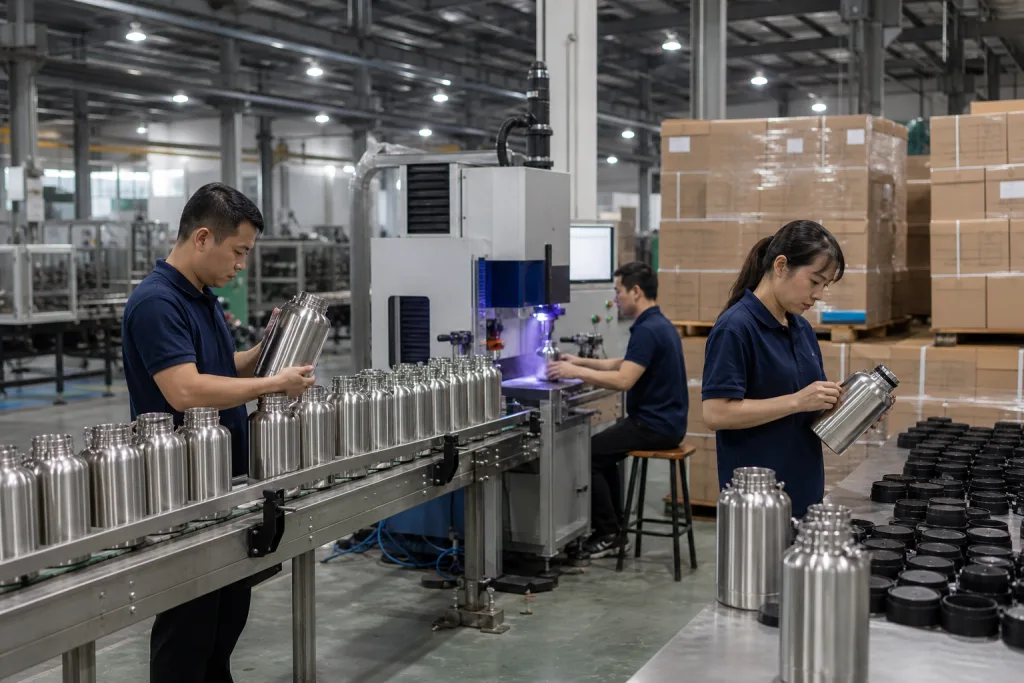
From our Zhejiang factory floor, the projects that ship cleanly are decided by use case before artwork. A brewery refill program, an outdoor retail line, and a canteen promo run should not share the same 0.8 mm wall, brushed finish, or leak test. If a buyer asks for one universal spec, that is the wrong question to ask. We run head-to-head samples, check the seam at 12 points, and make the call before the PO goes out.
The spec table buyers actually need
Custom drinkware quotes get messy fast because factories often start from different baselines. We see this on RFQs every week. One canteen manufacturer quotes 18/8 stainless with 70μm powder coating, while another canteen supplier prices thinner 201 stainless with a painted finish and a lighter cap. Both lines say “custom growler,” but QC will not treat them the same when the caliper shows a 0.45 mm body instead of 0.60 mm.
Build the comparison table before you ask for final pricing. The cheapest FOB line is often the trap. Last month a buyer flagged a USD 0.38 gap, but the lower quote used a 5-ply export carton instead of 7-ply, so the math failed after the 1.2 m drop test.
| Option | Typical capacity | Best use case | FOB range | Main risk |
|---|---|---|---|---|
| Stainless steel vacuum growler | 32 oz / 64 oz | Outdoor retail, beer refill programs, distributor growler orders with logo work | USD 7.20-13.80 | Higher tooling and coating cost, plus color drift if the line runs two powder batches |
| Single-wall stainless growler | 40 oz / 64 oz | Cold refill, event merchandise, short-run promo orders above 1,000 pcs | USD 4.80-8.50 | Denting and condensation, often caught when QC pulled the sample from the bottom tray |
| Glass growler | 500 ml / 1 L / 2 L | Brewery table service and gift sets where weight feels acceptable | USD 2.60-6.20 | Breakage and carton strength, especially if the PO forgets inner dividers |
| Tritan or PP growler | 32 oz / 1 L | Canteen promotional orders, sports channels, low-weight shipping projects | USD 2.10-4.80 | Heat limit and scratch visibility after logo handling on the packing line |
For a custom made growler, “steel versus glass” is the wrong question to ask. Ask where the product will be used, who refills it, and whether it ships by courier carton or full container. A distributor drinkware buyer selling to 30 breweries needs a different spec from a canteen distributor supplying schools or outdoor clubs. Start with the channel, then choose material. We run the sample that way because one missed cap thread measurement, even 0.2 mm off, can turn into returns after the first refill.
Stainless steel versus glass
Stainless steel wins when you need durability, insulation, and a lower damage rate through wholesale distribution. A 64 oz vacuum insulated customized growler usually runs 304 stainless steel inside, 201 or 304 outside, and a wall thickness around 0.45-0.55 mm before forming. For higher-end retail, we push 304 inside and outside, especially for acidic drinks and repeat washing. QC checked a bead-roll gauge at 0.5 mm on the line last week.
Glass wins when the buyer wants clarity, a brewery look, or a low unit cost for local refill use. It gives strong perceived value when the decoration is simple: one-color silk screen, embossed swing tag, or a printed kraft gift box. The wrong question is the bottle cost; the carton and divider cost the case. A buyer flagged a PO typo on the glass grade last month, and the real fix was a stronger carton spec. If your vendors ship one unit at a time through parcel networks, ask for a drop test protocol and better dividers. A nice bottle in a weak carton turns into a claims file.
For stainless custom growler projects, insulation gets oversold. A good vacuum growler should keep cold water below 10°C for roughly 18-24 hours under a 25°C room test, depending on lid design and fill volume. Hot retention is shorter for wide-mouth growlers than for narrow thermos bottles. QC pulled the sample with a laser thermometer at 25°C, and the hinge area leaked first. If a factory claims 48 hours hot for every size, ask for the test method, water start temperature, ambient temperature, and report photos.
Our practical advice from Zhejiang: choose stainless steel for distributor growler programs crossing three warehouses, and choose glass only when your channel controls handling closely. We have seen this go sideways on a loose pallet wrap job.
This is where an experienced drinkware factory or manufacturer earns its margin. The right supplier will challenge the brief instead of simply accepting a risky spec. If the drawing calls out 0.45 mm but the forming line loses 0.03 mm at the shoulder, we say so before tooling.
Plastic and Tritan use-case fit
Plastic growlers have a place, but the claim needs to stay honest. Tritan, PP, and PE work for lightweight outdoor promotions, gym packs, and canteen promo programs where the buyer wants capacity, low unit weight, and a large logo panel. They are the wrong pick for beer carbonation pressure unless the body, cap thread, gasket, and burst test were designed around that load. We have had buyers ask for a “cheap plastic beer growler” after seeing a 64 oz shape; the math doesn’t work unless the test standard is built into the project from day one.
For a custom canteen or customizable canteen line, Tritan is usually the cleaner B2B choice because it gives better clarity and drop resistance than basic PP. North American buyers often ask for BPA-free declarations, FDA food contact compliance, and sometimes California Proposition 65 review. European buyers ask for LFGB, EU 10/2011, and REACH-related documentation. If the product touches drinks, certificates cannot sit at the end of the job like a missing carton mark. QC pulled one sample last season where the material code on the base said “PC,” while the PO said Tritan; the buyer flagged it before we even discussed color.
The trade-off is simple. Plastic cuts freight cost, reduces breakage, and speeds color matching at volume. It also scratches faster, has temperature limits, and looks cheap when the cap, hinge, or handle is underbuilt. A 1 L plastic customized canteen with a weak hinge feels like a giveaway item, even if the logo print passes tape test. We run hinge cycling with a basic fixture on risky cap designs, and 0.3 mm extra wall thickness at the handle boss can be the difference between a clean sample and a cracked one.
MOQ depends on mold status. For existing Tritan growler molds, a canteen supplier in China may accept 2,000 pcs for one color. For custom molds, expect USD 3,000-12,000 tooling and 30-45 days mold development before mass production. At BottleForge Industrial in Hangzhou, Zhejiang, our monthly drinkware capacity is about 600,000 units across stainless bottles, tumblers, and related custom drinkware, so every quote separates prototype timing from bulk production timing. The line can ship bulk fast, but a new mold with texture, volume marks, and a leak-proof cap still needs T1 sampling, correction, and a proper pre-production sign-off.
Logo methods in real production
Decoration is where 7 out of 10 custom made growler projects start drifting. A buyer writes “logo printed” on the PO, then QC pulls the sample and finds the logo crossing a shoulder radius, the powder coat failing cross-hatch tape test, or the Pantone shifting after 180°C oven curing. Choose the branding method by surface, order quantity, and how the customer will wash it. That is the real question.
For stainless steel, laser engraving is durable and clean, especially on brushed or powder-coated surfaces. It is the wrong choice for full-color artwork. Silk screen works for one or two colors on a straight body, with typical setup around USD 40-80 per color; we run a curved jig when the body tolerance stays within about 1.5 mm. Heat transfer and water transfer can carry detailed graphics, but they need abrasion testing and careful edge placement, because a 3 mm lift at the seam will get flagged fast. For premium customizable drinkware, powder coating plus laser engraving is still one of the safest combinations.
For glass, screen printing and decal firing are common. Firing gives better durability but adds cost and can move sampling from 7 days to 12 days, depending on the kiln schedule. For plastic, pad printing, silk screen, in-mold color, or sleeves depend on the shape and draft angle; our pad-printing technician checks the silicone pad mark before we approve mass production. If you sell through retail, confirm barcode area, FNSKU placement if applicable, and carton labeling before sample approval. Artwork mistakes at 5,000 pcs are expensive and boring to fix.
- Low MOQ branding: laser logo or one-color silk screen, usually from 500-1,000 pcs depending on item; the buyer should confirm logo height in mm before we make the screen.
- Retail shelf branding: powder coating, printed box, hang tag placement, and warning label alignment, with carton marks checked against the shipping instruction.
- Distributor canteen programs: simple logo placement, repeatable color within approved sample range, and fast replenishment when the next PO only changes the school name.
A good canteen vendor should provide a print position drawing, not just a photo. Sign off on size in millimeters, not “looks good.” We have seen this go sideways over a 6 mm logo shift.
Lids, sealing, and failure points
The lid looks like a 20-cent part on too many customized growler projects, then becomes the claim that eats the margin. We see buyers spend 40 minutes approving the bottle body because the logo sits there, while the cap gets one line on the PO. Wrong focus. Customers do not complain about the brushed finish first; they complain about leaks, snapped handles, gasket odor, cross-threading, and caps with corners that a bottle brush cannot reach. QC pulled one sample last year with a 0.6 mm burr on the thread start, and that was enough to make the cap bite.
For stainless vacuum growlers, common lid choices include screw caps with silicone gasket, flip handles, straw-compatible caps, and wide-mouth caps with a small drinking port. For brewery use, a plain screw cap is often safer than a cap with five separate parts, two pins, and a hidden spring. Fewer parts mean fewer assembly mistakes on the line. If the growler will hold carbonated drinks, ask whether the lid is designed for pressure and whether the supplier has run pressure or leakage testing. Do not assume every growler is safe for carbonation. The math does not work if a 3,000 pcs order saves USD 0.18 per lid but creates 90 leaking units after filling.
For glass growlers, swing-top closures look good in photos, but the wire gauge, gasket compression, and neck tolerance need checking with calipers, not guesswork. A 0.4 mm change in glass neck diameter can weaken the seal. For plastic custom canteen models, inspect hinge pins and gasket material before mass production starts. Silicone is usually preferred for food contact gaskets; TPE may be used, but confirm odor and migration test results. We have seen this go sideways when the buyer approved a black gasket from photos and flagged a rubber smell only after the first 12 cartons arrived.
Our standard recommendation is 100% leak testing for growlers before packing, plus an AQL final inspection. We run the leak test at the packing bench with water fill, cap torque check, and an inverted hold; if the spec says 30 seconds, write 30 seconds. B2B orders often use AQL 2.5 for major defects and 4.0 for minor defects, but leakage is usually treated as a critical defect. Write that into the purchase order. In China, disputes often start because the buyer thought the test was included, and the factory thought the buyer did not want to pay the extra 12 minutes per carton.
Pricing, MOQ, and lead time
FOB price only means something when the quote sheet shows the build. A stainless steel custom made growler at USD 8.10 and another at USD 9.40 may look close, but the second quote may include 304 outer steel, powder coating, individual box, thicker carton, and 100% leak testing. We had one buyer flag a USD 1.30 gap, then QC pulled the sample and found the cheaper unit had a thinner carton and no air-pressure leak test. Big difference. The cheaper quote may work for a giveaway, not for a retail shelf product with returns.
As a practical reference, existing-mold stainless growlers usually start at 1,000 pcs per design for simple logo work. Color coating often pushes the MOQ to 2,000-3,000 pcs per color because the powder coating line wastes time and paint on tiny batches. We run better when one color fills the rack, not when 300 pcs in matte black stop the line for a wash-down. Glass growlers can sometimes start at 1,000-2,000 pcs if the bottle is standard and decoration is simple. Plastic customizable canteen projects can start around 2,000 pcs using an existing mold, while full custom tooling needs a larger forecast or the math does not work.
Lead time should be split into three parts: pre-production sample, mass production, and inspection/shipping. A normal stainless customized drinkware schedule is 7-12 days for digital mockup and sample arrangement, 35-50 days for mass production after approval, and 3-7 days for final inspection and export paperwork. Sample first. We usually check logo position with a caliper in mm before the buyer signs the artwork, because one 5 mm shift near the handle can make the whole growler look off. During Q3, add buffer. That is when roughly 6 out of 10 North American and European importers are pushing holiday orders through China at the same time.
Payment terms also matter. Around 8 out of 10 China suppliers we deal with use 30% deposit and 70% before shipment. For repeat canteen distributors with stable forecasts, negotiated terms may be possible, but new buyers should expect standard terms until order history is built. We have seen this go sideways when a PO had the bank name spelled wrong and the deposit sat for 4 days, then the buyer still asked us to keep the original ship date.
How to choose your version
If your product sits on a retail shelf at USD 24.99-39.99, we would run a stainless vacuum customizable growler: 304 stainless inside, powder coating around 70-90 μm, laser engraving checked against the logo file, and a screw cap that passes an inverted leak test after filling. For a local brewery refill program with staff handling the bottle, glass can make sense because customers know the feel and the landed cost stays lower. Different job. If the brief is a sports event or school program, a lightweight customized canteen or plastic growler may be enough, but do not promise insulation it cannot deliver. Buyers push back on that claim fast.
The supplier type should match the order. A trading company can bundle mixed SKUs, but a direct canteen factory gives you tighter control over steel grade, coating adhesion, leak testing, and repeat runs. Large canteen manufacturers often resist a 500 pcs MOQ color trial; smaller canteen suppliers can move faster, but their test reports and carton drop records may be thin. Ask for the last inspection report format, not only product photos. QC pulled one sample for us last month where the PO said 304 stainless, but the spec sheet still showed 201. That goes sideways.
For Europe, confirm LFGB or EU food contact needs before sampling, not after the mold charge is paid. For North America, confirm FDA food contact expectations, CPSIA only if children’s use is involved, plus the retailer’s packaging rules. If you sell through marketplaces, decide FNSKU labels, master carton marks, and polybag warnings before mass packing. We print carton marks on a 48 x 36 x 28 cm master carton template before the line starts packing. Boring detail. It saves rework.
The cheapest line on a spreadsheet is often the wrong question to ask. Choose the version that fits your channel, survives transport, passes inspection, and can be reordered next season without changing the body, lid, artwork position, or carton pack method.
Send us your growler brief for a practical quote
Share capacity, material, logo, target FOB, and delivery market. We will recommend a build that fits your channel and MOQ.
Frequently asked questions
What is the normal MOQ for a custom made growler?
For existing stainless steel molds, MOQ is usually 1,000 pcs for laser logo or simple silk screen. Powder-coated colors often require 2,000-3,000 pcs per color because coating lines need efficient batch volume. Glass growlers usually start around 1,000-2,000 pcs if the mold is standard. Plastic or Tritan growlers often start at 2,000 pcs. If you need a unique shape, handle, or lid, custom tooling can add USD 3,000-15,000 and should be supported by a realistic annual forecast.
Which material is best for a distributor growler program?
For broad distributor growler programs, stainless steel is usually the safest choice because it tolerates warehouse handling and parcel shipping better than glass. A 64 oz stainless vacuum growler costs more upfront, often USD 7.20-13.80 FOB depending on finish, but it reduces breakage claims. Glass works well for brewery-controlled local distribution, especially if cartons are strong and the product is not shipped individually. Plastic is suitable for lightweight promotional campaigns, not premium insulation or carbonation claims.
Can I use the same design for beer, water, and coffee?
Not always. Water is the easiest use case. Coffee needs food-safe coating, odor control, and a lid that can be cleaned properly. Beer adds pressure questions if it is carbonated. Many growlers are marketed for beer style use, but not every lid is designed for pressure retention. Before approving a customized growler, ask the canteen manufacturer for leak testing, pressure guidance, gasket material, and care instructions. For hot liquids, confirm insulation test results and external surface temperature.
How long does a custom growler order take from China?
For an existing mold with standard decoration, plan 7-12 days for sample or pre-production approval and 35-50 days for mass production after approval. Add 3-7 days for inspection, packing confirmation, and export documents. Sea freight to North America or Europe can add several weeks depending on port and season. If you need custom tooling, add 30-45 days for mold work before the normal production clock starts. Q3 orders should include extra buffer.
What quality checks should be required before shipment?
At minimum, require material confirmation, logo position check, color comparison, 100% leak testing for assembled growlers, and final inspection under AQL. Many B2B buyers use AQL 2.5 for major defects and 4.0 for minor defects, while leakage is treated as critical. For Europe, ask about LFGB, EU 10/2011, or REACH-related documents as applicable. For North America, request FDA food contact support where needed. Also check carton drop strength if products ship through parcel networks.