Key Takeaways
- A 64 oz custom made growler bottle usually needs MOQ 500 pcs and 25-35 days production, not a fast retail turnaround.
- For stainless vacuum builds, 304 steel with 0.5 mm walls is the safe default; go to 316 only when the use case justifies the cost.
- Ask for AQL 2.5 major and 4.0 minor, plus leak and drop tests, before you approve mass production.
- A Zhejiang canteen factory with 600,000 units/month capacity can still miss your launch if artwork, carton marks, or FNSKU data are not final.
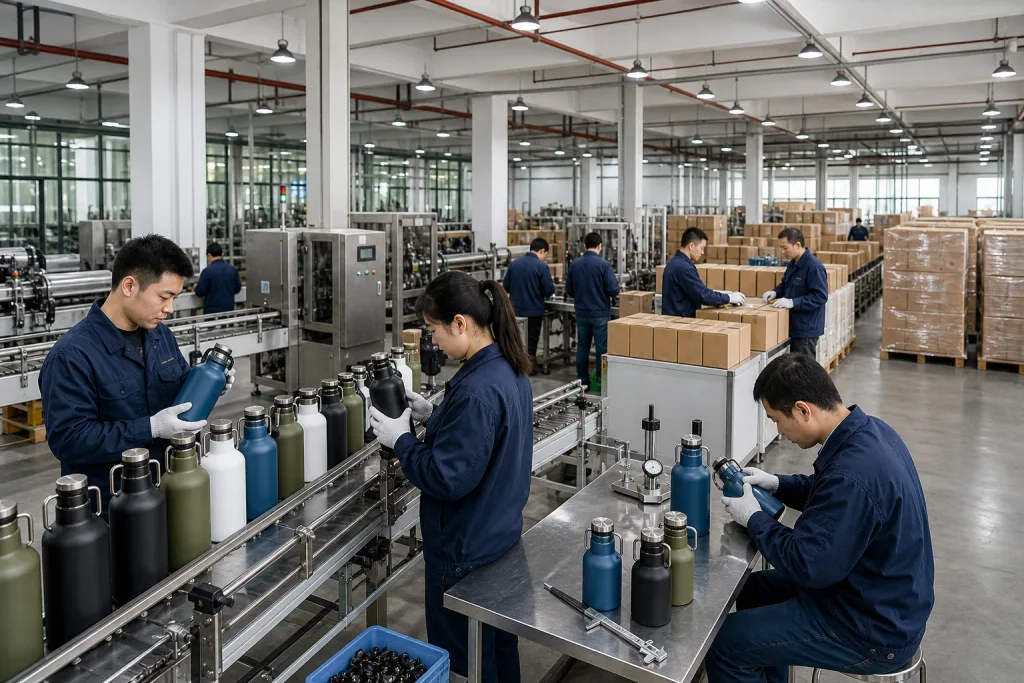
A custom made growler bottle looks simple until you place 1,000 pieces for retail, hotel service, or a distributor drinkware program. Then small specs start costing money: cap leakage after a 1-meter drop, coating rub marks after a 12 kg carton compression check, and margin loss after logo, inner box, and master carton are added. We see this often. If you are sourcing custom drinkware or building a wider canteen custom line, treat the growler as a technical item with drawings, test points, and approval samples, not as a cheap gift product.
From Zhejiang to other production bases in China, the better canteen factory teams will ask direct questions before quoting: liquid type, filling temperature, shelf-life target, logo process, compliance file, and carton drop standard. On our line, QC pulled one 64 oz sample last month because the lid gasket was 0.4 mm off and the buyer flagged seepage during a tilted shelf test. A good custom growler is not just a container. It is a controlled spec with a clear MOQ, workable lead time, and a packaging plan your canteen distributor, canteen supplier, or retailer can move through the channel without rework.
What job should the growler do?
Start with the job, not the decoration. A custom made growler bottle for craft beer distribution is a different build from a branded water vessel for outdoor retail. If it carries carbonated liquid, the lid seal and thread tolerance beat the logo every time; on the line we check the thread with a go/no-go gauge and reject caps that feel loose after one twist. If it is for cold brew, insulation and mouth opening matter because buyers will ask whether ice cubes fit without scraping the rim. For a distributor growler program, the bottle has to stack cleanly, survive freight, and stay inside the retail price band your channel can absorb. Ask this first. The artwork can wait.
For most B2B buyers, the useful starting point is 32 oz, 64 oz, or 128 oz. A 64 oz size is the sweet spot for about 7 out of 10 custom drinkware programs we see because it gives shelf value without making the master carton awkward. We usually check carton height, gross weight, and pallet count before talking about finish; a 64 oz growler packed 12 pcs per carton can look good on paper until the freight math breaks. If your line also includes a custom canteen or customizable canteen range, keep the growler close to those specs so tooling, closures, and packaging logic stay consistent.
- Ask first: still beverage or carbonated beverage?
- Set volume: 32 oz, 64 oz, or 128 oz.
- Set sales channel: retail with barcode packing, hospitality replenishment, promotional giveaway, or distributor canteen program.
- Define use conditions: dishwasher cycle claim, ice retention target, outdoor handling, or shelf display with gift box.
A canteen manufacturer in China will quote differently once you specify these points. In Zhejiang, the better factories do not guess. We map the product to the channel, then tell you what works on cost and lead time; last month QC pulled a sample because the buyer’s PO said “matte black” but the approved sample was powder-coated charcoal. That small typo added 3 days. We’ve seen this go sideways when buyers ask for the cheapest growler before defining the liquid, cap, and channel. The math doesn’t work.
Which build spec protects your margin?
The cheapest quote is the one that cuts the parts you pay for later. For a stainless steel custom growler, 304 stainless is the standard base. Go to 316 only when the use case needs extra corrosion resistance and the buyer accepts the step-up, which is often 15% to 25% on our side. On the line, we check 0.5 mm shell stock with a digital micrometer; 0.4 mm rolls can pass a visual check, but QC pulled the sample and it picked up dents after a 1 m carton drop. For retail shelves, 0.6 mm gives a firmer hand feel.
Single-wall stainless is cheaper and lighter, and it works for non-insulated drinkware. It is not the same product as a vacuum insulated growler, so the claim has to match the structure. If your buyer wants customized growler performance, spell out the insulation claim on the PO and artwork before we print. We stopped one job after the buyer flagged a PO that said "thermal" while the sample was single-wall 18/8; that kind of mix-up would have caused trouble at carton check. This is the wrong question to ask if the spec sheet is still vague.
Checklist for build decisions
- Material: 304 stainless steel for normal use, 316 when the customer needs stronger corrosion resistance
- Wall thickness: 0.4 mm for budget jobs, 0.5 mm for standard vacuum builds, 0.6 mm for a firmer retail feel
- Structure: single-wall or double-wall vacuum, matched to the claim on the artwork and PO
- Finish: matte powder coat, gloss, brushed, or bare steel, with the coating spec locked before sampling
- Target price: FOB China often lands around USD 4.80 to 8.60 depending on spec and decoration
A serious growler factory should send a costed BOM, not a headline number. Ask for body tube, lid, gasket, print, carton, and insert counts. On one order, a typo on the PO changed "black matte" to "black mate", and the art room caught it before the line ran 3,000 pcs. That is how you compare growler suppliers fairly and avoid a quote that only works before packaging and freight. If the numbers do not tie out on the packing table, the math does not work.
What lid and seal details matter most?
Most leak complaints start at the closure, not the body. For a custom made growler bottle, the lid has to match the thread finish, gasket material, and drink type. We run screw caps with food-grade silicone gaskets as the standard baseline. For carbonated liquid, we ask the tooling room to check thread pitch with a plug gauge before sampling, then pressure-test repeated open-close cycles. One sample fill means little. We have seen a cap pass on Monday, then leak after 30 twists on the buyer’s counter.
Ask your canteen manufacturer to confirm the gasket material, usually food-grade silicone, and whether contact parts meet FDA, LFGB, or REACH expectations for your destination market. For Europe, REACH and LFGB documents carry more weight than a loose “food safe” line on a quotation. For North America, buyers often ask for traceable material declarations and test reports tied to the exact production lot. QC pulled one sample last year because the PO said FDA, but the gasket supplier file only showed a general silicone sheet report.
Good closure design is boring. That is the point. If the cap looks clever but leaks in the carton, you bought a claim, not a bottle.
Check the following before sample approval:
- Thread fit with no cross-threading after 20 open-close turns
- Leak test at 1 meter drop and inverted hold for 30 minutes
- Torque consistency across 10 sample units, checked with a torque meter
- Replacement gasket availability for after-sales, packed by SKU code
- Dishwasher compatibility if your channel demands it, not just “hand wash recommended” on the insert
If you sell as customized drinkware or customized canteen across multiple SKUs, keep the cap system as standard as possible. This is where buyers sometimes ask the wrong question; a fresh cap shape for every size looks nice in a catalog, but the math does not work once spare parts hit the distributor shelf. One closure platform across a canteen custom line cuts mix-ups, especially when we ship 3,000 units now and gaskets six months later for your distributor canteen network.
How should the branding be applied?
Decoration changes both piece cost and service life. For a custom made growler bottle, we usually quote four routes: silk screen printing for 1–2 color logos, laser engraving on 304 stainless, heat transfer for full-color artwork, or powder coat with a reserved logo window. Each fails in a different way. Silk screen can scratch at carton rub points if the ink layer is thin. Laser is clean and lasts, but the buyer sometimes flags it as “too workshop” for gift retail. Powder coat with print looks shelf-ready, but the line has to control color against the Pantone chip and cure time in the oven, usually around 180–200°C depending on the powder.
If you are buying canteen customized items for retail, match the decoration to the sales channel, not the design team’s favorite mockup. This is the wrong question to ask: “Which logo method looks best on screen?” A canteen promotional order of 3,000 pcs may accept a single-color silk screen to protect price, while a premium distributor drinkware program often needs a tougher coating, a barcode panel, and a packed presentation box. We had one PO where the buyer wrote PMS 186C in the email and 185C on the artwork file; QC pulled the pre-production sample before bulk print, or 4,800 bottles would have shipped in the wrong red. If the same canteen distributor also handles bottles and tumblers, require one Pantone tolerance standard across the line.
- Simple logo, large quantity: silk screen usually wins when the artwork has flat colors and the order is 1,000 pcs or above
- Long wear and premium look: laser engraving, or laser after coating if the brand wants a sharper contrast
- Retail shelf impact: full-color wrap for complex graphics, or powder coat with a logo window for cleaner display photos
- Marketplace selling: reserve a clean panel for barcode or FNSKU labels, at least 35 mm wide so the scanner reads it
A good canteen supplier will also tell you where the decoration should not go. Curved shoulders, weld seams, and high-wear contact zones can ruin artwork fast. We run a tape test and a simple carton-rub check during sampling; if the logo sits 8 mm from the bottom edge, the math doesn't work after sea freight vibration. On a customized growler, the smartest logo is often the one that survives carton rub, not the one that wins a mockup review.
What should you verify before mass production?
This is where procurement earns its keep. A canteen factory in Zhejiang can show polished samples and still miss your ship date if the control points are loose. Before the PO, ask for a written sample approval sheet, signed artwork, carton spec, and inspection standard. We run into this often: the buyer approves a 64oz growler sample, then the PO says “matte black” but the artwork file says “satin black.” That one-word mismatch can stop the line for 2 days. A factory with 600,000 units per month capacity is useful only when your order is slotted correctly and the spec is frozen.
For export, ask for ISO 9001 if available, and check whether the plant can support BSCI if your retail customer asks for social compliance. For product quality, request incoming material checks, in-process leak testing, and final inspection using AQL 2.5 for major defects and 4.0 for minor defects. QC should pull samples from the line, not from a showroom shelf; for growler bottles, we usually check mouth diameter, lid thread fit, vacuum performance, and 24-hour leak results after shaking. If the order goes to the EU, ask for REACH documentation and any relevant LFGB or migration test reports. If the product will be shipped as Amazon FBA drinkware, carton labels and FNSKU placement need approval before packing starts, because relabeling 3,000 cartons after sealing is where the math does not work.
Factory questions that save money later
- What is the MOQ per color and per logo? Often 500 pcs per SKU, but powder coating may need 1,000 pcs if the color is custom mixed.
- What is the sample lead time? Usually 7 to 10 days, or 12 days if laser logo, color spraying, and retail box proofing are all included.
- What is mass production lead time? Commonly 25 to 35 days after approval; ask whether that means after deposit, artwork sign-off, or golden sample approval.
- Can you share drop test, leak test, and carton compression data? A serious factory should have test photos, carton kg data, and the actual test date.
- Will you support spare lids at 1% to 2% of order quantity? Buyers flag this late, and spare lids are cheaper to run with the main order than as a small rework batch.
If your canteen manufacturers cannot answer these points clearly, you are not comparing suppliers. You are comparing sales language. We have seen this go sideways: one buyer saved USD 0.18 per unit, then paid more than that replacing dented cartons and missing silicone gaskets after inspection.
How do you send a clean RFQ?
A clean RFQ gives us a quote we can build from, not a puzzle for sales to guess at. For custom drinkware, send one page with capacity in ml or oz, body diameter in mm, 304 stainless or other material, lid type, finish, logo size, carton count, and target market. Add photos or a simple sketch showing the logo position; even a phone photo with a 30 mm mark-up is better than “same as picture.” If you need a custom canteen or customized drinkware family, say whether the growler must match the rest of the range in color, shoulder shape, cap color, and retail box artwork. We’ve seen tooling go sideways because the buyer approved a 64 oz growler body, then later asked it to sit visually next to a 32 oz canteen from another line.
Buyers often ask a canteen vendor for “best price” with no packaging data. This is the wrong question to ask. You need unit carton dimensions, master carton count, pallet height limit, and whether the shipment is FOB Ningbo, FOB Shanghai, or delivered to a China forwarder. A 12 kg master carton and an 18 kg master carton do not quote the same, and the freight math changes fast. If you sell through a distributor canteen program, ask the factory to confirm outer carton strength and whether the master carton survives ASTM D4169 style handling or equivalent drop testing. Last month QC pulled a sample carton after a corner crush finding, and the buyer flagged it because their warehouse rejects boxes with more than 8 mm deformation.
- Product spec: capacity, steel grade, wall thickness in mm, finish, lid structure
- Decoration: logo file, Pantone number, print area, laser or screen print method
- Compliance: FDA, REACH, LFGB, BSCI if needed
- Packing: gift box, master carton, barcode, FNSKU, inner bag requirement
- Commercial terms: MOQ, unit price, sample cost, lead time, payment term
When you compare canteen suppliers in China or Zhejiang, do not stop at the unit price. Ask whether the factory can repeat the same customized canteen spec for three reorder cycles, including the same powder coating gloss, logo position tolerance, and lid gasket fit. That is the real test of a canteen manufacturer. We run a first-piece check on the line with calipers before mass production, because a 2 mm logo shift looks small in the workshop but looks sloppy on a retail shelf.
Send your growler spec and get a real quote
We will check MOQ, structure, decoration, and packing before you waste time on a sample that cannot ship.
Frequently asked questions
What MOQ should I expect for a custom made growler bottle?
For most stainless custom made growler bottle programs, expect 500 pcs per SKU as a normal starting MOQ. If you want two colors and two logo positions, some canteen manufacturers will split that into 500 pcs per color or even 1,000 pcs total with 500 per variant. Printed samples usually cost USD 40 to 120 depending on decoration. A small factory can sometimes go lower, but you will usually pay more per unit. For a canteen distributor testing a new market, 500 pcs is enough to check sell-through without overcommitting inventory.
Is a stainless growler better than glass for B2B retail?
For most distributor drinkware channels, yes. Stainless is lighter, less breakable, and cheaper to ship. A 64 oz stainless growler can usually save 20% to 35% on freight volume versus a thick glass format, especially if you pack six units per master carton. Glass does have a premium feel, but it needs more careful packing and usually more breakage allowance. If your channel is hospitality or canteen promotional gifting, stainless also gives you better branding flexibility with powder coat and laser engraving.
How long do sampling and production take in China?
A realistic schedule from a good canteen factory in China is 7 to 10 days for samples and 25 to 35 days for mass production after sample approval. If you need new tooling, add 15 to 20 days. In Zhejiang, factories that run both canteen custom and custom drinkware lines can be fast, but only when artwork, carton details, and compliance documents are final. If you keep changing Pantone colors or lid style after approval, the schedule slips immediately. Freight booking time is separate.
What tests should I ask for before shipment?
Ask for leak testing, drop testing, and visual inspection under AQL 2.5 major and 4.0 minor. For a vacuum model, ask for thermal retention data at 6 hours and 12 hours if you plan to make a performance claim. For export to Europe, request REACH and, where relevant, LFGB test reports. For the US market, material declarations and food-contact compliance should be tied to the production lot. If you are selling on Amazon, also confirm carton labels and FNSKU placement before the cartons leave the canteen supplier.
Can one supplier handle growlers and other canteen products?
Yes, if the supplier is a real canteen manufacturer and not just a trading desk. A capable plant in Zhejiang can often manage custom growler, customizable canteen, and other customized drinkware programs in the same production system, especially when lids, coatings, and packing are shared. That said, do not assume every canteen vendor can scale across categories. Ask for monthly output, which can reach 600,000 units in a strong factory, and check whether they have separate lines for vacuum, single-wall, and decoration. Capacity without process control is not useful.