Key Takeaways
- For stainless steel bottles, 0.4–0.6 mm body wall thickness changes dent resistance, weight, and FOB cost by 3–8%
- A realistic custom made drink bottle MOQ starts around 3,000 pieces per color for most factory-direct orders
- Decoration choice affects both look and yield: laser engraving is stable, while full-wrap printing needs tighter artwork control
- Retail projects should lock carton drop test, AQL level, barcode, and FNSKU rules before deposit
A custom made drink bottle looks simple on a quote sheet until the wrong line item gets approved. We have seen one 0.1 mm wall change, a loose “BPA free” claim, or a carton size missed by 8 mm turn a clean purchase order into chargebacks, air freight, or a buyer asking why Pantone 186C looked different after powder coating.
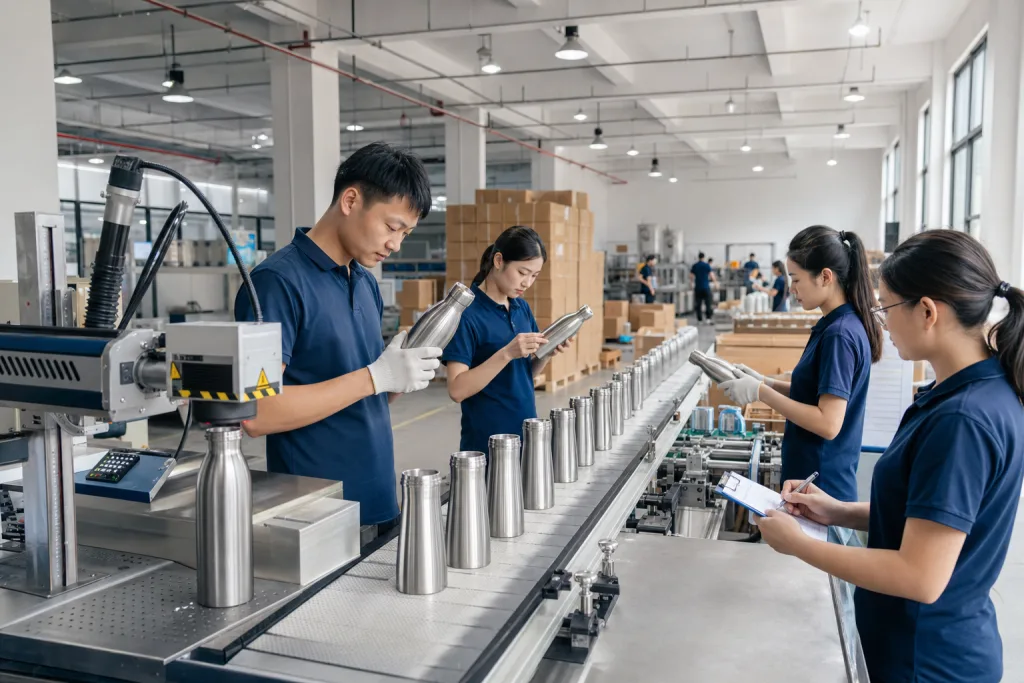
Buying from China, the specification sheet is the working contract. No romance here. At our Zhejiang factory, a normal custom drinkware project starts from 3,000 pieces MOQ, runs 25–35 days mass production after sample approval, and covers up to 600,000 units/month across stainless steel bottles, tumblers, canteens, and growlers. QC pulled a sample last month because the PO said matte black, but the approved PP sample was satin black; that one word would have cost the line 12 hours.
Capacity, shape, and use case
The first spec line we see on a buyer sheet is capacity: 350 ml, 500 ml, 750 ml, 1 L, or 64 oz for a custom growler. Do not choose capacity by the best-selling catalog photo. Choose it by channel and user. A 500 ml custom made drink bottle is a safe size for office gifting and school programs because it clears most car cup holders and slips into a 28–32 mm backpack side pocket. A 750 ml sports bottle fits outdoor retail, but carton CBM jumps fast; on our line, one recent 750 ml order packed 24 pcs/carton while the 500 ml version packed 36 pcs/carton. Freight tells the truth. A 64 oz customized growler goes to a different buyer: breweries selling taproom merch, plus outdoor stores where the shelf price can absorb the larger carton.
Shape is the next hidden cost driver. Straight-wall bottles are easier to polish, powder coat, and print; the fixture is simple, and the logo position stays steady under the silkscreen jig. Tapered canteen custom shapes look more premium, but they need tighter fixture design for laser logo and silkscreen registration, often within a 1–1.5 mm tolerance if the artwork has a border. A flask-style custom canteen may photograph well, but we have seen this go sideways when the broad flat face rubs against the next unit in a kraft divider. QC pulled the sample after 20 shakes on the packing table and found powder coat scuffs at both shoulders.
For distributor drinkware, I advise keeping one shared neck finish across several SKUs. If your 500 ml bottle, 750 ml bottle, and customized canteen use the same cap family, you cut spare part confusion and reorders move faster. The math does not work when every body shape needs its own lid mold, gasket, and color card. Canteen distributors gain more from stocking replacement lids in black and stainless across one neck size than from carrying 12 cap shapes that sit in the warehouse. We run this often for repeat buyers: same 53 mm thread, different bodies, fewer PO mistakes.
Ask your canteen manufacturer to confirm three numbers before tooling or sampling: brimful capacity, practical fill capacity, and finished weight. Buyers often approve “500 ml” without checking whether that means full to the rim or usable with the lid installed. That is the wrong question to leave open. On a recent sample tag, the PO said 500 ml, the lab sheet showed 520 ml brimful, and the practical fill was 480 ml after the cap and silicone straw were fitted. That small gap can create label claim problems in Europe and North America.
Material grade and construction details
Most B2B buyers ask for “304 stainless steel” and stop there. Too thin a spec. We ask them to list inner material, outer material, cap material, gasket material, and coating system on the PO, because one missing line can turn into 3 rounds of email after QC pulled the sample. For insulated bottles, we often run SUS304 inside, SUS201 or SUS304 outside, PP cap, and food-grade silicone gasket. If you sell into premium retail, SUS304 outside is easier to defend on the shelf card and gives better corrosion confidence. If the job is a canteen promotional order with a tight target price, SUS201 outside can work, but the buyer needs realistic coating and salt spray expectations.
Wall thickness matters. For vacuum bottles, 0.4 mm outer wall is common for cost-sensitive programs, while 0.5–0.6 mm gives better dent resistance. The math is simple. Thicker steel adds weight and pushes up FOB, but it cuts complaints from shipping dents and rough store handling. On one 20 oz bottle line, the buyer flagged side dents after carton drop testing at 76 cm, and moving from 0.4 mm to 0.5 mm solved most of it. For a custom growler or distributor growler program, I would not go too thin because large bodies show panel deformation fast.
Vacuum performance should be written as a test condition, not a slogan. “Keeps hot 12 hours” is weak. Better: fill with 95°C water, room temperature 20°C, test after 6 hours and 12 hours, record internal temperature. For cold retention, define ice-water or 4°C starting liquid. We use a digital probe thermometer and log the reading on the approved sample sheet, not just in a sales chat. A canteen factory in Zhejiang or elsewhere in China can run these tests, but the method must be agreed before bulk production.
If you buy plastic, glass, or Tritan-style customizable drinkware, specify material certificates and migration requirements early. For EU shipments, REACH and food-contact declarations may be requested. For the US, FDA food-contact suitability and, depending on the buyer, California Proposition 65 screening may enter the file. Do not wait until the booking date to ask for documents. We have seen this go sideways when a PO said “Tritan bottle” but the file had no resin grade, no supplier name, and no test report until 4 days before vessel closing.
Lid system, leakage, and user failures
The lid is where about 7 out of 10 custom made drink bottle complaints start in our after-sales files. The bottle body can pass vacuum, coating, and drop checks, but one weak hinge pin, 0.8 mm thin gasket, or loose thread fit creates the review nobody wants. Your spec sheet should name the lid type: screw cap, straw lid, flip lid, push-button lid, sports spout, or growler swing cap. Each one fails in a different way, and pretending they carry the same leakage risk is the wrong question to ask.
Screw caps are the safest for leakage and the easiest for a canteen supplier to control on the line. We run them with a torque meter, usually checking cap closure at the agreed kgf·cm range before packing. Straw lids sell well for gym and school use, but they add parts: straw tube and bite valve, vent hole and gasket, sometimes a spring or button insert. More parts mean more places for QC to pull the sample and find trouble. If you are buying for children, ask about ASTM F963 where relevant, small parts risk, and phthalate or heavy metal limits on colored components; one buyer once flagged a soft blue bite valve because the lab report named the resin but missed the pigment batch.
Leak testing must be written down. A practical factory test is filling the bottle, tightening to the agreed torque, inverting for 30 minutes, then shaking for 10–15 seconds. Simple test. Useful result. For travel tumbler styles, be honest with the end customer: some slider lids are splash-resistant, not leakproof. If your packaging says “100% leakproof” and the lid has an open sip slider, the claim hurts you more than the vendor. We have seen this go sideways when a carton drop test left 3 lids wet inside the polybag, then the buyer asked why the Amazon page promised backpack use.
Canteen vendors should confirm thread compatibility on reorders. If the mold changes or a subcontracted cap is used without notice, your second shipment may not match the first, even if the PO repeats the same item code with one typo in the lid suffix. At BottleForge in China, we lock cap drawings, gasket hardness, and thread gauge checks for repeat orders because distributor canteen programs often reorder lids separately after 6–12 months. We ship replacement lids by the thousand; a 0.2 mm thread drift is enough to turn a clean reorder into a claims file.
Logo method and decoration tolerances
Decoration is not just branding; it is a production process with yield loss, setup time, and QC sorting. For customized drinkware, we run silkscreen printing, pad printing, laser engraving, heat transfer, water transfer, UV printing, powder coating with logo mask, and embossing or debossing when tooling is involved. Each method has its lane. On one 18 oz bottle order last month, QC pulled 37 pieces for logo pinholes after the second silkscreen pass.
Laser engraving is the safest choice for stainless steel and powder-coated bottles. Clean edges. Low complaint rate. It works well for corporate programs where the buyer wants the logo to survive daily washing and bag rub. The limitation is color: you are exposing metal or a contrast layer, not printing Pantone ink. Silkscreen is cheaper for one-color logos on straight bodies or bottles with only a light curve. Full-wrap artwork needs a trial run because bottle taper, weld seam position, and jig pressure change the final alignment; we usually check the first 20 pieces with a 0.5 mm tolerance mark before releasing the line.
For a canteen customizable project with multiple logos for regional distributors, ask about mixed-logo production before you approve the artwork. A factory may accept 3,000 pieces total, but still require 500–1,000 pieces per logo or per color because each change needs screen cleaning, ink adjustment, and line restart. If you need 12 logos at 250 pieces each, that is not the same job as one 3,000-piece logo run. The math doesn't work unless the quote shows setup charges, film charges, and overrun allowance. We have seen buyers flag this after PO release because one tab said “assorted logos” and the artwork folder had 12 separate city names.
Color tolerance should be written down. Powder coating can be matched to Pantone, but metal substrate, gloss level, and oven conditions affect appearance. A Delta E target may be used for strict retail work, but most promotional programs approve a physical color chip instead. Keep one signed golden sample in your office and one at the Zhejiang factory. Photos help discussion, not final color control. Under the light box, a matte black sample and a semi-gloss black sample can look like two SKUs even when both were called “black” on the PO.
Artwork files should be vector AI, EPS, or PDF. Minimum line width often starts around 0.2 mm for laser and 0.3 mm for silkscreen, depending on surface and finish. Tiny legal text around a curved custom canteen may pass on screen and fail on steel. We check it with a digital caliper and a printed 1:1 film; if the ® mark closes up at 6 mm height, the buyer should simplify the mark before mass production.
MOQ, pricing, and freight math
MOQ is not a penalty; it is the point where coil purchase, coating setup, printing setup, inspection, and export packing stop bleeding money. For a custom made drink bottle order, a China factory-direct MOQ is often 3,000 pieces per color. If we run a stock body with a standard color and a simple logo, 1,000–2,000 pieces can work. Once you bring in a new mold, a special cap, or a matte powder coat, MOQ usually jumps to 5,000–10,000 pieces. On the line, QC pulled the first 20 samples before packing, and that alone tells you why tiny runs get expensive fast.
FOB pricing comes down to steel grade, capacity, lid structure, coating, logo method, packaging, and inspection level. A 500 ml stainless single-wall bottle may land around USD 1.20–2.20 FOB Ningbo or Shanghai depending on finish. A 500 ml vacuum insulated bottle often runs USD 2.80–5.50. A large customized growler can move above USD 6.00–12.00 once the lid, handle, and coating are upgraded. This is the wrong question to ask if you only want the lowest number; the math does not work. We once saw a buyer flag a quote that was USD 0.35 under market, and the sample came with a paint scratch at the seam.
Freight math can flip the winner. A low-cost bottle in an oversized gift box may cost more landed than a better-built bottle in a tight kraft carton. Ask for master carton dimensions, gross weight, net weight, pieces per carton, and HS code before you show final landed cost to your buyer. A 58 x 38 x 32 cm carton moves differently from a 62 x 42 x 40 cm carton, even if the bottle price is the same. We ship a lot of orders where 2 mm of extra carton height kills the pallet count.
For canteen distributors and canteen suppliers serving retail chains, Incoterms need to be clear from day one. FOB is normal for established importers. DDP sounds easy, but it hides duty, VAT, and the trucking side. If you need Amazon or marketplace delivery, spell out FNSKU labeling, carton labels, pallet height, and appointment rules at the quotation stage, not after production. We had one PO with a typo on the pallet height line, and the buyer flagged it after booking, which cost two days and one rebook fee.
Compliance, inspection, and packaging
A solid canteen manufacturer should not push back on a written inspection plan. We usually run drinkware under AQL Level II, with critical defects at 0, major defects at 2.5, and minor defects at 4.0, although some retail buyers set tighter limits in the PO. Critical defects mean unsafe sharp edges, oil or dust contamination, severe leakage, wrong material, or failed food-contact requirements. Major defects cover visible coating chips, logo position off by more than the approved tolerance, loose lid fit, and carton shortage. Minor defects are small cosmetic marks inside the agreed viewing distance, often 30–50 cm under the QC lamp. QC pulled the sample.
Packaging is quality. A bottle can pass the line and still lose the buyer if the export carton crushes on the first truck transfer. For export, specify inner bag or tissue, divider or individual box, master carton flute, carton sealing method, and drop test expectation. For ecommerce, we usually ask for ISTA-style testing because one bottle shipped alone takes harder hits than 24 pieces on a pallet. For club stores or retail shelves, packaging artwork, barcode grade, suffocation warning, and country-of-origin marking need approval before mass printing. We have seen this go sideways over a 1 mm barcode quiet-zone issue.
Compliance documents depend on market and material. For Europe, buyers often ask for LFGB or EU food-contact testing, REACH-related declarations, and sometimes BSCI or Sedex audit information. For North America, FDA food-contact suitability, CPSIA for children’s items, ASTM references, and Prop 65 risk review may be relevant. If your brand sells into both regions, tell the factory before sampling. Ink, coating, and silicone gasket choices should support both files, or the math does not work when 10,000 lids are already molded.
Our Zhejiang team runs incoming material checks, vacuum testing, coating adhesion checks with 3M tape, logo position checks by caliper, and final carton inspection. For a typical 10,000-piece customized drinkware order, we advise one pre-production sample approval, one mid-line check at 20–30% completion, and one final random inspection before balance payment. We also check carton weight and PO details; last month a buyer flagged a typo on “matte black” versus “matt black” before labels were printed. It costs less than sorting 10,000 bottles in your warehouse.
Sampling, lead time, and reorder control
Sampling should answer technical questions, not make a pretty photo. The wrong question is “how fast can you send a sample?” A normal path is 3–7 days for a stock-body logo sample, 10–15 days for custom color and decoration, and 25–40 days or more when new mold parts are involved. On the line, QC pulls the sample against the lid torque gauge and checks the gasket seat at 0.3 mm. If a canteen vendor promises a fully customized canteen sample in 48 hours, ask what is actually custom. Most of the time it is a digital mockup or a stock color with a temporary logo.
Mass production starts after three things are done: deposit received, artwork approved, and the pre-production sample signed. If one of those is missing, the schedule slips. For stainless steel custom drinkware orders in China, 25–35 days is realistic after approval. We run the first batch on the polishing line and check coating cure time at 180°C before packing starts. Peak season before summer and Q4 gifting can add 7–15 days, and powder coating plus complex lids will take the hit first.
Reorder control is where experienced buyers separate themselves from first-time importers. Keep one master spec sheet with model number, capacity, steel grade, wall thickness, lid drawing, gasket material, coating code, logo file version, packaging dieline, carton data, and inspection standard. Your canteen factory should keep the same file, not a random PDF on sales’ laptop. We have seen this go sideways when a buyer reordered from memory and the carton size changed by 2 mm, which broke pallet loading and forced a new drop test at 76 cm.
If you are building a distributor canteen or distributor growler line, plan for continuity. Fourteen colors sounds good in a pitch deck, not on a warehouse shelf. Start with 3–5 colors, one cap system, and packaging that can take multiple SKUs with label swaps. We usually see MOQ pain show up at 3,000 pcs per color, and dead stock piles up fast when one shade misses the reorder window. That setup keeps risk down and gives you more room on price with canteen manufacturers when volume climbs.
The best custom made drink bottle project is boring in production: approved sample, locked spec, stable schedule, clean inspection, and cartons that land without drama. QC signs off at AQL 2.5, the lid gap stays at 1.5 mm, and the PO matches the artwork file. That is the job.
Send your bottle spec and target landed cost
BottleForge will review capacity, material, logo, packaging, MOQ, and lead time, then quote a practical China factory option.
Frequently asked questions
What is a realistic MOQ for a custom made drink bottle?
For factory-direct orders in China, 3,000 pieces per color is a realistic starting point for most stainless steel custom made drink bottle projects. If you use a stock body, standard powder color, and one-position logo, some factories may accept 1,000–2,000 pieces, but the unit price will be higher. Custom molds, special lids, custom silicone parts, or new coating colors often require 5,000–10,000 pieces. For mixed-logo distributor drinkware programs, ask whether the MOQ is per order, per color, or per logo. That detail changes the real buying quantity.
How long does custom drinkware production usually take?
For a normal stainless steel custom drinkware order, expect 3–15 days for sampling depending on color and decoration, then 25–35 days for mass production after sample approval and deposit. Add 7–15 days during peak seasons or if you require complex full-wrap printing, special packaging, or third-party testing. Ocean freight to Europe or North America can add 25–45 days depending on port and routing. If you need a launch date, work backward from the warehouse delivery date, not the factory ship date.
Which logo method is best for a customized canteen?
For a customized canteen with a premium or outdoor positioning, laser engraving is usually the safest choice because it is durable and has low rejection risk. For colorful brand graphics, silkscreen or heat transfer can work, but curved canteen bodies need careful artwork adjustment and sampling. If you need retail-level appearance, approve a physical pre-production sample and define logo size, position tolerance, and color standard. For example, a ±1.5 mm logo placement tolerance may be acceptable for promotional goods, while retail buyers may request tighter control.
What compliance documents should I ask a canteen supplier for?
Ask based on your selling market. For Europe, common requests include EU food-contact declaration, LFGB testing for certain buyers, REACH-related declarations, and packaging material compliance. For North America, ask about FDA food-contact suitability, CPSIA if the bottle is for children, ASTM-related safety considerations, and Prop 65 screening where needed. If the order includes coated stainless steel, printed logos, plastic lids, and silicone gaskets, each material may need support. Also ask whether the factory has BSCI, Sedex, or ISO 9001 documentation if your retail customer requires social or quality audits.
Can one canteen manufacturer support both promotional and retail orders?
Yes, but the spec and inspection level should change. A canteen promotional order may focus on price, simple logo, and delivery date, with standard carton packing and AQL Level II inspection. A retail order needs tighter cosmetic standards, stronger packaging, barcode control, shelf-ready cartons, and sometimes third-party lab testing. The same Zhejiang canteen manufacturer can often make both, but you should not use the promotional spec for retail shelves. For a 10,000-piece retail run, budget time for pre-production samples, packaging approval, and final random inspection before shipment.