Key Takeaways
- A realistic MOQ for a private-label travel tumbler is 1,000-3,000 units per color, depending on coating and lid
- 304 stainless steel inner walls at 0.4-0.5 mm are the normal spec for mid-market coffee tumblers
- Laser engraving is durable but slower; silk screen and heat transfer work better for multi-color promotional logos
- Plan 35-55 days for mass production after artwork, sample approval, and deposit
A custom made coffee tumbler looks simple on a quote sheet. Then the buyer has to approve a 2D drawing, choose the lid gasket, lock the logo position within ±1 mm, hit the launch date, and explain why the first sample does not match the 3D render. Coffee brands and corporate-gift buyers usually push us on 3 points: no leaking inside a laptop bag, a logo that survives 300 dishwasher cycles, and export cartons that pass drop testing without crushed corners.
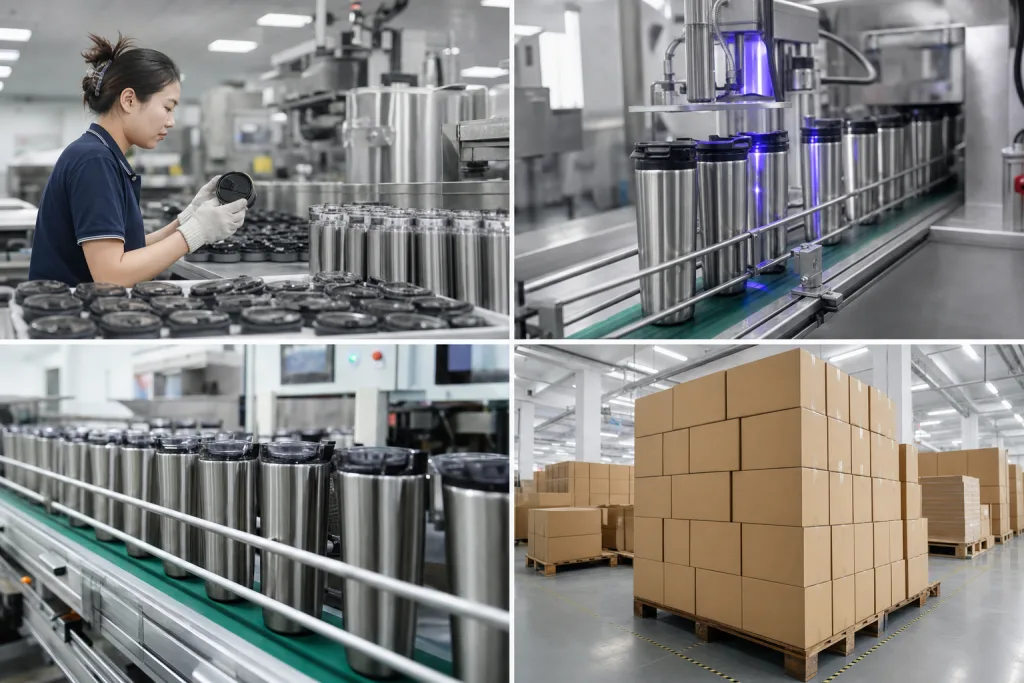
On our Zhejiang, China production floor, the real decisions are not about slogans. We run checks on 304 stainless steel thickness, vacuum loss rate after 24 hours, lid tooling fit, AQL inspection, and whether the line is set for 1,000 units or 50,000 units. Last month QC pulled a sample because the silicone ring sat 0.4 mm proud; the buyer had only flagged the PMS color. If you are comparing a coffee mug factory, a coffee mug supplier directory, or factory-direct quotes, ask the questions below before you pay for samples.
Start With The Buying Use Case
Before you ask any coffee mug manufacturer for a quote, define how the tumbler will be used. A retail coffee brand selling at $24.99 needs a different build than a corporate HR team buying a bulk coffee travel mug for a conference. The retail item needs a cleaner powder coat, tighter lid fit, retail box protection, and fewer lid complaints after the first shipment. The corporate-gift item can use a plain white box, but the logo must pass a 3M tape test and the delivery date is often locked to the event badge-printing schedule. We see this go sideways when the buyer asks only for “best price” and leaves the use case blank on the RFQ.
Ask yourself four questions before you send an RFQ. Put the answers in the first email, not after 6 rounds of quotation changes. Our merchandiser checks these points against the sample rack and caliper notes before we run costing.
- Where will it be sold or given away? Cafe shelf, subscription box, trade show, employee kit, online marketplace, or distributor catalog. A cafe shelf item needs a cleaner carton face; a trade show giveaway mainly needs cartons that survive stacking at 12 kg per master carton.
- What size does your user actually carry? 350 ml and 500 ml are common for hot coffee; 600 ml and 900 ml fit commuter and cold-brew use better. We run into trouble when a buyer chooses 900 ml for office staff, then flags that it feels too tall for a car cup holder.
- Does it need to be leakproof or just splash-resistant? Slide lids are usually not fully leakproof. Screw lids with silicone gaskets are safer for bags, and QC pulled the sample last month when the gasket groove measured 0.4 mm shallow.
- What is the real price target? A FOB China price of USD 3.20, USD 5.80, and USD 8.50 can describe three different products. The math does not work if the PO says gift-box packing, laser logo, spare straw, and still asks for the USD 3.20 build.
About 3 out of 10 new inquiries for coffee mug custom made options mix up ceramic mugs, desk cups, and vacuum travel tumblers. For a custom made coffee tumbler, the key product is usually double-wall stainless steel with vacuum insulation. If you need a desk-only coffee mug promotional product, lid sealing and heat retention matter less. If you need a commuter tumbler, the lid matters more than the decoration method. Simple point. A perfect laser logo will not save a tumbler that leaks in a laptop bag during a 40-minute subway ride.
What Should The Tumbler Be Made From?
For most coffee mug private label projects, we quote 304 stainless steel inside and outside, with food-grade PP or Tritan lid parts and LFGB or FDA-grade silicone seals. Some low-price models use 201 stainless steel on the outer wall. That is workable for a dry exterior shell, but 201 should not touch coffee. Full stop. Last month QC pulled the sample from a supplier bench and the inner wall marked 201 on the PMI gun; the buyer had only checked the carton photo.
A practical mid-range spec is 0.4-0.5 mm inner wall thickness and 0.5 mm outer wall thickness before forming. Thinner steel can cut cost by USD 0.15-0.35 per unit, but dent claims go up and the cup feels light in hand. Thicker steel feels better, then the math starts hurting on a 40HQ because gross weight climbs fast. For European buyers, we usually quote with LFGB contact-material testing available. For North America, FDA food-contact documentation and CA Prop 65 review may be requested depending on the channel. On the line, we check formed body thickness with a digital micrometer after drawing, not just the flat sheet spec from the coil supplier.
Coating is where cheap quotes go sideways. Powder coating gives a stronger matte finish and a better grip. Spray painting costs less and gives more Pantone flexibility, but abrasion resistance depends on degreasing, blasting, curing temperature, and line speed. For a bulk coffee tumbler with a dark logo, we normally recommend powder coating plus laser engraving or one-color silk screen. For full-color artwork, heat transfer or UV print can work, but test dishwasher behavior before printing any claim on the packaging. We once had a buyer flag logo rub-off after 20 dishwasher cycles because the PO said “dishwasher safe” while the approved sample was only hand-wash tested.
Do not approve a coffee mug customized sample only by photo. Ask for weight, capacity tolerance, lid material, coating type, and whether the sample came from existing stock or the actual production line.
Which Lid Design Causes Fewer Complaints?
The lid causes more after-sales claims than the steel body. We see it every season. Once the body tooling is stable, the cup wall, weld, and powder coating stay predictable. The lid is where trouble starts: moving parts, silicone compression, drinking angle, heat expansion, and customers dropping it on a car floor. Last month QC pulled 32 complaint photos from one buyer; 24 were lid-related. If you are a coffee mug distributor or buying for coffee mug distributors, lid reliability protects repeat orders more than an extra 30 minutes of heat retention.
Most projects come down to three lid types, but the choice is not equal. A push-on slide lid is cheap and comfortable for office drinking, usually around USD 0.18–0.35 lower than a screw flip lid, but it is splash-resistant, not leakproof. A screw lid with flip cap works better in a backpack because the thread and gasket give more control, although the line must watch gasket height, usually within 0.2 mm. A straw lid sells well for cold drinks, but hot coffee plus a straw is where we have seen this go sideways unless the warning mark is printed clearly. For coffee-focused buyers, a screw lid with a controlled sip opening is the safer pick.
Check the gasket before you check the logo. A crooked logo annoys the marketing team; a loose gasket creates refunds. Silicone should sit flat, not twist during opening, and stay tight after dishwasher-style washing tests. In our Zhejiang factory, we run lid-fit checks during production with a simple torque gauge and do water-leak sampling before packing. For a 10,000-unit order, a normal inspection plan may pull 200 units under AQL 2.5 for major defects and AQL 4.0 for minor defects, with extra functional checks for lid leakage and vacuum loss.
If your project is a bulk travel mug for a corporate campaign, tell the factory how users will receive it: backpack handout, mailer box, or desk kit. This changes the lid spec. A splash lid is fine for a desk kit, but the math does not work if the tumbler sits sideways in a courier bag for 3 days. If your product will be sold as a premium coffee mug customizable retail item, avoid loose claims like “spill-proof” unless the lid passes a written test, such as inverted water hold for 60 seconds after shaking. The buyer flagged this wording on a PO once, and they were right.
How Do Logo Options Really Compare?
Decoration is where brand and procurement start arguing. Brand asks for Delta E under 2 on the logo; procurement asks why the reject rate moved from 1.5% to 4% after printing. The right coffee mug custom decoration method depends on the artwork file, the order quantity, and the surface finish on the cup. We see this go sideways when a buyer approves a PDF render but skips the 10-piece pre-production sample.
Laser engraving
Laser engraving cuts through the coating and shows the stainless steel underneath. It is durable and clean, especially for simple café logos, hotel marks, and corporate names under 60 mm wide. No ink to peel. It does not match Pantone colors because the mark is metal, not print. For one-color coffee brand logos, we run it often because the defect rate stays low. Typical added cost is USD 0.20-0.45 per unit depending on logo size and run speed; on our line, a 35 mm logo usually runs faster than a full vertical name mark.
Silk screen printing
Silk screen is the usual choice for one or two solid colors. It fits coffee mug promotional products and corporate-gift programs where the buyer cares about cost per piece. Setup cost is usually USD 40-80 per color, and unit cost drops once the order passes 1,000 pcs. Curved walls are the catch. On textured powder coating, QC pulled samples after a 3M tape test because the ink lifted at the rim-side edge, so ink selection and adhesion testing need to happen before mass production.
Heat transfer and UV print
Heat transfer and UV print handle full-color designs, gradients, and larger wraps. They work for seasonal coffee campaigns or retail gift sets with artwork covering 120-180 mm around the tumbler body. The trade-off is process control, not just price. Artwork stretching, seam position, and scratch resistance must be checked on real samples, not only digital renders. The buyer flagged a 2 mm seam shift on a holiday wrap last December; the math doesn't work if you discover that after 8,000 pcs are packed.
For coffee mug private labeling, packaging decoration matters too. A plain white box with barcode is enough for some distributors. Retail usually needs a color box, instruction sheet, recycle marks, importer address, and sometimes FNSKU labeling. If you sell on online marketplaces, ask the factory to apply FNSKU labels at carton or unit level before shipment. We ship cleaner that way. Relabeling 3,000 units in a U.S. or EU warehouse costs more than printing and scanning labels in Hangzhou before the cartons are sealed.
What MOQ And Price Are Realistic?
Buyers often ask for coffee mug factory direct pricing, then request 200 units, four colors, custom packaging, and free samples. The math does not work. For an existing travel tumbler mold, a realistic MOQ is 1,000 units per model and 1,000-3,000 units per color when the job needs a custom powder coat. For a simple logo on stock colors, some factories can take 500 units, but the unit price and setup cost will be higher. Last month a buyer flagged this exact issue on a PO: 200 pcs split into matte black, white, navy, and pink. We pushed it back because the coating line loses time on color changeover, and the jig setup alone eats the savings.
As a working reference, a 500 ml double-wall stainless steel tumbler from a China coffee mug factory usually lands in these FOB ranges:
- USD 3.00-4.20: basic body with a simple lid, spray coating or stock finish, plain white box, and limited logo area.
- USD 4.50-6.80: better sealing lid, powder coating, 304 stainless steel, custom logo, color box, and normal AQL 2.5 inspection.
- USD 7.00-10.50: premium lid with tighter fit, stronger coating, special body shape, retail packaging with insert card, and extra checks for lid leakage and coating adhesion.
These ranges move with stainless steel prices, exchange rate, order quantity, and testing requirements. A coffee mug oem manufacturer will charge for new tooling if you need a unique lid, handle, base shape, or proprietary silhouette. Simple packaging dielines are often free after order confirmation, but new mold development can run from USD 1,500 to over USD 12,000 depending on complexity. QC pulled one 500 ml sample last week with a 0.6 mm lid gap; that small fit issue turned into a mold correction, not a “small adjustment” on the assembly table.
BottleForge Industrial is based in Hangzhou, Zhejiang, China, and our travel tumbler lines can support about 450,000 units per month across standard models. Normal lead time is 35-55 days after deposit and approved pre-production sample. Book early for Q4. Coating slots, carton printing, and vessel space tighten together, and we have seen a 35-day plan become 52 days when a buyer waited two weeks to approve the Pantone chip and barcode artwork.
Checklist Before You Approve Production
A passed sample is only the start. The production line needs a locked approval pack, or the 8,000 pcs you receive may not match the cup on your desk. We have seen this go sideways when one agent approved the lid, another approved the logo file, and the PO had “matte black” typed as “matt black” with no Pantone code.
- Capacity: Confirm whether 500 ml means brimful capacity or usable drinking capacity. On a 500 ml travel tumbler, we often measure a 30-60 ml gap with a graduated cylinder.
- Material: Write 304 stainless steel inner wall, lid resin type, and silicone grade in the purchase order. Do not leave this to a WhatsApp message.
- Weight: Record the approved sample weight on a digital scale and set the tolerance, often ±5%. QC should know if 285 g becomes 255 g.
- Color: Approve a physical Pantone chip or powder-coating swatch. A laptop screen will not protect you when the buyer flags “navy” as too purple.
- Logo: Lock logo size, distance from rim or base in mm, print color, and registration tolerance. For laser logos, include the engraving depth or visual sample.
- Lid test: State whether the product is splash-resistant or leakproof. This is the wrong place for marketing language; define the test angle, water volume, and test time.
- Packaging: Confirm inner box paper thickness, master carton dimensions, drop-test requirement, barcode, FNSKU, and warning text. One missing FNSKU can hold 300 cartons at the warehouse.
- Inspection: Use AQL levels, not “check carefully.” Common settings are AQL 2.5 for major defects and 4.0 for minor defects, with lid fit, coating scratches, and logo position listed as check points.
For EU shipments, raise REACH, LFGB, packaging waste markings, and importer information before we run bulk coating. For U.S. shipments, check FDA food-contact expectations, Prop 65 risk, and retailer packaging rules. If the tumbler is for children or school programs, ASTM or CPSIA-related review may apply, even when the shape looks like an adult travel tumbler. We once had QC pull the sample because the straw length was 6 mm too long for the child-use carton drawing.
One habit saves money: ask the factory to send a golden sample, signed specification sheet, and carton photos before final balance payment. For large coffee mug bulk orders, book third-party inspection before shipment. The inspection fee is small compared with replacing 5,000 units after a lid leak or a 2 mm logo shift. The math doesn’t work.
How To Compare Suppliers Without Guessing
A coffee mug supplier directory gives you a starter list, not the truth. It will not show who runs coating in-house, who buys lids from Yongkang, or who is only selling finished stock from a warehouse. When you compare a coffee mug supplier, send the same RFQ sheet to each company: capacity in ml, 304 stainless wall thickness in mm, lid type, finish, logo method, carton spec, AQL level, and target ship date. If one quote is 18% cheaper, ask them to break out steel grade, lid structure, wall thickness, packaging, testing, and defect allowance line by line. We once saw a “same” 20oz tumbler quoted lower because the inner wall dropped from 0.5 mm to 0.38 mm. QC caught it with a micrometer.
Factory direct does not automatically mean better. Still, it cuts one communication layer when you need technical changes before sampling. For a custom made coffee tumbler, you need a supplier who can talk through vacuum testing, coating adhesion, carton compression, and logo fixtures without waiting two days for another workshop to answer. Ask for production photos from the line, BSCI audit documents if your channel requires it, and recent export carton examples for Europe or North America. We also ask for a short video of the vacuum test station and powder coating area. No video, no confidence.
For coffee brands, the best supplier is usually not the cheapest one. This is the wrong question to ask if your launch date is fixed. You need the one that protects the schedule and says no when a requested feature is risky. A thin push lid may hit your target cost, but if your buyers commute by train, leak complaints will cost more than the saved USD 0.30. A premium box may look good, but if the master carton jumps from 58 cm to 64 cm on one side, the freight math gets ugly. We have seen this go sideways after the buyer flagged “too much air” in the carton during a pre-shipment inspection.
Send your RFQ with target quantity, destination port, required incoterm such as FOB Ningbo or CIF Los Angeles, logo files, packaging needs, testing requirements, and delivery deadline. Add the practical details too: 1,000 pcs or 5,000 pcs, Pantone code, barcode position, drop test standard, and whether you need FDA or LFGB reports. A serious coffee mug manufacturer should return a structured quote, not just a unit price in one WhatsApp message. Check the small things. Last month a PO typo changed “matte black” to “matte blank,” and the buyer flagged it before we opened the sample mold.
Send Your Tumbler RFQ For Factory Review
Share quantity, logo files, target price, destination, and deadline. We will check the practical build, MOQ, and lead time before quoting.
Frequently asked questions
What is the best size for a custom made coffee tumbler?
For coffee brands, 350 ml, 450 ml, and 500 ml are the most practical sizes. A 350 ml tumbler feels close to a cafe drink and fits smaller bags. A 500 ml model is better for commuting and corporate gifts because it looks more substantial. Larger 700-900 ml tumblers are popular for cold drinks but can feel oversized for hot coffee. If you plan to sell through distributors, 500 ml is usually the safest first SKU because carton efficiency, perceived value, and daily usability are balanced.
Can I order a bulk coffee mug with my logo under 1,000 units?
Sometimes, but you should expect limits. Under 1,000 units, most factories will ask you to use existing stock colors, standard lids, and simple logo decoration. A 300-500 unit trial order may be possible with laser engraving or one-color printing, but custom powder coating, retail packaging, and Pantone matching are difficult at that quantity. For better pricing and smoother production, plan 1,000 units per model as the working MOQ and 3,000 units if you need a special color.
Is laser engraving better than printing for a coffee mug customized project?
Laser engraving is better for durability and simple logos. It will not peel because it removes the coating surface instead of adding ink. The downside is color: the mark is usually stainless steel silver, not your brand Pantone. Silk screen printing is better when you need a white, black, or colored logo. Heat transfer or UV print is better for full-color artwork. For corporate-gift buyers, laser engraving on powder coating is often the lowest-complaint option for 1,000-10,000 units.
How long does production take for coffee mug private labeling?
For an existing travel tumbler model, allow 7-12 days for sampling and artwork confirmation, then 35-55 days for mass production after deposit. Add 3-7 days if you need lab testing, and more time during September-November peak season. Ocean freight from Ningbo or Shanghai to North America or Europe can add 25-45 days depending on port and service. If your launch date is fixed, work backward at least 90 days from the required warehouse arrival date.
What should I ask a coffee mug factory before paying a deposit?
Ask for material specs, capacity definition, wall thickness, lid test method, coating type, decoration method, packaging details, MOQ, lead time, FOB port, and inspection standard. Also ask whether the sample is from current stock or made to your final specification. If you need compliance documents, request FDA, LFGB, REACH, BSCI, or other relevant files before deposit. A reliable China supplier should be able to put these details into a proforma invoice or specification sheet, not only discuss them in chat.