Key Takeaways
- Define capacity, steel grade, wall thickness, lid type, coating, logo process, carton spec, and AQL before asking for a unit price
- A realistic MOQ for coffee mug custom made travel tumblers is usually 1,000 pieces per color, not 100 pieces
- Pre-production samples normally take 7-12 days after artwork and deposit, while bulk production takes 30-45 days
- Your PO should separate tooling, sample cost, unit price, packaging, inspection, FOB port, and spare parts instead of using one vague line
A custom made coffee mug looks simple until you send the same RFQ to three suppliers and get back three different prices. One quote includes the lid, one leaves out the color box, and one uses a 0.38 mm body that photographs well but comes back dented after a 1.2 m carton drop test. We see this weekly. For coffee brands and corporate-gift buyers, the wrong comparison turns into lost margin, a late launch, or a sales team asking why the sample felt better than the bulk shipment.
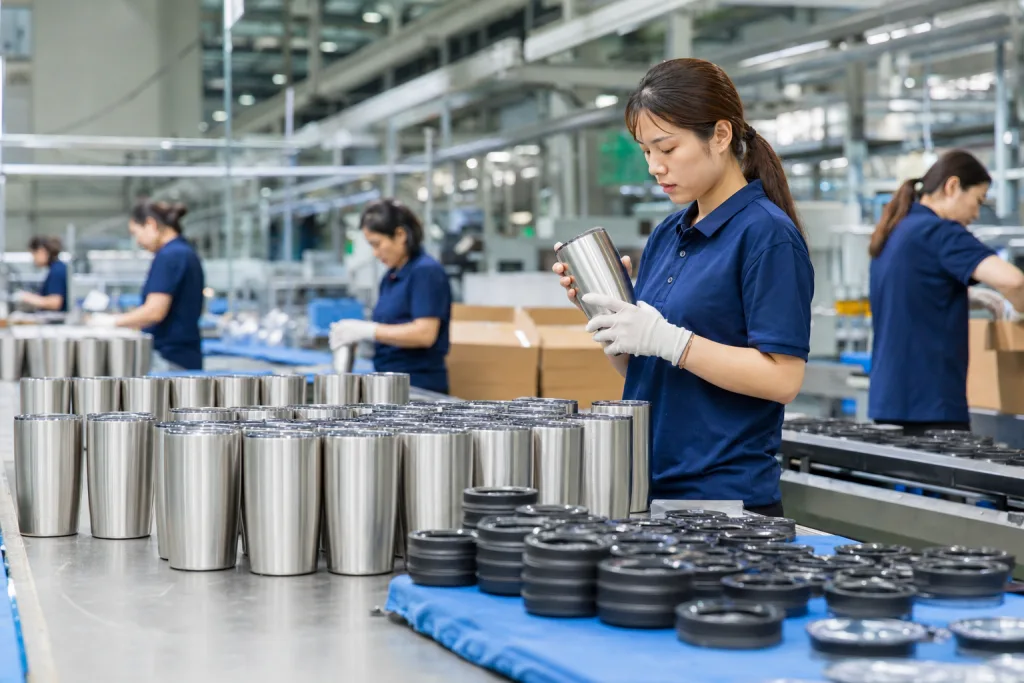
At our Zhejiang, China factory, most travel tumbler problems start before the line is scheduled: loose RFQs, missing artwork files, and PO lines with no AQL 2.5 or packaging standard written in. BottleForge Industrial makes about 420,000 stainless drinkware units per month, with typical MOQ from 1,000 pieces per color. QC pulled one sample last month because the buyer’s PO said “black lid,” while the approved sample had a smoke-grey slider; small wording, real delay. Here is how to move from RFQ to sample to bulk order without guessing.
Start with the mug use case
Before you search any coffee mug supplier list or send RFQs to coffee mug manufacturers, write down who will actually use the product. A coffee roaster selling retail merchandise is not buying the same mug as a corporate-gift buyer shipping 8,000 pieces to a conference hall. The roaster will argue over shelf color, hand feel, and whether the powder coating scuffs after 50 cycles in a rub test. The gift buyer usually cares more about PMS logo matching, carton marks, and whether the goods hit the warehouse before the event setup crew arrives.
For a custom made coffee mug in the travel tumbler category, the basic specification needs numbers. State the capacity in both milliliters and ounces, such as 350 ml / 12 oz or 590 ml / 20 oz. Define whether it must fit a car cup holder, usually under 73 mm at the base. Confirm if the lid needs to be splash-resistant or fully leak-resistant. We see this go sideways: buyers ask for leak-proof coffee lids, then approve a sliding lid that fails the 180-degree backpack shake test on our QC bench. That is not a factory defect. It is a specification mistake.
A practical RFQ line could read: 20 oz double-wall stainless steel travel tumbler, 304 inner / 201 outer, powder coating, plastic push-on lid with silicone gasket, cup-holder base, laser logo, individual kraft box, export carton, FOB Ningbo. That one sentence gives a coffee mug factory the details we need to quote tooling, logo cost, packing volume, and lead time; a mood board usually gives us 6 follow-up questions and 2 days of lost sampling time.
If you are buying coffee mug promotional products, also mention the event date and required delivery warehouse. If you are building coffee mug private label retail stock, mention barcode, hang tag, insert card, and whether you need REACH or LFGB-related material declarations for Europe. Good China suppliers can work from a rough idea, but the math does not work when the PO later adds a barcode sticker, 5-language insert, and 12 kg master carton limit after price approval. We have had QC pull the sample because the PO said “matte black” while the artwork file said “Black C.” Small typo, real delay.
Build an RFQ suppliers can price
A clean RFQ saves about 7 days of back-and-forth. We see it every week. It also lets you compare a coffee mug factory direct quote with a trading company quote without guessing what was hidden. Do not ask only, “What is your best price for coffee mug in bulk?” That is the wrong question to ask. Ask suppliers to price against one controlled specification, the same way our merchandiser checks a PO before sending it to the line.
Your RFQ should include the following PO-style fields: product name, capacity, body material, wall structure, lid material, coating, decoration, packaging, quantity by color, compliance needs, shipping term, destination, and requested delivery date. For example, a bulk coffee travel mug order may be 3,000 black, 3,000 cream, and 2,000 navy, not simply 8,000 pieces assorted. Color split affects powder coating setup, scrap rate, and carton markings. We once had a buyer flag “assorted” on a PO because the outer carton needed separate SKU labels for Amazon receiving.
For stainless travel tumblers, common material options are 304 stainless steel for the inner wall and either 304 or 201 for the outer wall. A typical body thickness is 0.4-0.5 mm per wall before forming, depending on shape and vacuum construction. Thinner material can cut cost by USD 0.12-0.25 per unit, but dent resistance suffers; QC pulled one 201 outer-wall sample after a 1.2 m drop test left a flat spot near the base. If you are a premium coffee brand, that saving is probably the wrong saving.
Ask the coffee mug manufacturer to quote at 1,000, 3,000, 5,000, and 10,000 pieces. You will see where the price curve flattens. At BottleForge in Zhejiang, about 6 out of 10 bulk travel mug programs drop noticeably after 3,000 pieces because coating and assembly lines run with fewer changeovers. The difference between 5,000 and 10,000 pieces is often smaller, especially when packaging is already optimized and the carton size has passed the 10 kg handling check.
Do not forget the boring lines: sample cost, mold or tooling charge if any, logo setup, carton dimensions, gross weight, production lead time, payment terms, HS code, and FOB port. For Zhejiang factories, FOB Ningbo or FOB Shanghai is common. A professional coffee mug oem manufacturer should answer these without drama. If a supplier skips carton dimensions or gross weight, push back; our shipping team cannot book space cleanly when a 58 x 39 x 24 cm master carton turns into “TBC” on the proforma invoice.
Choose decoration before sampling
Logo choice changes cost, lead time, and defect risk. We still see 6 or 7 RFQs each month where decoration is treated as “artwork to confirm later”; for a coffee mug customizable program, that is the wrong question to ask after the mold and sample are fixed. A 1-color silk screen logo on a flat 42 mm panel runs differently from a 360-degree wrap, laser engraving, heat transfer, or embossed badge, and QC will catch different defects at the light table.
For travel tumblers, laser engraving is durable and clean on powder-coated bodies. Clean edges matter. It usually adds USD 0.15-0.35 per piece depending on logo size and position, and our fiber laser line checks focus height before the first tray is run. Silk screen printing may cost less for one-color logos, often USD 0.08-0.20 per piece, but it needs a suitable surface and correct ink curing; last month QC pulled a sample with soft ink because the oven was set 8°C low. Full-color heat transfer can work for campaign graphics, but test abrasion and dishwasher exposure if the mug will be used daily.
Corporate-gift buyers often want exact Pantone matching. Fair request, but allow tolerance. Powder coating on curved stainless steel will not look identical to Pantone on paper, and the buyer flagged this twice on matte black bodies under office LED light. We normally ask buyers to approve a color chip or coated sample under daylight, not only a digital rendering. For a coffee mug customized order above 5,000 pieces, paying USD 80-150 for color proofing is usually worth it.
Your PO line items at this step should separate decoration clearly: laser logo on front, 35 mm wide, artwork file AI format, position centered 50 mm below rim. Spell it out. If you need a second logo or employee names, list them on separate lines so the operator does not mix files at the laser workstation. Variable data engraving is possible, but it adds file-control risk and can slow output to 800-1,500 pieces per day depending on machine capacity; we have seen one PO typo turn “Jason” into “Jasom” across 312 lids before the buyer caught it.
If you sell through retail or online channels, decide whether the visible brand is your coffee company or your client’s campaign. The math doesn't work if this is left until packing day. Coffee mug private labeling is not just a logo; we ship bottom marks, gift boxes, manuals, barcode stickers, FNSKU labels, carton marks, and product photos against the same approval file, down to a 3 mm label offset on the master carton.
Approve samples like production evidence
A sample is not a souvenir. It is production evidence for the bulk coffee tumbler order. Check it the way your QC team will check the carton lot. Measure capacity to the practical fill line, not only brimful volume. Weigh the tumbler on a 0.1 g scale. Measure height, top diameter, base diameter, and cup-holder fit; we usually test against a 70 mm car cup holder gauge because buyers flag this more often than they admit. Open and close the lid 30 times, then check thread bite, silicone gasket seating, and any rubbing marks.
For vacuum-insulated stainless mugs, ask for a simple heat retention test. We run a basic bench test by filling with 95°C water, closing the lid, and measuring after 6 hours at room temperature around 20°C. Write down the starting temperature, room temperature, fill volume, and lid type. No guessing. Performance depends on capacity and lid design, but a good 20 oz double-wall vacuum tumbler should not behave like a single-wall cup. If your coffee brand prints temperature claims on the box, confirm the test method before artwork release; we have seen this go sideways when marketing wrote “keeps hot 12 hours” without lab data.
Check coating adhesion before you fall in love with the color. A cross-hatch tape test is a practical factory-side screening method; QC uses a 1 mm cutter grid and 3M tape before we move the sample to photo approval. It is not a full laboratory report, but it exposes weak coating fast. For European programs, ask whether food-contact components can support LFGB or EU 1935/2004 documentation. For the US, many buyers request FDA food-contact declarations, and some retailers ask for ASTM-related packaging or transit tests before they open a vendor code.
Sample timing should be written down on the PI or sample request sheet. A normal pre-production sample takes 7-12 days after artwork confirmation. If you need a new lid mold or custom body shape, expect 20-35 days for tooling and first sample. The math does not work if the event is in 28 days and the mold shop still needs a 2D drawing, 3D file, and mold deposit. A coffee mug promotional rush order cannot absorb major tooling unless the event date is far enough out.
Your sample approval note should include photos, Pantone comments, logo size, packaging approval, and any deviations. Add the sample weight, carton label version, and PO reference too; one buyer once approved a sample under the wrong PO suffix, and the warehouse held 86 cartons for relabeling. Do not approve by saying “looks good” in a chat message. For a coffee mug custom made order, that phrase is too weak when a dispute appears six weeks later.
Write the bulk PO tightly
The purchase order is where buyers lose control fast. A one-line PO that says “10,000 pcs bulk coffee mug with logo” gives us nothing to work with. We need the PO to read like a production instruction and a commercial agreement in one. It should match the approved sample and the final proforma invoice, down to the lid type and carton count. One buyer once sent “matte black” in the email and “gloss black” on the PO. The line caught it before printing.
Good PO line items are simple and specific: item number, approved sample reference, quantity by color, unit price, decoration method, packaging method, spare lids or gaskets, barcode requirement, inspection standard, shipment term, payment term, and required ready date. If your coffee mug bulk shipment goes to three warehouses, list carton labels and pallet rules separately. Don’t bury that in a comment box. We ship cleaner when the PO says exactly which carton goes to which DC, and the buyer stops asking why pallet height hit 1,850 mm.
For example: Item 01: 20 oz stainless steel bulk travel tumbler, matte black, laser logo, 5,000 pcs, USD 4.35/pc FOB Ningbo, individual kraft box, 24 pcs/export carton, AQL 2.5 major / 4.0 minor, ready in 38 days after deposit and sample approval. That is the kind of PO we can run without a back-and-forth chain. A friendly email is not a production document. We’ve seen a PO typo add one extra zero to the quantity, and that kind of mistake does not get cheap to fix once the line starts packing.
For new B2B buyers from China, the usual payment term is 30% deposit and 70% balance before shipment, or before bill of lading release depending on relationship and credit. Letter of credit can work for large orders, but for 3,000-10,000 tumblers it often costs more in bank fees than it saves. If you want third-party inspection, name the inspection company and the timing in the PO. Final random inspection normally happens when 100% of goods are produced and at least 80% packed. We had a buyer push for inspection after full loading once. The math does not work.
AQL has to be realistic. For drinkware, the usual checks are dents, scratches, coating defects, logo misalignment, lid leakage, odor, wrong carton marks, and packaging damage. Critical defects stay zero tolerance. Major defects can follow AQL 2.5, minor defects AQL 4.0. If you want tighter limits, say it before the coffee mug supplier prices the job, because extra sorting and rework cost money. QC pulled 32 samples from a 500-piece lot last week, and one lid leaked under a 30-second shake test. That is the sort of finding the PO should already protect you from.
Plan freight and retail packing
Travel tumblers eat space fast. Freight changes landed cost more than some buyers build into the quote sheet. A 20 oz bulk coffee mug in an individual gift box often packs 24 pieces per export carton. Carton size might be around 55 x 38 x 48 cm, depending on the mug shape and box design. At 10,000 pieces, this is not “a few cartons”; we are talking about container CBM, warehouse unloading time, and whether the 5-layer carton survives stacking. QC pulled one sample carton last month with crushed corners after a 1.2 m drop test, and the buyer had to change the inner tray before shipment.
For urgent corporate-gift projects, air freight is possible but painful. A stainless tumbler with box may weigh 350-500 g. Air shipping 3,000 pieces can wipe out the goods profit if the delay is found after logo printing. The math doesn't work. Sea freight or rail-sea routing is better for planned campaigns, especially when the delivery window is 45 days instead of a last-minute 12-day panic. For North America, many buyers use FOB Ningbo, then let their forwarder handle ocean freight, customs, and trucking. For Europe, FOB Ningbo or Shanghai is common from Zhejiang and nearby China manufacturing clusters; our line usually books Ningbo when the cartons are ready before Friday cut-off.
Packaging should match the channel. A coffee mug distributor selling to cafés may prefer plain white boxes with outer carton labels, because café buyers care more about fast shelf stocking than glossy artwork. A corporate gifting agency may need a premium kraft box and master carton marks by department; we have seen POs where “HR-Blue-500 pcs” was typed as “HR-Black-500 pcs,” and the buyer flagged it only after packing. Online marketplace sellers may need FNSKU labels, packaging that can pass a drop test, and carton weights under warehouse limits. Retailers may request barcode placement, warning text, recyclable material symbols, and country-of-origin marking, usually with a 3 mm quiet zone around the barcode.
Do not copy retail packaging claims casually. If the box says “keeps hot 12 hours,” you need test data and a defined condition, such as 95°C starting water in a 25°C room with the lid closed. If it says “dishwasher safe,” the coating and logo should survive repeated wash cycles; our QC checks printed logos with 3M tape before approving mass packing. Many powder-coated tumblers are safer to market as hand wash recommended, even when the 304 stainless body itself is durable. We’ve seen this go sideways when a buyer approved the carton artwork before testing the coating.
For coffee mug distributors ordering mixed SKUs, ask your coffee mug factory to provide carton-level packing lists by color and barcode. It cuts receiving errors. A USD 0.03 carton label can save hours of warehouse confusion when 200 cartons arrive at once, especially if the same 20 oz shape has 6 colors and 2 logo versions. We ship mixed-color orders every week, and the best receiving teams still want the barcode, color code, and carton number printed big enough to read from a pallet jack.
Move from first order to repeatable program
The first order proves the supplier. The second order proves your system. After the first bulk coffee travel mug shipment, pull the QC report, defect photos, sell-through data, customer comments, and warehouse notes. Did the lid feel premium enough at 0.6 kg pull force? Did the matte coating scuff after retail staff handled 3 display samples for a week? Did the gift box crush at the corners under a 12 kg carton stack? These notes beat any coffee mug supplier directory ranking.
If the product sells, lock the specification. Create a buyer spec sheet with photos, 2D drawings, material, coating code, logo file version, packaging dieline, carton mark, and inspection checklist. Send that sheet to your coffee mug manufacturer before every reorder. We once saw a buyer chase USD 0.08 lower price and receive a mug with a 1.5 mm different lid fit. Customers noticed. The math did not work.
For repeat coffee mug private labeling programs, reserve color powder, lids, and packaging components before peak season. China drinkware factories fill up before spring promotional campaigns and Q4 gift programs. A safe reorder calendar is 15 days for quote and artwork updates, 7-10 days for deposit and material planning, 30-45 days for production, and 25-40 days for ocean freight depending on destination port. On the line, a delayed PMS color approval can push coating by 6 days, especially when the powder supplier is already holding 20 open orders.
You can cut cost without weakening the mug. Standardize one lid across two capacities. Use one carton size where possible, such as 47 x 32 x 28 cm if both SKUs pass the drop test. Keep logo positions consistent, and order 5,000 pieces twice a year instead of 1,000 pieces every month if your cash flow allows it. Factory efficiency improves when the line is not changing color and artwork every few hours.
A good coffee mug supplier should tell you when your idea is risky, not just say yes. At BottleForge Industrial in Zhejiang, we would rather correct the RFQ before sampling than apologize after 12,000 finished mugs are packed. QC pulled the sample, the buyer flagged the lid gap, and we fixed the tooling before mass production. That is the difference between buying a one-time promotional cup and building a repeatable coffee mug custom program.
Send us your tumbler RFQ for a clean quote
Share capacity, quantity, logo, packaging, and delivery market. We will return a practical FOB China quote with MOQ, lead time, and sample plan.
Frequently asked questions
What MOQ should I expect for a custom made coffee mug order?
For stainless travel tumblers, a practical MOQ is usually 1,000 pieces per color for standard shapes and standard lids. If you need a custom powder-coat color, many factories prefer 2,000-3,000 pieces because coating setup and color change create waste. For a fully custom body shape or new lid mold, MOQ may move to 5,000-10,000 pieces. Small trial orders under 500 pieces are possible only with stock mugs and simple logo decoration, but the unit price is higher and color choices are limited.
How much does a bulk coffee travel mug usually cost factory direct?
For a 12-20 oz stainless steel vacuum travel tumbler, factory direct pricing often falls around USD 3.20-6.50 per piece FOB China, depending on steel grade, lid design, coating, logo method, and packaging. A simple 12 oz tumbler with silk screen logo may sit near the lower end. A 20 oz powder-coated tumbler with laser logo and retail gift box will cost more. Tooling, sample fees, testing, inspection, and freight are normally separate, so compare total landed cost, not only unit price.
What should a coffee brand check before approving a sample?
Check more than appearance. Confirm real capacity, weight, base diameter, lid fit, drinking comfort, coating finish, logo size, and packaging. Run a basic heat retention test using hot water at about 95°C and measure after 3-6 hours. Open and close the lid at least 30 times. Rub the printed or engraved logo and inspect for sharp edges or uneven placement. If you sell in Europe or North America, request food-contact documentation for stainless steel, plastic, silicone, and coating materials before bulk production starts.
Can I use one supplier for both promotional mugs and retail private label?
Yes, but the supplier must understand both workflows. Promotional orders focus on event date, logo accuracy, and carton sorting. Retail private label orders require stronger packaging control, barcode or FNSKU labeling, repeatable color, product inserts, and sometimes compliance files for retailer onboarding. Ask your coffee mug supplier to show examples of both types. A factory making 300,000-500,000 units per month should be able to separate rush promotional production from repeat retail SKUs if the PO and inspection rules are clear.
How long does production take after sample approval?
For a standard coffee mug custom made travel tumbler, bulk production normally takes 30-45 days after deposit and sample approval. Add 7-12 days for pre-production samples, and longer if you need custom tooling. Peak season can add 7-15 days, especially before major gifting periods. Ocean freight to North America or Europe can add 25-40 days depending on port and routing. If your event date is fixed, work backward from delivery date and include at least 10 days of buffer for inspection, booking, and customs paperwork.