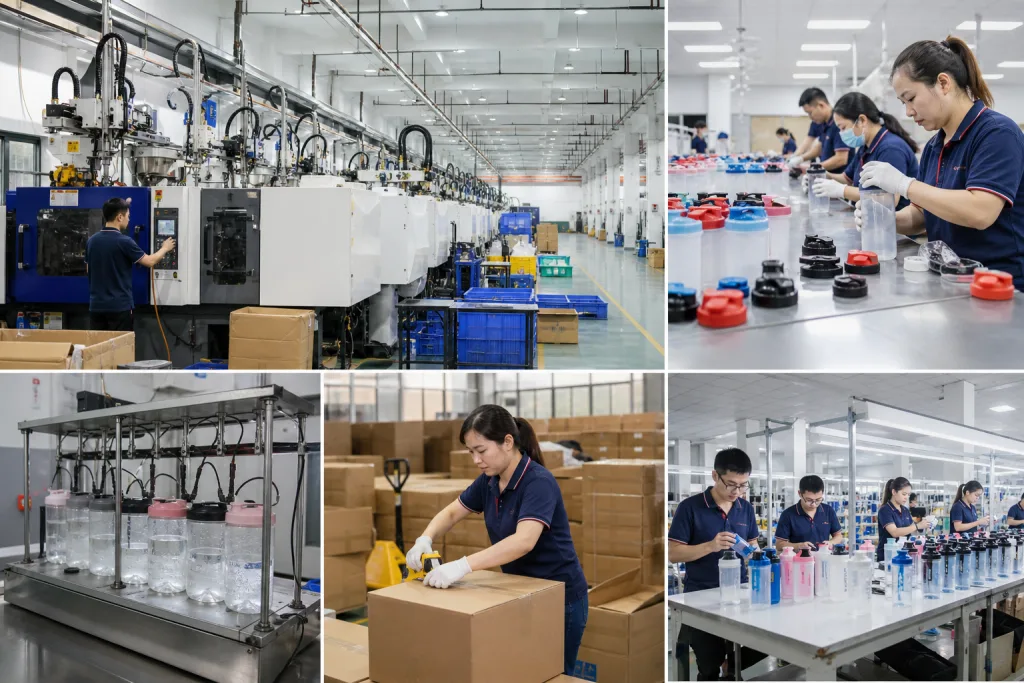
Key Takeaways
- For blender bottles, a practical MOQ is 3,000-5,000 units per color when injection molding and logo printing are involved
- Ask for food-grade PP or Tritan, 304 stainless mixing balls, and REACH or LFGB documents before deposit
- AQL inspection should separate critical leakage defects from minor cosmetic scratches instead of using one vague standard
- Plan 30-45 days production after sample approval for normal custom drinkware orders from Zhejiang, China
A custom made blender bottle looks simple until the buyer asks why the lid leaks, why the logo rubs off, or why the mixing ball showed rust after two weeks. We run these checks on the line all the time. QC pulled three lids on a bench test, tilted them at 45 degrees, and the weak point showed up fast. For B2B orders, the real risk is not the bottle shape. It is loose specs, weak material control, and no clear inspection standard before the cargo leaves.
Take one normal job: 5,000 units for a fitness supplement brand in Europe, shipped FOB Ningbo from Zhejiang, China. You need a bottle that breaks down powder cleanly, clears food-contact checks, looks retail-ready, and still fits the target cost. We set the lid thread with a torque gauge on that kind of order, because a PO typo on cap color or ball material can turn into a delay. The same logic applies when you source custom drinkware, a custom canteen, or a distributor growler program. This is the wrong question to ask: "What shape do you want?"
Start With The Real Use Case
The first mistake is asking a canteen supplier for “a 700 ml shaker bottle with logo” and expecting the factory to guess the real spec. That goes sideways. A custom made blender bottle for protein powder takes different abuse than a canteen promotional giveaway or a customized canteen for outdoor retail. Start with the drinker, the powder dose, the sales channel, and the complaint you cannot afford; last month QC pulled a shaker sample after 25 hard shakes because the flip cap wept around the silicone plug.
For this buyer scenario, the product is for gym members buying powdered supplements. The bottle sits in a gym bag, is shaken hard for 20-30 seconds, and may be washed in a dishwasher. The retail price target is USD 8-12, so the FOB China cost must usually stay around USD 1.35-2.60 depending on material, lid complexity, packaging, and logo process. The math gets tight fast: one buyer asked for Tritan, two-color printing, a wire mixing ball, and a color box under USD 1.50, and we had to push back before sampling because the BOM was already over target.
Capacity is the next decision. Common blender bottle sizes are 500 ml, 600 ml, 700 ml, and 800 ml. For European supplement brands, 700 ml is a safe middle ground because it leaves headspace for shaking a 30 g powder serving without foam reaching the thread. Wall thickness matters more than buyers expect. For PP bottles, I would not go below about 1.2 mm on the body wall for bulk promotional orders; 1.4-1.6 mm feels better for retail. Tritan can run thinner, but the resin cost is higher, and our caliper check on incoming trial parts often shows the weak spot near the shoulder radius, not the flat side wall.
At BottleForge Industrial in Hangzhou, Zhejiang, we normally ask buyers to confirm three items before quoting: target retail channel, dishwasher requirement, and packing method, with details like color box, OPP bag, or 24 pcs master carton. Our monthly drinkware output is about 480,000 units across shakers, tumblers, sports bottles, and canteen customizable projects, but the stable orders are the ones where the buyer defines use before color. We run the line better that way. One PO even had “dishwasher safe” on the artwork but “hand wash only” in the carton mark file, and the buyer flagged it two days before mass printing.
Build The Specification Sheet
A clean spec sheet is cheap insurance. It keeps the canteen factory, print shop, carton supplier, and QC team on the same page, so nobody builds off a guess. On a 5,000 pcs PO, we once caught a buyer typo that said 600 ml in the email and 60 ml in the attachment. That kind of slip costs time fast.
For a 5,000-unit custom made blender bottle order, our working sheet usually looks like this:
- Capacity: 700 ml marked to 600 ml, with 100 ml headspace.
- Body material: food-grade PP, BPA-free, natural translucent finish.
- Lid: screw cap with flip spout, silicone gasket, carry loop.
- Mixer: 304 stainless steel whisk ball, 0.5 mm wire diameter.
- Logo: one-color silk screen on front, 60 mm wide.
- Packaging: individual polybag plus retail color box, 24 pcs per export carton.
- Carton strength: 5-ply export carton, drop-test checked.
- Compliance: REACH, LFGB or FDA food-contact documentation depending on market.
If you want a premium line, Tritan is the cleaner upgrade. The clarity is better, and the impact resistance holds up on the line when the lids get torque-tested. For low-cost campaigns, PP is easier on the budget and gives us fewer complaints on color matching. We had a buyer push back on a “same spec for all bottles” request, and that was the wrong question to ask. A custom growler needs its own checks: coating adhesion, insulation performance, and weld quality. Do not copy shaker bottle wording onto a stainless growler and hope it passes.
Do not skip the measurement marks. We run both embossed and printed scales, and printed ones can rub if the ink system is weak. Embossed marks need mold support, so the tooling cost goes up. QC pulled a sample once and found the 600 ml line sitting 7 ml off target. For private-label supplement brands, ±5% is the usual target, and you should write that into the sheet before the mold is cut.
Quote Price Without Fooling Yourself
FOB pricing for a custom made blender bottle is never one clean number. A canteen vendor may quote USD 1.10 and a canteen factory may quote USD 1.85 for what looks like the same item on a PDF. We’ve seen this go sideways. Last month QC pulled a 600ml PP sample with a 0.6mm thinner wall than the approved sample, and the cheaper quote suddenly made sense. Resin grade, lid sealing, logo ink, carton thickness, and inspection discipline all change the real cost.
For our example order of 5,000 units, a realistic FOB Ningbo range from China is USD 1.45-1.95 for a PP shaker with stainless mixing ball, one-color logo, polybag, and plain export carton. Add a retail color box and you may add USD 0.18-0.35 per unit. Switch to Tritan and the cost may rise by USD 0.45-0.90 per unit depending on resin market and bottle weight. A new mold is a different conversation: simple adjustments may cost USD 800-2,000, while a fully new body and lid set can exceed USD 6,000. The buyer often asks, “Can you just copy this shape?” That is the wrong question to ask; first we check parting line, thread tolerance, and whether the lid needs a silicone gasket or only a pressure-fit seal.
MOQ is tied to process. For stocked shapes with logo printing, 3,000 units per color is often workable. For custom color matching, 5,000 units per color is cleaner because resin mixing and color control create waste; our line may scrap 80-120 kg of material during first-color adjustment if the Pantone target is tight. For a new molded product, 10,000 units is more sensible unless you accept higher tooling amortization. Small runs hurt. The math does not work when a USD 6,000 mold is spread over only 2,000 bottles.
When you compare canteen suppliers or canteen vendors, ask each one to quote the same packaging, inspection, and compliance scope. If one quotation includes LFGB testing and another only says “food grade,” those are not equal. If you are buying as a distributor drinkware company, ask for reorder validity too. We ship repeat orders where the buyer flagged a USD 0.07 increase because the first PO said “price valid 30 days” and their sales team assumed 6 months. A good quote should state price validity, lead time, Incoterm, carton dimensions, gross weight, and payment terms, not just a product photo and a unit price.
Approve Samples Like A QC Person
Sampling is where 7 out of 10 B2B buyers get too polite. Treat the sample as a small audit of how the supplier thinks. If a canteen manufacturer cannot control one courier sample on the QC bench, it will not control 5,000 production units on the line. For a custom made blender bottle, test function first. Looks come second.
Start with leakage. Fill the bottle to 80% capacity, close the lid, shake it hard for 30 seconds, then place it upside down for 10 minutes. Repeat with warm water around 50°C if the product may be used after dishwasher washing or with warm supplement drinks. Check the flip spout, lid thread, and gasket position; our QC team uses a 0.2 mm feeler gauge when the silicone ring looks uneven. A tiny leak on the sample is not “normal.” It is a design or assembly warning.
Next, test mixing. Use 30 g of powder with 400 ml water and shake for 20 seconds. This is not a laboratory test, but it quickly shows whether the whisk ball has enough spring and whether the inner base traps dry powder near the ribs. QC pulled one sample last month where 6 g of protein powder stayed stuck under the shoulder after shaking. Check if the stainless ball is truly 304 grade. For high-volume orders, request a material declaration; for retail programs, the math doesn’t work without third-party verification.
Logo sampling is another practical point. Silk screen is affordable and works well on PP, but curved surfaces can distort fine text, especially letters under 1.5 mm high. Laser engraving is not normally used on plastic shaker bodies, though it may suit stainless lids or metal accessories. Heat transfer can give stronger color, but adhesion testing matters. Use a 3M tape test and 50 rubs with a damp cloth before you approve; we have seen this go sideways when the buyer flagged peeling after only 12 rubs on a matte black sample.
Do not approve a sample only because the color looks good under office lighting. Approve it because it survives the same abuse your customer will give it.
Control Production Before Shipment
After sample approval, the buyer’s job is still on the table. The costliest mistake is finding leakage, color drift, or barcode errors after the container lands. For this 5,000-unit order, normal production lead time in Zhejiang is 30-40 days after deposit and artwork approval. If retail boxes, custom color resin, or third-party testing are involved, plan closer to 45 days. On our line, a custom resin color usually needs one extra 25 kg trial batch before mass molding, and skipping that step is where we have seen bottle bodies come out half a Pantone shade off.
Production control needs three real checkpoints, not just a few WeChat photos. First, lock the pre-production file: approved sample, Pantone color, logo artwork, packaging dieline, barcode or FNSKU if required, and carton marks. Second, run during-production inspection at around 20-30% completion, when there is still time to stop printing and adjust the mold fit. QC pulled the sample. Check color consistency, lid fit, and early logo defects before all units are printed. Third, do final random inspection before balance payment, with the packed cartons already sealed, weighed, and measured.
Use AQL properly. This is the wrong place to save USD 180 on inspection. For blender bottles, critical defects should include leakage, broken lid, sharp plastic flash near the mouth, wrong material, contamination, and missing gasket. Major defects include logo misprint over 1 mm off position, wrong color, heavy scratches, poor carton sealing, or unreadable barcode. Minor defects can include small cosmetic specks within an agreed limit, such as 2 specks under 0.5 mm on the bottle body. A common setup is Critical 0, Major 2.5, Minor 4.0, but you can tighten it for retail launches. We run a simple leak test with water filled to the mark, lid locked, then inverted for 3 minutes; it catches problems photos never show.
Cartons deserve attention. A distributor canteen order often fails not because the bottle is bad, but because the export carton is weak. For 24 pcs per carton, check carton weight, edge crush quality, and whether retail boxes deform. We have seen a 16 kg master carton split at the side seam after one drop test, even though every bottle inside passed. If you ship to an Amazon-style warehouse, carton labels, FNSKU, suffocation warnings, and master carton dimensions must match the receiving rules. China factories can handle this, but only if you put it in the purchase order; “same as last time” is not a spec, and one typo on a PO carton mark can hold up receiving for days.
Think Beyond One Shaker SKU
A solid custom drinkware program is rarely one shaker SKU. If your first custom made blender bottle moves 5,000 pcs cleanly, the buyer will often come back within 60–90 days asking for a matching sports bottle or a stainless travel tumbler for the same campaign. Plan the brand system before the first PP sample. We have seen this go sideways when a PO says “navy blue” and the approved sample card on the line is actually Pantone 2965C.
Color is the easiest control point. Keep one Pantone family across shaker bottles, custom canteen models, and the next customizable drinkware item, but do not promise exact color matching across every material. PP, Tritan, stainless powder coating, and silicone take pigment differently; on our light booth, the same blue cap can read clean on Tritan and slightly green on silicone. For serious retail programs, we can work to a Delta E target. For most promotional drinkware, a signed physical color chip works better and avoids arguments at final inspection.
Logo rules need the same discipline. Set the minimum logo width, the clear space around it, and the placement tolerance before artwork release. On a shaker bottle, a front logo tolerance of ±2 mm is usually workable; on a wraparound print, the seam drift needs tighter control or the buyer will flag it. One artwork package should include AI files, Pantone codes, barcode rules, and each packaging language version if your canteen distributors ship into more than one market. QC pulled a sample last month where the barcode was correct, but the French warning label was from an old dieline.
There is a sourcing advantage too. A canteen supplier that already knows your shaker bottle order can usually produce or coordinate a canteen promotional line, a customized drinkware set, or a distributor growler program using the same QC file. At BottleForge Industrial in Hangzhou, China, we build buyer files by brand, not by one-off inquiry. The math is better: repeat orders can cut sample approval from 18 days to about 12 days because the line already has the logo position, carton mark, and AQL 2.5 inspection notes on record.
The practical goal is simple: make the first order controlled enough that the second order feels boring. Boring is good in export manufacturing. It means the sample tag, quotation, purchase order, inspection report, and shipment documents all match, down to the lid color code and carton NW/GW. That saves more time than any last-minute discount.
Send Your Blender Bottle Spec For Review
We will check material, logo method, MOQ, packaging, and QC risks before you commit to tooling or bulk production.
Frequently asked questions
What MOQ should I expect for a custom made blender bottle?
For an existing mold with one-color logo printing, expect 3,000 units per color as a workable MOQ. If you need custom Pantone plastic, 5,000 units per color is more realistic because resin mixing creates waste and color setup cost. For a new private mold, 10,000 units is a healthier starting point, even if the factory accepts less, because tooling amortization can push the unit price too high. A mixed order with other custom drinkware may help with shipping efficiency, but it usually does not reduce the production MOQ for each color.
Which material is better, PP or Tritan, for shaker bottles?
PP is better when you need a lower FOB price, softer hand feel, and strong value for gym promotions. A 700 ml PP shaker may land around USD 1.45-1.95 FOB China with a stainless mixing ball and basic logo. Tritan is better for retail shelves where clarity, impact resistance, and premium appearance matter. It may add USD 0.45-0.90 per unit depending on bottle weight and resin cost. Both materials can be food-contact compliant, but you should ask for REACH, LFGB, or FDA-related documentation based on your sales market.
How do I check if the blender bottle will leak?
Do not rely on a factory statement. Define a leakage test in the purchase order and inspection checklist. A practical test is to fill the bottle to 80% capacity, close it, shake hard for 30 seconds, then place it upside down for 10 minutes. Test at least 20-32 pieces during final inspection, or more for large orders. For higher-risk lids, add a warm-water test around 50°C. Any leakage from the lid thread, flip cap, or gasket should be treated as a critical defect under AQL, usually with zero tolerance.
Can the same supplier make canteens, growlers, and blender bottles?
Some canteen manufacturers can handle several drinkware categories, but you should check the actual production base. Plastic shaker bottles require injection molding and lid assembly control. Stainless canteens and growlers require forming, welding, polishing, powder coating, and sometimes vacuum insulation testing. A canteen factory may produce one category in-house and subcontract another. That is not automatically bad, but you need transparency. Ask where each item is made, which QC team inspects it, and whether the supplier can keep one standard for your custom canteen, customized growler, and blender bottle line.
What lead time should I plan for a bulk order?
For a normal custom made blender bottle using an existing mold, plan 30-45 days after sample, artwork, and deposit approval. Add 7-10 days if you need third-party food-contact testing. Retail color boxes can add another 5-7 days if artwork approval is slow. Ocean freight to Europe or North America is separate and can range from about 25 to 45 days depending on port and season. If you need delivery before a fitness expo or product launch, build the schedule backward and leave at least 10 days for inspection and document corrections.