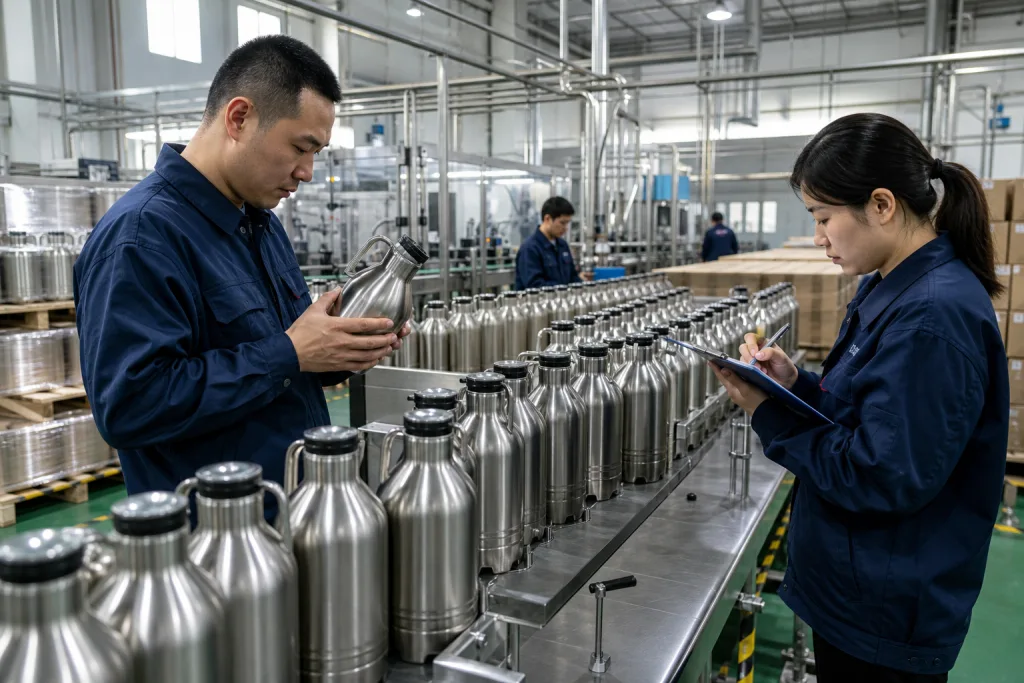
Key Takeaways
- A practical MOQ for a custom made beer growler is usually 1,000-3,000 pcs per color and logo
- Sample approval should confirm leak testing, logo position, lid torque, carton drop resistance, and coating adhesion
- 304 stainless steel at 0.5-0.6 mm wall thickness is common for insulated growlers
- Bulk lead time from approved sample is typically 30-45 days in Zhejiang, China
A custom made beer growler looks simple until you buy 3,000 pieces and QC finds the lid sweating on a 0.6 MPa pressure test, the powder coat rubs through in a 12 kg drop carton, or the logo sits 8 mm too low. We see this often. For B2B buyers, the hard part is not finding a canteen supplier; it is locking the specification before the deposit leaves your account.
We manufacture custom drinkware in Hangzhou, Zhejiang, and 7 out of 10 growler problems we see start with a loose RFQ. China factories can build a good customized growler, but the buyer needs to define capacity, steel grade, insulation target, decoration method, carton packing, inspection level, and delivery terms in writing. Treat the project like an engineered item, not a catalog giveaway. The math doesn't work if the PO says “black logo” but the artwork file shows Pantone 426C and the line has already mixed 40 kg of powder.
Start With A Usable RFQ
Your RFQ decides whether you get a serious quote or a padded guess. A custom made beer growler is not a generic custom canteen or sports bottle. Beer buyers care about seal tightness, odor retention, dark storage, cold hold, and shelf look. If you send only a photo and ask for “best price,” we see a canteen vendor quote the closest cheap model and leave the risky points open. QC pulled a sample once with a 2.0 mm gasket and it failed the flip test.
For the first RFQ, give the factory enough detail to lock 80% of the product. A good request includes target capacity, usually 32 oz, 40 oz, or 64 oz; body shape; single wall or vacuum insulated; stainless steel grade; lid type; logo method; color; packing; destination port; annual forecast; and your target retail or wholesale channel. If you are a distributor growler buyer, state whether the item goes to breweries, outdoor retail, corporate gifting, or Amazon FBA. Each channel changes the packaging and compliance burden. On our line, a neck finish off by 0.3 mm can turn into a lid fit complaint at packing.
Use PO-style line items even before the PO exists. It forces everyone to price the same thing:
- Item: 64 oz vacuum insulated stainless steel custom growler
- Material: inner 304 stainless steel, outer 201 or 304 stainless steel
- Finish: matte black powder coat, food-contact safe
- Logo: 1-position laser engraving, 55 x 45 mm
- Cap: threaded stainless cap with silicone seal
- Packing: 1 pc white box, 12 pcs export carton
- MOQ request: 1,000 pcs trial order, 5,000 pcs repeat forecast
- Trade term: FOB Ningbo or Shanghai
At BottleForge in Zhejiang, our monthly output is about 420,000 drinkware units across bottles, tumblers, canteens, and growlers. That scale helps pricing, but it does not fix a weak RFQ. The wrong question is “what is your best price.” A canteen manufacturer can only engineer what you actually specify. We ship faster when the PO text is clean, and we’ve seen a typo like “growels” on a buyer PO turn into a week of back-and-forth.
Fix The Product Specification
After the first quote, lock the spec before asking for another USD 0.10 off. On a custom made beer growler, the big calls are body construction, lid sealing, coating, and decoration method, because those four items decide tooling cost, scrap rate, sample lead time, and the complaints you get after the first brewery fill. We had one PO come in last month with “64 oz” in the title and “1.9 L” in the artwork file; QC pulled the sample and the fill line was off by 42 ml. Fix this early.
For insulated growlers, we usually recommend 304 stainless steel inside, 0.5-0.6 mm wall thickness, and vacuum insulation with copper lining when the buyer wants stronger cold retention. The outer shell can be 201 stainless steel to control cost, or 304 for a more premium customized drinkware line. Single-wall growlers cost less and weigh less, but they sweat on the shelf, dent faster in carton drop tests, and do not keep beer cold for a brewery customer driving home 30 minutes after filling. If your customer sells take-home fills, vacuum is the safer choice. The math works.
Lid design gets less attention than it deserves. A wide mouth, usually 50-58 mm, makes cleaning and filling easier on the line. The silicone gasket should come out for washing, but it cannot be so loose that it drops into the sink after three uses. Ask the canteen factory to run inverted leak testing for at least 30 minutes; we run this with a timer, dry tissue under the cap, and 10 samples from the pilot batch. Do not claim pressure-rated performance unless the lid, thread, and gasket have been built and tested for that job. Most reusable growlers are not made for long-term secondary fermentation or high internal pressure.
Decoration should match the selling channel, not just the artwork file. Laser engraving is durable and clean on stainless steel or powder coat, and it avoids the “logo scratched off” pushback we hear from retail buyers. Silkscreen costs less for larger colored artwork, but it needs adhesion testing before mass production. Heat transfer handles complex graphics, though the buyer should approve abrasion resistance with the actual coating, not a lab panel. A canteen promotional order may accept basic printing; a retail customizable growler should not. Put these lines in the development sheet:
- Capacity tolerance: nominal 64 oz, actual fill line verified by sample
- Thermal target: cold retention 12-24 hours, depending on design
- Coating test: 3M tape cross-hatch adhesion check
- Food contact: LFGB, FDA, or REACH documentation as market requires
Compare Quotes Without Fooling Yourself
After 17 quote comparisons last quarter, the cheapest line was wrong 6 times. Do not rank canteen suppliers by unit price alone. A USD 4.80 growler and a USD 5.35 growler may look close on a spreadsheet, but they are not always the same item. One quote may include 304 inner steel, 0.5 mm outer shell, individual retail box, and laser engraving. The other may use 0.4 mm material, a soft B-flute carton, and no logo setup. We see procurement teams get burned when they compare FOB against EXW, or a sample-based quote against a stock-model quote. QC pulled one sample in May where the PO said “matte black,” but the quote line was for plain powder coating with no logo.
Ask every canteen supplier to quote against the same line structure. A usable quote should show unit price, sample fee, mold or fixture cost, logo setup cost, MOQ, carton quantity, carton measurement, gross weight, payment terms, production lead time, HS code suggestion, and validity period. Put each cost in its own cell. For custom drinkware from China, common payment is 30% deposit and 70% before shipment after passed inspection. For new buyers, we do not recommend paying 100% upfront unless the order is very small, such as 50 samples or a low-value trial order. Our sales team uses a 0.01 kg scale and carton-size template when checking the gross weight, because a wrong 2 kg per carton can change the freight quote.
A realistic FOB Ningbo price for a 64 oz vacuum insulated customized growler can vary widely, often from about USD 5.20 to USD 8.80 depending on steel grade, cap design, coating, decoration, and packaging. A single-wall promotional version may be lower. A premium retail item with custom lid, gift box, and multi-color artwork may be higher. If a quote sits 20% below the market, ask what was removed. The math does not work if the supplier claims 304 stainless, copper coating, retail box, and free laser at the bottom end. We had one buyer flag this exact issue after the line found a cheaper cap gasket that failed the 24-hour leak test.
Your comparison sheet should separate the PO line items:
- Product price: growler body and standard lid, with steel grade, wall thickness, capacity tolerance, and cap type stated clearly
- Decoration: laser, screen print, or transfer print cost per piece, including logo position and artwork color count
- Packaging: polybag, white box, color box, inserts, barcode labels, and outer carton strength if the order ships by courier
- Compliance: test report fees if new testing is required, plus the exact market standard the buyer needs
- Logistics basis: EXW, FOB Ningbo, FOB Shanghai, or DDP estimate, with carton measurement and gross weight matched to the packing spec
This is also where you judge the canteen vendor, not just the canteen manufacturers behind the quote. Good canteen vendors answer technical questions directly, mark exclusions, and warn you about risks. Weak ones say everything is possible and then negotiate later. We have seen this go sideways when a buyer approved a USD 0.18 cheaper lid and only noticed the color mismatch after pre-shipment inspection under the light box. Ask for the ugly details early.
Order Samples Like A Buyer
Samples are not souvenirs. They are the control sample for bulk production. For a custom made beer growler, treat sample approval like a small PO with written pass/fail points. If you approve a random stock bottle with no logo, you have not approved the final item. We have seen this go sideways: the buyer approved a plain 64 oz body, then flagged the laser logo position after 2,000 pcs were already on the line.
We run 3 sample stages on most growler projects. First is the existing model sample, which checks shape, hand feel, lid concept, and baseline workmanship; if stock is on the shelf, it can ship in 3-7 days. Second is the pre-production sample with your finish and logo, usually 7-14 days after artwork confirmation. Third is the sealed golden sample before mass production, especially for a distributor drinkware program with repeat orders. QC pulled one last month because the lid gasket measured 1.8 mm instead of the approved 2.0 mm. Small gap. Big leak risk.
Your sample PO should list the same details as the bulk order, but with a small quantity. For example:
- Sample quantity: 3 pcs matte black, 3 pcs stainless steel finish
- Logo: laser engraving, centerline 90 mm from base
- Artwork file: AI or PDF vector, Pantone references for printed areas
- Sample charge: USD 80-180 including logo setup, depending on method
- Courier: DHL, FedEx, or UPS billed to buyer or prepaid
- Approval standard: no leakage, no visible dents, coating match within agreed tolerance
Test the sample the way your customer will use it. Fill it with cold water, invert it, carry it in a bag, open and close the lid 50 times, then wash it by hand. Check inside weld marks and smell. Use a flashlight, not a quick glance. If you sell to Europe, consider LFGB food-contact testing. If you sell to North America, review FDA food-contact expectations and any state-level requirements. For children’s or youth-oriented artwork, ASTM and CPSIA questions can come up, even if the product is not a kids bottle.
A canteen customizable program only works when sample comments are specific. Do not write “make quality better.” Write “increase logo width to 60 mm,” “reduce lid looseness,” or “change powder coating from gloss 20 to gloss 10.” The buyer flagged “black looks off” on one PO; that delayed approval 5 days because nobody named the Pantone or gloss target. The math doesn't work when vague comments hold a production slot.
Write The Bulk PO Properly
The bulk PO is where you remove ambiguity. A distributor canteen buyer may assume the factory remembers every email. We don’t. The purchase order needs to be the single work sheet for production, QC, invoicing, and shipment. If the PO only says “custom growler, 3,000 pcs,” the line will stop at the first question: lid type, carton mark, logo size, or who pays for the barcode sticker. We saw one PO with “mat black” typed in the color field; QC pulled the sample and held coating for 6 hours until the buyer confirmed matte black.
A proper PO for a customized canteen or growler should include buyer details, supplier details, item number, approved sample reference, quantity by color, unit price, total value, payment terms, production lead time, Incoterms, shipping marks, packaging, barcode requirements, and inspection standard. If you require BSCI, ISO 9001, Sedex, or factory audit documents, state that before deposit. Asking after production starts is the wrong question to ask. Our document clerk checks the PO against the signed sample card, artwork file name, and carton dieline; one missing FNSKU can hold 250 cartons in the packing area.
For a 3,000 pc order, a practical production schedule in Zhejiang, China may look like this: deposit and artwork confirmation on day 0; material preparation days 1-7; forming and welding days 8-16; vacuum process days 12-22; polishing and coating days 20-30; logo and packing days 28-38; final inspection days 39-41; vessel booking and loading days 42-48. Rush orders are possible. Rushing coating, curing, or inspection is how you create returns. We run powder coating with curing temperature checks on the oven gauge, and if the bottle leaves a 180°C tunnel too early, the finish can fail the tape test before it ever reaches your warehouse.
Use PO line items that operations people can follow:
- SKU A: 64 oz vacuum insulated growler, matte black, laser logo, 1,800 pcs
- SKU B: 64 oz vacuum insulated growler, brushed steel, laser logo, 1,200 pcs
- Inner packing: 1 pc/polybag/white box with warning leaflet
- Master carton: 12 pcs/carton, 5-ply export carton, drop-tested
- Labeling: FNSKU sticker on outer box if Amazon FBA, barcode on retail box if distributor stock
- Inspection: AQL general II, critical 0, major 2.5, minor 4.0
For distributor growler programs, include spare lids. A 1%-2% spare lid quantity is cheap insurance, especially when breweries or retailers handle warranty issues locally. We ship them in a separate marked carton, usually 30-60 lids for a 3,000 pc run, so your warehouse team does not cut open finished retail boxes to solve one leaking cap complaint.
Control Inspection And Shipment
Final inspection is not carton counting. For custom drinkware, especially a customizable drinkware item with a brand logo, the check needs to cover leak performance, surface finish, packing method, and retail labeling. We usually run 80-125 pcs under AQL 2.5 for a mid-size lot, then QC pulls 2 packed cartons from the stack and opens them on camera. You can use your own QC team, a third-party inspection company, or the factory QC report with random video checks. For first orders over USD 10,000, we recommend an independent pre-shipment inspection. The buyer flagged it once: the logo was approved, but the carton barcode scanned as the old SKU.
AQL inspection should include critical defects such as leakage, sharp edges, unsafe contamination, wrong material, and missing food-contact components. Major defects include visible dents over 2 mm, thin powder coating near the base ring, wrong logo position by more than 3 mm, lid mismatch, unstable base, or wrong carton label. Minor defects include small polishing marks within agreed limits. Ask for photos of the capacity test with a measuring jug, inner wall finish under LED light, carton markings, barcode scans, and packed pallets. We have seen this go sideways when the sample lid seals well, but the bulk lid from another mold leaks after 30 seconds upside down.
Shipping decisions depend on deadline and margin. Air freight is fast, but the math usually does not work for stainless steel growlers because the cartons cube out before they weigh out. Sea freight from Ningbo or Shanghai is usually the sensible option. A 3,000 pc 64 oz vacuum growler order may take roughly 10-14 CBM depending on box design. One recent 64 oz carton measured 46 x 34 x 29 cm for 12 pcs, and the buyer pushed back because Amazon storage fees jumped. If you sell through Amazon, carton size, FNSKU, suffocation warnings, and pallet rules must be agreed before packing, not after the container is booked.
Work with the canteen distributor or end retailer on receiving standards. Some retailers reject cartons with soft corner crush, no country-of-origin marking, or barcodes that fail on a Zebra scanner. For North America, mark “Made in China” clearly. For Europe, check language requirements for care instructions and recycling symbols. A Zhejiang factory can print or label almost anything, but you must confirm legal wording before mass packing. This is the wrong question to ask at 6 pm when the line has already sealed 1,200 cartons.
The last PO checkpoints should be simple:
- Balance payment: after passed inspection, before shipment release
- Documents: commercial invoice, packing list, bill of lading, certificate of origin if needed
- Photos: loaded cartons, shipping marks, container seal number
- Retention sample: factory keeps 2 pcs for future dispute comparison
Plan Reorders Before You Need Them
A custom made beer growler should not be handled as a one-time fire drill if you are building a brand or distributor drinkware line. Reorders are where you protect margin. After the first 3,000 pcs sell through, you know the actual defect rate, customer comments, best-selling color, and how many cartons arrived with crushed corners. Feed those findings into the next PO. QC pulled the sample from our last growler run and found two small coating chips near the handle weld, which is exactly the kind of detail that should not repeat.
For repeat orders, keep the same item code and revision number. If you change coating, lid gasket, carton thickness, or logo size, create a new revision. This matters when you work with 4 canteen distributors, 2 regional warehouses, or a retail chain using auto-replenishment. Nobody wants mixed versions in the same replenishment cycle. We have seen this go sideways when a buyer used the old PO file and missed one revised logo size by 3 mm.
Ask your canteen manufacturer to reserve critical tooling and fixtures, especially logo jigs and lid molds. If the order becomes seasonal, forecast 90-120 days ahead. Stainless steel prices move, coating capacity fills before holidays, and China production slows around Lunar New Year. A buyer who places a March promotion order on January 20 is already late. The math doesn't work when the lid mold needs 7 days for maintenance and the coating line is booked by 18 other SKUs.
Reorder PO lines should include performance corrections. Examples: “increase master carton edge crush strength,” “add desiccant per carton,” “change care card wording,” or “pack 6 pcs/carton instead of 12 pcs/carton for retail warehouse handling.” This is how a canteen customized project becomes a stable program instead of the same argument every shipment. On the factory floor, we run the carton drop test at 76 cm, and if the corner opens, the buyer will flag it again at receiving.
If you want a canteen promotional item, simpler packaging and a lower MOQ can work. If you want a long-term customizable canteen or premium growler line, pay for repeatable specifications, approved samples, and inspection discipline. The product is only half the job. The other half is making sure the second, third, and fourth container match the first one your customer approved. We ship programs, not just cartons, and a 1 mm gasket change can turn into 500 leaking lids if nobody controls the revision.
Send Your Growler RFQ For A Practical Review
Share capacity, quantity, logo, market, and delivery date. We will return a buildable specification, MOQ, sample plan, and FOB China quote.
Frequently asked questions
What is the normal MOQ for a custom made beer growler?
For an existing mold, the usual MOQ is 1,000-3,000 pcs per color and logo. Laser engraving can sometimes start at 500 pcs, but powder coating, custom colors, and retail packaging normally push the MOQ higher. If you need a new body shape or proprietary lid, expect tooling costs and a larger first order, often 5,000 pcs or more. For trial distributor growler projects, we usually suggest one body, two colors maximum, and one decoration method. That keeps the first PO controlled and gives you cleaner sales data before expanding the line.
How long does sampling and bulk production take?
Existing model samples usually take 3-7 days before courier pickup. A pre-production sample with your logo and finish usually takes 7-14 days after artwork approval. Bulk production normally takes 30-45 days after deposit and final sample approval, depending on quantity, coating, and packaging. Add ocean freight time separately. From Zhejiang, China to a North American port, sea transit is often 18-35 days; to Europe, often 30-40 days. Around Lunar New Year, add at least 2-3 extra weeks of safety time.
Which logo method is best for a customized growler?
Laser engraving is the safest choice for most stainless steel customized growler orders because it is durable, clean, and does not peel. It works especially well on powder-coated bodies. Silkscreen printing is useful when you need a solid color logo at lower cost, but you should request tape and abrasion tests. Heat transfer supports complex artwork and gradients, though it needs careful approval for scratch resistance. For brewery retail, we usually recommend laser for premium lines and screen print for budget canteen promotional programs.
Can I use the same supplier for canteen and growler orders?
Yes, if the canteen supplier has stainless steel forming, vacuum insulation control, coating, and leak testing experience. Many canteen manufacturers can make bottles but not all handle growlers well. Growlers have larger bodies, wider mouths, heavier lids, and stricter sealing expectations. Ask for production photos, capacity test results, coating examples, and references by product type. A good canteen factory should quote custom canteen, customizable canteen, and growler projects with different technical assumptions, not treat them as the same bottle with different names.
What should be included in inspection before shipment?
Use AQL general inspection, commonly general level II with critical 0, major 2.5, minor 4.0. Check leakage, capacity, lid fit, sharp edges, coating adhesion, logo position, barcode readability, carton strength, and quantity per carton. For a 3,000 pc order, inspection usually samples a few hundred units depending on AQL tables. Require photos and measurements, not only a pass/fail sentence. If the order is going to Amazon FBA or retail distribution, verify FNSKU labels, carton dimensions, country-of-origin marking, and any required warning or care cards.