Key Takeaways
- Specify 304 stainless steel at 0.4-0.5 mm wall thickness for most custom made alcohol flask orders
- Require 100% leak testing plus AQL 2.5/4.0 final inspection before shipment
- Use laser engraving or etched logo for flasks that will see repeated pocket and bag abrasion
- Plan 25-35 days production after sample approval, plus 7-10 days for pre-production sampling
A custom made alcohol flask looks simple until the shipment lands with loose caps, cloudy plating, failed leak tests, or logos that rub off during carton handling. We have seen QC pull 32 samples from a 1,200-piece lot and reject the run because the cap thread felt gritty after plating. For a retail brand, that turns into returns. For a canteen distributor or promotional buyer, the event date gets missed, and nobody wants to explain that to the end customer.
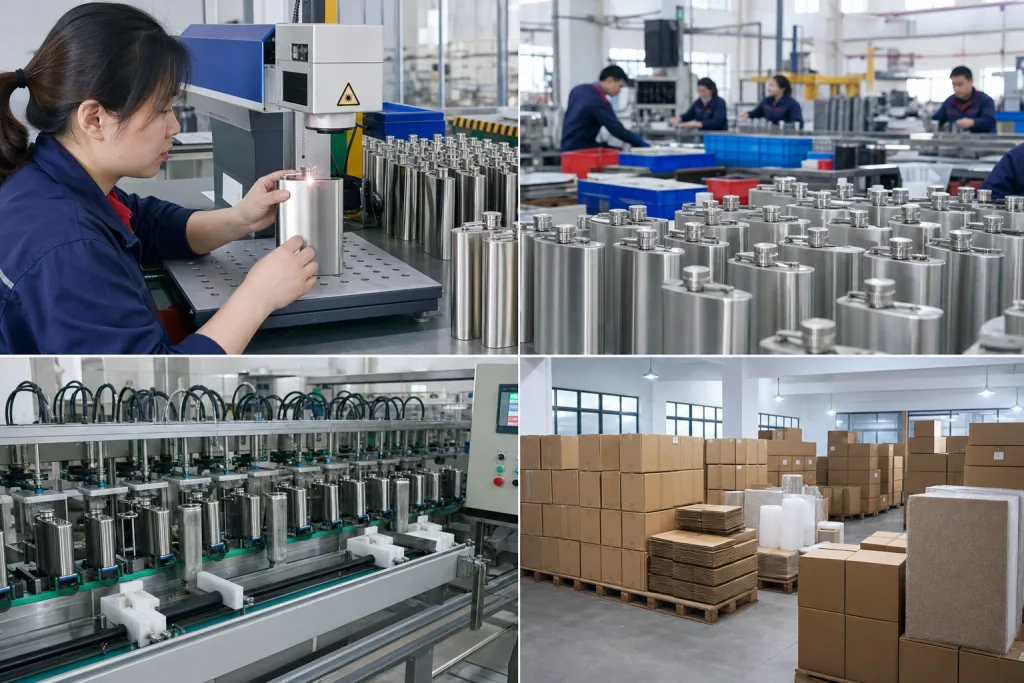
At our Zhejiang, China factory, we run flasks as small pressure-sensitive metal products, not cheap giveaways. The wrong question is “how low can the unit price go?” The buying decision needs to cover 304 stainless or other agreed steel grade, weld quality checked at the seam, surface finish thickness, cap fit by gauge, logo method after tape testing, packaging drop resistance, and final inspection before loading. Our Hangzhou production line handles about 480,000 drinkware units per month, with typical MOQ from 1,000 pieces per flask shape and 25-35 days lead time after artwork approval.
Leaks start with loose specifications
The costliest failure in a custom made alcohol flask order is not a crooked logo. It is leakage. A flask that leaks 5 ml in a handbag turns into a complaint your support team cannot talk around. We see leaks start in 3 places: mouth forming that is out by 0.2 mm, cap threads with shallow engagement, or a gasket picked from stock without checking the liquid contact surface.
For stainless flasks, specify 304 stainless steel for the body and cap contact parts, not vague “food grade stainless steel.” For mainstream 6 oz and 8 oz models, 0.4-0.5 mm body thickness is a practical range. Thinner metal may reduce FOB cost by USD 0.08-0.15 per unit, but the math does not work if the body dents during assembly or the mouth goes oval under the crimping fixture. We have seen QC pull 32 dented pieces from one 500-piece inline check. Bad saving.
The cap needs checks for thread engagement, gasket compression, and hinge strength if it uses a captive cap. Ask the canteen supplier to run a 100% water leak test, filled to at least 95% capacity, inverted for 30 minutes. For higher-risk programs, especially gift sets with funnels, add a random alcohol compatibility check; some low-grade gaskets swell after 24 hours in spirits, and the buyer only finds it after the Christmas set is already in retail cartons.
If you are comparing canteen manufacturers in China, do not only ask “does it leak?” That is the wrong question to ask. Ask what the factory does when 2% of caps fail during inline inspection. A serious Zhejiang canteen factory will quarantine the batch, adjust cap torque with a torque driver, change the gasket lot if needed, and retest. A weak canteen vendor will wipe the surface dry and pack it anyway.
Metal finish hides many sins
A polished flask can look clean in a sample photo and still fall apart when we run 3,000 pcs on the line. Mirror polish shows buffing waves near the shoulder. Brushed finish hides small handling marks but exposes wrong grain direction. Matte coating shows dust nibs. Electroplating shows cloudy black spots and thin color at the rim. Powder coating shows pinholes if the pre-treatment is rushed. On curved flask bodies, QC often catches defects by turning the piece under a 600 mm light box, because one bad angle is enough for the buyer to reject the carton.
For brushed stainless steel, write the grain direction into the spec and set the scratch limit before mass production starts. A practical inspection standard is no visible scratch longer than 5 mm on the main front logo area when viewed at 50 cm under normal light. Simple enough. For mirror polish, use stricter packing rules: gloves at final wipe, PE bag before the inner box, and no stacking bare bodies in the tray. Fingerprints and buffing marks show up fast. If you are ordering canteen promotional products for events, brushed finish usually gives better yield than mirror finish; we have seen mirror lots drop 8% at final QC just from hairline marks around the logo window.
Powder coating works for a custom canteen or flask program, but only if the coating survives real handling. Ask for a cross-hatch adhesion test and a simple 3M tape pull test on production samples. We cut the grid with a 1 mm blade, press the tape down, then pull at a sharp angle; if flakes lift at the corner, the line stops. For coated flasks, avoid sharp body edges because coating thickness builds unevenly at corners. If the design requires a deep matte black, approve a physical color chip, not only a digital rendering. The screen color is the wrong question to ask.
Electroplated finishes look premium, but they punish loose control. Rose gold, gunmetal, and rainbow effects can shift between batches, especially after the polishing wheel is changed or the plating bath runs past its target time. Your purchase order should allow a defined tolerance, preferably matched to an approved sealed sample. Without that sealed sample, two cartons made three days apart can look like two different SKUs; we had one buyer flag this after carton 17 because the gunmetal looked warmer under shop lighting. This is where a canteen manufacturer with stable polishing and finishing control is worth more than a USD 0.20 cheaper quote. The math doesn't work if you save USD 200 and then sort 1,000 pcs by hand.
Logo methods fail differently
Logo failure is not one problem; it changes with the decoration method. Silkscreen printing chips or rubs when the ink is under-cured, and QC will catch it with a 3M tape pull or a 500-cycle rub test on the line. Pad printing can squeeze the artwork on curved flask shoulders. Laser engraving lasts, but the mark may look weak on some matte finishes. Embossing needs tooling and can dent thin metal if the wall is only 0.4 mm. If your buyer only writes “logo included” on the PO, the spec is too loose.
For a custom made alcohol flask, laser engraving is usually the safest choice for long-term use. It stands up to pocket wear, carton rubbing, and normal hand cleaning. The look is the tradeoff. On brushed stainless steel, it reads clean; on black coating, it cuts through to silver metal and gives stronger contrast. For colorful brand artwork, silkscreen or UV printing works better, but we ask buyers to confirm ink adhesion and abrasion checks before we run mass production.
Artwork size also matters. A 70 mm wide logo on a 6 oz curved flask can wrap too far toward the side, and the buyer will flag the stretched letters after packing. Bad timing. Keep critical text inside the flattest front panel, usually checked with a paper gauge before the film is made. For small legal text, avoid fonts under 5 pt. If you need individual names or serial numbers, laser marking is faster than printing because we can feed the code file straight into the marking station for many customizable drinkware programs.
For distributor canteen orders, ask for a pre-production sample with the actual surface finish and the locked logo file, not a “similar” factory sample from last month. A blank sample tells you almost nothing about print risk. At BottleForge Industrial in Zhejiang, China, we normally need 7-10 days for this sample stage. This is the wrong place to save time: approving the right sample before mass production costs far less than arguing over a 10,000-piece logo reject after goods are packed.
Caps, funnels, and gift sets break margins
A flask program is rarely one flask only. On our line, 7 out of 10 gift orders include a funnel, two or four cups, a gift box, a sleeve, or a custom insert. Accessories eat margin quietly. A funnel with a rough edge scratches the flask mouth. Cups rattle in the box during ocean shipping. A paperboard insert collapses under stacking weight. At quotation stage, the buyer sees “gift set included” and thinks the job is done. QC sees it later on the packing table.
For funnels, specify stainless steel thickness and edge finishing. A typical low-cost funnel uses 0.25-0.3 mm material. It works for promotional use, but the edge must be deburred; we run a cotton-swipe check because burrs catch fibers fast. For a premium set, move closer to 0.35 mm. For cups, ask whether they are welded or deep drawn, and confirm that the rim is smooth. If the set is sold as barware, sharp rim complaints damage reviews fast. We have had a buyer flag 312 cup rims in one AQL pull because the rim felt “cheap,” not unsafe.
Gift box packaging needs to be tested like a product component, not treated as the last line on the PO. Use at least 800-1,000 gsm greyboard for rigid boxes, or specify E-flute corrugated for mailer-style packaging. If the order is intended for e-commerce, ask for a 1.2 m drop test on the packed unit; tape the actual funnel and cups inside, not dummy weight. For retail distribution, carton compression matters more: a 5-ply export carton is usually safer than a thin 3-ply carton for heavy flask sets. We have seen corner crush after 18 days at sea when the insert board was 1.5 mm instead of the approved 2.0 mm.
As a canteen vendor, we often see buyers fight for USD 0.05 off the flask body, then accept weak packaging that causes 3% damage. The math does not work. If your final sales channel is a canteen distributor, online marketplace, or corporate gifting campaign, build the set around the shipping route first, then tune the decoration. MOQ pressure is real, but saving USD 500 on cartons can turn into 60 replacement sets and one angry distributor email.
Compliance is not optional paperwork
Alcohol flasks are direct-contact drinkware, so compliance belongs in the spec sheet before the deposit hits our account. For Europe, buyers usually ask for LFGB or EU food contact testing, plus REACH screening for coatings or printed surfaces. For the United States, FDA food contact expectations apply, and some buyers request California Proposition 65 assessment based on the sales channel. We had one PO last March where the buyer typed “shot bottle for teen promo” in the item remark; QC flagged it before sampling. If the flask is part of a children’s or youth-themed line, stop and reassess the project; alcohol flask positioning and youth marketing do not belong together.
For stainless steel, the main concern is material grade and heavy metal migration. For coatings, inks, and plating, chemical risk rises fast. A plain brushed 304 stainless flask is easier to clear than a colored plated flask with full-surface artwork, especially when the artwork wraps over the welded corner radius. On the line, we check the body with an XRF gun and confirm wall thickness around 0.45-0.55 mm before polishing. If you need a low-risk program, cut the decoration complexity. Not fancy advice. It keeps cartons moving.
Factory audits matter too. BSCI, Sedex, ISO 9001, or customer-specific audits do not guarantee a perfect flask, but they show whether the canteen factory has documented process control. For larger canteen customized programs, ask for current audit status before sampling, not after the PP sample is approved. We have seen this go sideways when a buyer’s vendor manual required Sedex 4-pillar, while the supplier only had an expired BSCI report from 18 months earlier. If the supplier says the audit is “available later,” assume it may not match your customer’s vendor manual.
Testing also affects timing. A third-party lab test can take 5-10 working days after receiving samples. If your production lead time is 30 days and you wait until day 25 to begin testing, you built the delay yourself. The math does not work. We recommend testing the approved pre-production sample first, then locking the material lot, coating batch, and ink code before mass production starts. A good canteen supplier in China will record material lots and coating batches for traceability; in our shop, QC pulls one retained sample per SKU and tapes the batch label inside the inspection file.
Quantity planning changes the quote
MOQ is not a factory trick to annoy you. It comes from stainless sheet buying, press setup, laser jig time, line changeover, and printed box waste. For a standard custom made alcohol flask with one-color logo, we usually quote 1,000 pieces per design; below that, the setup cost eats the margin. For custom mold shapes, special caps, or full custom gift sets, MOQ often moves to 3,000-5,000 pieces because the stamping die, cap fixture, and foam insert knife mold have to be spread across the order. Last month QC pulled a 6 oz sample because the logo sat 2 mm off center after the jig was changed for a smaller trial run.
FOB pricing moves fast once finish and packing change. A basic 6 oz brushed stainless flask with laser logo may sit around USD 1.20-1.80 FOB China at volume, while a coated gift set with funnel, cups, and rigid box can move into the USD 3.00-6.00 range. The math does not work if you price a rigid box like a white tuck box; we see buyers miss USD 0.45 per set just on paperboard and EVA insert thickness. Custom growler and customizable growler projects need different tooling and larger stainless bodies, so do not use flask pricing to estimate them. The same applies to canteen customizable sports bottles or wider customized canteen programs.
If you are a distributor growler or distributor canteen buyer managing several SKUs, keep finishes tight. Running the same black coating across a flask, custom canteen, and custom growler reduces color matching problems and makes QC faster under AQL 2.5. Five similar black shades across five factories is how this goes sideways. The buyer flags “matte black” on the PO, the coating shop reads it as 10% gloss, and our line has 3 cartons that do not match the approved Pantone chip under the light box.
Lead time belongs in the purchase order, not only in a WeChat message. A reasonable schedule is 7-10 days for pre-production sample, 25-35 days for mass production after approval, and 3-7 days for final inspection and booking depending on season. Before Chinese New Year in China, add buffer. In Zhejiang, about 8 out of 10 upstream polishing and packaging workshops slow down before the final assembly factory, so a late artwork approval can turn a 12-day print slot into an 18-day wait. We ship plenty of rush orders, but after the carton mark is wrong or the PO has the logo color typo, the line stops.
Inspection must catch real failures
A final inspection that only counts cartons misses the failures buyers actually pay claims for. For custom drinkware, the inspection plan needs to match the real risks: leakage at the cap thread, pinholes after welding, dents under the powder coat, logo shift, short capacity, cap wobble, oily odor, weak inner boxes, barcode mismatch, and wrong carton side marks. Put the AQL terms in the purchase order before production starts. We once saw a PO with “matte black flask” typed as “mate black flask”; QC caught it at artwork sign-off, not at carton count.
For most B2B flask orders, AQL 2.5 for major defects and 4.0 for minor defects is workable. Critical defects, such as leakage or unsafe sharp edges, should be zero tolerance. The inspector should pull samples from sealed finished cartons, not from a clean table prepared by the factory office. Big difference. If the order includes FNSKU, retail barcode, or customer item labels, scan them with an actual scanner during inspection, not just by eye. A perfect flask with the wrong barcode is still a failed shipment, and the buyer flagged that exact issue on a 3,000 pcs Amazon order last year.
Capacity should be checked with water by weight. An 8 oz flask should not pass if it only holds 7.4 oz to practical fill level; the math does not work when the retail page promises 8 oz. Surface inspection needs fixed viewing distance and lighting rules, such as 30 cm under a 600 lux inspection lamp. Logo location should have a tolerance, for example ±2 mm horizontal and vertical from approved artwork position. These numbers stop the late-stage argument where sales says “acceptable” and the buyer says “crooked.”
The best canteen suppliers are not afraid of inspection because they already inspect inline. At BottleForge Industrial, our QC team checks incoming stainless coils, forming, welding, polishing, decoration, leak testing, and packing; on the line we run a pressure leak tester and pull samples before the goods reach the master carton. That does not replace your third-party inspection, but it cuts down surprises. Whether you buy from canteen vendors, canteen distributors, or direct canteen manufacturers, make inspection a shipment condition, not a polite request after the goods are finished.
Send your flask spec before you quote
Share capacity, finish, logo method, packaging, market, and target quantity. We will check the weak points before pricing.
Frequently asked questions
What is a realistic MOQ for a custom made alcohol flask?
For an existing 6 oz or 8 oz stainless steel flask shape, 1,000 pieces per logo is a realistic MOQ from a direct canteen manufacturer in China. If you need a custom color coating, printed gift box, or multiple accessories, 2,000-3,000 pieces is more practical because coating and packaging suppliers have their own minimums. For a new mold or unusual cap structure, expect 3,000-5,000 pieces plus tooling cost. If a supplier offers 100 pieces at mass-production pricing, check whether they are using stock goods with limited QC control.
Which logo method is best for flask orders?
Laser engraving is the safest choice for most B2B flask programs because it does not peel and handles abrasion better than printed ink. It works especially well on brushed stainless steel or black coated surfaces. Silkscreen printing is better when you need Pantone color, but you should request adhesion and rubbing tests. Embossing can look premium, but it needs tooling and a thicker body wall, usually 0.5 mm or more. For orders above 3,000 pieces, ask for a final pre-production sample using the real logo method before approving mass production.
Can one supplier handle flasks, canteens, and growlers together?
Yes, if the supplier has real stainless drinkware capability rather than only trading access. A factory that produces customized drinkware can often manage flasks, custom canteen orders, and customized growler programs under one QC system. The advantage is color consistency, shared packaging standards, and fewer communication gaps. The risk is assuming all products use the same process. A flask needs leak and cap-thread control, while a growler needs insulation, lid sealing, and larger body welding checks. Ask for separate specs and inspection checklists for each SKU.
What compliance documents should I request before production?
At minimum, request material declaration for 304 stainless steel, food contact test reports relevant to your market, and coating or ink compliance if the flask is colored or printed. For Europe, LFGB or EU food contact testing and REACH screening may be needed. For the U.S., confirm FDA food contact expectations and Proposition 65 risk if selling in California. Also ask for factory audit documents such as BSCI, Sedex, or ISO 9001 if your customer requires them. Start testing on the approved sample, because lab testing can add 5-10 working days.
How much time should I allow from artwork to shipment?
A safe schedule is 7-10 days for pre-production sampling after artwork confirmation, then 25-35 days for mass production after sample approval. Add 3-7 days for final inspection, carton correction if needed, and export booking. If your order includes custom packaging, plated finish, or multiple accessories, add another 5-10 days. Before Chinese New Year, plan even earlier because many Zhejiang and China subcontract processes, such as polishing and box printing, reduce capacity before the final assembly factory officially closes.