Key Takeaways
- A practical custom logo wine tumbler MOQ is usually 1,000 units per color for powder coating and 500 units for simple laser logo on stock colors
- For a 12 oz double-wall 304 stainless wine tumbler, FOB China pricing often sits around USD 2.35-4.20 depending on lid, coating, carton, and decoration
- Plan 7-10 days for pre-production samples and 30-40 days for mass production after artwork, deposit, and sample approval
- Use AQL inspection, adhesion tests, leak checks, and carton drop tests before shipment, not after goods arrive at your warehouse
A custom logo wine tumbler looks easy until you are staring at 5,000 units, a Pantone chip on the desk, a drop test spec, and a ship date tied to a promotion. The logo is the smallest risk. Lid snap, powder coat thickness, carton crush strength, barcode position, and whether QC can pull the same sample from the line decide if the order ships clean.
Here is a real RFQ-to-shipment path. You are buying customized drinkware from China for a distributor program in North America or Europe, and BottleForge Industrial in Hangzhou, Zhejiang, runs stainless steel drinkware with a wine tumbler MOQ of 1,000 units per color and monthly output near 600,000 units across tumbler, bottle, and canteen lines. If the artwork file is clean, we can get a sample turn in 12 days instead of 18; if the buyer flags a PO typo on 18oz versus 20oz, the booking slips, and we have seen that go sideways more than once.
Start with the real use case
Assume your customer wants a custom logo wine tumbler for a summer wine festival, corporate gift set, or retail seasonal display. Don’t ask for “a stainless wine cup with logo.” That is the wrong question to ask. We can quote it in 20 minutes, but the price often means nothing: the body might be 0.38 mm instead of 0.50 mm, the coating may scratch after 3 passes in a carton rub test, and the lid can feel like the cheap part the buyer flagged during pre-shipment inspection.
Write the RFQ like a buyer, not like a consumer. Specify capacity, body material, insulation, finish, lid type, logo process, packaging, compliance market, and delivery term, with enough detail for the line to build the same sample twice. For example: 12 oz wine tumbler, double-wall vacuum insulated, inner and outer 304 stainless steel, powder coated in Pantone 548 C, clear AS press-in lid, one-color logo, individual kraft box, master carton suitable for courier handling, FOB Ningbo or Shanghai. On our side, QC pulled the sample with a 600 g press-fit lid gauge last month because the lid was tight on the golden sample but loose after coating thickness changed.
If you also buy canteen custom products or distributor drinkware, keep the specification language consistent across the range. A custom canteen, customized growler, and wine tumbler can share the same powder coating code and logo artwork file, but not the same lid test or carton design. We’ve seen this go sideways when 4 SKUs were combined in one PO and the buyer wrote “same packing as canteen” for the wine tumbler; the insert tray left 8 mm of movement, and the courier drop test failed on the corner.
For Europe, ask about LFGB, REACH, and food contact documentation. For the United States, ask about FDA food contact, California Proposition 65 review where needed, and CPSIA only if the item is positioned for children. China factories can provide documents, but confirm the exact market before sampling. Zhejiang suppliers run dozens of export programs each season, and we still need a clear compliance target from you, not a line on the PO that says “standard certs required” with the market name missing.
Lock the product specification early
The usual B2B wine tumbler spec sits at 10 oz, 12 oz, or 14 oz. For promo work, we push 12 oz unless the buyer has a shelf-size reason: it looks like a real gift, still packs well, and does not feel bulky in hand. A normal body starts with 0.4 mm to 0.5 mm stainless steel before forming. Go thinner and the math looks good on the quote sheet, then QC starts seeing rim dents after polishing. Go thicker and the cup feels better, but FOB and carton weight move up fast. We checked one 12 oz line last month at 24 pcs/carton, and the buyer flagged freight before they flagged unit price.
For material, 304 stainless steel is the standard for inner food contact surfaces. Some low-cost quotations use 201 stainless steel on the outer wall. That is acceptable only if it is written clearly in the spec, not hidden in a vague “stainless steel” line on the PI. If your customer expects premium custom drinkware, use 304 inner and 304 outer. For acidic beverages and stronger corrosion resistance, some buyers ask for 316 inner, but this is less common on wine tumblers and adds cost. We have seen this go sideways when a PO said “SS304” and the factory read it as inner wall only, so spell out inner 304 / outer 304 or inner 304 / outer 201.
Decide early whether the tumbler is vacuum insulated or simple double-wall air insulated. Vacuum insulation is now expected for most modern customized drinkware programs. A good 12 oz vacuum wine tumbler should keep cold drinks noticeably chilled for several hours, but do not sell 12-hour or 24-hour claims without a written test method. Use starting water temperature, room temperature, fill volume, lid status, and time interval. On our bench we run a digital probe and 300 ml fill for comparison samples; without that, two suppliers can both “pass” while showing different results.
The lid needs more attention than buyers usually give it. A press-in clear lid with silicone gasket is common. Slider lids cost more and add assembly defect points. For a canteen promotional set or gift bundle, some buyers ask for a straw slot; for wine positioning, a simple sip opening looks cleaner. Ask for lid material, gasket material, and spare gasket policy. This is the wrong place to save half a cent. A canteen manufacturer may be strong in bottles but weak in tumbler lids, so test actual assembled samples before approval. QC pulled one sample with a 0.8 mm gasket gap after drop testing, and that cup would have leaked in the first customer video.
Choose decoration that survives handling
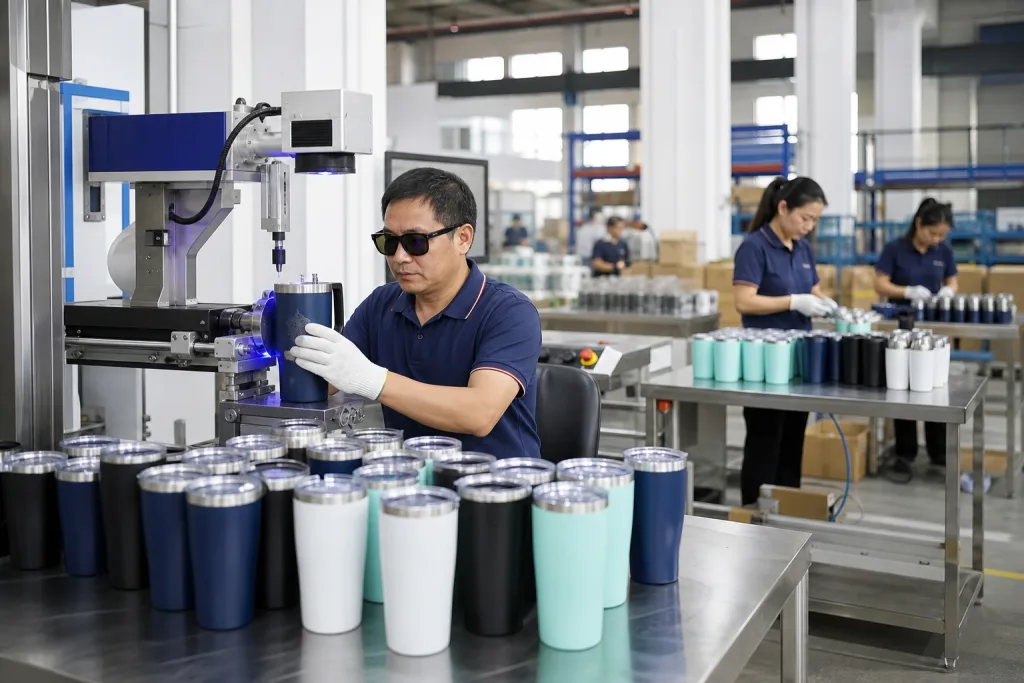
Your logo method has to match the finish and the sales channel. For a custom logo wine tumbler, we usually quote laser engraving for powder-coated bodies, silkscreen for spot-color logos on smooth paint, or heat transfer when the artwork has gradients or a wrap. Laser engraving is the safest bet on powder coating because our 20W fiber laser cuts through the coating and shows the 304 stainless underneath. Clean edge. No ink to peel. We use it for corporate programs, wine clubs, and distributor canteen catalogs where the buyer changes 6 to 12 logos per season but keeps the same tumbler body.
Silkscreen printing is better when the buyer needs a matched Pantone ink color on a smooth surface. It works for one- or two-color logos, but adhesion cannot be guessed from a nice photo. On powder coating, the line needs the right ink system, curing temperature, and dwell time; last month QC pulled the sample after 48 hours because the white ink softened at the rim. A simple tape test is not enough for retail goods. Ask for a cross-hatch adhesion test, 3M tape pull, and at least a basic rub test. If the tumbler goes into a gift box with paper inserts, check whether the ink transfers during 45°C heat and humidity storage.
Heat transfer gives you complex graphics, gradients, and full-wrap artwork. It costs more and setup is slower: for our line, laser samples are usually 3 to 5 days, while heat-transfer pre-production samples often take 10 to 14 days because the film, fixture, and alignment all need checking. For 1,000 units, the math often does not work unless the design needs full color. For 5,000 to 20,000 units, it becomes more practical. If your customer sells through retail or online marketplaces, artwork placement must be controlled within tolerance, usually plus or minus 1.5 mm to 2 mm depending on the tumbler shape and fixture.
Do not approve decoration from a flat PDF alone. Ask for a real sample photo under neutral lighting, plus one physical pre-production sample; we shoot against a grey card because bright factory lights can hide a crooked logo. If you are buying from a canteen supplier that also produces wine tumblers, confirm they have the right jig for the curved tumbler wall. We have seen this go sideways: a logo that looked centered on a straight bottle sat 3 mm high on a tapered wine tumbler, and the buyer flagged it only after carton inspection.
Build a quote you can compare
A quote worth comparing needs more than one unit price. Ask the supplier to break it out by order quantity, finish, logo method, and packaging type. For example, a 12 oz vacuum custom logo wine tumbler may quote around USD 2.35-2.80 FOB for a stock powder color with laser logo at 1,000 units, USD 2.70-3.40 for custom Pantone coating, and USD 3.20-4.20 with premium retail box, insert, barcode labeling, and multi-color decoration. Real ranges, not promises. Last month our costing sheet moved 6 cents because 304 stainless and white kraft paper both changed before the PO was signed.
MOQ follows the customization, not the buyer’s wish list. Stock body color with laser logo can sometimes start at 500 units. Custom powder coating usually starts at 1,000 units per color because the coating line loses time during color changeover, and we still need to clean the spray gun, booth filter, and hanging hooks. Custom molded lid parts can push MOQ to 5,000 or 10,000 units. If you need a canteen customizable family with wine tumbler, custom growler, and custom canteen in matching colors, expect each body shape to have its own MOQ. One buyer flagged this as “same color, same MOQ,” but the math doesn’t work when three body tools run on different fixtures.
Separate tooling, sample, and mass production charges. Logo setup may be USD 30-80 per design for screen or fixture work. A new mold is much higher and rarely justified for a first wine tumbler program. Pre-production samples typically cost USD 50-150 including decoration, sometimes refundable after bulk order. Air freight for samples is usually extra. We run sample logos on a positioning jig first; QC pulled one sample last week because the laser mark sat 3 mm off-center against the cup seam.
Payment terms for new buyers from China are often 30% deposit and 70% before shipment after inspection. Established distributor drinkware customers may negotiate better terms after several clean orders. Be careful if a canteen vendor offers a price 15% below the market without explaining material, wall thickness, coating, packaging, or inspection standard. We’ve seen this go sideways: the PO said “gift box,” the supplier packed plain white box, and the buyer only caught it during AQL 2.5 inspection. The cheapest line item often becomes the most expensive claim.
Sample approval is not a formality
The pre-production sample is your contract in physical form. Don’t treat it like a photo prop. Fill it with water to the practical fill line, not only to the brim, then write down the ml result on the sample tag. Weigh the tumbler on a 0.1 g digital scale and record it. Measure height, top diameter, bottom diameter, and wall thickness with calipers if you have them. Check that the lid seats flat and does not pop out when the cup is squeezed by hand or tilted 45 degrees. QC pulled one wine tumbler sample last month with a 1.2 mm lid gap; the buyer missed it in photos, then flagged it after air shipment.
For color, compare the powder coating against Pantone under a D65 light box or another agreed light source. Powder coating on stainless steel will not look exactly like ink on paper, and pretending it will is the wrong question to ask. Agree on an acceptable visual range before mass production. If your brand owner needs tight color control, approve a sprayed metal color chip, not just a Pantone code on the PO. Keep one signed sample at your office and one at the factory in Zhejiang; we usually tape a dated approval label across the box flap so nobody swaps it on the line.
For logo, check size, position, edge quality, and rotation. A 60 mm wide logo may look good on a 12 oz tumbler, while 75 mm may wrap too far around the curve and disappear from the front view. For laser engraving, inspect whether the mark is clean or smoky under side light. For silkscreen, test adhesion after 24 hours with 3M tape, not right after printing while the ink still feels fresh. If the tumbler is dishwasher-safe, define the dishwasher test cycle in writing. We’ve seen this go sideways: the buyer approved “dishwasher-safe” in email, but the user instructions said hand-wash recommended, and the claim came back after 2,000 pcs shipped.
Packaging samples matter too. A retail box made from 300 gsm paperboard feels different from 350 gsm, especially once the lid presses against the top panel. If the goods ship by parcel or FBA-style handling, inner protection must stop lid scuffing and body dents. Ask your canteen factory or tumbler supplier to pack one sample exactly as mass production, with the same polybag, EPE insert, carton flute, and sealing tape. Then run a basic drop test before approving the carton structure. We ship enough parcel orders to know the math doesn’t work if the box looks premium but fails at the first corner drop.
Control production with practical QC
Check mass production in stages. We run a mid-production check when 20% to 30% of goods are finished, especially on a new powder coat color or a first-time logo. Final random inspection should happen when 100% is produced and at least 80% is packed. Use AQL, commonly AQL 2.5 for major defects and 4.0 for minor defects, unless your customer requires a tighter standard. On the line, QC usually pulls cartons with a random number table, then checks against the signed PP sample under a D65 light box.
Define defects before inspection. Major defects include sharp edges, rust, wrong material, failed vacuum insulation, loose lid, serious coating chip, incorrect logo, barcode error, and wrong carton mark. Minor defects include small dust dots in coating, slight color variation within approved range, tiny box rub marks, or small logo position variation within tolerance. Write the tolerance down in mm. For example, we allow a 1.5 mm logo position shift only if the approved artwork says so. Without this list, you will argue after the inspector opens cartons. We have seen this go sideways when a buyer called a 0.8 mm laser mark offset “brand damage” after packing was done.
For a custom logo wine tumbler, QC should include vacuum test, visual coating check, logo adhesion or engraving check, lid fit check, capacity check, odor check, carton count, gross weight, and packaging drop test. QC pulled the sample into the 85°C hot water test last month and caught 17 lids with slow seepage before carton sealing. If you are shipping to Amazon or another marketplace, FNSKU label placement and scanability should be checked at inspection with a handheld scanner, not by eyesight. For distributor canteen and distributor growler programs, carton labels often need customer SKU, PO number, color, quantity, and country of origin. One typo on a PO number can hold 120 cartons at the receiving dock.
At BottleForge Industrial, a normal 5,000 unit wine tumbler order from approved sample to ready shipment is about 30-40 days, depending on coating queue and packaging. Hangzhou, Zhejiang is close to Ningbo and Shanghai ports, which helps with export routing. Port distance is the wrong question to ask if artwork is still moving. A vessel cut-off can be 12 days away, but a delayed logo approval can turn 30-40 days into 45 days fast. If your event date is fixed, freeze artwork and packaging before deposit, not two weeks into production. We ship cleaner when the buyer signs the mockup, carton mark, and barcode file in one email.
Plan freight, cartons, and reorder data
Wine tumblers take up carton space fast for their FOB value, so freight planning changes the real landed cost. A 12 oz tumbler in an individual box may pack 24 or 36 units per master carton depending on box size and EPE or egg-crate protection. Ask for carton dimensions and gross weight before you confirm the PO; for one matte black order last month, QC measured 52 × 35 × 28 cm at 9.6 kg on the scale, and the forwarder changed the quote the same day. Your forwarder needs this to price sea freight, rail, truck, or air. Air kills margin. Use it for approval samples, urgent top-up orders under 300 pcs, or small VIP batches where the buyer already accepts the freight hit.
For North America, 7 out of 10 buyers we work with choose FOB Ningbo or FOB Shanghai and let their forwarder handle consolidation. For Europe, some buyers ask for DDP because the number looks simple, but DDP rolls duty, VAT, and customs risk into one line. This is the wrong question to ask if your team needs cost control. If you are new to importing from China, FOB plus your own forwarder is cleaner; we have seen DDP quotes go sideways when the HS code was keyed wrong by one digit on the booking sheet. Once you know landed cost per tumbler, you can compare canteen suppliers and tumbler suppliers without guessing.
Keep a reorder file after shipment: approved sample photos with date stamps, material spec, coating color, logo file, box dieline, carton marks, inspection report, HS code, and final packing list. Boring file. Big money saver. Six months later, your customer will ask for the same champagne powder coating and the same 45 mm logo position, and “close enough” will not pass. QC pulled the sample against a reorder once and found the old PO said PMS 872C while the artwork file showed PMS 871C; that typo would have changed the whole look. A good canteen distributor or drinkware distributor wins repeat business by controlling these details, not by sourcing every order from zero.
If you plan to expand from wine tumblers into customized canteen, customizable growler, or canteen customized gift sets, build the range around shared colors and decoration rules. Use the same matte black, white, navy, and stainless finish across the line, then set logo size limits by product shape instead of approving every SKU from scratch. That can cut sampling from 18 days to 12 days when the coating and logo method already passed on the wine tumbler. The line likes repeat rules too; one jig setting for laser position is better than four last-minute buyer requests. Strong canteen manufacturers and canteen vendors will help standardize the range, but you still need to own the specification.
Send your wine tumbler spec for factory review
Share capacity, logo, color, quantity, market, and deadline. We will check feasibility, MOQ, pricing range, and sampling path before you commit.
Frequently asked questions
What is a realistic MOQ for a custom logo wine tumbler?
For most China factories, 500 units is possible only when you use an existing tumbler body, stock color, and simple laser logo. For custom powder coating, plan on 1,000 units per color. If you need a new lid color, special box, or full-wrap artwork, MOQ often moves to 2,000-5,000 units. Custom molded parts can require 5,000-10,000 units because tooling and plastic injection setup are involved. If you are testing a new account, start with 1,000 units in one color and one logo. That is large enough for stable production but not so large that a specification mistake becomes painful.
How long does production take after sample approval?
A normal timeline is 7-10 days for a decorated pre-production sample, then 30-40 days for mass production after approval and deposit. Packaging with custom dielines or retail inserts can add 5-7 days if artwork is late. Inspection and booking usually take another 3-7 days before vessel departure. For a fixed event date, work backward at least 75-90 days if shipping by sea to North America or Europe. Air freight can shorten transit, but it may add USD 1.50-4.00 per unit depending on carton size and destination.
Which logo method is best for wine tumblers?
Laser engraving is usually the safest for a custom logo wine tumbler with powder coating. It is durable, clean, and economical for changing logos across distributor programs. Silkscreen is better when the logo must be a specific printed color, but it needs adhesion testing on the coating. Heat transfer is best for full-color or wraparound graphics, especially above 5,000 units where setup cost spreads out. For first orders, avoid overcomplicated decoration. Approve one physical sample, check logo position within about 1.5-2 mm tolerance, and keep the signed sample for inspection reference.
What quality tests should I require before shipment?
Use a final random inspection with AQL 2.5 for major defects and 4.0 for minor defects unless your retailer specifies otherwise. Tests should include capacity check, vacuum insulation spot check, lid fit, coating appearance, logo accuracy, adhesion for printed logos, odor check, barcode scan, carton quantity, and drop test for packed cartons. For food contact, request FDA or LFGB-related documents depending on market, plus REACH review for Europe when relevant. If your goods are marketplace-bound, also check FNSKU labels, suffocation warnings for polybags if used, and master carton marks before paying the balance.
Can I combine wine tumblers with canteens or growlers in one order?
Yes, but each SKU usually has its own MOQ, sample approval, and inspection criteria. A canteen customizable bottle, customized growler, and wine tumbler can share the same powder coating color and logo file, but lids, leak tests, carton sizes, and decoration jigs are different. Combining SKUs may help freight consolidation, especially from Zhejiang or nearby China ports, but it does not automatically reduce production MOQ. For a first program, keep the range to 2-3 SKUs, use one or two colors, and standardize carton marks and barcode rules across all items.