Key Takeaways
- A realistic custom logo vacuum flask MOQ starts at 500 pcs for stock colors and 3,000 pcs for custom powder coating
- Most 500 ml to 750 ml stainless vacuum flasks quote between USD 3.20 and USD 7.80 FOB China depending on steel, lid, finish, and packaging
- Normal production lead time is 25-35 days after deposit and artwork approval, with 7-12 extra days for complex packaging
- Use AQL 2.5/4.0 inspection and require 304 inner stainless steel, vacuum testing, and coating adhesion checks
A custom logo vacuum flask looks simple on a quote sheet: capacity, color, logo, carton size, FOB price. Then two thermos quotes land USD 0.80 apart and both suppliers write “same quality.” That is where orders go wrong. For outdoor retailers and promotional brands, USD 0.80 on a 5,000 pcs PO is USD 4,000, and it can decide margin, ship date, and whether the bottle comes back with dents after one season of real use. Last month QC pulled a 500 ml sample from the line and found the powder coat 18 μm thinner than the approved sample. Same photo, not the same bottle.
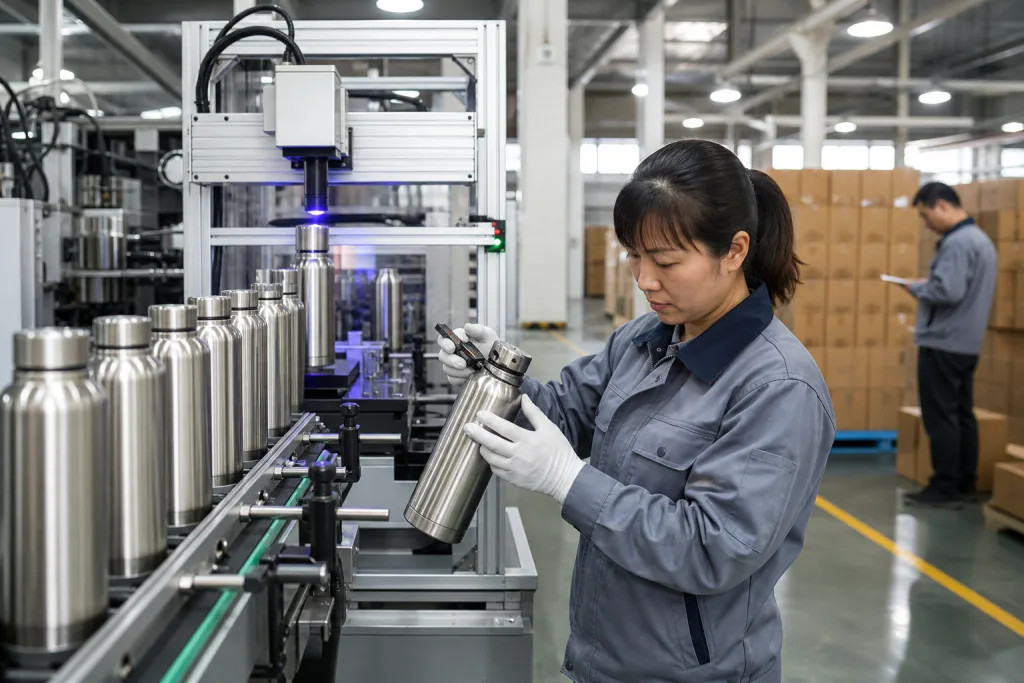
At our Zhejiang factory, buyers ask practical questions: what MOQ is realistic, how much powder coating adds per piece, when laser engraving beats silk screen printing, and whether a launch needs 12 days or 18 days before booking space. We run these checks with a coating thickness gauge, a 24-hour hot water test, and a carton drop test before we talk about “premium quality.” The wrong question is “which quote is cheaper?” The better question is which supplier priced the steel grade, finish, logo method, packing, inspection time, and rework risk honestly. Below is the cost and lead-time breakdown we use with new bulk thermos buyers sourcing from China.
Where the unit cost really moves
For a custom logo vacuum flask, the stainless body is not where the quote ends. Buyers often sort the sheet by capacity first; that is the wrong question to ask. The price moves on steel grade, wall thickness, lid structure, surface finish, decoration method, and packaging spec, with each line item tied to a real process on the floor. A 500 ml manufacturer thermos with a simple PP lid and stock matte black finish can be FOB Ningbo around USD 3.20-4.20 at 3,000 pcs. The same shape with a leakproof push-button lid, custom powder coat, laser logo, and color box can move to USD 5.20-6.80. Last month QC pulled the sample after the buyer flagged a 1.5 mm lid gap; fixing that gap changed the silicone ring and added USD 0.08 before mass production.
Most outdoor retail buyers should ask for 304 stainless steel inside and outside, or at least 304 inner with 201 outer if the target price is tight. For food-contact and brand reputation, I do not recommend reducing the inner liner to 201. The saving may be USD 0.15-0.25 per unit, but corrosion complaints cost more than that. We have seen this go sideways after a salt-water rinse test: 201 inner looked fine on day 1, then small rust points showed by day 6 under the bench lamp. The math doesn't work.
Wall thickness also matters. Common stainless vacuum flask bodies use about 0.40-0.50 mm sheet before forming. A heavier-gauge shell feels better in hand and dents less in the drop test, but it raises material cost and shipping weight; on a 3,000 pcs order, even 18 g extra per bottle changes the carton weight and freight quote. Vacuum performance depends more on the weld seam, evacuation time, and copper lining quality than on thickness alone. On the line, we check the mouth weld with a 0.02 mm feeler gauge before the vacuum furnace run.
For a promotional thermos order, buying the lowest price and accepting a thin body can work for a 10-day event giveaway. Different job, different standard. For a retailer SKU expected to carry reviews, returns, and repeat orders, spend the extra USD 0.30-0.60 on body quality and lid reliability before paying for fancy packaging. We ship plenty of color boxes, but a nice box will not save a lid that leaks at 45 degrees in the inverted test.
MOQ tiers you can actually use
MOQ is not a factory trick; it comes from color changeover, material purchasing, logo setup, packaging printing, and carton planning. For a custom thermos using an existing mold and stock colors, 500 pcs per model is usually workable. At 500 pcs, expect 2 or 3 stock color choices, a higher unit price, and simpler logo processes such as laser engraving or one-color silkscreen. We run this on standard fixtures, and QC checks logo position with a 0.5 mm tolerance gauge before packing. This tier suits small outdoor shops, event programs, and pilot launches.
At 1,000-2,000 pcs, pricing starts to behave better. A thermos supplier can usually hold steadier costs, split two colors, and accept custom logo placement without treating the order like a sample job. For 7 out of 10 distributor thermos programs we quote, 1,000 pcs per SKU is the point where the factory team can plan the line properly without pushing the buyer into dead stock. One buyer flagged this last month: 800 pcs looked cheaper on paper, but after film setup and export carton changes, the math did not work.
At 3,000 pcs and above, custom powder coating, private color matching, retail color boxes, and tighter production scheduling become realistic. Our Zhejiang line capacity for stainless vacuum products is about 450,000 units/month across models, but production slots are still booked by color, mold, and finishing process. If you want Pantone-matched coating, plan MOQ around 3,000 pcs per color because the paint room and curing line have setup loss. We usually lose 30-50 pcs during spray gun adjustment, hanging hook marks, and first-round adhesion testing.
For thermos bulk orders above 10,000 pcs, the discussion changes. You can negotiate tool amortization, carton layout, pallet loading, and a fixed QC plan. You can also lock materials earlier, which helps when stainless steel prices move. Large thermos distributors should ask for tiered quotes at 3,000, 5,000, and 10,000 pcs instead of one flat number. Ask for the pallet plan too; we have seen a PO approved with the wrong carton size typo, and the buyer lost 4 cbm in the container before anyone noticed.
Decoration costs and artwork delays
Logo decoration is where a custom logo vacuum flask schedule often loses 7 days. The low-cost choice is usually one-color silkscreen, around USD 0.08-0.18 per position at volume. We run it on smooth powder coating with a 120T mesh screen, but fine lines under 0.2 mm can fill in on curved bodies. For promotional brands with a simple mark, the math works.
Laser engraving costs more, usually USD 0.15-0.35 per unit depending on logo size and line speed, but it gives a cleaner, tougher result. On powder-coated bottles, the laser burns off the coating and exposes 304 stainless underneath. QC pulled samples after a 3M tape test last month, and the poor print failed before the laser mark moved. For a premium customized thermos, laser is worth the small upcharge.
Full-wrap printing, heat transfer, and UV printing turn a thermos customizable with multi-color art, gradients, campaign graphics, and edge-to-edge placement, but cost and scrap rate both climb. Expect USD 0.45-1.20 per unit depending on coverage and registration tolerance. We have seen this go sideways when a buyer approved a 360° wrap without checking the handle-side seam. Ask for a pre-production sample and rub test before bulk production.
The most common artwork delay is not the factory. It is a 96 dpi logo, missing Pantone code, or placement marked as “center” with no millimeter size. Send AI, EPS, or PDF vector files, specify logo size in millimeters, and mark the front-facing direction relative to the lid. For retail packaging, barcode, FNSKU, warning text, country of origin, and REACH-related material statements need checking before printing plates are made. One missed barcode can add 5-7 days; one PO typo on “matte black” versus “matt black” already cost one buyer a full sample round.
A realistic lead-time calendar
A normal custom logo vacuum flask order from China should not be counted from bulk production only. Build the calendar from sample, artwork approval, deposit, material prep, production, inspection, and freight booking. For a stock-shape order, we plan 40-55 days before vessel departure. If the buyer wants a custom Pantone coating and printed gift box, use 55-70 days. We see this go sideways when a PO says “ready in 30 days” but the dieline is approved 9 days late.
Sampling usually takes 5-10 days for an existing factory thermos model with laser logo or silkscreen. A new lid, new mold, or special finish can push sampling to 15-25 days. Do not skip the physical sample for retail SKUs. Photos hide lid fit, powder texture, and hand feel. QC pulled one 500 ml sample last month where the lid thread felt tight after 3 turns, and the buyer only caught it because we couriered the sample.
After sample and artwork approval, bulk production is commonly 25-35 days for 1,000-5,000 pcs. Before summer outdoor campaigns and Q4 promotional orders, add 7-10 days. Zhejiang supply chains move fast, but the line still waits for powder coating slots, carton printing, and final packing space. The math does not work if 5,000 pcs need a matte black finish and the coating room is already booked for two 20-foot container runs.
Pre-shipment inspection normally happens when goods are 100% packed and at least 80% finished. Book inspection 3-5 days before the planned loading date. If the order fails AQL, sorting or rework can take 3-8 days. For sea freight to North America or Europe, add 25-40 days on water depending on port and service. Air freight works for urgent promotional thermos orders, but the freight can exceed the bottle cost. We ship it only when the buyer accepts that trade-off in writing.
Packaging choices that change margin
Packaging is not presentation alone. It moves unit cost, damage rate, carton volume, warehouse handling, and shelf readiness. We run pack-out checks on the line with a caliper and a 20 kg scale before we sign off. A plain white box may add USD 0.12-0.25 per unit. A four-color retail box with matte lamination can add USD 0.28-0.60. A rigid gift box can add USD 0.80-1.80 and push the carton size up enough to lift freight per piece. The math does not work if the box looks nicer but eats margin.
For outdoor retailers, I would take a strong printed tuck box or kraft retail box over oversized gift packaging every time. It protects the bottle, looks honest, and does not waste shelf or warehouse space. Last month QC pulled the sample after a 1.2 m drop test because the shoulder insert left a 3 mm gap and the lid kissed the box wall. A dented shoulder from weak inner support is a defect we see again and again. One buyer flagged a PO because the carton was 18 mm taller than spec. That killed pallet efficiency.
For promotional brands, carton efficiency is where margin lives. A 500 ml thermos custom order might pack 24 pcs per export carton, while a bulkier handle-lid model may pack only 12 pcs. That changes freight cost per unit fast. We checked one carton at 560 x 370 x 320 mm, and the buyer asked why the shipper invoice jumped by 14%. Ask your thermos vendor for carton dimensions, gross weight, and CBM before you lock the bottle shape. Waiting until after sample approval is the wrong question to ask.
If you supply large retailers or fulfillment centers, label planning belongs in the packaging quote. FNSKU labels, carton marks, suffocation warnings for polybags, and country-of-origin marking need labor, not guesswork. Our Zebra printer on line 3 runs those stickers one roll at a time, and a typo on a PO can stall the whole batch. We had one case where “orign” was printed on 8,000 cartons and the buyer made us rework them. Do not assume your suppliers thermos team will throw that in free after production; small labels still take time, and the line has to stop to get them right.
Quality checks worth paying for
Good vacuum flasks fail in boring ways: poor vacuum retention, leaking lids, weak coating adhesion, sharp rim edges, wrong logo color, or cartons crushed at the corner after stacking. We see it on the line. A serious thermos manufacturer should keep incoming steel checks, vacuum test logs, leak test records, and final inspection sheets with photos. Ask for the QC checklist before you place the order, not after defects appear; last month QC pulled 32 pcs with 0.4 mm burrs on the drinking rim during a pre-pack check.
For stainless steel, request 304 inner liner confirmation and food-contact compliance documents suitable for your market. European buyers often ask for LFGB or REACH-related declarations. North American buyers may request FDA food-contact statements and ASTM-related test references for children’s products where applicable. If it is a kids bottle, standards and labeling become stricter. Small detail, big headache: we once had a PO typo listing “316 inner” while the approved sample was 304 stainless, and the buyer flagged it before deposit.
AQL inspection is the practical export method. For B2B orders, we usually see AQL 2.5 for major defects and 4.0 for minor defects, with critical defects at 0. For a 3,000 pcs order, that usually means a few hundred units are checked depending on inspection level. Tests should include leak check, hot water retention sample test, coating tape test, logo rub test, lid thread fit, odor check, and carton drop check. Do not skip the boring parts. On a 5,000 pcs run, one loose silicone ring can turn into 200 complaints if nobody checks lid assembly with a torque gauge.
For performance, most 500 ml stainless vacuum flasks should keep hot water above roughly 55-60°C after 12 hours when starting near 95°C, depending on opening size and lid design. Be careful with exaggerated claims. Wide-mouth outdoor flasks with complex lids may not match narrow-mouth models. Printing “keeps hot 24 hours” on every shape is the wrong question to ask; the math does not work if the mouth is 58 mm and the lid has three plastic parts. It is better to print a conservative claim than handle return disputes later.
How to compare supplier quotes
Compare thermos supplier quotes in one spreadsheet, line by line. Show capacity, steel grade, coating type, lid material, logo method, packaging, MOQ, lead time, Incoterm, sample cost, and validity period. “500 ml bottle, logo included” is not a specification. It is a future argument. We had one PO come in with “black cup” only; QC pulled the sample and found matte powder coating on one quote, glossy spray paint on another.
FOB China is usually the cleanest price basis for distributor thermos buyers who control freight. EXW looks lower on paper, then local trucking from Hangzhou to Ningbo, export handling, and customs docs land back on your desk. DDP is handy for trial orders like 500 pcs, but it hides freight and duty assumptions. Ask for the FOB equivalent anyway. You need to know the real bottle cost before arguing over 0.18 USD on a lid.
Check whether the manufacturer thermos quote includes pre-production sample approval, and write down what happens if the sample fails. Ask if the price is tied to the current stainless steel cost and how long it stays valid; 15-30 days is normal. For repeat programs, ask the thermos factory to keep a golden sample and batch record. On our line, we mark logo height in mm, Pantone number, lid torque feel, and carton weight, because “same as last order” is where reorders go sideways.
Do not choose a supplier only because they say yes to every request. This is the wrong question to ask. A reliable China factory will push back on unrealistic MOQ, weak artwork, risky coating, or delivery dates that leave no inspection time. We have told buyers that 12 days for mass production plus logo printing is not the same as 18 days with a real AQL check. That pushback is not bad service. It is how experienced thermos supplier teams protect your launch date and your margin.
Get a priced flask quote before your launch calendar tightens
Send capacity, MOQ, logo file, packaging plan, and target delivery date. We will return a practical FOB China quote with lead time.
Frequently asked questions
What is the minimum order for a custom logo vacuum flask?
For an existing stainless thermos shape, 500 pcs is a realistic starting MOQ if you accept stock colors and a simple logo such as laser engraving or one-color silkscreen. For custom powder coating, Pantone color matching, or printed retail packaging, plan around 3,000 pcs per color. Some factories advertise 100 pcs, but the unit cost is high and the order often runs through sample or trading stock, not a stable production line. For a retailer test order, 500-1,000 pcs is sensible. For a promotional campaign with a fixed event date, 1,000-3,000 pcs gives better pricing and more reliable production scheduling.
How much should I budget for a 500 ml custom thermos?
A practical FOB China range for a 500 ml custom thermos is USD 3.20-7.80 depending on construction. The low end usually means existing mold, stock color, basic lid, simple box, and one-position logo. A stronger retail-grade version with 304 stainless steel, better powder coating, laser logo, leakproof lid, and printed color box often lands around USD 5.00-6.80. Full-wrap artwork, premium lids, gift boxes, or small MOQ can push it higher. Always compare quotes with the same steel grade, lid design, decoration method, packaging, and Incoterm, or the price comparison is not useful.
How long does bulk thermos production take after sample approval?
For bulk thermos production using an existing model, normal lead time is 25-35 days after deposit and final artwork approval. Add 5-10 days if you need a pre-production sample with logo, and add 7-12 days for custom printed boxes or special labels. Custom powder coating may add another week during busy seasons because the coating line has batch scheduling. A safe purchasing calendar is 40-55 days before vessel departure for simple orders and 55-70 days for custom color plus retail packaging. Sea freight to Europe or North America then adds roughly 25-40 days depending on port.
Which logo method is best for outdoor retail thermos products?
For outdoor retail, laser engraving is usually the safest logo method because it is durable, clean, and does not peel. It often costs USD 0.15-0.35 per unit depending on logo size. One-color silkscreen is cheaper at about USD 0.08-0.18 per unit and works well for promotional thermos orders, but abrasion resistance depends on ink and coating. UV printing and heat transfer are better for multi-color graphics, but they need stronger testing: rub test, tape test, dishwasher-related claim control, and sample approval. If your bottle will be handled outdoors, clipped to bags, or sold at premium price, choose durability before color complexity.
What quality documents should a thermos manufacturer provide?
At minimum, ask your thermos manufacturer for material confirmation, food-contact declarations, QC checklist, and pre-shipment inspection plan. For Europe, buyers often request LFGB or REACH-related documents. For North America, FDA food-contact statements are common, and ASTM-related requirements may apply for children’s drinkware. You should also require AQL inspection, commonly 2.5 for major defects and 4.0 for minor defects, with critical defects at 0. The inspection should cover leak testing, vacuum performance sampling, coating adhesion, logo position, odor, sharp edges, carton strength, and barcode or FNSKU accuracy if used.