Key Takeaways
- A basic 500 ml custom logo vacuum bottle usually starts around USD 3.20–5.80 FOB at 3,000 pcs
- Stock-shape orders can ship in 25–35 days after artwork approval; new mold projects need 60–90 days
- Laser engraving is often USD 0.08–0.25 per unit, while full-wrap printing can add USD 0.35–0.90
- For promotional thermos orders, 3,000 pcs is a practical MOQ; retail packaging often raises MOQ to 5,000 pcs
A custom logo vacuum bottle looks simple on a line sheet, but the landed cost can shift by 20–40% after capacity, steel grade, lid tooling, decoration, packaging, and inspection terms are fixed. Outdoor retailers and promotional brands often ask for one FOB price first. Fair request. It just does not protect margin or the delivery date. Last month QC pulled a 750 ml sample from the line with a 0.4 mm powder-coat buildup near the mouth thread; that small detail changed lid fit and added two days of rework.
From our factory in Zhejiang, China, we see this mistake every season: a buyer compares a 500 ml stock bottle with laser logo to a 750 ml custom thermos with powder coating, gift box, and a new lid mold. Same category, not the same product. We’ve seen this go sideways. The wrong question is “what is your best FOB price?” Ask instead what specification, MOQ, and production calendar you need before the campaign date. If the PO says “matte black” but the approved sample is PMS Black 6C, the buyer flags it at pre-shipment, and the line loses 3–5 days.
Start With The Real Specification
Before asking any thermos supplier for a quote, fix the specification so the price is usable. A custom logo vacuum bottle is not one product. It might be a 350 ml coffee flask with a push lid, a 500 ml hiking bottle with a screw cap, a 750 ml outdoor bottle with a carry loop, or a 1,000 ml worksite bottle with a cup lid. Body diameter, lid structure, mouth opening, coating, and packaging all move the FOB price. We had one buyer flag a USD 0.42 price gap, then we found their drawing showed 68 mm body width while the sample on our bench measured 72 mm with a digital caliper. Different bottle. Different cost.
For stainless vacuum bottles, the usual structure is double-wall 304 stainless steel inside and 201 or 304 outside. Retail outdoor programs choose 304 inner and 304 outer when the bottle sits on a higher shelf. Promotional brands often accept 304 inner and 201 outer to keep cost down for short campaigns. Wall thickness is typically 0.35–0.45 mm per stainless sheet before forming. Go thinner and the math looks nice on paper, but dent resistance drops, especially on 750 ml and 1,000 ml bottles. QC pulled one 1,000 ml sample last season after a light drop test left a visible flat spot near the lower weld line.
Capacity changes cartons and freight. A 500 ml bottle usually packs 24 pcs per export carton. A 1,000 ml bottle usually packs 12 pcs. That matters for distributors thermos programs because warehouse handling and pallet density can damage the landed cost even when the FOB unit price looks attractive. We run carton checks by actual packing, not by catalog photo; a 500 ml carton at 24 pcs might pass stacking, while the 1,000 ml version needs thicker dividers and takes more pallet space. Small difference. Real money.
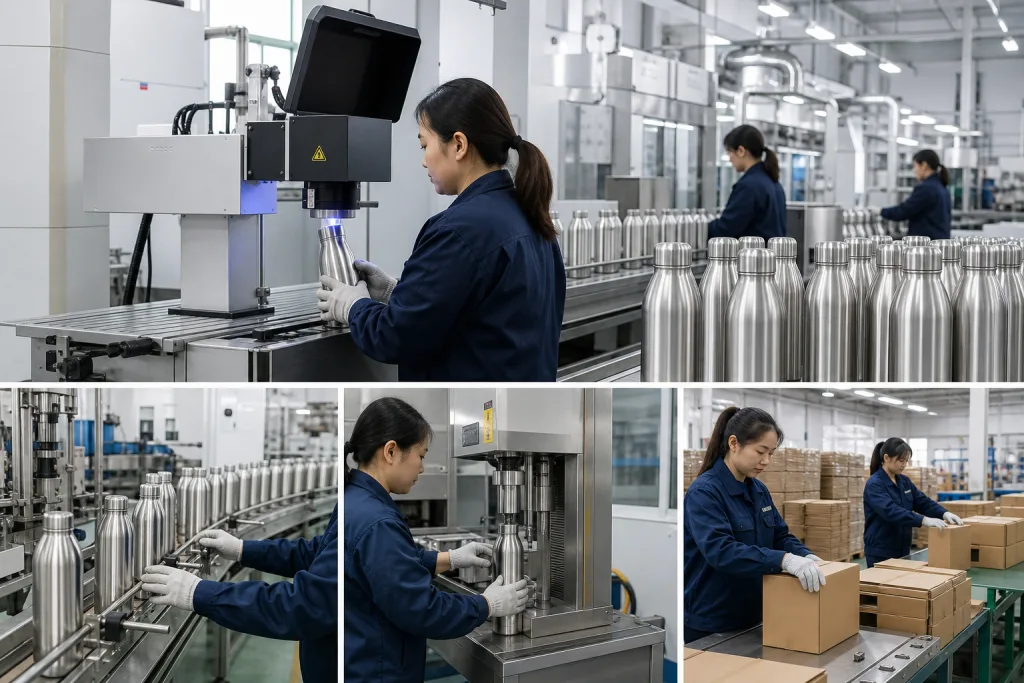
At BottleForge Industrial in Hangzhou, Zhejiang, our normal stainless thermos output is about 420,000 units per month across stock and customized thermos projects. For quoting, we ask for capacity, lid type, finish, logo method, packaging, test standard, target country, and order quantity. Without those eight items, a China price is only a guess wearing a quotation number. We have seen this go sideways from a simple PO typo: “powder coating” written as “painting,” then the buyer expected dishwasher resistance. The line cannot fix that after mass production starts.
Where The Unit Cost Goes
The unit cost usually comes from steel grade, vacuum target, lid build, decoration, surface finish, and packing. On a 500 ml factory thermos, the raw bottle body is only one line on the cost sheet. We weigh the drawn inner tank on a 0.1 g scale and check wall thickness with a micrometer; a 0.05 mm change in steel thickness already moves the quote. A leak-proof lid with silicone ring, carry handle, push button, or straw spout can add USD 0.25–0.85 per unit compared with a basic screw cap.
For a standard 500 ml manufacturer thermos with 304 inner, 201 outer, screw lid, powder coating, and one-position logo, FOB Ningbo or Shanghai often lands around USD 3.20–5.80 at 3,000–5,000 pcs. Move to 750 ml with 304/304 steel, wide mouth, stronger coating, and retail color box, and the range often becomes USD 5.20–8.80. A 1,000 ml outdoor customized thermos with handle lid and premium packaging can sit at USD 7.50–12.50, depending on finish and inspection requirements. The buyer often asks why 304/304 costs more than 304/201; the answer is not sales talk, it is steel weight, polishing loss, and slower welding on the line.
Decoration is not free, even when the supplier thermos quotation buries it in the unit price. Laser engraving is stable for outdoor retailers because it does not peel; typical cost is USD 0.08–0.25 per logo depending on size. Silk screen printing is cheaper for simple one-color logos, around USD 0.05–0.18 per position, but curved surfaces and multiple colors need tighter jigs and cleaner registration marks. Heat transfer or full-wrap printing can add USD 0.35–0.90 per unit. UV printing works for colorful promotional thermos designs, but agree abrasion testing before mass production. QC pulled one sample last season after 300 rubs with 3M tape because the blue ink lifted at the logo edge. Cheap print is the wrong place to save money.
Packaging catches new buyers. A plain white box may add USD 0.12–0.25. A printed retail box with insert can add USD 0.25–0.60. If you need FSC paper, barcode labels, FNSKU labels, warning inserts, or drop-test cartons, quote them from the beginning. We have seen a PO say “white box” while the artwork file showed a 4-color retail sleeve, and that typo delayed shipment 12 days vs 18 days after the carton supplier rebooked paper.
MOQ Tiers That Actually Matter
MOQ is not just a supplier preference. It sits on coating line setup, logo jig setup, carton printing plates, material purchasing, and the weekly production board. For a stock-shape custom thermos, 1,000 pcs is sometimes possible if you accept 2–3 standard powder-coating colors, a single-position logo, and our existing white box or kraft box. The unit price will be higher because the line still needs a spray gun wash, fixture change, and first-article QC check, even if we only run half a shift.
For serious thermos bulk orders, 3,000 pcs is the more practical starting point. At 3,000 pcs, you can usually choose one body color, one logo method, and standard packaging without the factory losing efficiency. At 5,000 pcs, you get more room for Pantone color matching, retail box printing, and better unit pricing. At 10,000 pcs and above, a manufacturer thermos project can justify dedicated production slots, color splitting, and sharper stainless-steel purchasing. We have seen buyers push for 2,000 pcs with 4 colors and a printed gift box; the math does not work once the coating line counts changeover loss.
Here is a realistic tier view for a custom logo vacuum bottle using an existing 500 ml or 750 ml mold:
- 1,000 pcs: sample-friendly, limited options, often USD 0.30–0.80 higher per unit; best kept to 1 stock color and laser logo.
- 3,000 pcs: normal promotional MOQ, stable for one color and one logo; QC pulled the sample after coating and checked logo position within 1.5 mm.
- 5,000 pcs: better for outdoor retail packaging and custom Pantone coating; carton printing cost starts to spread properly.
- 10,000 pcs: better factory allocation and stronger FOB negotiation; we can split production across 2 colors without killing the schedule.
If you need a new lid mold or unique bottle profile, MOQ usually moves to 10,000–30,000 pcs. Tooling can range from USD 1,500 for a simple plastic lid change to USD 8,000–20,000 for a more complete bottle and lid system. A thermos vendor who promises 500 pcs with a new exclusive mold is either hiding tooling in the unit price or not planning a true custom mold. We have seen this go sideways when the PO says “exclusive lid,” but the drawing is only a 2 mm button change.
Lead Time By Project Type
Lead time starts after deposit, final artwork, and specification approval. Not after the first email. For a stock bottle with one-color silk screen or laser logo, our Zhejiang, China production schedule is usually 25–35 days after approved pre-production sample. If the order uses custom powder coating, printed retail box, and multiple SKUs, plan for 35–50 days. We run the job only after the PI, logo file, and carton mark are locked; last month QC held 1,200 pcs because the PO said “mat black” and the artwork file said matte black.
A new color is not just a paint decision. The coating supplier needs the Pantone target, the line needs a small trial, and the buyer should approve the shade under D65 light instead of office yellow light. Color approval can add 5–10 days if the first sample misses the target by one visible shade. For outdoor retailers, matte powder coating sells well because it feels better in hand, but it must pass adhesion and scratch checks. We normally recommend cross-hatch adhesion testing with 3M tape and a basic rub test for printed logos. Chasing the lowest coating price is the wrong question to ask here; we have seen cheap powder fail around the bottom rim after 20 minutes in a carton-drop check.
New mold projects move slower. A custom lid, handle, straw cap, or body profile normally needs 15–25 days for design and tooling, 7–10 days for first samples, then adjustments if sealing or fit is not right. Mass production after final approval adds another 35–50 days. That puts a true thermos custom development at 60–90 days in a healthy schedule. On the factory floor, the mold room checks lid thread fit with a go/no-go gauge, and a 0.3 mm mismatch can still cause leaking after hot-water inversion.
Shipping time must be added separately. Sea freight to North America West Coast can be 18–28 days port to port in a normal market. Europe is often 28–40 days depending on port. Air freight is possible for urgent distributors thermos orders, but it can add USD 1.50–4.50 per bottle on bulky stainless drinkware. The math does not work for most low-margin promo orders. If your retail launch date is fixed, work backward from the warehouse date, not the factory finish date; we ship after final AQL 2.5 inspection, carton weighing, and booking release, and a missed cut-off can turn 12 days of buffer into 3.
Logo Methods And Finish Choices
The right logo method depends on where the bottle will be sold. A promo buyer usually wants a clean mark, low unit cost, and 7-day sample turnaround. A retail outdoor bottle has to survive rubbing, shelf handling, and customer returns. For a customizable thermos, choose decoration by surface finish and real use, not by artwork color alone. We see this go sideways when a PO says “same as PDF” but the logo file is only 96 dpi.
Laser engraving is our safest choice for powder-coated stainless bottles. It cuts through the coating and shows the stainless base, so the logo will not peel off in a backpack or cup holder. We run it on a fiber laser, and QC checks logo position with a 0.5 mm ruler before bulk packing. It suits corporate gifts and outdoor bottles, but it cannot print full-color artwork. Silk screen printing fits simple logos and price-sensitive campaigns. Ink matters. Curing matters more. Matte coating needs the right hardener and oven time, or the buyer will flag rub marks during the tape test. UV printing gives sharper color, but we test abrasion first if the bottle will sit in bike cages, tool bags, or work trucks.
For finishes, powder coating is the main choice for outdoor retailers because it gives grip and feels better in hand. Spray painting costs less, but weak pretreatment can chip after one drop test from 80 cm. Brushed stainless gives a clean industrial look and removes color-matching risk. Mirror polish looks bright on the sample table, then shows fingerprints and scratches after 20 minutes in the showroom. For a distributor thermos program, we usually cap the first order at 2–4 colors. More colors look good in a catalog, but the math does not work when MOQ is 500 pcs per color and cartons need separate labels.
Ask your thermos manufacturers for a decorated pre-production sample, not just a blank bottle. Approve the exact logo size, placement tolerance, color, and packaging label. QC pulled the sample on one order because the carton label had “theroms” instead of “thermos,” and that typo came straight from the buyer’s PO. A 2 mm logo shift may not matter on a giveaway, but it looks careless on a retail shelf.
Compliance, Inspection, And Risk
Drinkware touches lips and hot water, so compliance is not optional. For Europe, most importers ask for LFGB or EU food-contact testing, plus REACH material declarations for powder coating, silicone rings, PP lids, and plastic straws. For the United States, FDA food-contact rules apply, and California Proposition 65 review comes up often on retail POs. Kids products need stricter checks, including CPSIA-related requirements. If the bottle is for hot liquid, the lid structure and pressure release need a real review; we once had QC pull a flip-lid sample because steam pushed the button open after a 95°C fill test.
AQL inspection should be written into the purchase order, not discussed after cartons are taped. A common inspection level is AQL 2.5 for major defects and 4.0 for minor defects, but Target-style and supermarket programs often ask for tighter limits. Major defects include leakage, poor vacuum insulation, sharp edges, wrong logo, serious coating damage, and carton mismatch. Minor defects include small dust points, slight color variation, or tiny cosmetic marks inside the approved sample range. We run calipers on rim thickness, a 3M tape test on logos, and a carton drop check when the buyer’s packing spec calls for it.
Vacuum performance is measurable. No guessing. A typical test fills the bottle with hot water around 95°C, closes the lid, and checks temperature after 6, 12, or 24 hours with a probe thermometer. The exact pass level depends on capacity and design. Do not accept a vague claim like “keeps hot 24 hours” without a test method; this is the wrong question to ask unless the starting temperature, room temperature, and fill volume are written down. For 500 ml bottles, we often set a 6-hour retention target above 65°C, but wide-mouth structures lose heat faster than narrow-mouth designs because the opening can be 55 mm instead of 38 mm.
Factory audits matter if you sell to chains or large promotional accounts. BSCI, ISO 9001, or similar audit records can shorten vendor approval. As a suppliers thermos team in China, we prefer buyers to state audit and document needs before deposit, including test reports, factory profile, social audit files, and carton marking rules. Chasing paperwork after production is finished burns 3 to 7 days; we have seen shipments miss a vessel because one PO had the importer name typed differently from the test report.
A Practical Buying Calendar
If you are sourcing a promotional thermos for an event, start at least 70 days before the warehouse date for a normal stock-shape order by sea freight. We run that schedule all the time: 5–7 days for quotation and artwork cleanup, 7–10 days for sampling, 30–40 days for production, 3–5 days for inspection and loading, then 25–35 days for ocean transit and customs buffer. QC pulled one sample last month and found a 0.4 mm lid gap, so the buyer moved the ship date by a week. Tight, yes. Still workable.
For outdoor retail programs, use a 120–150 day calendar. Retail packaging, color range decisions, barcode setup, carton drop tests, compliance reports, and internal approvals all eat calendar days. If you want thermos customized with a new lid or exclusive silhouette, start 6 months before the selling season. We have seen that go sideways when a buyer asked for a 1.2 m drop test after the artwork was already signed off. The line can move fast, but tooling correction and coating trials do not care about the spreadsheet.
Payment terms also affect timing. The common structure from China is 30% deposit and 70% balance before shipment, or before bill of lading release for approved customers. FOB Ningbo and FOB Shanghai are both standard for Zhejiang factories. If you need DDP, Amazon FBA preparation, or distributor warehouse labeling, state it early. FNSKU labels, master carton labels, and pallet requirements belong in the production file, not in a last-minute email, and a typo on the PO can hold the label print run for a day. That is the wrong question to ask after cartons are sealed.
The cleanest RFQ is one page: bottle capacity, target FOB price, quantity, logo file, decoration method, lid type, packaging, test standard, destination port, and required delivery date. Give us that and a thermos factory can quote the right bottle instead of a low number that changes three weeks later. On our packing table, the Zebra printer and the carton stamp need those details before we ship.
Send Your Bottle Spec For A Firm Quote
Share capacity, quantity, logo method, packaging, and delivery date. We will return practical FOB pricing and lead-time options.
Frequently asked questions
What is the normal MOQ for a custom logo vacuum bottle?
For an existing stainless bottle mold, 3,000 pcs is the normal working MOQ for one color and one logo. We can sometimes support 1,000 pcs for a simple laser logo on available stock colors, but the unit price is usually USD 0.30–0.80 higher. Retail packaging, Pantone coating, or multiple colorways usually push the practical MOQ to 5,000 pcs. If you need a new lid or exclusive bottle shape, expect 10,000–30,000 pcs depending on tooling complexity.
How much does a custom stainless thermos cost FOB China?
A standard 500 ml custom stainless thermos with 304 inner wall, 201 outer wall, powder coating, screw lid, and one logo usually runs around USD 3.20–5.80 FOB Ningbo or Shanghai at 3,000–5,000 pcs. A 750 ml outdoor bottle with 304/304 steel and retail box is more often USD 5.20–8.80. The lid can change the price quickly; a handle, straw, push-button, or multi-part leak-proof cap may add USD 0.25–0.85 per unit.
Which logo method is best for outdoor retail bottles?
For outdoor retail, laser engraving is usually the safest choice because it will not peel or fade like surface ink can. It normally costs USD 0.08–0.25 per position depending on logo size. If you need full-color branding, UV printing or heat transfer can work, but you should approve abrasion and adhesion testing before production. For promotional campaigns with simple artwork, one-color silk screen printing is cost-effective at roughly USD 0.05–0.18 per position.
Can you make a thermos with my own shape or lid?
Yes, but it changes both MOQ and calendar. A simple custom plastic lid may need USD 1,500–5,000 in tooling and 10,000 pcs MOQ. A more complete bottle body and lid system can require USD 8,000–20,000 tooling and 20,000–30,000 pcs MOQ. Plan 60–90 days before shipment for development and production, assuming only one or two tooling adjustments. If your launch date is close, start with an existing factory thermos shape and customize color, logo, and packaging.
What quality checks should I require before shipment?
Require a pre-production sample, inline checks if the order is large, and final inspection using AQL. A common setting is AQL 2.5 for major defects and 4.0 for minor defects. Inspection should cover leakage, vacuum performance, coating damage, logo position, lid fit, smell, sharp edges, carton labels, and barcode accuracy. For temperature retention, define the test method, such as filling with 95°C water and checking after 6 or 12 hours. Do not rely only on catalog claims.