Key Takeaways
- A 20 oz double-wall stainless tumbler usually lands at USD 3.20-5.80 FOB China depending on lid, finish, and packaging
- For custom logo travel tumbler orders, 1,000 pcs is a realistic MOQ for standard colors; 3,000 pcs is safer for custom powder coating
- Logo method affects both appearance and durability: laser engraving, silk screen, heat transfer, and UV printing are not interchangeable
- AQL 2.5/4.0 inspection, lid leak testing, and carton drop testing should be written into the purchase order
A custom logo travel tumbler looks simple on a quote sheet: capacity, Pantone color, logo position, lid type, carton size. Then the samples arrive. One lid leaks at the silicone ring, the powder coat marks after a fingernail test, and the 5-ply export carton splits during a 76 cm drop test. For coffee brands and corporate-gift buyers, those small spec gaps turn into chargebacks, missed launch dates, and uncomfortable calls with the end client.
As a Zhejiang coffee mug factory shipping to Europe and North America, we see this about 6 times a month: buyers compare unit prices before they compare the build. This is the wrong question to ask. A USD 0.35 saving does not work if the tumbler fails a dishwasher claim or the laser logo scratches after 200 cycles. We run the spec sheet like a control document on the line, with wall thickness, coating process, lid fit, carton test, and logo tolerance checked before mass production starts.
Capacity Is a Marketing Decision
The capacity line on a custom logo travel tumbler spec sheet is not a small detail. For coffee brands, 12 oz and 16 oz usually sit well beside café menus, while 20 oz and 24 oz fit commuter and corporate-gift briefs better. A 30 oz cup photographs well, but it needs a wider body, a taller gift box, and often a lid with a larger PP slider or straw opening. Carton size jumps too; on one 30 oz quote, the buyer flagged that the master carton moved from 42 cm to 49 cm high, and the freight math stopped working.
For a bulk coffee mug program, ask who will actually use it. This is the right question. Office gift buyers often choose 20 oz because it fits most car cup holders and still leaves room for iced coffee. Coffee subscription brands often stay with 16 oz because it matches hot-drink serving habits and does not look oversized on a desk. We run cup-holder checks with a 75 mm base gauge before sampling, because one buyer once approved artwork first and found the lower diameter too fat after QC pulled the sample.
Wall construction matters as much as volume. A common build is 18/8 stainless steel inner wall with 18/0 or 18/8 outer wall, double-wall vacuum insulated, with 0.4 mm to 0.5 mm wall thickness. Thinner steel cuts cost, but it dents faster during domestic courier delivery. We have seen this go sideways. If you sell through e-commerce or ship corporate kits one by one, do not chase the thinnest gauge; our drop-check table and carton compression test usually tell the truth before the first 500 pcs leave the line.
At BottleForge Industrial in Hangzhou, Zhejiang, our standard travel tumbler line runs about 450,000 units/month across shared stainless drinkware production. For coffee mug custom made projects, we normally recommend starting with a stock mold unless your forecast is above 20,000 pcs. New tooling can make sense, but for most coffee mug private label launches, your budget works harder on finish, lid sealing, and packaging. A stock 20 oz body with a clean powder coat and a tight lid beats a new mold with a loose slider; we ship those repeat orders every month.
Material Grade Changes Buyer Risk
Most quotes say “stainless steel.” Too vague. For a custom logo travel tumbler sold into Europe or North America, the inner liner should be food-contact grade 304 stainless steel, also described as 18/8. On the line, we check this before mass production with incoming material records and, for larger orders, a PMI gun spot check on the coil. 304 handles coffee residue, tea tannin, milk drinks left overnight, and acidic cleaning tablets better than lower-grade material. The outer shell may be 201 or 304 depending on the target price, but the buyer should know the exact grade before approving the PI.
If your tumbler is positioned as premium, ask the coffee mug manufacturer to state the material grade on the proforma invoice and inspection checklist. Put it in writing. For EU shipments, request LFGB or relevant food-contact migration test reports where applicable, plus REACH checks for coatings and plastic parts. For the US market, FDA food-contact compliance and California Proposition 65 review may be relevant, especially for decorated coatings and colored lids. We have seen buyers flag this after artwork approval, and changing a coated lid at that stage can add 12 days, not 2.
Plastic components need the same attention. Lids are commonly made from AS, PP, Tritan, or similar materials, and each one changes the feel in hand and the cost on the BOM. PP is practical and cost-effective, while Tritan gives better clarity and a more premium look. Silicone gaskets should be removable if the product will be used daily with dairy-based drinks. QC pulled one sample last year where the gasket groove measured 1.8 mm too deep, and milk odor stayed after three wash cycles. A beautiful bulk coffee travel mug with a gasket that traps odor will create complaints within two weeks.
A reliable coffee mug oem manufacturer should also explain passivation and cleaning. Stainless interiors need proper polishing and residue removal before packing. Oil marks, metal dust, or welding discoloration are not cosmetic details; they affect customer trust. We run a white-cloth wipe test after ultrasonic cleaning because grey residue on the cloth tells the real story. When buyers search a coffee mug supplier list, 8 out of 10 compare photos first. This is the wrong question to ask. Ask for material declarations and current test reports before you compare cents.
Lid Design Decides Daily Usability
The lid line is where 7 out of 10 bulk travel tumbler complaints start. A slider lid, flip lid, straw lid, screw lid, and push-button lid all set different expectations, so we do not treat them as cosmetic choices. For corporate gifts, a simple sliding lid keeps the unit cost down and users understand it. For commuting, a screw lid with a sealed drinking port is safer. For iced coffee campaigns, a straw lid often fits the photo brief better, but it adds a silicone plug, straw tolerance control, cleaning questions, and spare-part risk. Small part, big trouble.
Be careful with the word “leakproof.” Most travel tumblers with slider lids are splash-resistant, not fully leakproof. If the cup sits upside down in a laptop bag for 12 minutes, a slider lid will usually start to seep at the drink opening or gasket corner. We had one buyer flag this after a 500 pcs sample order because their artwork proof said “100% leakproof” on the belly sticker. The math does not work if the lid structure cannot support the claim. For a coffee mug promotional campaign, overclaiming causes more damage than choosing a safer, less ambitious lid.
Ask your coffee mug supplier for practical lid tests, not polished sample photos. We usually run a 100% visual check for gasket placement, random water-fill leak checks during production, and pre-shipment AQL inspection. QC pulled the sample for one 20 oz tumbler after the gasket sat 1.5 mm out of groove, which looked fine in a photo but failed on the tilt test. For a screw lid, torque consistency matters. For a slider lid, the slider should move smoothly without rattling. For a straw lid, the straw hole tolerance should hold the straw upright without tearing the silicone.
Lid tooling also affects reorder stability. If you plan coffee mug private labeling for multiple clients, choose a lid system that your factory can support for at least 18 to 24 months. We have seen this go sideways when a trendy lid from an upstream mold shop vanished before the second 3,000 pcs reorder. Ask who owns the mold, how many replacement lids are in stock, and whether the same lid fits 12 oz, 16 oz, and 20 oz bodies. Factory direct sourcing in China helps because you can ask about spare parts, mold ownership, and replacement lid availability instead of guessing through a trading chain.
Decoration Must Match the Finish
A custom logo travel tumbler is bought for the logo, so decoration needs its own technical check. Laser engraving works well on powder-coated 304 stainless bodies; it cuts through about 25-40 μm of coating and shows the metal underneath. No Pantone choice there. Silk screen printing is cost-effective for one or two colors on straight-wall cups, but tapered bodies need a tight fixture, or the logo walks 1-2 mm around the curve. UV printing handles fine lines and gradients, but we still run a 3M tape test and a 60°C warm-water soak before approving mass production.
For coffee mug customized projects, test the finish and logo process as one set, not as separate line items. Matte powder coat usually engraves clean. Glossy coating can show handling scratches faster; QC pulled one sample last month with scuff marks from a loose carton divider. Full-wrap heat transfer gives strong shelf impact, but the seam position, rim gap, and bottom alignment need sign-off on a real pre-production sample. If your artwork has a small QR code, this is the wrong question to ask: “Can you print it?” Ask if it scans at actual size on the curved wall, after printing.
Typical decoration costs move with quantity, logo size, and reject risk. A one-position laser logo may add USD 0.15-0.35 per unit. One-color silk screen can land in the same range if the order is 1,000 pcs or more and the print area stays modest. Full-color UV or heat transfer can add USD 0.50-1.20 per unit, and the math doesn't work for every giveaway order. For coffee mug promotional products, that extra cost makes sense when the tumbler must carry campaign artwork, retail graphics, or a seasonal design instead of a simple company mark.
Submit vector artwork in AI, EPS, or editable PDF, with fonts outlined and line weight checked above 0.25 mm where possible. Define Pantone colors if printing is required; “same as logo file” is not a production color instruction. For a coffee mug customizable program with 20 corporate clients, build a logo placement rule: for example, 45 mm wide logo, centered 70 mm below rim, opposite the seam. That small rule saves hours of back-and-forth, and it stops the classic PO typo where one buyer writes “70 mm from bottom” while the approved mockup says rim.
MOQ and Price Need Context
MOQ is not a punishment. It is the point where material buying, line setup, decoration trials, and export packing stop wasting money. For a standard bulk travel mug using an existing mold and existing color, 1,000 pcs is often workable; we run those on the regular line with the same lid gauge and carton knife. For custom powder coating, 3,000 pcs per color is more realistic because the spray booth needs a full color change, curing test, and 2-3 panels checked against the Pantone card. For a new lid color, custom carton, and retail insert, expect the factory to ask for a higher quantity or a surcharge.
As a practical FOB China range, a 20 oz double-wall stainless tumbler may sit around USD 3.20-5.80 depending on steel grade, lid type, coating, logo, and packaging. A basic bulk coffee tumbler for a one-time corporate event may land near the lower end. A retail-ready coffee mug private label item with premium coating, printed box, barcode label, and passed third-party testing will sit higher. If a quote is 18% below the market, do not celebrate first. Ask for wall thickness in mm, lid material, vacuum test result, and carton burst strength; QC pulled one cheap sample last quarter and found a thin inner wall plus a lid that cracked after a 1.2 m drop test.
For coffee mug factory direct orders, price validity is usually 15 to 30 days because stainless steel, plastic resin, and exchange rates move. Payment terms for new buyers are commonly 30% deposit and 70% before shipment. Lead time is typically 25 to 35 days after deposit and artwork approval for standard builds, and 45 to 60 days when custom color or new packaging is involved. The clock starts after clean artwork, not after a WhatsApp photo; we once lost 4 days because the PO said matte black but the artwork file was named gloss_black_final.pdf.
Be precise when you compare coffee mug manufacturers. “20 oz tumbler with logo” is not a complete RFQ, and this is the wrong question to ask if you only want the lowest number. Send capacity in oz and ml; material such as 304 stainless; lid type with straw, slider, or flip design; finish and logo process; packaging details; test requirement; target incoterm; destination port; 3-month or 12-month forecast. A professional coffee mug distributor or brand buyer should make factories quote the same spec. If not, the cheapest line is usually just the one with the most blanks, and we have seen this go sideways during pre-shipment inspection.
Packaging Is Part of the Product
Packaging is part of the tumbler, not a carton we throw around it at the end. For coffee brands and corporate-gift buyers, it sets the first impression and affects warehouse scans, breakage claims, and labeling compliance. We run a common export pack as 1 tumbler in a polybag or tissue wrap, then 1 white box or kraft box, with 24 pcs per master carton. For heavier 30 oz tumblers, 12 pcs or 18 pcs per carton may be safer; the math changes fast once the gross weight passes 15 kg. Master cartons should normally use 5-ply corrugated board for export, especially if the goods move by LCL sea freight and get re-stacked twice before loading.
If you sell through Amazon or ship to a 3PL, send labeling rules before the line starts packing. FNSKU labels, carton content labels, suffocation warnings on polybags, and country-of-origin marking should be confirmed before mass packing; one buyer once sent us an FNSKU file with a 1-digit typo on the PO, and QC pulled the sample before 900 boxes were sealed. For corporate gifting, you may need individual name labels, belly bands, greeting cards, or kitting with coffee sachets. These details add labor time and defect risk, so they belong on the quote sheet, not in a late Friday email.
Carton testing should be discussed before shipment. A basic internal drop test from 76 cm on corners, edges, and faces can catch weak boxes before a container leaves China. For retail packaging, rub testing on printed boxes helps avoid ink transfer; we use a simple abrasion tester and check the logo area after 50 cycles. If your custom logo travel tumbler uses a dark matte finish, separators or proper bag thickness matter because tumblers scuff each other during truck vibration. We have seen this go sideways with black powder coating.
For coffee mug in bulk orders, ask for a packing photo report before final inspection. It should show unit box, master carton, carton mark, gross weight, net weight, carton dimensions, and pallet plan if used. Ask for the scale photo too. A coffee mug factory that controls packing well usually controls production better, because the same QC team checking carton marks is often the team catching loose lids, mixed colors, and wrong inserts before sealing.
QC Checks Before You Pay Balance
Agree on quality control before the deposit, not after the line has packed 86 cartons. For most bulk coffee mug orders, AQL 2.5 for major defects and 4.0 for minor defects is a workable baseline. Critical defects such as sharp metal edges, contaminated interiors, unsafe plastic, or hard leakage should be zero tolerance. No debate there. If your buyer manual uses another standard, send it at RFQ stage; we have seen this go sideways when the PO says “standard QC” and the buyer later expects a stricter retail inspection.
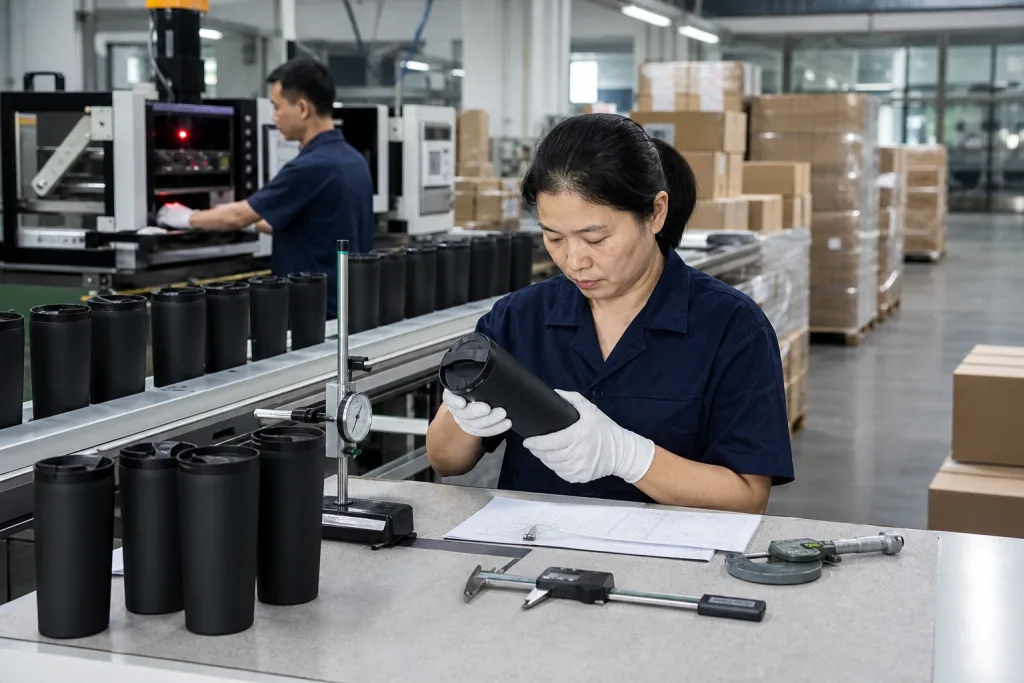
A pre-shipment inspection for a custom logo travel tumbler should check dimensions with a digital caliper, capacity by ml fill test, unit weight on a 0.1 g scale, logo position against the approved artwork, color against the Pantone target, coating adhesion, lid opening and sealing, vacuum performance, barcode scan rate, inner box packing, and carton marks. Vacuum testing can be done by hot water temperature drop checks or factory vacuum detection equipment. For insulation claims, define the method: water temperature, starting temperature, room temperature, fill level, and test duration. “Keeps hot 12 hours” means nothing if the test uses 95°C water in a 20°C room one day and 85°C water in a 28°C room the next.
Decoration durability is where small assumptions cost money. For silk screen or UV printing, request cross-hatch adhesion testing where suitable, plus alcohol rub or dishwasher simulation if you plan to print cleaning claims on the box. For laser engraving, check logo edge clarity and position consistency; QC pulled one sample last month where the logo looked clean, but the jig allowed a 3 mm left-right drift across 50 pcs. A 3 mm placement drift may pass for a staff gift. It does not work for a premium retail coffee mug custom program with front-facing shelf display.
Working from Zhejiang, China, we usually tell new buyers to approve one golden sample, one packaging sample, and one signed inspection checklist before mass production starts. Keep those files tied to the PO number, including artwork version, carton mark file, and any odd detail like the buyer’s PO typo on “matte balck” that still needs confirmation. Whether you found us through a coffee mug supplier directory or direct referral, the process should stay the same: written spec, approved sample, controlled production, documented inspection, then balance payment. The math does not work if the first serious QC discussion happens after goods are sealed in export cartons.
Send us your tumbler spec before quoting
Share capacity, lid, finish, logo, packaging, quantity, and destination. We will return a factory-direct quote with practical production notes.
Frequently asked questions
What is a realistic MOQ for a custom logo travel tumbler?
For an existing mold and standard factory color, 1,000 pcs is usually realistic. If you need a custom Pantone powder coat, plan around 3,000 pcs per color because the coating line setup and powder purchasing need volume. For a full coffee mug private labeling project with printed box, insert card, barcode, and custom lid color, 3,000-5,000 pcs is more efficient. Some factories may accept 500 pcs, but the unit price can increase by 15-35%, and decoration options may be limited. If you are testing a corporate-gift program, use a stock color first and put your budget into logo quality and packaging.
How much should I budget for a bulk coffee travel mug with logo?
A practical FOB China range for a 20 oz stainless bulk coffee travel mug is USD 3.20-5.80 per unit. The low end usually means a standard lid, standard powder coat, simple logo, and basic box. The higher end may include 304 stainless inner and outer walls, better lid material, laser engraving or full-color print, retail packaging, and third-party testing. Freight, duty, and local delivery are separate. For North America and Europe, landed cost can change sharply depending on carton size and shipping mode, so compare cubic meters and carton weight, not only the FOB unit price.
Which logo method is best for coffee mug promotional products?
For long-term use, laser engraving on powder coating is the safest choice because it will not peel like ink. It is best for one-color logos where a metal-colored mark is acceptable. Silk screen is good for simple one- or two-color logos and can be cost-effective above 1,000 pcs. UV printing is better for gradients, small details, or campaign artwork, but you should request adhesion and rub testing. For coffee mug promotional products used at events, silk screen may be enough. For a premium coffee brand retail item, laser or well-tested UV usually gives a better customer experience.
Can I use the same tumbler for corporate gifts and retail sales?
Yes, but the spec should be adjusted. Corporate-gift buyers often care most about logo visibility, reliable delivery date, and safe individual packaging. Retail sales need stronger shelf presentation, barcode labels, legal markings, and more consistent cosmetic standards. A coffee mug customized for retail should have tighter color control, cleaner coating, and better packaging than a one-day event giveaway. If you plan both channels, choose one core tumbler body and create two packaging versions: a simple kraft box for corporate orders and a printed retail box with barcode for retail. This keeps MOQ manageable.
What documents should I request from a coffee mug manufacturer?
Request a written spec sheet, material declaration, food-contact test reports where applicable, coating or plastic compliance documents, artwork proof, packaging dieline, and pre-shipment inspection report. For Europe, ask about LFGB, REACH, and relevant food-contact migration testing. For the US, ask about FDA food-contact suitability and Proposition 65 review if needed. If your company requires social compliance, ask whether the factory has BSCI, Sedex, or another audit. A serious coffee mug manufacturer should be able to provide current documents, not just old certificates from unrelated products.