Key Takeaways
- A basic 12 oz custom logo travel mug usually lands at USD 2.80-4.60 FOB China at 1,000-3,000 pcs
- Laser engraving is slower but durable; silk screen is cheaper for 1-color logos above 1,000 pcs
- Normal production lead time is 25-35 days after sample approval and deposit
- Custom mold, private label packaging, and special coatings can add 10-25 days
A custom logo travel mug looks simple until the quotation sheet hits your inbox. One supplier gives you USD 3.20, another says USD 5.80, and both write 30 days. The gap is not magic. For a coffee brand, corporate gifting program, or distributor catalog, the real check is what the price covers, what becomes an add-on after artwork approval, and whether the goods can pass final inspection before your launch vessel closes. We have seen this go sideways over a 0.3 mm lid gap that QC pulled on the caliper table.
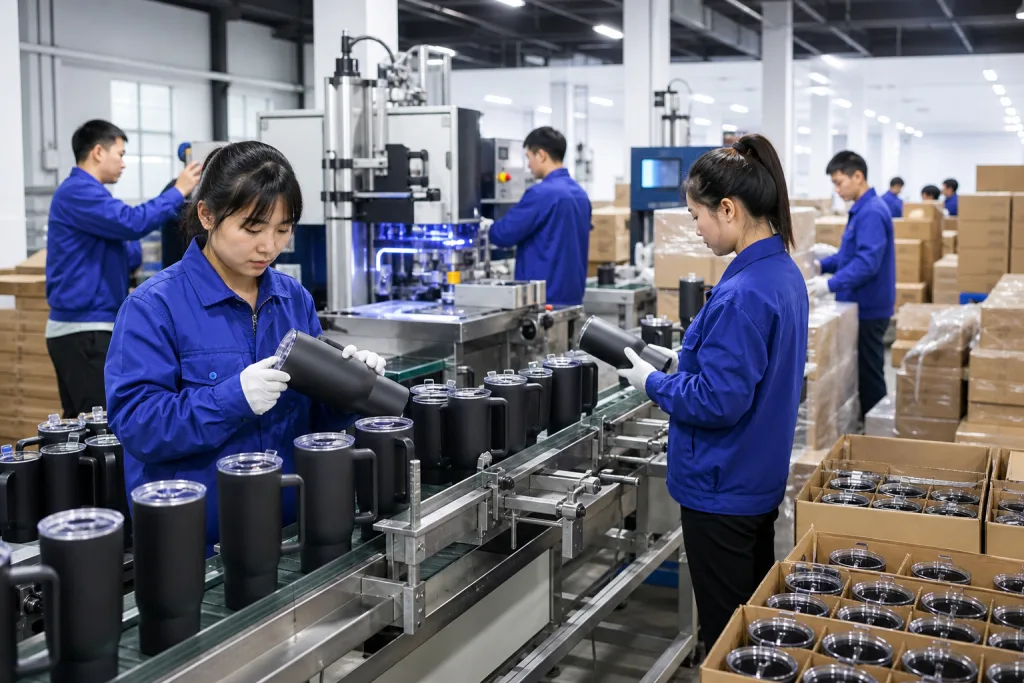
From our Hangzhou, Zhejiang production base, we answer the same buying questions 18 to 25 times a week: stainless body with plastic lid, laser logo on 304 stainless, silk screen with Pantone matching, 500 pieces or 5,000 pieces, gift box or bulk carton. BottleForge Industrial produces up to 420,000 drinkware units per month, with standard MOQ from 500 pieces per model for repeatable travel tumbler designs. The line moves fast, but the math does not work if the PO says matte black and the artwork file says gloss black; the buyer flagged that exact mismatch last month before we opened the carton dieline.
What you are really pricing
A custom logo travel mug quote is not one price for one cup. We are pricing the steel grade, declared capacity, lid mold, surface finish, logo process, packing method, inspection level, and export term. A 14 oz vacuum tumbler with 304 stainless steel inner wall and sliding PP lid cannot be compared with a single-wall promotional cup, even if both get written on the PO as “bulk coffee mug.” We see that typo on buyer POs at least twice a month, and it usually causes a 2-day sample-confirmation delay.
For coffee brands, the working range is 12 oz to 20 oz. Corporate-gift buyers often pick 16 oz because it sits well on an office desk and still fits most car cup holders and gift boxes. A practical spec we run often is 304 stainless steel inside, 201 or 304 outside, 0.4-0.5 mm wall thickness, BPA-free PP lid, silicone seal ring, powder coating, plus silk screen or laser engraving. The wall gauge matters. QC pulled one pre-production sample last quarter at 0.36 mm after polishing, and the buyer flagged the cup as feeling “thin” even though the catalog photo looked fine.
Here is a realistic FOB China range from a coffee mug factory direct quotation. This is the wrong question to ask if the buyer only says “send your best price” without capacity, lid type, and logo color count; the line cannot cost a vacuum cup until we know whether the lid needs a simple sip hole or a sliding part with a silicone plug.
- Single-wall stainless travel mug: USD 1.80-2.90 at 3,000 pcs, suitable for low-cost coffee mug promotional products where heat retention is not the selling point.
- Double-wall non-vacuum tumbler: USD 2.30-3.60 at 2,000 pcs, with better hand feel than single-wall cups but limited heat retention in a 2-hour desk test.
- Double-wall vacuum bulk travel tumbler: USD 3.20-6.50 at 1,000-5,000 pcs, the main choice for coffee mug private label programs when buyers need insulation performance and retail-style packing.
- Ceramic-coated inner tumbler: USD 5.20-8.80 at 1,000 pcs, used when coffee taste and staining resistance matter, especially for black coffee and milk drinks.
If a coffee mug supplier quotes below these levels, check steel thickness, the vacuum test method, lid leakage rate, carton strength, and whether the logo cost is included. Cheap quotes often move the cost into setup, packaging, inland freight, or inspection rework later. We have seen this go sideways: a USD 0.18 saving on the cup became USD 0.42 extra after the 5-layer carton failed the drop test and the buyer asked for repacking before shipment.
MOQ tiers that change the price
MOQ is not a penalty. It is the point where 304 stainless coil buying, powder-coating gun setup, logo jig cost, and packing-table labor stop fighting the price. For a custom logo travel mug, we run MOQ in layers: blank stock pulled from our Hangzhou warehouse, a standard model with your logo added on the line, or coffee mug custom made tooling with a new mold and lid fit test.
At 300-500 pieces, you are usually taking available blank inventory. Fast, but limited. Last month QC pulled 420 black tumblers for a trade-show order, and the buyer flagged that the shade did not match their Pantone book under a D65 light box. Unit price may be 15-35% higher, and color choice is usually 2-6 stock colors, not a full custom run. Around 60% of coffee mug distributors use this tier for customer sampling or regional test campaigns. It is a weak level for retail resale because freight and handling cost per unit stay high.
At 1,000-3,000 pieces, you reach the normal bulk coffee travel mug tier. Powder coating gets a proper production slot, logo cost becomes easier to absorb, and custom paper sleeve or white box packaging can be added without making the math ugly. We set the screen frame once, check logo position with a 0.5 mm ruler mark, then the line can keep moving. A 1-color logo by silk screen may cost USD 0.10-0.25 per piece, while laser engraving is often USD 0.18-0.45 depending on logo size and surface curvature.
At 5,000-10,000 pieces, you have room to push steel purchase price, run a dedicated color batch, and upgrade carton strength for export stacking. This is where a coffee mug oem manufacturer can justify special lid color, branded instruction leaflet, barcode sticker, and a cleaner AQL inspection plan. On one 8,000-piece order, we changed from a 5-layer carton to a stronger 7-layer master carton after the drop-test corner split at 76 cm. For large coffee mug private labeling orders, the savings may be 8-18% compared with 1,000 pieces, assuming the design does not change.
Do not split one 5,000-piece forecast into five 1,000-piece orders unless you need cash-flow flexibility. The math does not work most of the time: you pay setup again, packaging again, and shipping again.
Logo method and finish costs
The logo process is where 6 out of 10 custom logo travel mug RFQs either stay clean or start leaking margin. A coffee mug customizable for a corporate event does not need the same decoration plan as a retail coffee mug customized for shelf display. The right choice comes down to order size, artwork detail, surface finish, and dishwasher expectations. We check this at the sample table with a 150 mm steel ruler and the buyer’s AI file open, because a logo that looks fine on screen can wrap badly on a tapered tumbler.
Silk screen printing works well for simple 1-2 color logos on powder-coated tumblers. Setup is usually USD 40-80 per color, with running cost around USD 0.08-0.25 per piece at 1,000 pieces. Fast. Clean edges. Still, Pantone matching on curved steel has tolerance, and the line will not hit a paper-brand color the same way on matte black powder. If you need a tight corporate color, ask for a physical drawdown or pre-production sample, not only a digital mockup. Last month QC pulled a navy logo sample that was 1 shade too purple under the D65 light box, and the buyer flagged it before we ran 3,000 pcs.
Laser engraving removes coating to expose stainless steel. It feels more premium and does not peel like ink. Cost is commonly USD 0.18-0.45 per piece. The weak point is speed; a large wraparound logo can slow output from 3,000 pieces per shift to below 1,200 pieces depending on machine power and logo area. This is the wrong question to ask if the buyer only says, “Is laser better?” Better for durability, yes. Bad for a 12-day rush order with 40 mm high artwork on both sides, unless we reserve two laser machines from the start.
Full-color UV printing is useful for gradients, illustrations, and coffee mug promotional artwork. It costs more, often USD 0.35-0.90 per piece, and needs adhesion testing on powder coating. For retail, we suggest 3M tape test, cross-cut test, and 24-hour water exposure check before mass production. We run the cross-cut with a 1 mm blade grid, then press the tape down by hand roller; if flakes lift at the edge, the math does not work for shelf-ready goods. We have seen this go sideways when the PO says “dishwasher safe” but the approved sample only passed a dry rub test.
Surface finish changes cost as much as the logo method. Standard powder coating is the practical default. Rubber paint feels soft but scratches more easily during ocean freight, especially when dividers shift inside a 15 kg export carton. Mirror polish looks good in photos but shows fingerprints after one sales meeting. If you are building a long-term coffee mug bulk program, choose a finish we can repeat across 3 or 4 production lots in Zhejiang, not just one sample batch. We ship repeat orders better when the color code, coating supplier, and approved gloss range are written on the spec sheet, not buried in an email thread with a typo on the PO.
Packaging, compliance, and hidden charges
Packaging gets quoted too late. We see it on 3 out of 5 tumbler RFQs. A bulk coffee tumbler in an egg-crate carton costs less than a retail gift box, but it looks wrong for a corporate gifting program. A standard white box may add USD 0.12-0.25 per unit. A printed color box commonly adds USD 0.25-0.60 per unit, depending on paper gsm, lamination, insert spec, and MOQ. If you need a rigid gift box, expect USD 0.80-1.80 or more. Last month the packing line stopped a 10,000 pcs order because the EVA insert was 2 mm too tight around the lid.
For coffee brands selling online, barcodes and carton labels are not small artwork tasks. FNSKU labels need scan distance checked, master carton marks need the right SKU and qty, polybags need suffocation warning, and drop-test packaging must survive the buyer’s warehouse rules. We had QC pull a carton because the FNSKU sat 6 mm too close to the edge and the handheld scanner missed it twice. For North America, 8 out of 10 buyers ask us for FDA food-contact related documentation and California Proposition 65 review. For Europe, REACH, LFGB, and packaging waste requirements may apply. For children’s or youth gift sets, ASTM or EN-related checks can become relevant depending on design and market.
A serious coffee mug manufacturer should discuss AQL before production starts. For travel mugs, we commonly use AQL 2.5 for major defects and 4.0 for minor defects, with critical defects at 0. Define the defects in writing: leakage after a 30-minute inverted test, poor vacuum insulation after hot-water holding, sharp edges on the rim, logo position outside the approved mm tolerance, or mixed colors in one inner carton. “Good quality” is the wrong question to ask. The buyer flagged it once after production because their approved logo height was 42 mm, while the line ran 39 mm from an older film.
Common hidden charges include sample freight at USD 45-95 by courier, logo screen setup, Pantone color sample fee, revised artwork fee, inner carton change, palletizing, and local China port charges if terms are not clearly FOB. Ask whether the quote is EXW, FOB Ningbo, FOB Shanghai, or delivered duty paid. We ship plenty of Zhejiang drinkware through Ningbo because trucking from Hangzhou is about 2.5 hours on a normal day, but the port should match your forwarder’s booking plan. We’ve seen this go sideways from one PO typo: the buyer wrote “FOB Shanghai” while the supplier priced EXW, and the math didn’t work after the container was ready.
A realistic 45-day timeline
A custom logo travel mug project should not be planned backward from the event date with zero buffer. If you need goods in a European warehouse on October 1, artwork approval on September 1 is too late for sea freight. We’ve seen this go sideways when the buyer approved a matte black proof on a Friday, then QC pulled the sample under a D65 light box and the logo looked 1.5 mm off-center. Production in China can run clean, but sampling, carton printing, inspection booking, customs release, and vessel cut-off dates still move.
For a standard bulk travel mug order, this is the timeline we run. Quotation and specification confirmation take 1-3 working days if you send capacity, logo file, target quantity, packaging, and destination. Digital mockup takes 1 day. Physical logo sample takes 5-10 days for stock colors, or 10-15 days if a new powder coating color is required. After sample approval and 30% deposit, mass production is usually 25-35 days for 1,000-5,000 pieces. Send clean files. A 300 dpi AI or PDF logo saves time; a screenshot from a website usually adds 2 days because our prepress guy has to rebuild the edges.
Pre-shipment inspection should happen when at least 80% of goods are packed. Plan 1 day for inspection and 2-4 days for corrective sorting if problems are found. Trucking to Ningbo or Shanghai port from Hangzhou, Zhejiang is normally 1-2 days. Ocean freight to the US West Coast is often 18-25 days port to port; to US East Coast 30-40 days; to major North Europe ports 28-38 days. Air freight is faster at 5-9 days airport to airport, but it can add USD 1.80-4.50 per tumbler depending on carton volume. The math doesn’t work for every order: a 12 kg master carton with bulky handles eats airfreight budget fast, even when the mug itself looks small on the product page.
If you are a coffee mug distributor building a seasonal catalog, lock your final artwork 60-75 days before your delivery deadline. If you require coffee mug custom made tooling, add another 20-35 days for 3D drawing, mold opening, T1 sample, and adjustment. We had one PO last year with “Pantone 186C” typed as “168C”; the buyer flagged it after the first coating panel, and that small typo cost 6 days on the line.
How to compare supplier quotes
A coffee mug supplier list from a trade show or search engine can look solid, but the quote format tells you more than the slogan on the booth wall. A usable quote should state model number, capacity, material grade, inner and outer steel, lid material, insulation performance, surface finish, logo process, packaging method, MOQ, lead time, payment terms, Incoterm, carton size, and gross weight. We also like to see the carton drop-test note, such as 5 layers, 12 kg gross weight, 61 × 41 × 28 cm. If any line is missing, you are not comparing prices; you are comparing guesses. The math doesn't work.
Buyers often search a coffee mug supplier directory and send the same artwork to 12 companies. That is fine for a price check, but narrow the field after the first reply. Ask whether the company is a trading office, a coffee mug factory, or a hybrid exporter with audited partner lines. Trading companies can work well, but for repeat coffee mug in bulk programs you need to know who controls vacuum testing, coating, and final packing. On our line, QC pulled one 40 oz sample last month after the vacuum tester showed heat loss outside spec at 6 hours. That is the kind of control you are buying.
Factory audits matter when your order is tied to a public brand. BSCI, Sedex, ISO 9001, and customer audit history do not guarantee perfect goods, but they cut basic risk. Ask for recent test reports matching similar materials, not a random certificate from five years ago. For powder coating, ask whether adhesion and dishwasher claims were tested with a cross-cut knife and 3M tape, or just written into the quotation. We have seen this go sideways when a buyer approved “dishwasher safe” on a PO, then the coating chipped after 20 wash cycles.
The best coffee mug manufacturers will push back when your spec is risky. For example, a large white logo on a matte black curved tumbler can show pinholes, especially when the print area passes 70 mm wide. A leakproof claim on a sliding lid is usually unsafe; splash-resistant is more honest unless the lid has a locking seal. A good coffee mug manufacturer protects both sides by writing these limits before the purchase order. Small detail, big trouble: we once had a PO typo saying “leak proof” while the approved sample card said “splash proof,” and the buyer flagged it during final inspection.
Best-fit specs for coffee buyers
For coffee brands and corporate-gift buyers, we usually start with a 16 oz vacuum insulated travel tumbler: 304 stainless steel inner wall, 201 or 304 stainless outer wall, 0.45 mm average wall thickness, powder coating, PP lid with silicone ring, and a base diameter under 72 mm for car cup holders. Safe spec. It fits a bulk coffee mug campaign or a staff gift without opening new tooling, and our caliper check on the base is normally 70–71.5 mm before the line signs off.
If your brand sells premium roasted coffee, use ceramic inner coating only when the shelf price can absorb it. It improves taste perception and cuts staining, but the math does not work for low-budget event giveaways. We run extra drop checks on ceramic-lined samples because one 2024 buyer flagged hairline chips after a 1.2 m carton drop test. For coffee mug promotional products, standard stainless is tougher and easier to reorder.
For logo placement, keep the main mark within 55 mm wide by 45 mm high on tapered bodies unless you have approved a curved surface proof. Small detail, big headache. For gift buyers ordering coffee mug custom projects for 3–5 departments, one neutral body color with department-specific laser engraving is usually cheaper than five powder coating colors, and it avoids a common PO typo where “matte black” becomes “matt black” on one line item. For coffee mug private label retail, pay for a clean color box, but do not overbuild packaging until freight volume jumps by 20%.
Our China production recommendation is simple: approve the plain body first, then the logo, then the packaging. Changing all three after the sample arrives can turn a 12-day approval into 18 days. We have seen this go sideways. If you want coffee mug factory direct pricing, send a real forecast, acceptable tolerance, and target delivery date; the lowest unit price means nothing if QC pulled the sample on Friday and the mug misses the campaign.
Send your tumbler spec for a factory quote
Share quantity, logo file, packaging, and delivery market. We will return a clear FOB China cost and lead-time breakdown.
Frequently asked questions
What is the normal MOQ for a custom logo travel mug?
For a standard model, 500 pieces is possible if you accept available colors and simple logo work. The better price tier starts at 1,000 pieces, especially for a bulk coffee travel mug with powder coating and 1-color logo. At 3,000 pieces, setup cost is spread more efficiently and FOB pricing often drops by 5-12%. For a coffee mug custom made shape, new lid, or exclusive body, MOQ usually starts at 3,000-5,000 pieces because tooling, testing, and material purchasing need more volume.
How much does a custom logo travel mug cost FOB China?
A practical FOB China range is USD 2.80-4.60 for a basic stainless custom logo travel mug at 1,000-3,000 pieces. A better vacuum insulated bulk travel tumbler with powder coating and laser logo is often USD 3.80-6.50. Ceramic inner coating, special lids, retail color boxes, and full-color UV printing can push the price above USD 7.00. Always ask whether the quotation includes logo setup, inner box, export carton, and normal AQL inspection preparation.
Which logo method is best for corporate gifts?
For corporate gifts, laser engraving is usually the safest choice if the logo is simple and the mug has powder coating. It looks permanent, resists peeling, and works well for names or department versions. Cost is commonly USD 0.18-0.45 per piece. Silk screen is cheaper for 1-color logos at 1,000 pieces or more, often USD 0.08-0.25 per piece, but ink adhesion and color tolerance must be checked. For complex full-color artwork, UV printing works, but you should approve a physical sample before mass production.
Can a factory ship directly to our fulfillment warehouse?
Yes, but define labels and carton rules early. For online coffee mug private labeling or corporate gift distribution, we can apply FNSKU, carton labels, warning labels, and pallet marks if files are approved before packing. Labeling may add USD 0.03-0.12 per unit depending on complexity. If goods go to an Amazon-style warehouse, carton weight, carton dimensions, barcode placement, and master carton quantity must be confirmed before production. Changing labels after packing can add 3-7 days.
How do I avoid delays on a bulk coffee tumbler order?
Freeze the specification before sampling: capacity, color, logo size, packaging, Incoterm, and inspection standard. Send vector artwork, preferably AI, EPS, or PDF, not a low-resolution PNG. Approve the physical sample within 48 hours if it is correct. For 1,000-5,000 pieces, plan 5-10 days for sampling and 25-35 days for production after deposit. Add at least 7 days buffer for inspection, trucking, and vessel booking. Rush changes to coating color or lid design are the most common delay sources.