Key Takeaways
- A 500 ml custom logo thermos usually needs 0.4-0.5 mm 304 stainless steel for a reliable retail feel
- Laser engraving is durable, but screen printing gives stronger color control for promotional thermos programs
- Typical MOQ is 1,000 units per color, with 35-45 days mass production after sample approval
- For Europe and North America, confirm LFGB, FDA, REACH, AQL, and drop-test requirements before tooling or packaging
A custom logo thermos looks simple on a retail shelf: 304 stainless body, PP lid, one logo, one color box. The buy is not simple. Outdoor retailers and promo brands usually check 6 numbers before they approve a sample: unit cost, heat retention hours, logo rub result, carton weight, MOQ, and ship date. Last month QC pulled a 500 ml sample from the line because the laser mark was 1.5 mm off center; the buyer noticed it before they asked about price.
If you source from China, the wrong choice at the quote stage can trap you with thin margin or a bottle that feels cheap in hand. We see this go sideways. At our Zhejiang factory, we run a custom thermos project through four decisions first: wall construction with measured vacuum performance, size matched to the retail price point, branding method tested for scratches, and the compliance file the importer actually needs. A nice logo cannot fix a weak body or a late carton booking.
Start With The Buying Decision
Most buyers start by asking for a price on a custom logo thermos. That is too early. Start with the job the bottle must do. A hiking retailer needs a 35 mm grip zone, insulation that holds heat on a cold ridge, and a lid that stays shut in a pack. A promotional brand may care more about a 60 x 40 mm logo panel, tight color match, and carton count. The same 500 ml shape can sell well on a shelf or fail as a giveaway if those details are off.
We ask for four inputs before any quotation goes out. First, the use case: trail, commute, corporate gift, school, or travel. Second, the size: 350 ml, 500 ml, 750 ml, or 1,000 ml. Third, the logo treatment: subtle and permanent, or bright and visible from two meters away. Fourth, the test pack and paperwork your channel needs. A buyer once sent us a PO with the logo code in the wrong line, and QC pulled the sample before we wasted steel.
A factory quote without those details is just a rough number. The math does not work otherwise. Changing from a standard screw lid to a push-button lid can add USD 0.35-0.80 per unit. Adding a second powder coating color can extend production by 5-7 days. Retail color box packaging can add USD 0.18-0.45, depending on paper weight and print coverage. On the line, that push-button lid also means one extra spring and a 0.2 mm seal check, so a cheap quote can turn ugly fast.
At BottleForge in Zhejiang, China, we typically quote custom thermos projects from 1,000 units per color, with 35-45 days mass production after signed samples. That timeline is realistic for a manufacturer thermos order with logo, color coating, packaging, and pre-shipment inspection. Last week QC pulled a sample for a 24-hour leak test, and a 1 mm cap insert mismatch stopped approval until we fixed the tooling.
Choose Steel, Wall, And Insulation
The material line in a quotation is not decoration. It decides taste, rust risk, dent resistance, and whether your file passes customs or a retailer QA desk without back-and-forth. For most stainless thermos programs, we quote 304 stainless steel for both the inner wall and outer wall; our incoming QC checks the coil with an XRF gun before the line cuts the first sheet. Some buyers ask for 316 stainless for premium outdoor use, but for standard coffee, tea, and water, the math usually does not work.
For a mid-range 500 ml customized thermos, a common wall thickness is 0.4 mm to 0.5 mm before forming. Go thinner and the unit cost drops a little, but QC pulled the sample after a 1.2 m drop test because the shoulder dented and the bottle sounded hollow. For large 750 ml or 1,000 ml models, we run a stronger structure and reinforced base because the filled weight is higher. Outdoor users are not gentle.
Vacuum insulation depends on welding quality, vacuum process control, and leak testing. A serious thermos factory tests vacuum performance; a claim on a PDF is not enough. On our line, we fill hot water at 95°C, then measure after 6 hours and 12 hours in a controlled room, with the thermometer probe set the same way each time. Do not compare supplier thermos claims unless the test method matches.
- 304 inner wall: suitable for food contact and broad market use; check the material report against the PO, not just the catalog page.
- Copper coating: improves heat retention for higher-end retail lines, but it adds a process step and needs clean masking.
- Double-wall vacuum: standard for a real thermos custom project, not an option to cut when the buyer asks for a lower price.
- Base design: affects dent resistance and how stable the bottle feels on uneven ground; we have seen flat thin bases wobble after packing pressure.
If your brand sells into Europe, ask for LFGB food contact testing. For the United States, FDA food-contact compliance is the usual baseline. China manufacturers can provide these documents, but confirm the test scope covers the exact materials in your order; one buyer flagged a report that listed the silicone ring but missed the PP lid, and the shipment sat 9 days before the file was corrected.
Match Capacity To Sales Channel
Capacity is a merchandising decision, not just a volume choice. Outdoor retailers usually sell through 500 ml and 750 ml bottles because they fit a 72 mm backpack side pocket and suit day-trip use. Promotional thermos buyers usually land on 350 ml or 500 ml because the unit cost, carton size, and giveaway weight stay under control. A 1,000 ml bulk thermos looks strong on a sample table, but the math can break once we add freight and shelf space; last month a buyer flagged the 14.8 kg carton weight before they even checked the logo print.
For distributors thermos programs, do not build too many shapes at the first launch. Start clean. A practical opening range is 500 ml in three colors and 750 ml in two colors, with one shared mold family and the same 304 stainless inner body. That gives your sales team enough choice without splitting stock into slow-moving fragments. If you need a distributor thermos for several outdoor clubs or regional clients, change the finish, logo, or sleeve design instead of opening another body; we have seen this go sideways when a PO typo turned “matte black 750 ml” into two separate SKUs the warehouse could not merge.
Lid choice is another channel issue. A simple screw lid is cheaper, more reliable, and easier to clean. A cup lid fits camping and winter use. A flip lid or push-button lid feels convenient, but it adds components, silicone parts, and leak-test risk. For retail, the lid should pass an inverted leak test and a sensible drop test; on our line, QC pulls the sample, fills it to the neck, inverts it for 30 minutes, then checks the thread and silicone ring. For promotional orders, the lid still has to survive rough carton handling and event distribution.
Carton configuration matters more than new buyers expect. A 500 ml thermos bulk shipment may pack 24 pieces per export carton, while larger bottles may pack 12 or 18. If you sell through e-commerce or to retailers with warehouse rules, ask for carton dimensions, gross weight, and barcode placement before mass production starts. Small detail, big cost. A carton only 20 mm taller can push a shipment into a different pallet plan, and that can matter as much as USD 0.10 on the product price.
Pick A Logo Method That Lasts
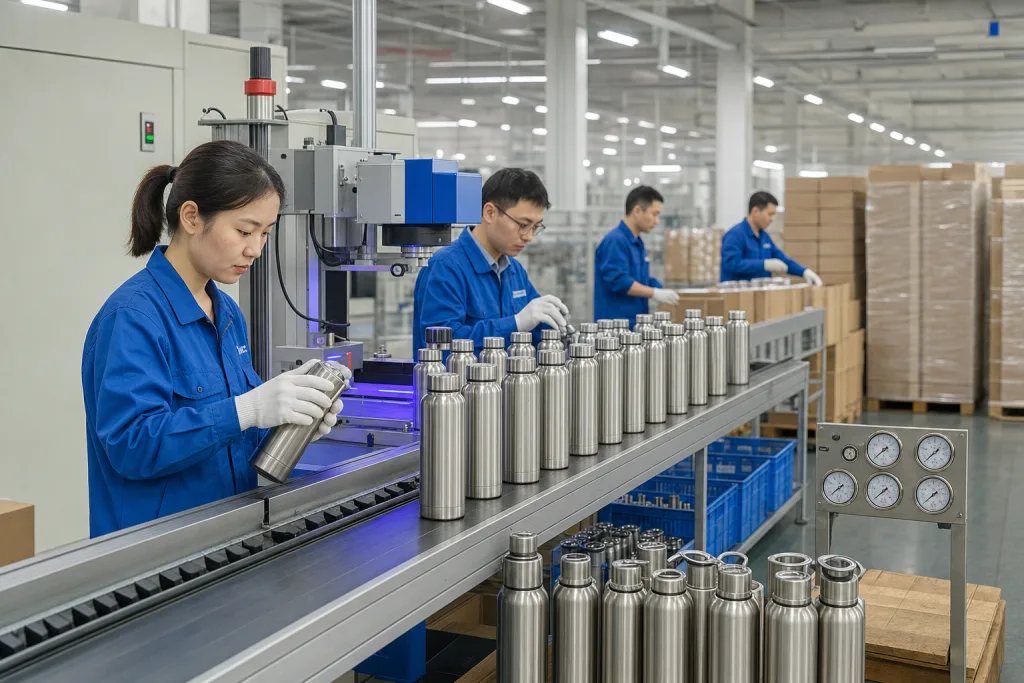
A custom logo thermos wins or loses at the decoration station. The right method depends on the coating, logo detail, MOQ, and where the bottle will be used after delivery. Laser engraving is still the safe pick for durability because it cuts through powder coat or marks bare 304 stainless steel, not a layer of ink. No peeling. On our line, a 30W fiber laser usually gives a clean mark on a 0.5 mm coated wall, which works well for outdoor retailers asking for a premium, low-key customized thermos.
Silkscreen printing is the better choice when the buyer needs exact brand color. It suits one-color logos and simple two-color layouts, and the unit cost makes sense for 1,000 to 10,000 pc promotional thermos runs. The weak point is abrasion. On powder-coated bottles, ink adhesion cannot be guessed. We run a 3M tape pull and a 75% alcohol rub test before bulk approval; QC pulled one black matte sample last month after 40 rubs showed edge fade.
Pad printing works better on curved shoulders or small logo panels than standard screen printing, but the math does not work for a large front logo. Heat transfer and water transfer can deliver full-color graphics or wraparound artwork for seasonal retail programs. They cost more and need scratch testing, especially for bottles that sit in car cup holders or get tossed into backpacks. We have seen this go sideways: one buyer flagged scuff marks after only two passes in a carton rub test with 12 kg stacking weight.
For most custom thermos orders, send logo artwork as AI or EPS; if you send a vector PDF, make sure the text is outlined. Pantone color numbers beat RGB screenshots every time. If the logo must face outward in retail packaging, define its direction against the lid, handle, or box window. Small detail, big problem. One typo on a PO said “logo opposite handle,” while the approved sample showed “logo under handle,” and that kind of miss can put 5,000 units in the wrong-facing position.
Practical rule: choose laser for lifetime durability, screen printing for clean promotional color, and transfer printing only when the artwork value is worth the extra sampling, tape pull, and scratch test.
Price The Real Landed Cost
FOB unit price is only the first number. A thermos manufacturer may quote USD 3.20 for a standard 500 ml bottle, while a cleaner-finished version comes in at USD 4.10. The USD 3.20 bottle can cost more after you add a 3% to 5% defect allowance, replacement stock, crushed color boxes, and customer service claims. We have seen QC pull samples with thin paint at the shoulder radius, where the dry film measured 28 μm instead of the 35 μm we asked the coating line to hold. Judge the finished product. Not the spreadsheet alone.
Typical cost drivers include steel thickness, lid structure, coating type, logo process, packaging, testing, and inspection. A 0.5 mm body costs less than 0.6 mm, but the lighter wall dents faster when cartons get stacked under 14 kg during sea freight. Powder coating costs more than basic spray paint, and I would still choose it for outdoor retail because the grip feels better and the bottle looks less promotional. A retail color box adds cost, but it is hard to avoid if the product sits on a shelf. For event giveaways, a plain kraft box is usually enough, especially when the bottle goes into a welcome kit with a towel or notebook.
MOQ changes the unit price fast. At 1,000 units, mold setup, screen setup, and line cleaning are spread over fewer bottles. At 3,000 to 5,000 units, the price improves because the coating booth and logo station can run longer without color changes. For thermos customized orders with several colors, the buyer often flags this late: MOQ usually applies per color, not just per total order. Three colors at 1,000 units each means 3,000 units. Simple math, but it gets missed on POs when someone writes “3 colors assorted” without a color breakdown.
Payment terms from China suppliers commonly run 30% deposit and 70% balance before shipment, especially for new buyers. FOB Ningbo or FOB Shanghai are common for Zhejiang factories. If you compare thermos suppliers, make every quote match on Incoterm, packaging, logo method, test requirement, and inspection level. A quote with laser logo, white box, and no third-party inspection is not the same product as one with powder coating, retail box, LFGB testing, and AQL 2.5 inspection. We ship both types, but mixing them in one comparison is the wrong question to ask.
Control Samples, Inspection, And Delivery
Sampling is where 8 out of 10 avoidable order problems should be caught. A pre-production sample must show the real steel finish, coating color with Pantone or powder code, logo size in mm, logo position from the bottle base, lid function, silicone color, packaging, and barcode. Do not approve a sample if the lid is hand-fitted, the box is a white dummy, or the logo is printed on tape just “for checking.” QC pulled the sample for one 500 ml order last month because the logo sat 6 mm higher than the signed drawing. A golden sample should be signed, dated, and kept by both you and the factory thermos team.
For a custom logo thermos order, we suggest three sample stages when time allows: a reference sample to confirm the bottle shape and hand feel, a logo sample to check printing or laser position, and a pre-production sample made with the final coating, lid, silicone, carton, and barcode. Shortcuts cost money. A logo sample is usually ready in 7-10 days if we have the bottle body in stock on the line. New mold development or a customizable thermos design with a special lid, new capacity, or private tooling takes 25-40 days before reliable samples are ready.
Inspection should be written into the purchase order, not discussed after cartons are sealed. AQL 2.5 for major defects and AQL 4.0 for minor defects is a common starting point for drinkware, though some retailers require stricter limits. Check visual defects under a light box, capacity with a measuring cylinder, weight on a 0.1 g scale, coating adhesion by cross-cut tape test, logo position with a caliper, leak performance after inversion, lid assembly, odor, barcode scan, carton drop condition, and packaging count. If you sell online, check the item weight and carton dimensions against your listing data; we have seen this go sideways when a buyer used 0.42 kg in the listing but the packed unit was 0.51 kg.
Our Zhejiang production line capacity for stainless thermos is about 300,000 units per month across standard models, depending on season and decoration mix. Peak season before Q4 is not forgiving. If your launch date is fixed, book production 60-75 days before you need goods leaving China. That gives room for sampling, deposit, mass production, inspection, and vessel booking, instead of trying to save 12 days and then paying for air freight that breaks the margin. The math does not work.
Send Your Thermos Brief For A Factory Quote
Share capacity, logo artwork, target price, market, and delivery date. We will return practical options, MOQ, lead time, and FOB pricing.
Frequently asked questions
What is the normal MOQ for a custom logo thermos order?
For most stainless steel models, the practical MOQ is 1,000 units per color. If you use an existing bottle body, standard lid, and one-position logo, that quantity is workable for factory scheduling. For custom powder coating, special silicone colors, or retail color boxes, 2,000-3,000 units may give better pricing and fewer setup charges. If you need a fully customized thermos with a new mold or exclusive lid, expect a much higher commitment, often 10,000 units or more depending on tooling cost. Small trial orders are possible only when you accept available colors and limited decoration options.
Which logo method should outdoor retailers choose?
For outdoor retail, laser engraving is usually the most reliable option because it resists scratching, water, and repeated handling. It works especially well on powder-coated stainless steel bottles. If your brand needs exact Pantone color, silkscreen printing is better, but you should request adhesion testing before mass production. For a promotional thermos, one-color screen printing can be cost-effective and visually strong. For full-color artwork, heat transfer is possible, but it adds cost and should pass rub and scratch testing. We normally ask buyers to approve a real logo sample before producing 1,000 or more units.
How long does production take after sample approval?
For an existing manufacturer thermos model with custom logo, normal mass production takes 35-45 days after sample approval and deposit. Add 7-10 days for a logo sample if the body is in stock. Add 5-7 days if you need a special coating color. Add more time before September and October, when many China factories are producing Q4 retail and holiday promotional orders. Sea freight to North America or Europe can add 25-40 days depending on port and route. If your delivery date is fixed, start the project at least 60-75 days before shipment.
What tests should I request for Europe or North America?
For Europe, ask for LFGB food-contact testing and REACH screening where applicable. For North America, FDA food-contact compliance is the usual baseline, and some buyers also request ASTM-related physical tests depending on the sales channel. You should also define functional tests: leak test, coating adhesion test, odor check, capacity check, heat retention test, and carton drop test. For inspection, AQL 2.5 major and AQL 4.0 minor is a common commercial standard. If your retailer has its own protocol, send it before quotation, not after production has started.
Can one thermos supplier handle both retail and promotional packaging?
Yes, but you need to define the packing route early. Retail packaging may need a printed color box, hang tag, barcode, warning text, and shelf-facing logo orientation. Promotional packaging may use a kraft box, polybag, or gift box with a lower decoration cost. For e-commerce, you may need FNSKU labels, master carton labels, and stronger drop-test packaging. A capable thermos supplier in China can manage all three, but each version changes cost, lead time, and carton dimensions. Ask for a packaging mockup and carton specification before approving the final purchase order.