Key Takeaways
- A practical MOQ for custom logo thermos flask orders is usually 1,000-3,000 pcs per color and model
- Pre-production samples should confirm capacity, lid fit, coating, logo position, carton marks, and packaging
- For outdoor retail, specify 304 inner stainless steel, vacuum performance, leak test, and drop test requirements
- AQL inspection, REACH/LFGB/FDA declarations, and spare lid ratios should be agreed before bulk production
A custom logo thermos flask can look straightforward on a quotation sheet: capacity, 304 stainless, logo area, carton count, FOB price. The trouble starts later, when QC pulled the sample after a 1.2 m drop test and the lid popped open, the logo was reduced to 18 mm and disappeared on a retail shelf, or the bulk thermos shipment landed with mixed lid colors. We’ve seen that go sideways. For outdoor retailers and promo brands, those mistakes turn into returns, chargebacks, and a lost selling window.
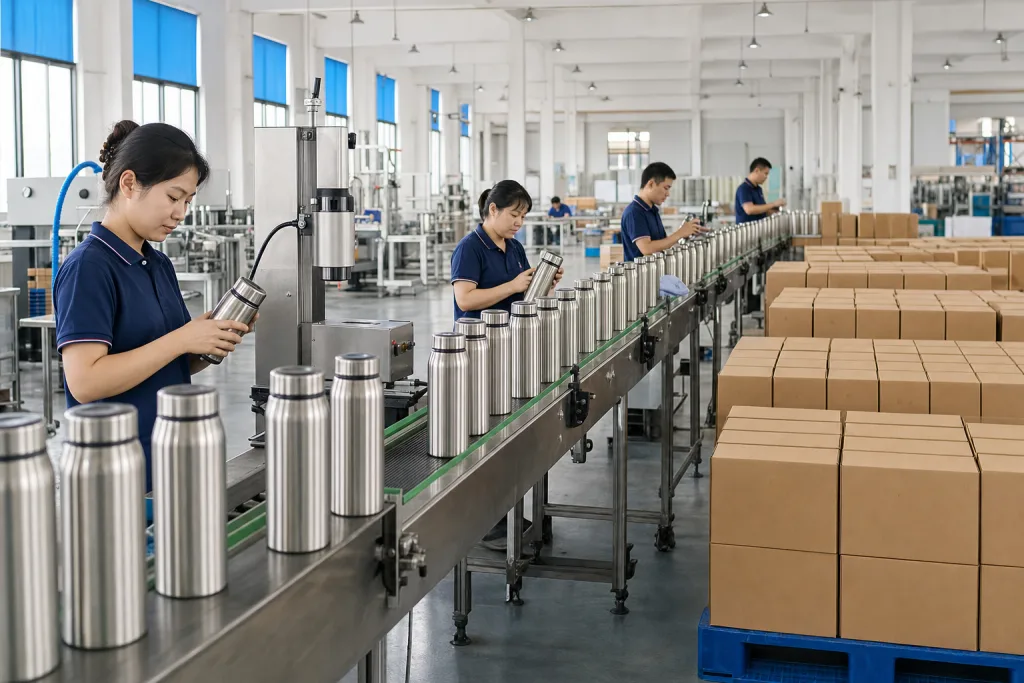
From our factory side in Zhejiang, China, the sourcing process is simple only if you write it down. Start with a clean RFQ, move through a paid or tightly controlled sample stage, and put the purchase order line by line with wall thickness, lid color, packing method, and carton marks before the thermos factory runs the line. Our Hangzhou line ships about 480,000 stainless vacuum units per month, but that capacity means little if the buyer brief is sloppy. One typo on a PO, such as “matt black” instead of “matte black,” can trigger a whole round of rework.
Start with a usable RFQ
Your RFQ decides whether you get a real factory price or a pretty guess. A custom logo thermos flask has too many price points for a one-line request like “quote 500 ml bottle with logo.” Send the thermos supplier a short, complete spec so the sales engineer does not fill blanks with the lowest-cost cap, thinner carton, or stock coating. We see this every week on the line.
For a stainless custom thermos, include capacity, body shape, lid style, stainless grade, coating, logo method, packaging, destination port, expected order quantity, and certification needs. A 500 ml powder-coated flask with a carry loop and gift box is not priced like a 750 ml outdoor flask with a cup lid and retail sleeve. Even the carton drop requirement changes the cost, because a 1.2 m drop test may need a thicker K=K carton instead of standard K=A board.
A good RFQ line can read: 500 ml double-wall vacuum flask, 304 inner / 201 outer stainless steel, matte powder coating, one-color silkscreen logo 60 x 35 mm, screw lid with silicone seal, individual kraft box, export carton 24 pcs, FOB Ningbo, 3,000 pcs, REACH and LFGB food-contact documents required. This gives our costing team enough to check the BOM, pull the right lid from the sample shelf, and confirm whether the 60 x 35 mm logo fits the straight wall without distortion.
Ask for the price to separate tooling, sample, logo setup, and mass production. Some thermos manufacturers quote one attractive unit price and add a USD 80-150 screen fee or USD 300 mold change later. That is not always dishonest; it is often poor RFQ discipline on both sides. Around Zhejiang and Guangdong drinkware clusters, one sales desk may handle 30 to 60 bottle inquiries a day. Clean data gets checked first. Messy data waits.
Your RFQ should also state your commercial role. An outdoor retailer may need shelf packaging, barcode labels, and carton compression strength tested on a 50 kg stack. A promotional thermos buyer usually cares more about fast logo approval and event delivery, especially when the buyer flagged a fixed launch date on the PO. A distributor thermos program may need mixed colors under one master PO, such as 1,000 black, 1,000 white, and 1,000 navy. Tell the thermos vendor which case you are buying for, because the math changes fast.
Define the flask before artwork
Logo work starts only after the flask body is fixed. Too many buyers pick artwork first, then find the print zone gets cut by a taper, a seam, powder texture, or the lid curve. We saw a 25 mm logo band shrink to 18 mm on a 500 ml sample, and QC pulled the part the same morning. For custom thermos jobs, body first. That is the right order.
The usual material choice is 304 stainless steel for the inner wall. For the outer wall, 201 stainless steel is common on promotional thermos orders, while 304 outer gives better corrosion resistance and a cleaner retail look. Wall thickness often sits around 0.4-0.5 mm per layer for standard vacuum flasks, and heavier outdoor models may use thicker sheet or reinforced bases. Thicker is not automatically better. It adds cost and weight. We check that with a micrometer on the line, and a 750 ml hiking flask at 390-450 g can feel solid, while a 500 ml commuting flask should not feel like a dumbbell.
Vacuum performance should be written as a test condition, not a sales phrase. A common benchmark is hot water at 95°C, measured after 6 hours and 12 hours at 20°C room temperature. If you need 12-hour outdoor positioning, put a minimum retained temperature into the PO. For cold retention, ask for a separate test using 4°C water or ice-water conditions. We run that with a probe thermometer in the lab, and a buyer once wrote only "good heat hold" on the PO. That spec goes nowhere.
For lids, ask for silicone hardness, thread material, and whether replacement gaskets are available. Outdoor retailers should stay away from lids that look clever but hide four parts and leave no cleaning access. Promotional brands should avoid complex lids when delivery time is tight, because lid tooling and color matching can hold up the whole thermos bulk order. We do a 1.2 N·m twist test on the cap, and the buyer flagged a loose thread on one sample before mass production.
At this stage, your PO draft should already list model number, capacity tolerance, material grade, finish, lid type, and target weight. One typo can send the line the wrong way. We have seen "matte" turn into "metallic" and waste a day of setup. Artwork sits on top of that foundation, not the other way around.
Choose decoration that survives use
A custom logo thermos flask is bought for visibility, but outdoor buyers also need durability. The cheapest logo method can turn into the priciest one if the mark rubs off after two weekends in a backpack. We have seen that go sideways on the line. On our bench, QC pulls a sample for a 500-cycle tape rub before release. Match decoration to the surface, order quantity, and retail promise.
Silkscreen printing is cost-effective for one- or two-color logos on smooth powder coating. MOQ can be as low as 1,000 pcs per design, with setup around USD 50-120 per color depending on size. On our side, the screen room usually starts with a 100-mesh frame and a clean 3 mm stroke. It fits a promo run when the logo stays simple and the budget is tight. The risk is abrasion if the ink system does not match the coating, and the buyer will flag that fast.
Laser engraving gives a cleaner look on stainless or coated bottles when you want a permanent mark. On powder coating, it strips the top layer and shows the metal underneath. We run it on a 20W fiber laser for small marks, and a 304 stainless sample will usually hold up through handling and wash tests. It works for outdoor retail and corporate gifting, but brand color is off the table. Unit cost is higher than silkscreen, especially for large artwork or wrap designs, so asking for color here is the wrong question.
Heat transfer and water transfer handle more complex graphics. They suit camouflage, map-style prints, or seasonal retail editions, but the artwork needs tighter control and more sampling. A buyer once approved a print from a phone photo, then the edge at the bottom radius lifted 2 mm on the first trial piece. For a customizable thermos program with many brand SKUs, do not approve transfer printing from a screen shot. Ask for a physical decorated sample and inspect the edges near the bottom radius.
For the PO artwork line, include logo file name, Pantone code, decoration method, logo size, logo placement from bottom or centerline, acceptable color tolerance, and approval sample reference. If you order a thermos customized with multiple colors, list every body color and logo color separately. We have lost half a day because the PO typed “centerline” one way and the sample note used another. “Same as sample” is not enough unless the sample is sealed, dated, and photographed in your QC file.
A practical rule: if the flask is sold for hiking, camping, or daily commuting, decoration durability matters more than saving USD 0.06 per unit.
Sample in controlled stages
Samples are not souvenirs. They are production controls. For a custom logo thermos flask, we normally run two stages: a stock sample to lock the model, then a pre-production sample to lock your exact customized thermos specification. Skip one and the math doesn't work; QC cannot compare bulk goods against a vague photo in WeChat.
A stock sample checks hand feel, lid operation, capacity, coating quality, and basic insulation. It may not carry your logo or exact color. For 30-40 standard manufacturer thermos models we keep around the Zhejiang supply chain, a stock sample can ship in 3-5 working days if available. Expect sample charges of USD 20-60 per piece plus courier cost. If the factory offers a free sample, still record what it represents; last month QC pulled one stock bottle with a 0.3 mm lid gap that was fine for model approval but not acceptable for bulk sign-off.
The pre-production sample should match the final order: body color with Pantone code, logo method with size in mm, packaging, barcode, warning label, manual, and carton mark. This step usually takes 7-15 days after artwork approval. If the project requires a new lid mold or special color powder coating, allow 18-25 days. Rushing this stage is how buyers end up approving a logo on a white bottle, then receiving poor contrast on dark green bulk goods. We've seen this go sideways on the line when the buyer flagged the bulk sample only after 1,200 pcs were already powder coated.
Your sample approval should include measurable checks. Fill the flask to rated capacity and verify actual volume with a measuring jug. Check lid leakage by inverting for 30 minutes after filling with water. Measure logo size with a ruler, not your eyes. Run a tape test on printing where appropriate. For outdoor retail, perform a simple 1 m drop test on a filled sample, even if the formal lab test happens later; one dented base ring tells more than ten nice photos.
On the sample PO or sample invoice, list: model, color, logo file, decoration method, packaging type, documents required, courier account, and the deadline for dispatch. Use file names, not “latest logo”; we once received a PO with the barcode typed as 697 instead of 679, and the buyer only caught it at carton proof stage. This avoids the common “sample approved but not the same as bulk” argument. A careful supplier thermos partner will accept this discipline because it protects both sides.
Build the purchase order line
The purchase order is where sourcing turns into engineering. A weak PO says “custom thermos, 3,000 pcs, black, logo.” A strong PO tells the thermos factory what material to book, which line to run, what QC must measure, how cartons are marked, and which forwarder receives the goods. We saw one buyer’s PO miss the lid color; QC pulled the golden sample and found black bodies with gray lids after 600 pcs were already packed. Expensive lesson.
Each PO line should include SKU, factory model number, capacity, material, finish, body color, lid color, logo method, logo size, packaging, carton quantity, unit price, MOQ, delivery term, and inspection standard. For mixed colors, split the lines with clear quantities: 1,000 pcs black with matte powder coating, 1,000 pcs forest green matched to the approved color chip, 1,000 pcs navy with the same logo position. Do not rely on an email sentence saying colors are mixed. The line follows the PO, not your inbox.
For commercial terms, most stainless thermos suppliers in China quote FOB Ningbo or FOB Shanghai for Zhejiang production. Small trial orders may ship EXW or by courier, but bulk thermos orders should state port, currency, payment terms, and latest shipment date. A normal deposit is 30% with 70% before shipment after inspection, though established accounts may negotiate differently. Put the date in one place, not scattered across the PI and PO; we once had a PO typo showing 18 June while the deposit receipt said 12 June, and the buyer flagged it during booking.
Add packaging details. Retail buyers often ask for individual color boxes, EAN/UPC labels, hang tags with material claims, and master carton labels with SKU and quantity printed on two sides. Amazon-oriented promotional brands may need FNSKU labels, carton weight below 22 kg, and no mixed SKUs per carton. Outdoor distributors often need spare lids or gaskets. A practical spare parts ratio is 0.5-1% of order quantity, either free or priced as a separate PO line. The math doesn't work if you ask for 2% free spare lids on a 500 pcs trial order; the mold room and packing table still treat them as real parts.
Include compliance and document lines: food-contact declaration, REACH statement if needed, LFGB or FDA test report where applicable, BSCI audit request if your customer requires social compliance, and inspection booking responsibility. A manufacturer thermos order without document requirements may still be legal, but it may fail retailer onboarding. We ship plenty of compliant cups, but if the PO does not call out the report holder, test item, and factory name, your buyer’s QA team can reject the file before they even open the carton.
Inspect before the cartons close
Final inspection should happen when at least 80% of goods are packed and 100% are produced. For thermos custom orders, checking after shipment is just complaint writing. Before shipment, it gives the buyer real control. QC can still pull cartons from the line, open the inner boxes, and stop a pallet before the sealing tape goes on.
Use AQL sampling unless your customer has a stricter protocol. A common setting is AQL 2.5 for major defects and 4.0 for minor defects, with critical defects not accepted. Critical issues include leakage, sharp edges, wrong material claim, contamination, unsafe lid failure, or a logo for the wrong customer. Major defects include poor vacuum performance, visible dents, wrong Pantone outside tolerance, misaligned logo, or damaged retail box. Minor defects include small coating specks within agreed limits or slight carton printing variation. We once had a buyer flag a 3 mm logo drift on a matte black flask; that was a major defect because the approved sample showed the logo centered under the lid seam.
Inspection should check function, appearance, packaging, and quantity. Ask the inspector to run random leak tests, lid fit checks, capacity checks, barcode scans, carton drop checks if required, and logo position measurements with a caliper or printed jig. For vacuum performance, a full 6- or 12-hour test may not fit into a same-day inspection, so agree whether the factory thermos QC team provides batch records and whether the third-party inspector verifies a shorter heat-loss screen. This is the wrong question to leave until inspection day.
Do not ignore carton data. A 500 ml stainless flask packed 24 pcs per carton may produce a carton around 12-15 kg depending on packaging. If your PO says maximum 18 kg and the actual carton is 23 kg, warehouse teams will complain and some retailers may reject it. Carton dimensions also affect container loading and LTL costs in North America and Europe. We run a carton weight check on a floor scale before mass packing, because 10 mm extra on the gift box can kill a loading plan.
Our practical advice from Hangzhou, Zhejiang: book inspection 5-7 days before the planned vessel closing date, not the day before. If defects appear, the factory needs time to rework, replace lids, repack boxes, or reprint labels. One late label typo on a PO can burn 2 days. A good thermos supplier would rather fix issues on the production floor in China than debate claims after arrival.
Move from first order to program
The first order tells us if the flask spec, the factory line, and your buying process can work together. The second order should cut waste: sharper cost, cleaner lead time, fewer SKU surprises. If every reorder lands as an urgent PO on Friday night, you keep paying air-freight premiums and overtime packing fees. Bad habit.
After the first bulk shipment, review the actual numbers: defect rate, customer comments, sell-through, carton damage, and warehouse handling notes. QC pulled 32 pcs from one 750 ml matte black lot last year and found 5 with display-bin scratches near the shoulder radius. If customers like the 750 ml model but say the lid is hard to clean, fix the lid brush gap or gasket groove before ordering 10,000 pcs. If the matte black coating marks up in retail display bins, switch powder formula or move to a lighter texture. A custom logo thermos flask is not just a logo item; it sits on desks, in cars, and in gyms with your brand showing every day.
For distributor thermos programs, forecast by quarter and lock shared components early. We run three body colors with one lid, one gasket, one box structure, and one carton size; the line changes faster, and purchasing does not chase 6 different silicone SKUs. That gives the thermos manufacturer better material control and cuts wrong-part mistakes. For promotional thermos campaigns, reserve production capacity 45-60 days before your event delivery date, especially before China holidays. Around Chinese New Year, stainless drinkware lead times can stretch from 30-40 days to 60-75 days because polishing wheels, powder coating booths, and packing tables all get short on labor.
For reorders, your PO can reference the approved sample and previous shipment, but still list current color, logo, packaging, and compliance requirements. Put the Pantone code, logo position in mm, barcode file name, carton mark, and test standard on the PO. We once saw a buyer flag “old barcode” after goods reached the forwarder; the PO had copied last year’s pack text with one digit wrong. Standards change. Retailer manuals change. Your own brand guide changes. Good thermos manufacturers will ask you to reconfirm artwork and packaging every time. That is not bureaucracy; it is how you avoid receiving last year’s barcode on this year’s retail pack.
Send us your thermos RFQ for review
Share capacity, quantity, logo file, packaging, and destination. We will return a practical China factory quote with sample and bulk timelines.
Frequently asked questions
What MOQ should I expect for a custom logo thermos flask?
For standard stainless models, a realistic MOQ is 1,000 pcs per logo and color, but 3,000 pcs usually gives better unit pricing and more stable coating production. If you want a custom body color, special lid, or retail packaging, many thermos suppliers will ask for 2,000-5,000 pcs. New mold projects are different; tooling may require 10,000 pcs or more to make sense. For a first outdoor retail test, we often suggest 1,000-1,500 pcs in one color rather than splitting 3,000 pcs across six colors. Too many small color lots increase coating loss, packing errors, and inspection complexity.
How long does sampling and bulk production take?
A stock sample normally ships in 3-5 working days if the model is available. A decorated pre-production sample usually takes 7-15 days after artwork and color approval. Bulk production for a standard custom thermos order is commonly 30-45 days after deposit and sample approval. If you need a new lid mold, special powder coating, transfer print, or complex gift box, plan for 45-60 days. Before Chinese New Year in China, add at least 2-3 weeks of buffer. Vessel booking to Europe or North America is separate and can add 25-40 days depending on route.
Which logo method is best for outdoor retail flasks?
For outdoor retail, laser engraving and well-cured silkscreen are the most common choices. Laser is the most durable because it does not sit as an ink layer on the surface, but it usually gives a metal-color mark rather than a Pantone brand color. Silkscreen is better when you need a clear colored logo and a lower cost, often around USD 0.05-0.18 per position depending on size and color count. For full-wrap artwork, heat transfer can work, but you should test abrasion near curved areas. Always approve a physical sample, not just a digital mockup.
What tests should I require before shipment?
At minimum, require leakage testing, capacity check, visual coating inspection, logo position check, lid assembly check, and carton quantity verification. For outdoor or retail programs, add vacuum performance testing, 1 m drop testing on selected samples, barcode scan verification, and carton drop testing if your packaging must survive courier handling. Use AQL inspection, often 2.5 for major and 4.0 for minor defects. Food-contact documents should match your market: LFGB is often requested in Europe, while FDA-related declarations are common for the United States. If children may use the product, ask about applicable ASTM or safety requirements.
Can I order several logo designs in one bulk thermos order?
Yes, but each logo design should be treated as a separate PO line or at least a separate SKU line. The factory needs clear quantities, artwork files, logo positions, packaging labels, and carton marks for each design. If you order 3,000 pcs total with three logos, expect the supplier thermos team to price setup fees for each logo, even when the bottle is the same. For distributors thermos programs, we recommend minimum 500-1,000 pcs per artwork to reduce line change waste. Smaller splits are possible, but the risk of mixed cartons and higher inspection time increases.