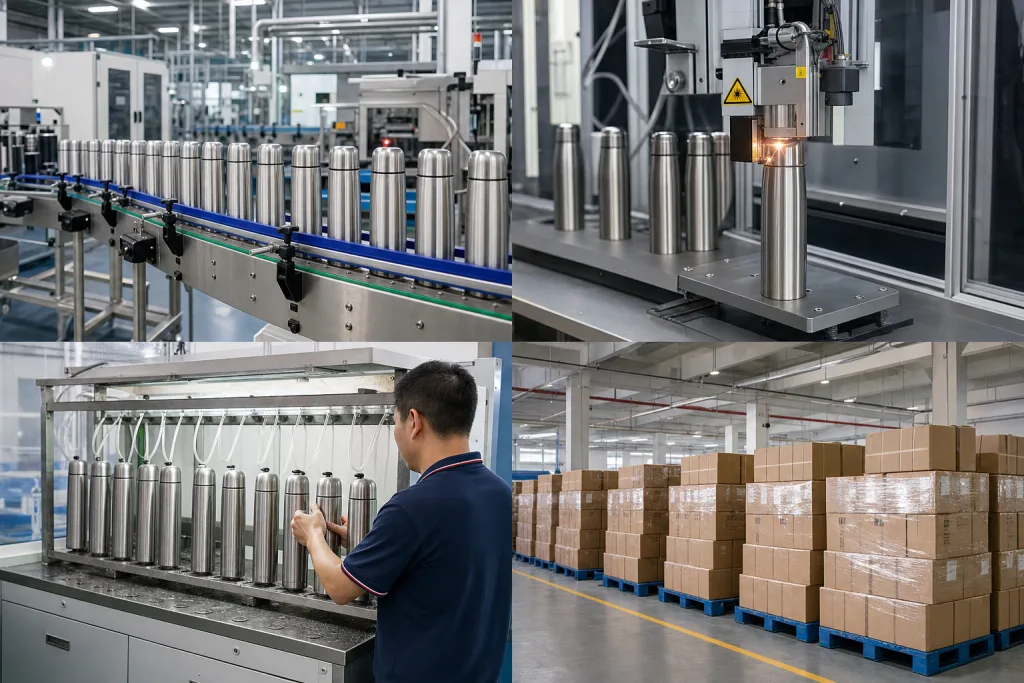
Key Takeaways
- A practical MOQ for a custom logo thermos bottle is usually 1,000-3,000 pcs per color, with better pricing at 5,000 pcs
- 304 stainless steel inner wall, 201 or 304 outer wall, and 0.4-0.5 mm body thickness are common commercial specs
- Vacuum retention, coating adhesion, logo durability, and carton drop testing should be checked before final payment
- FOB Ningbo or Shanghai lead time is typically 30-45 days after deposit and approved pre-production sample
You are not buying a pretty bottle. You are buying a repeatable retail SKU that has to survive 18–22 kg export cartons, shelf handling, outdoor use, and your customer’s dishwasher habits. A custom logo thermos bottle looks simple until the buyer flags a loose lid thread, 18 μm paint instead of 25 μm, a carton spec missing the 5-ply grade, or a logo process that starts peeling after 30 days.
Use one real order as the base: 5,000 pieces of a 600 ml stainless thermos for an outdoor retailer or promotional thermos program. We ask the same questions our Zhejiang sales and engineering team uses before quoting, and QC pulled the sample with a digital caliper, thread gauge, and cross-cut tape test before we priced the last run. China can produce almost any customized thermos. The clean orders are locked before sampling; fixing spec gaps after mass production is where the math doesn’t work.
Start with the selling use case
The first question is not color or logo. It is the selling channel. Where will the bottle sit, and what abuse will it take? A retail outdoor bottle and a low-cost giveaway bottle can both be sold as a custom thermos, but they should not run the same spec sheet. We ask this before opening the color chip book, because the wrong starting point leads to a wrong BOM.
For this buyer scenario, you are ordering 5,000 pcs of a 600 ml custom logo thermos bottle for hiking shops and corporate outdoor gift sets. The target retail price is USD 22-30, so the factory thermos cannot feel light in hand, leak inside a backpack, or show chipped coating after one weekend. A reasonable FOB China target might be USD 4.20-6.80 depending on lid type, coating, logo method, carton requirements, and inspection level. On our line, QC would usually pull 32 pcs before packing and run a lid leak test at 45° and upside down; if 2 lids seep, the buyer will flag it fast.
For an outdoor retailer, we would usually specify a one-hand drinking lid or screw lid with a carry loop, 304 stainless steel inner wall, powder coating, and a slim base that fits common car cup holders, often around 70-72 mm. For a promotional thermos, you may accept a simpler lid and lower insulation requirement if the event budget is fixed. Be honest about the channel. Overbuilding a giveaway wastes money; underbuilding retail stock creates returns. We have seen this go sideways when a buyer asked for retail packaging but approved a promo-grade lid to save USD 0.28.
A manufacturer thermos quote should include capacity, dimensions, net weight, stainless grade, lid material, silicone type, coating, logo method, packing, test standard, MOQ, and lead time. If your suppliers thermos quote only says “stainless steel vacuum flask, logo available,” you do not yet have a quote you can compare. Ask for the drawing in mm, carton size, gross weight, and logo artwork position; one PO typo, like 600 ml written as 650 ml, can delay sampling by 3-5 days.
Lock the body specification early
For a 600 ml stainless thermos, we usually run a double-wall vacuum insulated stainless steel body. The inner wall should be food-contact 304 stainless steel. For the outer wall, 201 stainless steel keeps the quote down, while 304 stainless steel gives better corrosion resistance and supports a cleaner premium claim on the carton. In the last 17 outdoor brand RFQs we handled, 304 inside with 201 outside was the common pick; distributor programs with stricter after-sales pressure asked for 304 inside and outside. QC checks the steel mark against the material sheet before the first sample leaves the line.
Wall thickness matters. Thin bottles dent. For this order, we would target 0.4-0.5 mm stainless sheet before forming, with finished bottle weight around 300-380 g depending on lid. If a thermos supplier offers a surprisingly low price, ask for body weight and steel grade in writing, then have them weigh the sample on a 0.1 g digital scale. Chasing the lowest shell quote is the wrong question to ask. We have seen “savings” come from 0.32 mm sheet and a loose lid gasket, and the buyer only flagged it after carton drop testing.
Insulation performance should be written as a test condition, not as sales copy. For a retail custom thermos, a practical requirement is hot water at 95°C, tested at room temperature around 20°C, with temperature after 6 hours above 60°C. We test with a probe thermometer and log the bottle number on masking tape, because mixed samples cause arguments later. Some designs perform better, but lid geometry and mouth diameter change the result. Wide-mouth bottles fill and clean faster; narrow-mouth bottles usually hold heat better.
Confirm the inside electropolishing, mouth rim smoothness, and base rubber pad before tooling is locked. Consumers notice these parts first. A sharp rim is an instant complaint. On one PO, the buyer typed “rubber paid” instead of “rubber pad,” and our merchandiser still had to confirm it before sampling. A thermos manufacturer in Zhejiang or elsewhere in China can adjust these details, but only before the mold shop cuts parts and the sample room seals the final version.
Choose decoration that survives use
A custom logo thermos bottle gets judged twice: once when the buyer opens the carton, and again after 30 days in a backpack or cup holder. Cheap decoration is not cheap if QC pulled the sample after a 3M tape test and half the print came off.
For outdoor retail, we run laser engraving on powder-coated bottles because it cuts through the coating and shows the stainless steel underneath. No ink layer. Less to peel. On a 500 ml bottle, a 35 mm wide logo usually engraves cleanly; a 12 mm logo with thin reversed letters is where buyers start asking why the “e” filled in. For promotional brands with full-color artwork, screen printing or heat transfer can work, but adhesion testing matters. Small logos suit screen printing. Wraparound artwork suits heat transfer, though the math gets worse once coverage passes 60% and the line needs slower handling.
Here is a practical decoration decision:
- Laser engraving: best for durable premium logos on coated bodies, usually USD 0.10-0.35 per position. We check depth and edge burrs under a 10x loupe.
- Silkscreen printing: works for 1-2 color logos, usually USD 0.08-0.25 per color per position. Registration under 0.5 mm is normal, but tiny gaps can show on curved bottles.
- Heat transfer: suits full-color graphics, often USD 0.40-1.20 depending on coverage. QC should run a rub test after curing, not just inspect the first 20 pcs.
- Embossed or debossed parts: possible on silicone or plastic components, but may need tooling. A lid insert mold change can add 10-15 days before bulk production.
For a 5,000 pc thermos custom order, ask for a pre-production sample using the exact coating, exact logo size, and exact Pantone color. Do not approve a digital mockup as final proof. This is the wrong place to save three days. We have seen POs with “Pantone 186C” typed as “168C,” and the buyer flagged it only after the red sample looked brown on the inspection table. A customizable thermos is still limited by process: fine lines, tiny reversed text, metallic inks, and matte coatings need real samples before the line starts.
Price the order without guessing
Ask a thermos factory for price with enough detail, or you will get a fake low number. Capacity is only one line on the cost sheet. A usable RFQ for thermos bulk buying should include target capacity, lid type, steel grade, color count, logo method, packaging, testing requirements, destination market, and annual forecast; our costing clerk will still ask for the artwork file in AI or PDF because a 35 mm laser logo prices differently from a 180 mm wrap.
For this scenario, assume 5,000 pcs, 600 ml, 304 inner and 201 outer, powder coating, laser logo on one side, individual kraft box, 24 pcs per master carton, FOB Ningbo. We run this kind of bottle often. A realistic factory thermos quote from China may land around USD 4.20-5.50. Change to 304 outer wall, full-color wrap, custom gift box, or extra leakproof lid parts, and the price can move above USD 6.50. Push the order down to 1,000 pcs, and the unit price often rises 8-20% because coating setup, logo setup, and carton printing are spread across fewer units; the math doesn't work when the powder booth has to wash down for one small Pantone batch.
MOQ also varies by finish. Stock bottle shape with custom logo may start at 500-1,000 pcs. Custom Pantone coating usually starts at 1,000-3,000 pcs per color. A new lid mold can require 5,000-10,000 pcs or a separate tooling charge, commonly USD 1,500-6,000 depending on complexity. QC pulled a sample last month where the lid gasket groove was 0.3 mm shallow, so a “cheap new lid” became two mold corrections before the buyer would sign off.
Do not compare suppliers thermos pricing without checking payment terms and incoterms. FOB Ningbo is not the same as EXW Zhejiang. If you need DDP delivery or Amazon-style labeling, say so before the quote; FNSKU labels, suffocation warnings, and 150 mm carton drop-test notes change both labor and packing cost. We’ve seen this go sideways: one PO had “FOB” in the email and “DDP LA warehouse” in the attachment, and the buyer flagged the USD 0.72 per pc gap after production had started.
Build QC into the purchase order
Do not write “good quality required” on the PO and expect the line to guess. Write the checks down. For a custom logo thermos bottle, we lock the high-risk points into the purchase order: vacuum insulation, leak rate, coating adhesion, logo position in mm, lid fit, odor, and carton strength. We’ve had buyers flag a logo that was 3 mm off-center on a 500 ml bottle; that is easy to argue about unless the PO already says the tolerance.
For this 5,000 pc order, we would set inspection under ANSI/ASQ Z1.4 or ISO 2859-1, using General Inspection Level II. A common AQL is 0 for critical defects, 2.5 for major defects, and 4.0 for minor defects. Critical defects include sharp metal burrs, leaking bottles, unsafe odor, or wrong food-contact material. Major defects include poor vacuum performance, obvious logo misalignment, lid thread failure, large dents, or serious coating scratches. QC should also record the caliper reading for mouth diameter and lid thread fit; 0.4 mm can be enough to make a cap feel cheap.
Ask the thermos manufacturer to run 100% leak testing and vacuum testing during production. For final random inspection, pull samples for hot water retention, upside-down leak test for 4 hours, tape adhesion test on logo and coating, rub test for printed artwork, and carton drop test. Use 3M tape for the adhesion test, not a no-name roll from the packing desk. If the bottle is sold in Europe, check LFGB or EU food-contact requirements where relevant, plus REACH for coatings and components. For North America, ask about FDA food-contact compliance and, for children’s items, ASTM and CPSIA considerations.
BottleForge Industrial runs about 450,000 stainless drinkware units per month across standard and custom projects in Zhejiang, with typical mass production lead time of 30-45 days after approved sample. That capacity helps, but it does not replace a written QC plan. The math doesn’t work if you find the problem after cartons are sealed and stacked on 20 pallets. Capacity makes the order possible; inspection makes it safe to ship.
Plan packing before production starts
Packing is decided before the line opens, not after bottles come off the conveyor. It affects damage rate, warehouse labor, and retail presentation. For a distributor thermos order, lock the individual box size, master carton count, carton board grade, barcode position, country of origin marking, and pallet preference before mass production. We run a carton drop check from 76 cm on export packs, and QC pulled one sample last month because the barcode sat across the box seam.
A typical 600 ml bottle may be packed 1 pc per kraft box, then 24 pcs per export carton. For e-commerce or club-channel orders, 12 pcs per carton often gives better compression control, especially when the carton stacks 5 layers high on a 1.2 m pallet. If you sell through online fulfillment, set the FNSKU or item barcode placement, suffocation warning on polybags if used, and carton labels on two adjacent sides. Small detail. Big headache. If your warehouse uses automated receiving, carton dimension tolerance of 3 mm matters more than some buyers expect.
For outdoor retail, we prefer avoiding glossy gift boxes unless the brand position needs that shelf look. Matte kraft with a clean line drawing travels better and hides scuffs after a 30-day sea shipment. For promotional thermos campaigns, a plain white box may be enough, but confirm whether the end client expects retail-ready packaging. We have seen this go sideways when the PO said “white box” but the buyer flagged missing color artwork during pre-shipment inspection. Repacking in Europe or North America usually costs more than doing it correctly in China.
Check the shipping math early. A 5,000 pc bulk thermos order might fill roughly 8-12 cbm depending on carton size and bottle shape. Freight cost per piece can change the real landed cost by USD 0.30-1.00, especially when moving by air for late events. If you have a launch date, build the carton and freight plan while the sample is still being approved, not after goods are finished. Waiting until final packing is the wrong question to ask; by then the line has printed cartons, the pallet height is fixed, and the math may not work.
Approve samples like a buyer
The final sample stage is where good buyers slow down. A clean sample on your desk does not guarantee bulk production unless every detail is locked. For this customized thermos order, approve a golden sample with the final bottle body, lid, gasket, coating, logo, packaging, instruction sheet, and barcode label. We usually mark the approved piece with a white paint pen on the base, then seal the factory copy in a polybag with the PO number and date.
Measure the sample. Record height, diameter, capacity by fill volume, bottle weight, logo size, logo position from base or centerline, lid torque feel, and color under normal light. Use a caliper, kitchen scale, Pantone light box, and 95°C water fill test, not just eyesight. Keep one approved sample with you and one sealed at the thermos factory. Add photos to the purchase order. If a future dispute happens, “same as approved sample” only works when the approved sample is clearly identified. We have seen this go sideways when a buyer approved matte black by email, but the PO photo showed semi-matte under warehouse lighting.
Before paying the balance, ask for production photos, inline QC records, and final inspection. For a first order with a new thermos supplier, use a third-party inspection or your own China-based agent. The math is simple: rejecting 38 cartons in Zhejiang costs less than explaining chipped coating to outdoor retailers after delivery. Ask QC to pull samples from sealed cartons, not from the line table. Check AQL 2.5 results, carton drop marks, barcode scans, and whether the inner box typo from the sample stage was actually fixed.
The best suppliers thermos relationship is not built on the lowest first quote. It is built on clear specs, honest lead times, and fast correction when something is off. If you want a repeatable manufacturer thermos program, treat the first 5,000 pcs as the start of a platform: same body, controlled colors, tested lids, and artwork rules your sales team can reuse for the next season. We run better when the buyer freezes one 304 stainless body, two lid options, and a logo safe zone in mm, instead of changing the bottle neck after tooling is already on the press.
Send your thermos spec before you request pricing
Share capacity, logo artwork, target MOQ, packaging, and destination market. We will return a practical FOB quote and sample plan.
Frequently asked questions
What MOQ should I expect for a custom logo thermos bottle?
For a stock stainless thermos shape with one logo, MOQ is often 500-1,000 pcs. For custom Pantone powder coating, expect 1,000-3,000 pcs per color because coating setup and color changeover take time. For a new lid, new body mold, or exclusive shape, MOQ may move to 5,000-10,000 pcs plus tooling. If your first order is below MOQ, ask whether the thermos manufacturer has stock colors you can decorate. That is usually the cleanest way to test a market without paying for unnecessary customization.
Which logo method is best for outdoor retail thermos bottles?
For outdoor retail, laser engraving on powder coating is usually the safest choice. It is durable, clean, and does not rely on ink adhesion. Silkscreen printing is good for simple 1-2 color logos and promotional thermos orders, but it should pass tape and rub testing. Heat transfer works for full-color wrap designs, though it costs more and needs tighter process control. If the bottle will be clipped to backpacks, stored in car cup holders, or washed often, choose durability over a complex graphic. Always approve a real pre-production sample, not only a mockup.
How long does production take after sample approval?
For a standard custom thermos using an existing body shape, normal production lead time is 30-45 days after deposit and approved pre-production sample. Add 7-14 days for custom color sampling or complicated artwork. New tooling can add 20-35 days before production starts. Sea freight to North America or Europe often adds 25-45 days depending on port and season. If you need goods for a fixed event date, work backward from delivery, not factory completion. Late artwork approval is one of the most common causes of rushed air freight.
What compliance documents should I request?
For Europe, ask for food-contact documentation relevant to stainless steel, plastics, silicone, and coatings. LFGB, EU food-contact declarations, and REACH screening may be requested by retailers. For North America, ask for FDA food-contact compliance support, and if the item is for children, check CPSIA and applicable ASTM requirements. Documentation should match the material actually used in production, not a generic file from another bottle. For larger distributor thermos programs, you may also request BSCI or similar social audit records from the factory.
Can I order one bottle shape for both retail and promotional use?
Yes, and it can be smart if you control the specification. Use the same 500 ml or 600 ml body, then vary color, logo method, and packaging by channel. Retail can use powder coating, laser logo, and printed kraft box. Promotional orders can use stock colors, silkscreen logo, and plain white box to reduce cost. This keeps testing, freight planning, and spare lid management simpler. Just avoid weakening the core body specification too much. If consumers see both versions, the cheaper one should not damage your retail brand perception.