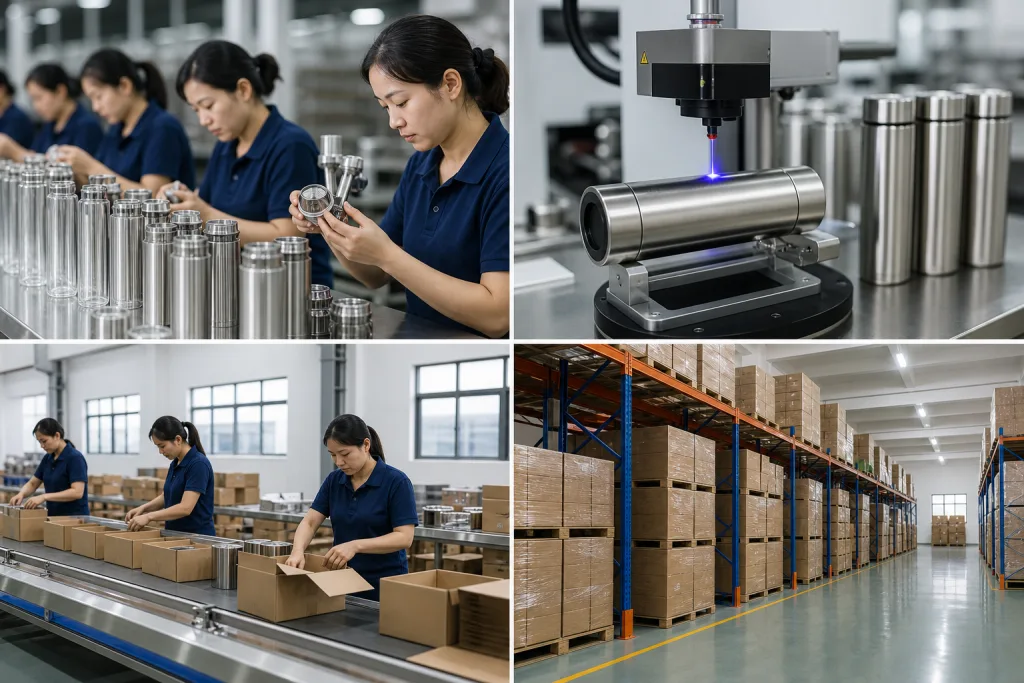
Key Takeaways
- A practical custom logo tea bottle MOQ starts at 500-1,000 pcs for existing molds and 3,000 pcs for special colors or private parts
- FOB China pricing often ranges from USD 2.40-6.80 depending on steel grade, lid, infuser, coating, and logo process
- Normal lead time is 30-45 days after deposit and artwork approval, with 7-12 days for pre-production samples
- AQL inspection, REACH/LFGB documentation, and packaging tests should be planned before mass production, not after
A custom logo tea bottle looks simple on a quotation sheet until you put the parts on the table: 304 stainless body, 500 ml capacity, tea infuser mesh, powder coating, logo process, carton size, and ship date. We’ve quoted the same 500 ml tea bottle with a USD 1.20 gap against another China supplier, and both prices can be honest. The wall thickness, lid gasket, coating pass rate, and inner polishing are not the same.
If you buy custom drinkware for retail, promotion, or distributor channels, get the price map before approving artwork. We see this every month in our Hangzhou line: a buyer asks for a “nice tea bottle,” then flags the MOQ, mold fee, testing time, or color box lead time after the PO is already typed. Bad timing gets expensive. A realistic plan saves 10-20 days and keeps you away from rushed air freight, especially when QC pulled the sample and found the logo sitting 3 mm off center.
Start With The Real Bottle Spec
The fastest way to get a bad quote is to ask for “a tea bottle with logo” and send only a picture. That quote will be soft. A custom logo tea bottle usually has seven cost drivers: body material, capacity, insulation structure, tea filter, lid system, decoration method, and packaging. If one line is missing, the canteen supplier will pad the price or quote low and add the missing charge after the sample. We see this weekly; last month QC pulled a 500 ml sample where the buyer’s PO said “steel lid,” but the reference photo showed PP inside.
For B2B buying, start with a specification table. A normal retail tea bottle runs 450-600 ml, double-wall 304 stainless steel inside, 201 or 304 outside, 0.4-0.5 mm wall thickness, screw lid, removable stainless infuser, and powder coating. A promotional version may use single-wall stainless steel, 0.35 mm body thickness, and a simple PP lid. The difference can pass USD 2.00 per unit before logo and packaging, and the math does not work if the buyer expects retail weight at promo pricing. On the line, we check body thickness with a digital caliper before polishing, because 0.35 mm and 0.5 mm do not behave the same during rolling.
Infusers matter. A short basket filter costs less and is easier to clean. A full-length tea strainer uses more steel and needs tighter fitting tolerance, usually around 0.2-0.3 mm at the neck to stop rattling. If you want fruit infusion, herbal tea, or loose-leaf tea positioning, do not approve filter mesh that is too thin. Buyers often ask for a low price, then complain that the mesh bends after 20 uses. That is not a quality mystery; it is a spec decision, and we have seen this go sideways when the approved sample used 0.4 mm mesh but the PO only wrote “stainless filter.”
For distributor drinkware or a canteen promotional program, define carton drop requirements, barcode labels, inner box style, and pallet loading before we open artwork. Packaging blocks production. A Zhejiang factory can produce 300,000-500,000 drinkware units/month, but your order still slows down if packaging files arrive five days late. We run cartons through a 76 cm drop test when the buyer asks for retail shipment, and one missing EAN barcode on the inner box can hold 120 cartons at final inspection.
FOB Price Ranges You Can Use
Custom logo tea bottle quotes from China usually fall into a tight FOB band when the supplier shows the real BOM. For existing molds, a single-wall stainless tea bottle with a basic logo is usually USD 2.40-3.60 at 1,000 pcs. A double-wall vacuum model with a 304 stainless infuser, powder coating, and laser logo often lands at USD 4.20-6.80, mainly driven by capacity and lid structure. A premium gift-box version with color sleeve, insert card, and upgraded coating can move above USD 7.00. We run these on the same line as 500 ml and 750 ml travel bottles, and QC still checks wall thickness with a micrometer before the first carton is sealed.
Here is how the cost normally breaks down:
- Body material: 304 stainless inside costs more than 201, but it is the safer choice for tea contact and export compliance. We have seen buyers save USD 0.18 here, then lose the order after LFGB review.
- Vacuum insulation: double-wall vacuum construction adds welding, vacuum testing, and higher scrap risk. On one 3,000 pcs run, QC pulled 47 pcs for weak vacuum after the hot-water hold test.
- Infuser: a removable 304 stainless filter can add USD 0.25-0.70 depending on length and mesh. A 120 mm filter costs differently from a short 75 mm basket, even if the product photo looks close.
- Surface finish: powder coating is usually tougher than basic spray paint, but the curing oven must be controlled. If the line runs 8 minutes short, the coating may pass packing inspection and still chip in transit.
- Logo method: laser engraving is clean for stainless or coated surfaces; silk screen is cheaper for a large flat mark, but it is less forgiving on curved bodies. The buyer flagged a 2 mm logo drift on a tapered bottle last month.
- Packaging: white box, color box, kraft box, and gift set packaging can differ by USD 0.15-0.90 per unit. The carton spec matters too: 5-layer export carton vs thin local carton is not the same quote.
For a custom canteen or customizable canteen program using the same production line, pricing follows the same cost logic. The body shape, cap tooling, and coating yield drive the price more than the marketing name on the inquiry sheet. Watch the low quote. We have seen this go sideways when a canteen vendor used 0.38 mm steel instead of 0.45 mm, mixed-grade material, or coating powder without a proper test report. It may pass a quick photo check, but the math does not work if your customer fills it with hot tea every day.
MOQ Tiers And What Changes
MOQ is not just a sales policy. It comes from coating line setup, logo fixture setup, carton printing, and material buying. For an existing custom logo tea bottle mold, BottleForge Industrial in Zhejiang can usually run 500 pcs for laser logo on stock colors, but the unit price will be higher because the laser jig still needs setting and QC still checks logo position with a 0.5 mm tolerance gauge. At 1,000 pcs, FOB pricing becomes more reasonable because the setup cost is spread across more units. At 3,000 pcs, you can usually request custom color coating with a Pantone target, subject to color matching tolerances; on the line, we compare the coated body against the approved swatch under a D65 light box before packing.
A practical MOQ ladder looks like this:
- 500 pcs: existing shape, existing color, laser logo or one-color silk screen, plain box or stock box. QC pulled the sample from one recent 500 pc run because the logo sat 2 mm lower than the artwork.
- 1,000 pcs: better unit pricing and more logo options, with color box printing possible if the artwork uses simple plates and the PO file does not arrive with a missing barcode.
- 3,000 pcs: custom powder color and full printed packaging, with tighter batch consistency because the coating room can run the color in one planned lot instead of splitting it across shifts.
- 5,000-10,000 pcs: private lid color, special accessories, planned freight space, and enough volume for retailer labeling such as FNSKU stickers or country-specific warning text.
If you need a canteen customized for a campaign, ask whether the factory is using shared molds or new tooling. This is the right question. Existing molds are faster and cheaper. New tooling for a lid, filter, or body shoulder can take 20-35 days for prototype tooling and another 10-15 days for correction, especially if the first T0 sample shows a parting-line mark or the lid thread feels tight on the torque test. For most canteen distributors, tooling only makes sense when annual demand is above 20,000 pcs or when the shape is central to the brand identity.
Do not push MOQ down without accepting tradeoffs. A 200 pc order with custom color, custom box, and special lid is not a manufacturing order; it is a sample project pretending to be production. The math does not work. We have seen this go sideways when a buyer asked for 200 pcs, four carton marks, and a custom silicone ring, then flagged the sample cost as “too close to bulk price.” A serious canteen manufacturer will tell you this directly.
Logo And Packaging Cost Decisions
Your logo method changes the unit price, the sample schedule, and the chance QC rejects finished goods. Laser engraving is still the safest choice for 6 out of 10 custom logo tea bottle orders we run, since there is no ink adhesion issue and it performs cleanly on 304 stainless steel and most powder-coated bodies. It usually costs around USD 0.08-0.25 per position depending on logo size and order quantity. Silk screen printing can be USD 0.05-0.18 per color, but the line needs a proper curved-bottle fixture, and 0.3 mm fine text often fills in after 500-800 prints.
UV printing works for full-color artwork, but I would not sell it as the default answer for every tea bottle. Hot water use, hand oils, and repeated washing expose weak adhesion when the surface prep is rushed. We have seen this go sideways on matte black powder coating when QC pulled the sample and the logo lifted at the edge. If you need UV, ask for a 3M tape test, cross-hatch adhesion test, and 24-hour room-temperature cure before packing. For dishwasher-safe claims, get a defined test protocol. A salesperson’s promise does not protect your PO.
Packaging is where 3 out of 10 distributor canteen projects lose time. A plain white box can be arranged fast from stock. A printed color box needs dieline confirmation, CMYK proofing, and often 7-10 days for packaging production after artwork approval. If you sell through online channels, add FNSKU labels and carton labels with scannable barcodes, then check suffocation warnings on polybags and master carton weight limits before mass packing. For North America, most buyers we ship to prefer cartons under 15 kg. For Europe, distributors may ask for REACH-related material declarations and recycling marks, and one typo in a recycling icon on the box file can hold the packing line for a full day.
A customized drinkware program should treat packaging as part of the product, not a last-minute purchase. If you approve the bottle sample but delay box artwork, the production line may finish bottles and wait for cartons beside the sealing machine. Storage is not free. Mixed shipment schedules get messy fast, and the math does not work when 20,000 finished bottles sit in our warehouse for 12 days instead of moving out in 3.
Lead Time From Sample To Shipment
A normal custom logo tea bottle order from China takes 30-45 days for mass production after deposit, confirmed artwork, and approved pre-production sample. That timing assumes we run an existing mold, standard material, and the coating cross-hatch test passes on the first try. If you need custom color coating or new packaging, plan closer to 40-55 days. If you need new tooling, add 30-50 days before mass production. We’ve seen this go sideways when a buyer confirms the logo but leaves the Pantone number blank on the PO.
The early stage is usually 7-12 days for samples. A blank sample from stock can be sent in 2-4 days, but a logo sample needs fixture setup, artwork conversion, and surface preparation before the pad printing plate or laser file is ready. Courier time matters. International courier delivery adds 3-6 days depending on destination and customs. If your internal approval team needs one week to review the sample, add that honestly to your calendar. The factory cannot pull back every lost day without putting the line under pressure or skipping a normal QC check.
A realistic schedule looks like this: 1-2 days for quote and spec confirmation, 2-3 days for invoice and deposit, 7-12 days for logo sample, 2-5 days for buyer approval, 30-45 days for mass production, 2-3 days for final inspection, and 3-7 days for loading and export documents. QC pulled the sample at 9:30 a.m.; if the logo is 1.5 mm off-center, approval stops until the buyer signs off or we remake it. Sea freight then depends on route. Ningbo or Shanghai to West Coast North America may be 18-28 days port to port; to Europe often 30-40 days.
For urgent canteen promotional orders, air freight can save weeks but may add USD 1.50-4.00 per bottle depending on weight and destination. That is painful when the product itself costs USD 4.80 FOB. The math doesn’t work for most 3,000 pcs orders unless the event date is fixed and missing it costs more than the freight. Good planning beats emergency freight almost every time.
Compliance And Inspection Costs
Tea bottles hold hot liquid, so compliance is part of the job. For Europe, buyers usually ask for LFGB food contact testing, REACH declarations, and, for some coating systems, heavy metal limits. For North America, FDA food contact expectations and California Proposition 65 screening may apply by sales channel. If the bottle is for children, the bar goes up fast, and ASTM plus CPSIA enters the file set. On our line, QC pulls the first sample and checks the gasket code against the PO before we release mass production.
Testing cost depends on the lab and the scope, full stop. A basic food contact test on stainless and plastic contact parts may run several hundred USD. A wider package with coating, silicone gasket, PP lid, and printed surface checks costs more, and the buyer often pushes back on that quote. The math does not work if you leave the test owner undefined before sampling. For repeat orders with unchanged material, some buyers accept valid test reports within 12 months, but large retailers often want fresh reports under their own protocol. We usually see this at SGS or Intertek, and a 0.2 mm print shift can send the sample back for retest.
Final inspection should use AQL, not a casual photo check. For drinkware, many buyers use AQL 2.5 for major defects and 4.0 for minor defects, with critical defects set at 0. Inspection should cover vacuum performance, leakage, logo placement, coating defects, lid fit, odor, barcode scanning, carton marks, and drop test results. A 1,000 pc order may only need a few hours on the inspection table; a 20,000 pc distributor growler or distributor drinkware order needs a written plan, carton count, and hold points. Photo review alone is the wrong standard. QC pulled the sample from 32 cartons and ran the lid torque check again.
As a canteen factory in Zhejiang, we prefer buyers who raise compliance early. It is cheaper to change a gasket material before production than to quarantine finished goods in a warehouse in China. On our line, that swap means one mold insert and a fresh trial shot; after packing, it means pallets, labels, and a stop-ship notice. We have seen that go sideways, and nobody wants to pay for rework after the cartons are sealed.
Choosing A Supplier Without Guesswork
Compare canteen suppliers or canteen manufacturers by asking them to break down the price, not by chasing the lowest unit price. A professional canteen manufacturer should state the steel grade, coating type, MOQ, sample time, mass production lead time, inspection standard, payment terms, and export port without five follow-up emails. If we quote a 500 ml tea bottle, our sheet lists body thickness in mm, lid material, carton size, and Ningbo or Shanghai port. No mystery pricing.
For a custom logo tea bottle, ask for three files before you pay a deposit: a written spec sheet with material and capacity, a decoration mockup showing logo size in millimeters, and a packaging layout with barcode position. We’ve seen a buyer flag a 42 mm logo because the PO said 45 mm and the artwork proof had no scale. If the supplier only sends lifestyle photos and a short price, you do not have a production-ready offer yet. This applies to a custom growler, customizable growler, customized growler, custom canteen, customized canteen, or canteen customizable program as well. Product names change; welding, coating, packing, and inspection risks stay the same.
Factory audits matter, but certificates are not magic. BSCI, ISO 9001-style quality systems, and clear incoming material controls are good signals only when the factory can show what happens on the line. Ask for recent production photos, inspection reports, and monthly capacity by process. A serious China canteen vendor should know its own bottleneck: coating, welding, vacuum testing, or packaging. Last month QC pulled the sample after a vacuum tester showed pressure loss on 7 pcs from one welding batch. If every answer is “no problem,” the buyer should hear a warning bell.
For payment, 30% deposit and 70% before shipment is common for FOB orders. Larger canteen distributors may negotiate staged payments or credit after a relationship is built. For first orders, keep the spec simple, use an existing mold, and order enough quantity to see real production behavior. The math doesn't work on a 100 pc trial with a new lid mold, custom powder coating, and gift box printing. One clean 1,000-3,000 pc order, with AQL checks and real carton drop-test feedback, teaches more than chasing quotes across ten canteen vendors.
Price your tea bottle project with real factory numbers
Send capacity, logo file, MOQ target, packaging needs, and destination port. We will return a practical FOB quote and timeline.
Frequently asked questions
What is a realistic MOQ for a custom logo tea bottle?
For an existing mold and existing color, 500 pcs is usually workable for laser engraving, although the FOB unit price will be higher. At 1,000 pcs, most factories can offer better pricing and more stable decoration setup. If you need a Pantone-matched powder coating, custom printed box, or special lid color, plan for 3,000 pcs or more. New tooling for a private body or cap can push the practical MOQ to 5,000-10,000 pcs because mold cost, trial production, and spare parts purchasing need volume to make sense.
How much should I budget per bottle FOB China?
For B2B planning, budget USD 2.40-3.60 FOB for a basic single-wall stainless tea bottle with simple logo, and USD 4.20-6.80 for a double-wall vacuum custom logo tea bottle with 304 stainless interior, infuser, powder coating, and laser engraving. Gift packaging, UV printing, thicker steel, premium lids, and testing can push the total higher. If a quote is 25-35% below other canteen suppliers, ask for wall thickness, steel grade, coating process, and packaging details before assuming it is a bargain.
How long does sampling and mass production take?
A blank stock sample can usually ship in 2-4 days. A logo sample normally takes 7-12 days before courier transit because the factory must prepare artwork, fixtures, and decoration. Mass production usually takes 30-45 days after deposit and sample approval for existing molds. Custom color, printed retail packaging, or added compliance testing can make the schedule 40-55 days. New tooling may add 30-50 days before production. Sea freight from China to Europe or North America is separate and should be planned early.
Which logo method is best for tea bottles?
Laser engraving is the safest option for many B2B tea bottle projects because it is durable, clean, and does not depend on ink adhesion. It usually costs around USD 0.08-0.25 per position. Silk screen printing is cost-effective for one-color logos, often around USD 0.05-0.18 per color, but curved surfaces and fine details need testing. UV printing works for full-color artwork, but you should request adhesion checks such as a 3M tape test and confirm whether the bottle is intended for hand wash or dishwasher use.
What documents should a distributor ask from the factory?
Ask for a formal quotation, product specification sheet, material declaration, artwork proof with logo size, packaging dieline, and lead-time schedule. For Europe, request LFGB or relevant food contact reports, REACH declarations where applicable, and carton recycling marks if needed. For North America, ask about FDA food contact suitability and Proposition 65 screening if your channel requires it. Before shipment, use an AQL inspection report covering leakage, vacuum performance, coating, logo position, barcode scanning, carton marks, and drop test results.