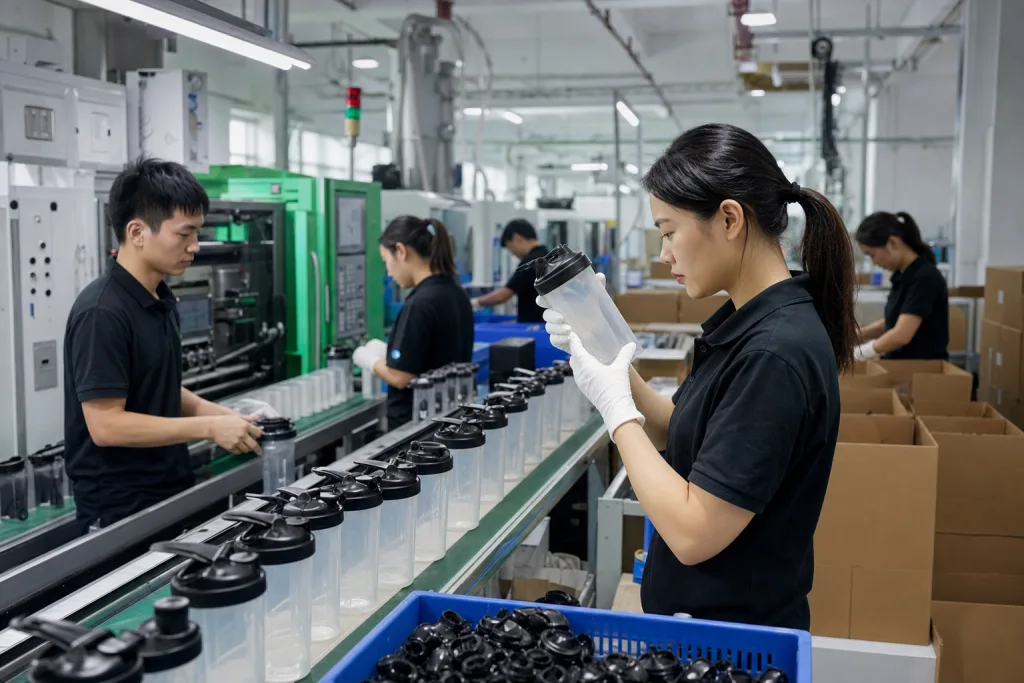
Key Takeaways
- For a custom logo shaker bottle, specify lid leak test at 100% or AQL 1.5 before carton packing
- Typical MOQ is 3,000 pieces per color for PP shaker bottles and 1,000 pieces for stainless sports bottles
- Silkscreen logos usually need 24-48 hours curing; rushing packing increases rub-off risk
- For gym retail, carton drop testing and barcode placement matter as much as bottle appearance
A custom logo shaker bottle looks simple until 5,000 units land with loose lids, cloudy plastic, weak logos, or export cartons crushed before they reach a gym chain warehouse. We see this at pre-shipment inspection: QC pulled the sample, filled it to 600 ml, shook it 20 times, and the flip cap still wept at the hinge. Fitness buyers often compare price first. Wrong starting point. Most failures begin in the specification sheet, not on the production line.
We manufacture sports bottles in Zhejiang, China for export buyers who need repeatable bulk shaker bottle programs, not one lucky shipment. We run jobs for fitness brands, franchise gyms, supplement companies, and distributor shaker bottle catalogs, with details like logo position in mm, carton drop-test notes, and MOQ written before the deposit invoice goes out. The useful question is not “Can you put my logo on it?” It is “What can fail, and how do we lock it down before deposit?” That question saves more money than arguing over USD 0.03 on the lid.
The lid leaks under real gym use
The costliest failure on a custom logo shaker bottle is not a small scratch. It is a leaking lid. A gym member throws the bottle into a sports bag with protein powder dust on the scoop, loose keys, a wet towel, and headphones. If whey slurry runs through the zipper, your brand gets blamed, not the factory in China. We had one buyer flag 37 wet cartons after a courier drop test, and nobody wanted to hear about “minor seepage.”
Leakage normally starts at the thread, the gasket, or the flip-cap hinge. For PP or Tritan shaker bottles, ask for thread dimensions on the drawing, with the major diameter, pitch, and stop position marked in mm. A 0.2 mm variation can change the closing feel. On the line, we check this with a digital caliper and a go/no-go sample lid, not a phone photo. For flip caps, the silicone plug needs enough grip to hold pressure, but if users need two hands to open it, the design is wrong.
For a bulk gym water bottle order, do not accept “we test some pieces” as the full QC plan. That line has caused arguments. A practical spec is 100% water leak test for every bottle after assembly, then AQL 1.5 for final inspection. The test should include filling to 80% capacity, closing the lid, shaking upside down for 10 seconds, and leaving the bottle inverted for at least 3 minutes. For higher-risk lids, add a pressure squeeze test. QC pulled the sample from tray 12 last month after seeing water beads around the cap skirt, and that was before packing.
If you are buying a customizable shaker bottle with a mixing ball, strainer, or pill compartment, each extra part brings another tolerance point. Ask for assembled samples from mass-production tooling, not handmade pre-production samples from the sample room. We run into this on pill boxes where the small latch looks fine on 20 samples, then pops open after 5,000 shots from the mold. Zhejiang factories with stable export lines can produce 300,000 to 600,000 drinkware units per month, but capacity does not replace a written leak-test protocol with pass/fail photos attached to the inspection report.
Plastic grade becomes a silent complaint
About 6 out of 10 buyer disputes we see start with “the bottle looks cheap.” On the line, that usually traces back to uncontrolled resin grade, not the logo print. For a custom shaker bottle, we run PP, PE, PETG, and Tritan. PP is cost-efficient and common for a bulk fitness water bottle, but the surface looks softer and the wall clarity drops, especially at 0.6-0.8 mm wall thickness. Tritan gives cleaner clarity and better drop performance; the FOB cost is often 35-70% higher depending on capacity and lid design.
For fitness brands and gym chains, match the material to the sales channel. A premium supplement brand can usually defend Tritan or stainless steel at retail. A distributor sports water bottle for onboarding packs or member giveaways often works better in PP, especially at 3,000-10,000 pcs MOQ. Cheap is not the problem. Unspecified is. We had one buyer flag a 700 ml PP shaker as “too cloudy” after production, but the PO only said “plastic bottle.” The math does not work if the material decision is left open until QC.
Your purchase order should name the material, food-contact compliance, and color control method. Write it plainly: “PP, FDA food-contact, Pantone 286C lid, natural body,” not “blue gym bottle.” For Europe, ask for LFGB or EU food-contact documentation plus REACH-related material declarations where relevant. For North America, FDA food-contact compliance is commonly requested. If the bottle is for children or youth sports programs, discuss ASTM and CPSIA expectations early. QC pulled one sample last quarter where the PO had “Trian” instead of Tritan; that typo cost 2 days before the buyer confirmed the resin.
Color is another hidden failure. A customized sports water bottle in “black” can come out blue-black, gray-black, or recycled-black if the masterbatch is not approved before injection. Request a Pantone target and an approved color chip under D65 light, then keep that chip with the sealed sample in the QC room. For transparent colors, exact Pantone matching is harder because wall thickness changes the shade; use a tolerance range and approve a physical sample before production. We ship fewer arguments when the buyer signs the chip, not just a PDF mockup.
Logo decoration fails after two weeks
A custom logo shaker bottle is bought for branding, so logo failure gets noticed fast. We see 4 repeat problems on the line: weak silkscreen adhesion, crooked placement, color bleeding, and laser engraving that reads too shallow on coated surfaces. Not bad luck. They usually start with the wrong decoration method for the bottle shape, surface texture, or use case. Last month QC pulled 32 samples from a 5,000 pcs shaker order; 7 failed the 3M tape test because the PP surface had release oil left from molding.
Silkscreen printing is cost-effective for 1-3 color logos on cylindrical areas. It works for a custom gym water bottle or bulk sports water bottle when the artwork is bold and the wall texture is smooth enough for a clean ink edge. For curved or tapered shaker bodies, check the print window with a real fixture, not only a flat PDF. The buyer may approve a 62 mm wide logo on screen, then flag it later when it stretches around a tapered 700 ml bottle. We run a simple wrap test with transparent film before opening the screen plate.
Heat transfer handles fuller artwork and gradients, but it adds cost and peels when the bottle surface is oily or the temperature curve is wrong. Laser engraving works well on stainless steel sports bottles and powder-coated finishes, not on every plastic shaker. For a customizable gym water bottle with a premium logo, we normally ask buyers to approve one decorated pre-production sample, then we keep it as the golden sample for inspection. Small step. Big savings. We have seen this go sideways when a PO says “black logo” but the artwork file is Pantone 432C and the buyer expects a soft charcoal.
Set the inspection standard before mass production. Use numbers: logo position tolerance ±2 mm, no visible pinholes at 50 cm viewing distance, no ink transfer after 3M tape test, and rub test of 50 cycles with dry cloth. If the order must survive dishwashing, write that on the PO and sample approval sheet. Around 8 out of 10 low-cost PP shaker bottle projects we ship are hand-wash recommended, and claiming dishwasher-safe without testing is the wrong question to ask. The math does not work after warranty claims start.
The mixing system feels cheap
Fitness buyers judge a custom made shaker bottle by one thing first: does it break up protein powder without leaving paste in the corners? The bottle body can pass drop test and still feel like a cheap promo item if the mixer is weak. We usually quote three mixing setups: 304 stainless ball for low cost, plastic grid insert for quieter gym use, or a fixed agitator when the buyer does not want loose parts. QC pulled 12 samples from one 5,000 pcs order last month, and 4 failed because powder sat under the lid thread.
A stainless ball is familiar and low-cost, but it rattles in cartons and users lose it. Wire gauge matters. A thin ball bends after a few washes; a typical commercial option is 304 stainless steel with about 0.8-1.0 mm wire, depending on diameter. A plastic strainer runs quieter and keeps the parts together, but bad mold polishing leaves burrs that hold powder. We check that with a fingernail and a 10x loupe on the line. Fixed agitators cut loose parts, but the mold needs clean ribs and no dead corners, or the math does not work after the first complaint batch.
For a bulk shaker bottle program, ask for a functional test, not just visual approval. Mix 30 g whey powder with 300 ml room-temperature water and shake for 20 seconds. Then check residue at the bottom, inside the lid, and around the strainer. Simple test. Still useful. It is not a laboratory test, but it matches how members use the bottle after training, and we have seen buyers reject a glossy sample because 6 g of wet powder stayed under the insert.
If you sell through distributors shaker bottle channels, spare parts matter. Ask whether lids, balls, and inserts are stocked separately, and put the spare-part wording on the PO, not only in WeChat. For gym chains, a 1-2% spare lid allowance can save customer-service time. One buyer flagged this after 18 days because their warehouse had bottles but no replacement flip caps. It costs less to include extra components in the first shipment than to airfreight replacement lids from Zhejiang two months later.
Cartons collapse before retail handoff
Packaging failures look boring until 800 bottles arrive with rubbed paint and dented lids. We ship distributor fitness water bottle orders from Hangzhou to Ningbo or Shanghai, then ocean freight, then a 3PL warehouse, then a gym distribution center. That is 4 handoffs before retail. Weak cartons and loose inner packing turn acceptable bottles into scratched inventory fast; QC pulled one sample last year where the divider gap was 6 mm too wide, and every second bottle had a ring mark.
For a bulk gym water bottle or custom sports water bottle, carton specs need to be written on the PO. No guessing. Use 5-ply export cartons for heavy bottles or stainless units. For lighter PP shaker bottles, 5-ply is still the safer call if the master carton exceeds 12-14 kg; the math does not work when a 16 kg carton sits at the bottom of a pallet for 32 days. Ask for carton dimensions, gross weight, packing quantity, and drop-test method before mass production, and make the line confirm it with a tape measure and scale.
Retail and gym chain orders need barcode discipline. If you require FNSKU, UPC, EAN, carton labels, country of origin marking, or mixed SKU packing, put it in the purchase order. Do not assume the factory knows your 3PL rule. We have seen this go sideways over one missing “Made in China” line on the carton mark. For North American and European buyers, missing carton labels can trigger warehouse rejection even when the bottle quality passes AQL 2.5.
One practical rule: approve a packed sample, not only a bottle sample. The packed sample should show polybag or tissue protection, divider layout, instruction sheet, barcode placement, and outer carton label. If you want plastic-free packaging for a customized fitness water bottle line, say so before tooling or color approval, because paper sleeves, molded pulp trays, and kraft boxes can add 8-15% cost and increase carton volume by 10-20%.
MOQ and price hide the real cost
MOQ is where a custom logo shaker bottle project first hits the wall. For a standard PP shaker bottle, we usually run from 3,000 pieces per color for logo printing; below that, the pad-printing setup, ink loss, and line changeover eat the margin. A new custom mold is a different discussion: 10,000-30,000 pieces is usually needed before the tooling math works. Stainless steel sports bottles often start at 1,000 pieces per color for logo decoration, but special powder coating colors can push the MOQ higher because the coating shop wants a full batch, not half a rack. The wrong question is “What is your lowest MOQ?” Ask what process changes at each quantity.
FOB China pricing depends on material, capacity, lid structure, decoration method, packaging spec, and inspection level. A simple 600 ml PP customized shaker bottle might land around USD 1.10-1.80 FOB at commercial volume. Tritan can move into the USD 2.20-4.00 range. Stainless insulated sports bottles sit higher, especially with 304 stainless inner wall, copper coating, or a custom cap with silicone parts. On the factory floor, a 0.2 mm gap in the flip lid or a heavier 5-layer export carton can change the quote more than buyers expect. Treat these as planning ranges, not final quotes.
The cheapest quote often cuts out the controls you need. Ask what is included: logo setup with film or laser file handling, sample charge, carton quality, food-contact test reports, third-party inspection support, spare parts, and the replacement policy for leaking lids. We have seen a USD 0.08 saving disappear fast when QC pulled the sample and 3% of lids failed the upside-down leak test. It gets worse if 400 cartons need relabeling at the destination warehouse because the shipping mark on the PO had one wrong digit. Cheap can be expensive.
Lead time also needs a sober check. For repeat logo orders, 25-35 days after artwork and deposit is common. For new color matching, custom packaging, or new mold components, plan 45-60 days. Around Chinese New Year, add at least 3-4 weeks, and do not expect miracles from the line after workers start booking train tickets. A China supplier can move fast, but only after artwork, Pantone numbers, packaging files, and shipping marks are frozen; one late barcode revision can turn a 12-day packing plan into 18 days.
Inspection catches issues too late
Final inspection is useful, but it is not magic. If you wait until 100% of your customizable sports water bottle order is packed, the inspector can only sort cartons, reject the lot, or push for a discount. Too late. Better control starts with sample approval, incoming material checks, first-article confirmation, and in-line inspection; on our line, QC pulled 8 cartons last month because the logo jig was set 3 mm too low after lunch shift change.
For fitness brands, we run three control points. First, approve a pre-production sample using the correct material, Pantone color, logo size, lid type, and export carton mark. Second, check the first 50-100 mass-production pieces for leak, logo position, color, and assembly; we usually fill them to the neck and lay them sideways for 30 minutes. Third, run final inspection under AQL, commonly Critical 0, Major 1.5, Minor 4.0, unless your retail contract requires stricter limits. Skipping the first-article check to save 1 day is the wrong question to ask; one bad pad-print plate can ruin 5,000 bottles before final QC sees the carton.
Define defects in plain language. Critical defects include contamination, sharp edges, wrong material, or major leakage. Major defects include non-functioning lids, badly tilted logos over 2 mm from the approved artwork, wrong color, missing components, and barcode errors. Minor defects include small scratches, tiny color specks, or slight packaging wrinkles within agreed limits. Without this list, every dispute becomes subjective, and we have seen a buyer flag “bad printing” when the real issue was a PO typo: matte black bottle, glossy black logo.
If you are a distributor gym water bottle buyer managing several SKUs, keep a defect photo library. Label each photo with SKU, defect name, allowed limit, and inspection result; 20 clear photos beat a 12-page QC email every time. It helps your China factory, your inspection agency, and your sales team use the same terms. Good suppliers in Zhejiang will not object to clear QC rules. We prefer them because they cut arguments and make repeat orders easier, especially when the same shaker bottle moves from a 3,000 pcs trial order to a 30,000 pcs promotion.
Send your shaker bottle brief for factory review
Share capacity, material, logo method, MOQ target, and delivery market. We will flag production risks before you commit tooling or deposit.
Frequently asked questions
What MOQ should we expect for a custom logo shaker bottle?
For a standard PP custom logo shaker bottle, a practical MOQ is usually 3,000 pieces per color and logo. If you use an existing mold and one-color silkscreen print, some projects can start lower, but unit cost rises. For Tritan, expect similar or slightly higher MOQ depending on resin color. For stainless sports bottles, 1,000 pieces per color is often workable. If you want a custom made shaker bottle with new body tooling, special lid, or proprietary mixing insert, plan 10,000-30,000 pieces to make tooling and setup economical.
Which material is best for gym chains buying bulk shaker bottle orders?
For gym chains, PP is usually the best cost-controlled choice for member welcome packs, challenges, or seasonal campaigns. It is light, food-safe when sourced properly, and can keep FOB cost near USD 1.10-1.80 for common 600-700 ml styles. Tritan is better when clarity, impact resistance, and premium shelf appearance matter. Stainless steel is stronger for retail merchandise, but it is heavier and more expensive. The best material depends on whether you need a low-cost bulk shaker bottle, a premium custom fitness water bottle, or a retail-ready product.
How do we stop logos from rubbing off?
Start by matching decoration to the bottle surface. Silkscreen works well on smooth PP, Tritan, and stainless surfaces when ink, curing time, and pretreatment are correct. Require a decorated pre-production sample and run a 3M tape test plus 50-cycle dry rub test before approval. For coated stainless, laser engraving or high-quality transfer may be safer than cheap printing. Give the factory vector artwork, Pantone colors, and logo placement tolerance such as ±2 mm. Also confirm whether the bottle is hand-wash only or dishwasher resistant, because that changes the ink system.
Can we order multiple colors under one MOQ?
Sometimes, but do not assume it. If the factory MOQ is 3,000 pieces per color, asking for 1,000 black, 1,000 blue, and 1,000 red may increase setup cost or be rejected. Color changes require machine cleaning, masterbatch adjustment, print setup, and separate QC records. For distributor sports water bottle programs, a better structure is often 3,000 pieces per main color, then smaller quantities only for repeat orders once the line is stable. If you need mixed colors for a launch, discuss it before quoting, not after deposit.
What should be checked during final inspection?
Final inspection should check function, appearance, packaging, and labeling. For a customized gym water bottle or shaker, include leak testing, lid closing force, mixing ball or strainer fit, logo position, color match, scratches, odor, sharp edges, carton strength, barcode scan, and shipping marks. AQL can be set at Critical 0, Major 1.5, Minor 4.0 for many commercial orders, although stricter contracts may require more. Pull samples from finished packed cartons, not from a prepared table. If possible, add an in-line check at 10-20% production to catch problems earlier.