Key Takeaways
- A practical custom logo protein shaker MOQ starts at 1,000-3,000 units depending on mold, color, and logo method
- PP is the budget choice; Tritan is better for clarity, odor control, and retail positioning
- Leak testing should cover 100% inline checks plus final AQL inspection at 2.5/4.0 or stricter
- Most repeat B2B shaker programs use 500-800 ml capacity with 0.8-1.2 mm plastic wall sections
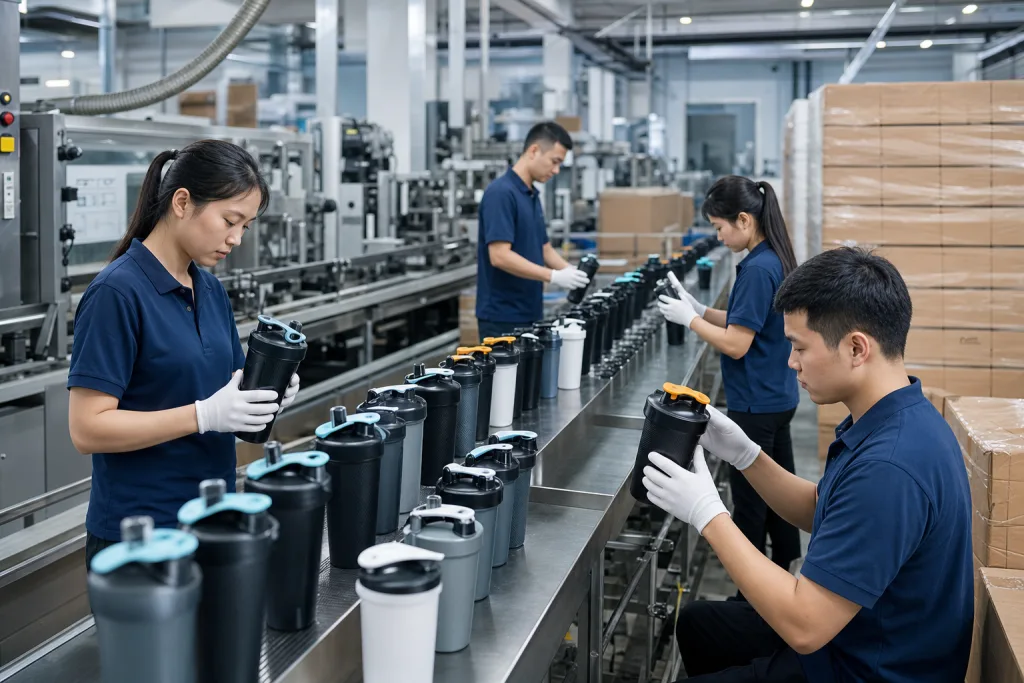
A custom logo protein shaker looks simple until you start buying 5,000 units for a gym chain, supplement brand, or distributor drinkware program. Then the small parts start costing money: PP versus Tritan, ball whisk versus mesh insert, silk screen versus laser, leak claims, carton size, and whether a 92 mm flip cap still seals after 300 open-close cycles on the line.
At BottleForge Industrial in Hangzhou, Zhejiang, we see buyers spend 6 email rounds on logo size and only 1 line on gasket fit. That is the wrong order. China has thousands of canteen suppliers and bottle factories, but a shaker order needs tighter control than a basic promotional bottle; QC pulled one sample last month where the logo passed, but the mixing ball left rust marks after salt-spray testing. Start with the use case, not the catalog photo.
Protein shaker versus canteen specs
If you are comparing a custom logo protein shaker with a custom canteen, do not put them on the same spec sheet and call it done. A shaker gets shaken hard, opened 20-30 times a day, left with whey residue, and then blamed if one drop leaks into a gym bag. A canteen custom program is judged on fill volume, strap feel, dent resistance, and whether the logo still looks clean after carton rubbing. On our line, QC pulled a 600 ml shaker sample last month because the silicone gasket sat 0.4 mm proud and failed the inverted leak test.
The useful head-to-head comparison looks like this:
| Spec | Protein shaker | Custom canteen |
|---|---|---|
| Typical capacity | 500 ml, 600 ml, 700 ml | 750 ml, 1 L, 1.2 L |
| Common material | PP for budget runs, PE lids, Tritan for retail, stainless insert for mixing weight | PP for promo, Tritan for clear body, 304 stainless steel for outdoor retail |
| Key failure point | Flip cap snap, thread match, gasket height, mixing insert fit | Loop handle pull strength, cap seal, body denting after drop test |
| Best logo method | Silk screen for 1-2 colors, pad print on curved caps, IML for volume orders, sleeve for full wrap | Silk screen on plastic, laser on 304 stainless steel, powder coat print for retail finish |
| Buyer use case | Supplement brand, fitness chain, retail gift set | Outdoor event, school program, corporate promotional order |
A canteen customizable for outdoor promotion may accept a wider cap and a simpler seal. A shaker cannot. This is where buyers push back on tooling cost, but the math does not work if the flip cap needs two hands to open. Gym users complain fast. If the strainer does not seat properly, powder clumps around the ribs; we check this with a 30-second dry fit before packing. If the plastic holds odor after three uses, the brand gets blamed, not the canteen factory or shaker supplier behind it.
For most B2B buyers, the safe starting point is a 600 ml PP shaker for budget campaigns or a 700 ml Tritan shaker for retail and subscription boxes. We run 600 ml PP when the PO says giveaway and the target price is tight; we ship Tritan when the buyer wants shelf display and fewer complaints on clarity. If you also buy customized drinkware such as custom growler or customized canteen items, do not copy the same test protocol across all SKUs. We have seen this go sideways: one buyer used the canteen drop-test plan on shakers, missed the flip-cap fatigue test, and found 3 leaking cartons during AQL 2.5 inspection.
Material choice changes the order
Material is where the price spread starts. PP is common because it is light, impact-resistant, and cost-efficient. For a 600 ml PP custom logo protein shaker, FOB China pricing usually sits around USD 0.85-1.45, depending on lid structure, logo colors, and carton packing. Tritan pushes that to about USD 1.60-2.80, but the body looks clearer and the shelf feel is closer to retail stock. We run those jobs every week, and the buyer usually notices the cap before the cup.
Do not ask only whether the material is “food grade.” Ask for the standard. For Europe, request EU 10/2011 migration testing and REACH-related declarations where applicable. For North America, many buyers ask for FDA food-contact compliance and sometimes California Prop 65 review. If the shaker is sold for children or school sports, ASTM-related checks can enter the discussion. QC pulled a sample last month and caught a lid print that bled after a 40°C soak, which is the kind of problem that turns into a claim if you skip the paperwork.
The material fit is plain once you match it to the channel. PP fits gym giveaways, supplement scoops, low-cost membership gifts, and canteen promotional campaigns where the shelf is not the main channel. Tritan fits paid merchandise, influencer kits, premium supplement bundles, and distributor canteen programs that need a higher perceived value. Stainless steel looks premium, but for protein shakers it adds weight and cost; it shows up more often in custom growler, customizable growler, and insulated bottle lines. The buyer flagged it before: “Why is this shaker 80 g heavier than the last one?” That is the right pushback.
At our Zhejiang facility, wall sections on plastic shakers usually sit around 0.8-1.2 mm, depending on geometry. Too thin and the body flexes at the thread. Too thick and cycle time rises, which pushes cost. A sensible canteen manufacturer will not promise the cheapest resin, the clearest body, and the strongest hinge in the same USD 0.70 product. The math does not work. On the line, we’d rather reject that PO typo on the lid spec than spend a day reworking 5,000 pcs later.
Lids, inserts, and leak reality
The lid system decides whether your custom logo protein shaker becomes a reorder item or a complaint file. Buyers often argue over a mixing ball versus a fixed mesh insert. This is the wrong question to ask if the cap does not seal. Both options work, but they fit different sales channels. A 304 stainless mixing ball gives the familiar fitness look and stronger agitation, especially with 30 g whey powder in 400 ml water. A molded mesh insert costs less, does not get lost in the gym bag, and runs better for 10,000 pcs promotional packs. On the line, QC usually catches more trouble at the flip-cap hinge than inside the cup body.
Here is the practical comparison:
- Flip cap: convenient for gym use, but we test hinge fatigue and snap tightness with a 0.5 kg pull gauge. A loose cap is still the leak point buyers complain about first.
- Screw cap: gives better sealing confidence and works well when we ship powder samples inside the cup, though users drink from it a bit slower.
- Mixing ball: raises perceived value, but adds USD 0.08-0.18 per unit depending on grade and size. The buyer often flags this when the target is under USD 1.20 FOB.
- Mesh insert: lower cost and less noise in transit, but the insert must click under the lid. If it sits 1 mm high, it can push the gasket out of position.
- Storage compartment: useful for supplement brands, but it adds mold complexity and increases carton volume. We have seen a 24 pcs carton grow from 0.056 cbm to 0.071 cbm after adding a lower pill box.
For leak testing, do not accept a vague “no leak” line on a supplier report. We run a 100% inline water check after cap assembly, then random final inspection under AQL 2.5 for major defects and 4.0 for minor defects. For premium retail orders, you may tighten major defects to AQL 1.5. Our usual check is simple: fill samples to 80%, invert for 30 minutes, then shake by hand for 10-15 seconds. Not fancy. It catches the real failures, including gasket roll-over, weak snap caps, and thread flash left from the mold parting line.
Canteen vendors that mainly produce simple outdoor bottles may not have the same cap assembly discipline. If you are qualifying canteen manufacturers in China for shakers, ask how they control silicone gasket hardness in Shore A, cap torque in N·cm, and hinge cycle testing with an opening fixture. We once had a PO typo calling for “canteen lid” instead of “shaker flip lid,” and the first sample leaked after 12 shakes. A distributor growler or customized growler carries different risks; a shaker lid is opened, snapped, washed, and dropped far more often each day. The math does not work if you save USD 0.03 on the cap and lose the reorder.
Logo methods against real budgets
The phrase custom logo protein shaker covers two different jobs: a one-color gym logo on a promo cup, or a full retail graphic that has to survive shelf handling and dishwasher claims. Match the logo method to the sales channel and the product life you promise on the carton. For a local promotion, we run one-color silk screen on PP bodies and call it done. For branded merchandise, the buyer may need multi-color print, heat transfer, in-mold labeling, or a shrink sleeve. Small detail matters here. On our No. 4 screen-print line, a 0.3 mm logo stroke can fill in if the artwork was built for a paper brochure, not a curved shaker.
| Branding method | Best fit | Typical note |
|---|---|---|
| Silk screen | 1-3 color logos | Low setup cost, works well on PP and Tritan when the surface is clean |
| Pad print | Small curved areas | Good near lids, grips, and recessed panels |
| Heat transfer | More colors and finer gradients | Sharper detail, higher unit cost, needs careful edge checking |
| In-mold label | Large retail graphics | Needs higher MOQ and locked artwork before tooling trial |
| Laser engraving | Metal parts | Better for stainless custom drinkware than plastic shaker bodies |
A one-color silk screen setup may add roughly USD 45-80 per color per artwork. Unit print cost may be only a few cents at 3,000 units. Heat transfer can add USD 0.12-0.35 per unit depending on size. IML can look excellent, but MOQ often starts around 5,000-10,000 units because film registration and scrap rate must be controlled. We’ve seen this go sideways when a buyer approves a PDF only; QC pulled the sample after 50 pcs because the white layer shifted 1.2 mm on the side wall.
If you are a canteen distributor building a mixed catalog, keep branding rules consistent across custom canteen, customizable canteen, and shaker SKUs. Buyers want one Pantone system, one logo safe area, and one approval process. The wrong question is “which logo method is cheapest?” Ask which method will pass the buyer’s use case without rework. Zhejiang export factories can match Pantone references closely, but plastic base color, surface texture, and transparency change how the color reads. Last month a PO came in with PMS 186C in the header and PMS 185C in the artwork file; the buyer flagged it after the pre-production sample, not before. Always approve a physical pre-production sample before mass production.
MOQ, lead time, and landed cost
MOQ is not just a sales policy. It comes from resin buying, color changeover, print screen setup, carton printing, and QC time on the line. For an existing mold custom logo protein shaker, a realistic MOQ is 1,000-3,000 units for standard colors and 3,000-5,000 units for a custom Pantone body. For new mold work, you should expect tooling discussions starting around USD 3,000-12,000 depending on lid complexity and number of cavities. Last month QC pulled a PP color chip that was 1.5 Delta E off the approved Pantone, and the whole batch had to wait for resin adjustment. Small orders feel simple on email. On the factory floor, the math often does not work.
At BottleForge Industrial in Hangzhou, Zhejiang, our drinkware lines can produce about 420,000 plastic and stainless units per month across shaker, bottle, tumbler, and canteen customized programs. A normal shaker order takes 7-10 days for sampling after artwork confirmation and 25-35 days for mass production after deposit and sample approval. Peak season before spring fitness campaigns and Q4 gifting can add 10-15 days. We run lid assembly, logo printing, leak testing, and carton packing in separate stations, so one late artwork file can hold the line for a full shift. We have seen buyers approve the cup body on Monday, then flag a 2 mm logo position change on the lid on Friday. That becomes 12 days, not 7.
FOB Ningbo or FOB Shanghai is common for China drinkware exports. Buyers sometimes compare only unit price and miss carton volume. This is the wrong question to ask. A 700 ml shaker with a large domed lid may ship fewer units per 40HQ than a straight-wall 600 ml model. If the factory saves USD 0.08 on the product but adds USD 0.12 per unit in freight because of inefficient packing, you did not save money. Our packing engineer checks carton size with a tape measure and a 40HQ loading sheet, not a guess in Excel. One recent 700 ml dome-lid design lost 1,920 units per container because the lid height pushed the inner box up by 18 mm.
For Amazon or direct-to-consumer channels, ask about barcode labels, FNSKU placement, master carton marks, and drop-test packing. For distributor drinkware and distributor canteen orders, you may need neutral cartons, mixed color packing, or retail boxes. Price those items before deposit, not after production is finished. We have had a PO say “white carton” while the artwork file showed a 4-color retail box; the buyer flagged it during pre-shipment photos, and repacking cost more than the logo print. A 1.2 m drop test, corner-first, also tells you fast whether the insert tray is strong enough.
Which buyer should choose what
A supplement brand usually needs a different shaker than a corporate gift buyer. If the cup ships bundled with protein powder, we run a 600-700 ml Tritan or food-grade PP body, a tight flip cap, and a mixing ball or fixed mesh. Spend on leak control first. Fancy box later. On our leak test bench, QC fills the shaker to 80%, turns it upside down for 30 minutes, then checks the thread and cap hinge; one leaking shaker inside a powder kit can ruin the full shipment value.
A gym chain buying member gifts can use a 500-600 ml PP shaker with one-color silk screen and a standard ball. The target is not luxury; it is daily logo exposure at a price the club can repeat every quarter. For this channel, MOQ of 2,000-5,000 units by color is normal, and we suggest spare caps at 1-2% if the program runs all year. Buyers often push back on that extra cap cost, but the math does not work when a front desk has 37 broken lids and no replacements.
A canteen supplier or canteen vendor serving outdoor, school, and wellness clients may want a family look across shaker, custom canteen, and custom growler products. In that case, keep the same Pantone body color, a close cap accent, and one fixed logo height, such as 55 mm on the main print area. A canteen customizable program looks more professional when the SKUs sit together in a catalog, even if the molds are different. We have seen this go sideways when one PO says “matte black” and the next artwork file says “black gloss.”
For retail brands, spend more time on packaging compliance and shelf appearance. A clear Tritan body, 700 ml capacity marking, printed instruction insert, and UPC or EAN label can matter more than saving USD 0.10. If you sell in Europe, keep food-contact documents ready for material review. If you sell in North America, prepare product specs, carton dimensions, and testing records for your retailer portal. One buyer flagged a master carton because the printed carton size was 1 cm different from the portal entry; small mistake, slow booking.
The right choice is rarely the most expensive shaker. It is the model that matches how your buyer will use it, how your warehouse will ship it, and how your brand will handle defects six months later. Ask that first. On the line, a 12 g heavier lid or a 0.3 mm better gasket often matters more than a new gift box photo.
Send your shaker brief for a factory quote
Share capacity, logo method, target MOQ, market, and packing needs. We will return practical specs, pricing, and lead time from Zhejiang.
Frequently asked questions
What MOQ should I expect for a custom logo protein shaker?
For an existing mold, expect 1,000-3,000 units if you accept standard body colors and a simple one-color logo. Custom Pantone plastic usually starts around 3,000-5,000 units because the factory must control resin coloring, machine cleaning, and scrap. If you need a new lid, special compartment, or exclusive body shape, tooling may cost USD 3,000-12,000 and MOQ can move to 10,000 units. For mixed orders with custom canteen or customized drinkware SKUs, some factories can combine production planning, but each color and logo still has its own setup cost.
Is PP or Tritan better for a branded shaker bottle?
PP is better when budget is the main driver. It is light, durable, and common for gym promotions at roughly USD 0.85-1.45 FOB China for many 600 ml designs. Tritan is better for retail, supplement bundles, and premium fitness programs because it offers clearer appearance, better odor resistance, and a higher perceived value. Tritan can cost USD 1.60-2.80 or more depending on lid and print. If your shaker sits next to premium customizable drinkware or a customizable growler in a catalog, Tritan usually looks more consistent with that positioning.
How do I reduce leakage risk before mass production?
Start with the lid design, not the logo. Ask for pre-production samples with the final gasket, cap material, and thread finish. Test samples filled with water, inverted for 30 minutes, then shaken for 10-15 seconds. During production, require 100% inline water checks for assembled lids and final random inspection using AQL 2.5 for major defects, or AQL 1.5 for stricter retail orders. Also check cap snap force and gasket placement. Many leakage problems come from inconsistent assembly, not from the body mold itself.
Can the same supplier make shakers, canteens, and growlers?
Yes, but check actual capabilities. A canteen manufacturer may be strong in stainless bottles but weak in plastic flip-cap shakers. A shaker factory may be efficient with PP injection molding but not suitable for insulated custom growler production. If you want one canteen supplier for shaker, custom canteen, and distributor growler lines, ask for production photos, monthly capacity, testing reports, and samples from each category. The advantage is consistent Pantone control, carton marks, documents, and export handling from China.
What lead time should I plan for a shaker order?
Plan 7-10 days for artwork layout and pre-production sampling after you provide logo files, Pantone colors, and packaging requirements. Mass production normally takes 25-35 days after deposit and sample approval for standard molds. Add 10-15 days during peak season or if you need retail boxes, custom color resin, or multi-color heat transfer. Ocean freight to Europe or North America can add 25-45 days depending on port and service. For launch campaigns, start sourcing at least 10-12 weeks before your required warehouse date.