Key Takeaways
- Typical MOQ for custom logo military canteen orders starts at 1,000-3,000 pcs per color and logo
- 304 stainless steel is heavier than aluminum but better for odor control and long-term drink contact
- Laser engraving is durable, while silkscreen is better for larger logos under 2-3 color artwork
- AQL 2.5/4.0 inspection should cover leakage, coating adhesion, cap fit, carton drop, and logo position
A custom logo military canteen looks simple until you quote it. Then the questions start: stainless steel or aluminum, single wall or insulated, 750 ml or 1 L, powder coat or bare metal, silkscreen or laser engraving, flat cap or cup set. For retail, promotional programs, outdoor kits, cadet groups, or uniformed service merchandise, the wrong spec turns a low-cost item into a claim problem fast. We’ve seen it go sideways: QC pulled a 1 L sample from the line with a 0.6 mm body dent after carton drop testing, and the buyer only found out after asking for “same as army style” on the PO.
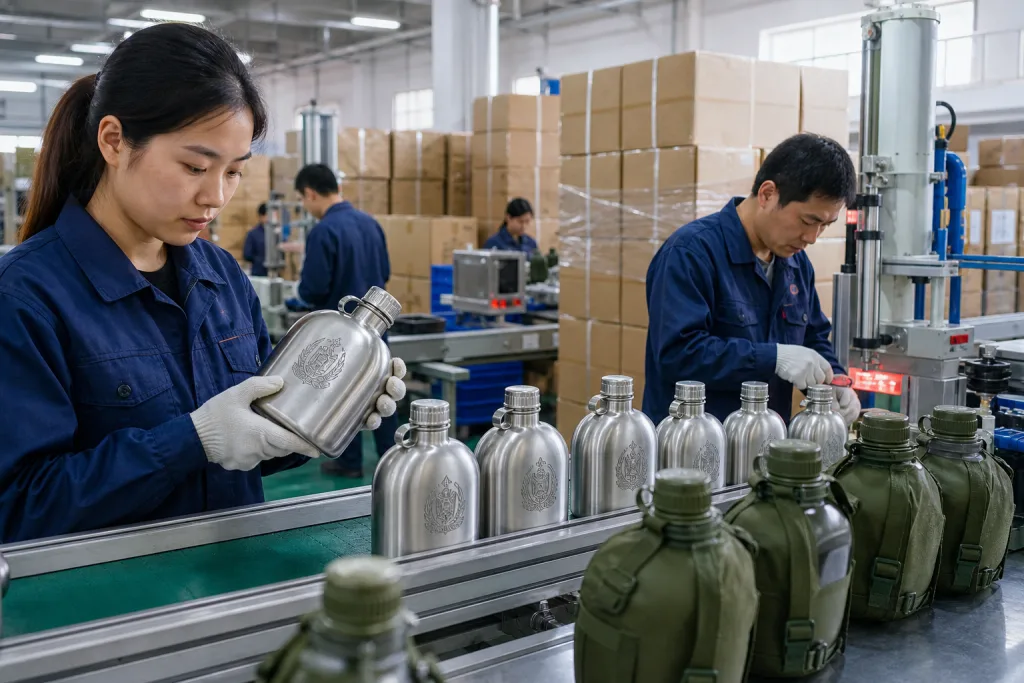
As a canteen manufacturer in Zhejiang, China, we see buyers compare canteens with sports bottles and travel tumblers, sometimes even custom growler programs. Fair comparison, wrong question. A canteen built for rugged outdoor use carries different risks from standard custom drinkware: denting, coating adhesion, leakage, strap durability, and logo placement on curved bodies. On our line, a 750 ml curved body that looks clean in a mockup can still fail print alignment by 3 mm if the fixture is not made for that radius, and the buyer flagged it immediately on pre-production photos.
Canteen specs compared head to head
For B2B buyers, the logo is not the first decision. Body construction is. We usually settle this before sampling, because a 0.2 mm wall-thickness change can shift weight, dent resistance, carton strength, and the FOB price on a 5,000 pcs PO. QC checks the first drawn body with a digital caliper, not a catalog photo.
| Spec option | Best fit | Trade-off |
|---|---|---|
| 304 stainless steel, single wall, 0.5-0.6 mm | Retail outdoor canteen, scout club merchandise, paid promotional gift meant for 2-3 seasons | Higher FOB cost and more weight; buyers sometimes push back when the packed carton passes 14 kg |
| Aluminum, single wall, 0.7-0.8 mm | Budget canteen promotional campaigns, event kits, lightweight packs where the target price drives the brief | Needs a stable inner coating; dents show faster after drop testing on the line |
| Double-wall stainless canteen | Premium outdoor line, winter use, higher shelf value for retail sets | Tooling and MOQ are higher; the military canteen curve is harder to insulate cleanly without weld marks |
| Plastic canteen, PP or Tritan-style material | Low weight, youth programs, non-metal restricted venues such as schools and stadium entries | Lower premium feel; compliance testing must match the exact resin grade and colorant batch |
If you need a rugged custom canteen for paid retail, we normally push buyers toward 304 stainless steel. Not because it sounds premium. Because the math works. It handles acidic drinks better than unlined aluminum, creates fewer odor complaints, and matches what most Europe and North America buyers expect from customized drinkware. Last quarter, one buyer flagged a 0.8 mm aluminum sample after a small dent appeared near the shoulder during a 1.2 m drop check. For a one-season giveaway, aluminum still makes sense when the target price is tight.
Our Hangzhou, Zhejiang line can produce about 320,000 stainless drinkware units per month across bottles, tumblers, and canteens, with canteen-specific capacity depending on body shape and coating workload. Normal lead time is 35-50 days after artwork approval and deposit, plus 7-10 days for pre-production samples. We run canteens through forming, trimming, polishing, coating, logo print, leak test, and AQL packing checks; a small typo on one PO, such as “matte army green” versus “matte olive green,” can cost 3 days before mass production starts.
Shape, capacity, and real use fit
A custom logo military canteen is usually bought for the field-utility look, not because every end user is going to a training range. That matters. The shape and capacity have to match the sales channel, or the buyer ends up paying for a product story that does not fit the shelf. We have seen this go sideways when a PO says “military bottle” but the retail pack is meant for office staff gifts.
For outdoor retail and uniformed organization merchandise, 1 L is the safest capacity. It feels substantial, fits most belt pouches we run with 58-62 mm webbing loops, and leaves enough face area for a unit logo. For promotional kits, 750 ml often works better because the master carton is lighter and parcel cost drops. A 1 L stainless canteen may weigh 220-310 g depending on wall thickness and cap system; aluminum can be 120-180 g. The math becomes real when we ship 5,000 pcs by sea and the distributor splits them into single-parcel deliveries.
The classic flattened oval body is good for nostalgia and packability, but it is harder to decorate than a round sports bottle. A large logo can stretch on the shoulder curve. If your brand manual requires a perfect rectangular badge, ask the canteen factory to mark the printable area with tape on a pre-production sample before artwork approval. QC pulled the sample on one 1 L body last month and the “straight” logo leaned 3 mm at the right edge. On many 1 L military-style bodies, a safe front logo zone is around 55 x 70 mm for silkscreen and 45 x 60 mm for laser, depending on curvature.
A canteen customizable with cup, pouch, chain, shoulder strap, or carabiner can sell better in retail packs, but every accessory adds inspection points. Webbing thickness needs a caliper check, snaps need pull testing, stitching must survive rubbing, and pouch odor can kill a shipment before the bottle is even checked. Simple sells too. For distributor canteen programs, a plain bottle plus cap is often more reliable than a complicated gift set with four components from three vendors.
Logo method: durability versus artwork
Most custom drinkware buyers ask for the biggest logo first. Wrong question. On a canteen, the print area is fighting a curved body, powder texture, and the strap lug near the shoulder. Last month QC pulled a 1L sample with a 62 mm logo, and the left edge broke because it crossed the stable print zone by 4 mm. Field-style bottles also take more pocket-knife scratches than a desk tumbler.
Laser engraving is the safest choice for a stainless custom logo military canteen with powder coating. We run it on a fiber laser after coating, so the beam cuts through the top layer and shows the 304 stainless underneath. No ink layer. Nothing to peel. It holds up better when the buyer expects outdoor use or clips the bottle to a pack. The tradeoff is color: most jobs come out silver or charcoal gray, depending on coating thickness and steel surface. Text below 1.5 mm height is risky; our pre-production sample once lost the inside of an “A” at 1.2 mm.
Silkscreen printing makes sense when the buyer needs a solid color logo, slogan, or event mark. One or two colors are clean if the artwork stays inside the stable print zone and the fixture holds the canteen tight. For promotional orders, silkscreen keeps the unit cost below full-wrap decoration. From China, a normal add-on is USD 0.08-0.25 per position for simple one-color print, depending on order size and ink system. We ship a lot of 500-3,000 pcs runs this way, but the buyer should not push 0.3 mm line art onto a rough matte coating.
Heat transfer or water transfer handles complex artwork, camouflage effects, and larger side panels. It looks strong for military-inspired retail. The math does not work for every order, though, because reject rate and setup time climb when the pattern must align around rivets, curves, or a cap strap. We have seen this go sideways after a dishwasher test: the artwork looked fine at carton inspection, then lifted at the edge after 8 cycles. Many outdoor-style canteens are hand-wash only, especially coated bodies with gasket caps.
Our practical rule: choose laser for a long-use customized canteen, silkscreen for budget promotional volume, and transfer printing only when the visual design is the product.
Materials and compliance buyers overlook
Compare canteen suppliers by asking for material and compliance documents before you fight over USD 0.10. This is the wrong first battle. We have seen quotes cut by USD 0.08 per piece because the supplier left out LFGB testing, then the buyer paid 12 days later and missed the vessel cut-off. Ask before tooling.
For stainless steel, confirm whether the inner contact surface is 304 stainless steel. On the line, we check incoming sheet with an XRF gun; QC pulled one sample last year that was marked 304 on the PO but tested as 201 on the body. Some lower-cost bodies use 201 stainless on the outside or throughout. 201 is not automatically unsafe for every application, but it has weaker corrosion resistance and brings more complaint risk in humid or salty storage, especially after 48 hours in a salt-spray check. For Europe, request LFGB or EU food contact testing when needed, plus REACH for coatings and straps. For the United States, buyers often ask for FDA food contact suitability and sometimes California Proposition 65 screening. If the canteen may be used by children, discuss CPSIA and applicable ASTM requirements early.
For aluminum canteens, the inner coating is the main risk. Get the coating type, curing temperature, adhesion result, and the factory’s track record with acidic beverage contact in writing. We run cross-hatch adhesion checks with 3M tape after curing; if flakes lift at the neck radius, the math does not work no matter how nice the logo print looks. If the product instruction says “water only,” do not market it for juice, coffee, or alcohol. A customized growler can be designed for beer; a military canteen is usually the wrong substitute unless the cap seal, volume, pressure expectation, and material spec are built for that use.
Factories in Zhejiang and other parts of China can produce reliable canteen customized programs, but do not treat every canteen manufacturer as equal. Ask for BSCI or similar social audit status if your retailer requires it, ISO 9001 if process control matters, and recent food contact reports with matching material descriptions. We ship plenty of compliant orders from Hangzhou, but the buyer flagged one report because the test sample said “stainless bottle” while the PO said “custom logo military canteen.” That one wording gap cost 6 days.
MOQ, pricing, and landed cost
For a custom logo military canteen, the real number is not the FOB unit price alone. You pay for the body, cap, coating, logo, packing, testing, freight, duties, and inspection. On our line, QC pulls 3 pcs from every 500 and checks wall thickness with a caliper before we release the lot. If you only compare FOB, the math does not work.
For planning, a 750 ml to 1 L single-wall stainless canteen from China often lands around USD 2.20-4.80 FOB, depending on steel thickness, cap, coating, packaging, and order size. Aluminum usually comes in lower, often USD 1.40-3.20 FOB for a simple promotional build. A premium gift set with pouch, cup, color box, and laser logo will move up fast. The buyer flagged a PO once with “750 ml” typed as “7500 ml”; we caught it before the screen plate was made. These are planning numbers, not fixed offers.
MOQ sits around 1,000-3,000 pcs per color and logo for common body shapes. If you need a custom mold, special cap, embossed body, or a tight color match, expect higher MOQ and tooling charges. Pantone powder coating often needs 2,000-5,000 pcs to run cleanly, especially when that shade is not already in the production queue. We run one color at a time on the powder booth, and a changeover eats about 45 minutes. Buyers who ask for eight colors on a 1,000 pc order are asking the wrong question.
Packaging changes the cost more than new buyers expect. A plain white box may add USD 0.10-0.20. A printed retail box can add USD 0.25-0.60 depending on board, size, and finish. If you sell through e-commerce, drop-test the final carton, not just the bottle. QC pulled the sample on a 1.2 m drop test, and the insert shifted on the third corner. For Amazon-style programs, confirm barcode, FNSKU labeling, carton weight limits, and master carton dimensions before mass production. Distributor growler and distributor canteen buyers often lose margin on oversized packaging, not on the canteen itself.
Factory comparison checklist
China has 200+ canteen manufacturers and canteen vendors, but a serious B2B comparison starts with controls you can measure on the line. Do not judge from one glossy sample on your desk. That is the wrong question to ask. Compare how the factory keeps 5,000 pcs or 20,000 pcs consistent after stamping dies heat up, polishing wheels wear down, and QC pulled the sample from carton 37 instead of the showroom shelf.
- Body forming: Ask for wall thickness tolerance, forming die maintenance records, welding method if used, polishing grade, and dent control during transfer between stations. For a 0.55 mm body, even a 0.08 mm thinning at the shoulder can show up after powder coating.
- Leakage testing: Every unit should be checked, not just random cartons. We run water or air-pressure checks on the line because cap thread fit and silicone gasket compression are where buyers usually flag failures.
- Coating control: Request cross-hatch adhesion testing, ΔE color tolerance, and abrasion expectations based on the finish you ordered. Powder coating must cover the shoulder curve evenly; QC will usually catch thin spots under a 6500K inspection lamp.
- Logo positioning: Confirm a physical jig is used for repeat placement, not just an operator’s eye. A 3 mm shift is visible on a centered crest or military-style badge, especially when the logo is 50 x 60 mm.
- AQL inspection: Use AQL 2.5 for major defects and 4.0 for minor defects as a baseline. Critical defects such as leakage should be zero tolerance, and the carton drop test should be listed on the inspection sheet if you ship individual kraft boxes.
Sampling should use the actual logo method, final coating, final cap, and final packaging. No shortcuts. A raw stainless sample tells you shape and weight, but it does not prove coating adhesion or print quality. For repeatable customizable drinkware, we prefer a signed pre-production sample with photos, measured weight in grams, capacity check to 1 L, color reference, and approved logo location marked on the jig.
If you compare 3 canteen suppliers, make them quote against the same specification. “1 L stainless canteen with logo” is not a specification; we have seen this go sideways when one factory quoted 201 stainless and another quoted 304 stainless. “1 L 304 stainless single wall, 0.55 mm body, matte black powder coat, laser logo 50 x 60 mm, screw cap with silicone gasket, individual kraft box, AQL 2.5/4.0, FOB Ningbo” is a specification.
Choose the version by channel
The right canteen customizable version depends on the sales channel. A 3,000 pcs corporate gift order, a military surplus-style retailer, and a camping distributor are not buying the same build, even if the drawing looks identical on the first RFQ.
For promotional campaigns, we usually run aluminum or lighter stainless with a one-color silkscreen logo, then pack in bulk cartons or plain white boxes. Keep the capacity at 750 ml if freight cost matters; one 40HQ loads better at this size than with the taller 1 L body. Skip extra clips and pouches unless the budget covers AQL 2.5 inspection, because QC pulled loose snap hooks on a promo order last April. This is where canteen promotional pricing works, but the use claim must stay modest.
For outdoor retail, choose 304 stainless with a thicker body, powder coating, a laser logo or a clean two-color print, plus a retail box with care instructions. The buyer will compare wall thickness with a caliper. A retail customer expects the product to survive real use, not just look good under booth lights. If the cap strap breaks after two weekends, the complaint lands on your brand, not on the canteen factory in Zhejiang.
For uniformed groups, clubs, or institutional buyers, put consistency ahead of decoration tricks. Lock the Pantone color, keep the logo method durable, and hold the same cap design for at least 12-24 months. We have seen this go sideways when a reorder PO copied the old item code but the buyer flagged a 0.4 mm difference in cap thread pitch. Nothing annoys a reorder buyer more than a “same item” that arrives with a different cap thread or shade of green.
For premium gift sets, compare a custom canteen against a custom growler or travel tumbler honestly. The math doesn't work if you force one bottle shape into every gift channel. A custom growler or customizable growler is better for beer and large-volume sharing, especially at 1.9 L. A military canteen is better for field identity, compact packing, and outdoor branding. Treat each as a different tool, not as interchangeable customized drinkware.
Send your canteen spec for a factory quote
Share capacity, material, logo method, quantity, and destination. We will return a practical FOB quote and sampling plan.
Frequently asked questions
What is the normal MOQ for a custom logo military canteen?
For existing body molds, a realistic MOQ is 1,000-3,000 pcs per color and logo. If you need Pantone powder coating, a special cap, custom pouch, or embossed body, the MOQ can move to 3,000-5,000 pcs. Some canteen suppliers will quote 500 pcs, but the unit price is usually much higher and color control may be weaker because the factory is squeezing your order into another production run. For a serious distributor canteen program, 2,000 pcs is a more practical starting point for cost, QC, and packaging efficiency.
Is stainless steel or aluminum better for canteen custom projects?
Stainless steel is better for long-term use, retail programs, and higher-value custom drinkware. A 304 stainless body resists odor and corrosion better and does not need an inner coating for basic water contact. Aluminum is lighter and cheaper, so it works for canteen promotional campaigns or event kits. The weakness is denting and dependence on inner coating quality. If your end users may put juice, sports drinks, or hot liquids inside, be careful with aluminum claims. For most European and North American B2B buyers, stainless is the safer specification.
Which logo method lasts longest on a customized canteen?
Laser engraving usually lasts longest on a powder-coated stainless canteen because the mark is cut into the coating rather than printed on top. It is ideal for crests, unit marks, outdoor brands, and repeat-use merchandise. Silkscreen is still useful for larger one-color or two-color logos, especially when budget matters. For a curved 1 L canteen, keep artwork inside a safe zone around 50 x 70 mm unless the factory confirms a larger jig. If you need full-color camouflage or large graphics, request abrasion testing before approving mass production.
How long does production take after sample approval?
For a standard custom logo military canteen using an existing mold, typical production is 35-50 days after deposit and artwork approval. Pre-production sampling usually takes 7-10 days if the coating color and logo method are straightforward. Add time for compliance testing, retail packaging proofing, or custom accessories. Sea freight to Europe or North America can add roughly 25-40 days depending on port and season. If your retail launch date is fixed, start the project at least 90-120 days before the required warehouse arrival date.
What should I inspect before paying the balance?
Use a pre-shipment inspection with AQL 2.5 for major defects and 4.0 for minor defects. Check leakage, cap fit, gasket presence, coating scratches, dents, logo position, barcode or FNSKU labels, carton markings, and packing strength. For coated canteens, add a cross-hatch adhesion test and basic rub test on the logo. Measure capacity and weight against the approved sample. Critical defects such as leaking bottles should be treated as zero tolerance. A canteen vendor that refuses final inspection is not a good fit for B2B distributor drinkware orders.