Key Takeaways
- A practical MOQ for a custom logo kids bottle is 1,000-3,000 pcs per design, depending on material and lid type
- FOB China unit cost usually moves by USD 0.25-1.20 based on logo method, straw lid complexity, and packaging
- A realistic production timeline is 30-45 days after deposit and approved pre-production sample
- School and importer orders should budget 5-7 days for safety test review before mass production
A custom logo kids bottle looks simple on a procurement sheet until lid tooling, straw parts, age grading, carton labeling, and test reports hit the quote. We’ve had QC pull 32 cartons because the inner box age mark said 3+ while the test report covered 6+. Unit cost is the wrong question to ask by itself. Missed school term dates, rejected cartons, leaking flip caps, or a logo that peels after 20 dishwasher cycles will cost more than a few cents saved on the bottle.
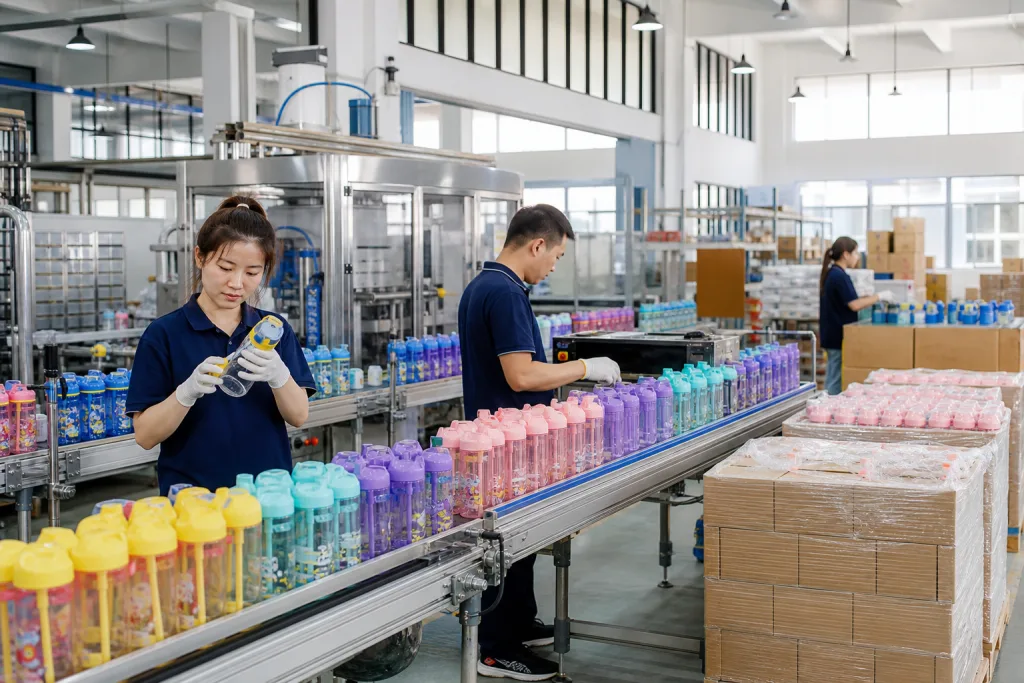
Our factory is in Zhejiang, China, and we run kids bottle production for export buyers who need firm pricing before they approve artwork. A bulk kids water bottle order is not priced like adult promotional drinkware. Smaller hands mean different grip diameters, school bag abuse means we check lid torque on the line, and BPA-free material rules change both testing and lead time. We ship these with stricter carton marks too; one buyer once flagged a PO typo between “straw lid” and “spout lid,” and the math didn’t work after packaging had started.
Start With The Real Landed Cost
Ask a children water bottle manufacturer for a quick price and you will usually get FOB Ningbo or FOB Shanghai. Fine for the first email. It is not the number your finance team signs off. A custom kids water bottle landed cost includes the bottle, logo, inner packaging, master carton, compliance documents, inland trucking, ocean or air freight, duty, and your own warehouse handling. We see this miss show up after the PO is already typed, sometimes because the buyer wrote “FOB China” instead of a real port on the PO.
For a basic 350-500 ml PP or Tritan-style kids bottle, a sensible FOB China range is often USD 1.20-2.80 at 3,000 pcs. Stainless steel insulated kids bottles usually sit higher, often USD 3.20-6.50 depending on wall thickness, cap structure, powder coating, and decoration. Wall thickness matters. A 0.4 mm body and a 0.5 mm body do not quote the same, and QC will feel the difference before the caliper confirms it. A small bulk school water bottle order below 1,000 pcs may look attractive, but the math gets bad once logo screens, carton printing, and sample work are spread over fewer units.
Buyers often miss three cost lines, and all three hit kids bottle projects hard. First, child-friendly lids cost more than plain screw caps. A flip straw lid can add USD 0.35-0.90 versus a simple cap because it uses a button, spring, silicone straw, air valve, and hinge pin; if the hinge pin is loose, QC pulled the sample before packing starts. Second, retail packaging is not free. A printed color box can add USD 0.18-0.45 per pc, while a plain white box may be USD 0.08-0.15, and a 5 mm carton size change can still affect pallet loading. Third, testing costs are real. REACH, LFGB, FDA food-contact review, or age-related physical checks may be charged per material and color.
At BottleForge Industrial in Zhejiang, we usually ask buyers to quote two versions: a minimum acceptable version and the preferred retail version. One line for the school tender. One line for the retail shelf. That gives you a clean comparison before you negotiate with your board, district office, or retail account. We have seen this go sideways when a buyer approved the cheap cap in sampling, then the retail account flagged it as “too adult” two weeks before shipment.
MOQ Tiers That Actually Work
MOQ is where custom children water bottle projects start to lose margin. A children water bottle supplier may quote 500 pcs, but on our line that usually means stock body color, stock lid color, one-position logo, and plain export carton. Ask for a Pantone body, custom straw color, printed name panel, or school district carton label, and the MOQ moves because we need to set the mixer, change the pad-print fixture, and book carton printing. We had one PO last spring with “sky bule” typed as the color name; QC pulled the sample against the Pantone chip before mass production, or 2,000 pcs would have gone the wrong way.
For most buyers, these tiers are realistic from a China factory:
- 500-999 pcs: best for testing a stock bulk kids bottle with one logo. Unit price is higher, color choice is usually limited to 2-3 stocked bodies, and the logo plate charge still has to be spread across a small run.
- 1,000-2,999 pcs: practical for school programs and children water bottle promotional orders using one lid system. We run these on standard cartons, often 24 pcs/ctn, so warehouse handling stays simple.
- 3,000-5,999 pcs: better pricing and more lid color options. Packaging control also improves because the carton supplier will accept printed marks without pushing the cost too hard.
- 6,000-10,000 pcs: suitable for importers, children water bottle distributors, and regional education supply programs when they already know the selling channel. At this level, the buyer usually asks for AQL 2.5 inspection and barcode checks on every carton.
- 10,000 pcs plus: where custom mold inserts and private packaging systems start to make commercial sense. Split shipments can work too, such as 6,000 pcs first and 4,000 pcs after the school tender confirms warehouse space.
Our monthly capacity for kids and sports bottle lines is about 450,000 units/month, with separate assembly teams for plastic and stainless steel. That does not mean every order can ship tomorrow. The line depends on material stock, lid tooling, coating oven space, and whether the silicone straw supplier has the right diameter in stock, often 6 mm or 7 mm. For a bulk children water bottle order, reserve capacity after sample approval. Asking for a rush slot after the school year has started is the wrong question to ask; the math does not work when coating needs 12 days and ocean booking needs another 18 days.
If you are a children water bottle distributor, do not over-customize the first order. Choose one body size, two colors, and one lid system. We have seen this go sideways when a buyer opens 8 SKUs at 1,000 pcs each, then finds only the 500 ml blue bottle sells through. Start tighter, check sell-through, then put tooling money behind the SKU that proves itself.
Materials Change Price And Timing
A custom school water bottle can be plastic, stainless steel, or glass with a silicone sleeve, but age decides the material. For preschool and primary school orders, drop resistance beats a “premium” hand feel. We run a 1.2 m drop check on filled samples; if the cap cracks on the third corner drop, that bottle will come back as a complaint before the carton reaches the second distributor.
Plastic kids bottles usually give the lowest FOB price and the shortest lead time when the buyer accepts existing molds. PP and co-polyester bodies, BPA-free claims, silicone seals, and food-grade straws are the 4 requests we see most often. Ask for the material list and the test scope, not a loose “food safe” line in an email. For Europe, REACH and LFGB come up in most RFQs. For North America, FDA food-contact expectations apply, and children’s products often need CPSIA-related review depending on age labeling and final use. QC pulled one sample last month where the PO said “Tritan style,” but the actual resin code was PP; that typo would have caused a test report mismatch.
Stainless steel kids bottles cost more, but about 6 out of 10 importers still choose them for retail programs because the bottle feels durable and takes powder coating or laser engraving well. A common insulated build uses 304 stainless steel inner wall, 201 or 304 outer wall, and vacuum insulation. Wall thickness is often around 0.4-0.5 mm on kids models, with the final gauge tied to shape and capacity. Don’t stop compliance review at the metal body. The lid still has plastic, a silicone ring, and sometimes a straw valve; the buyer flagged a black silicone seal once because the LFGB report covered only the bottle body.
Glass kids bottles are niche. They work for older children or premium retail sets, but the math often fails for school tenders: higher breakage risk, heavier cartons, and extra silicone sleeve assembly. One 350 ml glass bottle with sleeve can add 80-120 g against a similar plastic item, which changes freight cost fast on a 5,000 pcs order. If the target is a bulk school water bottle for daily classroom use, glass is the wrong first choice.
For a children water bottle factory in Zhejiang, China, material choice also changes the calendar. Stock plastic pellets and standard stainless bodies can move quickly; we ship some repeat SKUs in 18 days after artwork approval. Custom Pantone plastic matching, new silicone colors, or an unusual coating finish can add 7-14 days before mass production starts. The line cannot run until the color chip, spray panel, and pre-production sample match within the buyer’s approved tolerance.
Logo Methods And Their Trade-Offs
A custom logo kids bottle is more than a mascot on the front. Decoration has to survive small hands, wet lunch bags, bottle brushes, and the dishwasher test we run on sample day. On our line, QC pulls one piece and rubs the print 20 times with a damp cloth. The cheapest logo method is not always the cheapest after returns. This is the wrong question to ask.
Silk screen printing is common for simple one- or two-color school logos. It works well at 1,000 pcs and above, with setup charges usually around USD 30-80 per color, depending on artwork size. We run 80-mesh screens for this job on cylindrical plastic or coated stainless steel. Fine gradients and photo-style art are not its strength, and the buyer usually sees that in the first proof.
Heat transfer or water transfer gives you more color on the bottle. We use it for cartoon patterns, class-year artwork, and full-wrap children water bottle customizable programs. The unit cost is higher, often USD 0.20-0.80 per pc more than a simple screen print. On a curved 500 ml body, the film can lift at the shoulder if the adhesion test is weak, so we always check the edge after a 60°C wash.
Laser engraving is clean and durable on stainless steel, but it gives you one color only. For school district logos, it looks sharp, and on a powder-coated bottle the beam cuts through the coating to show the metal underlayer. Expect an add-on of about USD 0.15-0.45 per pc, based on logo size and line speed. We use a fiber laser with a 110 x 110 mm field, and if the logo sits too close to a seam, the buyer flagged it for wobble on the first trial.
Embossed or molded logos are a different job. They need tooling, and below 5,000-10,000 pcs the math usually does not work unless you are building a long-term custom made kids bottle program. A lid insert can be cut on a CNC in 3 days, while a new bottle mold takes 25-35 days and costs much more. We saw a 2,000 pc PO ask for this once, and the numbers killed it fast.
Ask your children water bottle vendors for a decoration sample, not just a digital mockup. QC pulled the sample, soaked it for 24 hours, and the buyer caught a color shift before we shipped the full order. A 7-day logo sample can save a 30,000 pc mistake. Do the sample first.
Lead Time From Artwork To Shipping
For school district buyers, timing is usually the real pressure. The bottle has to land before registration day, sports season, or a health campaign launch. A responsible children water bottle supplier should give you a timeline with cut-off points for artwork, sample approval, deposit, inspection, and vessel booking, not a loose “35 days” promise. We see this go sideways when a PO says “blue” but the approved Pantone is 2925C.
A normal schedule for a custom kids bottle order looks like this:
- Artwork check: 1-2 working days for logo size, Pantone, placement, and printable file review. Our prepress desk checks AI, PDF, or CDR files against the bottle curve before the line opens a film or screen.
- Price confirmation and PI: 1-3 working days depending on packaging and test requirements. A 350gsm color box, barcode sticker, and FDA or LFGB test request change the costing fast.
- Pre-production sample: 7-12 days for standard logo work, 12-20 days for custom color or transfer print. QC pulled the sample last month because a straw cap logo sat 2 mm too close to the hinge.
- Sample approval and deposit: buyer-controlled, but delays here are common. Three days lost on a bank slip or one missed signature pushes the whole booking window.
- Mass production: 25-35 days for 3,000-10,000 pcs using existing molds. We run molding, printing, assembly, and leak testing in batches, not one school logo at a time.
- Inspection and packing: 2-4 days, including AQL check and carton measurement. Carton size matters; a 1 cm change can affect container loading and freight cost.
- Export booking: 3-7 days before vessel cutoff in normal seasons. Before Christmas and August school shipments, our forwarder asks for space 10-14 days ahead.
That puts a realistic door-to-port production timeline at 30-45 days after deposit and sample approval. Add ocean freight separately. From Ningbo to major North American ports, transit is roughly 18-35 days depending on route and congestion. To Europe, 12 out of 15 routes we quoted this quarter sat around 28-40 days. Air freight saves time, but the math often fails on a bulk kids water bottle order; shipping 3,000 pcs by air can cost more than the bottles unless the quantity is small or the deadline cannot move.
If you are coordinating several schools, lock artwork early. Ten separate mascot files, each supplied as a 96 dpi JPG, can burn 5-7 working days before production even starts. This is the wrong place to “fix it later.” The line needs clean files, approved Pantone numbers, and one final logo layout before we cut screens or prepare transfer film.
Safety, Inspection, And Packaging
Kids bottles need tighter control than general promotional bottles because the user is a child, not an office worker. We usually see six risk points on the line: leaking caps, loose small parts, odor, sharp rim edges, weak logo adhesion, and crushed cartons. QC pulled one 420 ml sample last month where the silicone straw valve came loose after a 3 kg pull test. That is not a small issue. For children water bottle wholesale orders, a low unit price without a written inspection plan is the wrong question to ask; the claim math does not work after one school reports leaks.
For mass production, we usually run an AQL inspection before shipment. A common setup is AQL 2.5 for major defects and AQL 4.0 for minor defects, although some importers set stricter levels for school contracts. Major defects include leakage, broken lids, failed flip mechanisms, wrong logo, strong odor, or contamination. Minor defects include light scratches, color drift against the approved Pantone chip, or a print edge off by 0.5 mm within the signed tolerance. On our QC table, the inspector normally uses a torque gauge, water leak jig, 3M tape test, and a sample board from the pre-production meeting.
Packaging should match the sales channel. A school bulk distribution order may only need individual polybags or paper sleeves, inner cartons, and strong export master cartons. Retail importers often ask for color boxes, hang tags, warning labels, SKU stickers, and barcode labels, and the buyer flagged it before when the PO said “hangtag” but the artwork file said “hang tag with string.” Small typo, big delay. If the product goes to a fulfillment warehouse, label placement matters. For online channels, FNSKU or carton barcodes must be confirmed before packing, not added later with panic stickers at the warehouse.
Ask children water bottle suppliers for carton dimensions, gross weight, and units per carton before you approve the order. A small change from 24 pcs/carton to 36 pcs/carton can change pallet height, warehouse handling, and freight quoting. We ship 40HQ containers often, and 20 mm extra carton height can break the pallet plan. For a 500 ml plastic custom children water bottle, common master cartons may weigh 8-14 kg depending on packaging. Stainless steel cartons can be heavier and may need stronger 5-ply board.
A good children water bottle vendor will show you drop test logic, seal test method, and inspection photos. Ask for photos of the carton corner after a 76 cm drop, not only the clean hero shot on a white table. If they only send beauty photos, you are missing half the quality story.
How To Compare Supplier Quotes
Compare children water bottle manufacturers line by line, not by FOB unit price alone. We see this mistake on RFQs every week. Two quotes can both say “500 ml custom logo kids bottle” while the actual goods are not equal: one spec may use a 1.8 mm straw, food-grade silicone seal, printed inner box, and pre-shipment inspection; the other may be a light bottle in a 3-layer carton with no testing budget. QC pulled one sample last month where the lid looked fine, but the straw wall was 0.6 mm thinner than the approved sample. The cheap quote was not cheap after rework.
Use a quote sheet with fixed fields: material grade, capacity, bottle weight in grams, lid components, logo method, number of colors, packaging type, MOQ, sample time, production lead time, FOB port, test standard, payment terms, and validity date. Make suppliers fill the blanks, not send a pretty PDF. If a children water bottle custom project includes 8 school names or 12 mascot logos, ask whether each logo counts as a separate SKU for MOQ and setup. It usually does. On our line, changing from one logo to another means cleaning the pad-printing plate, checking color against the Pantone card, and signing off the first 5 pcs again.
Payment terms for new importers are often 30% deposit and 70% before shipment after inspection. For larger children water bottle distributors with repeat orders, staged terms can be discussed, but do not build your first project around credit terms the factory has not approved. The math doesn't work. If the order is funded by a school district, align your internal purchase approval with the factory’s deposit schedule; production will not start from a purchase order screenshot alone. We had one PO arrive with the bank name typo and no deposit slip, so the 304 stainless batch stayed off the welding line for 6 days.
The best quote is the one you can execute. If your deadline is 60 days to your warehouse, do not choose a custom mold, 3 lid colors, 5 logos, and retail packaging that still needs legal review. That is how schedules slip. Start with a stable children water bottle bulk configuration, prove quality under AQL 2.5 inspection, then build the custom program in the second purchase cycle. For a first run, we would rather ship 3,000 pcs on time than promise 10,000 pcs with artwork, tooling, and carton approvals all fighting for the same 18-day production window.
Price your kids bottle program before artwork approval
Send bottle size, target quantity, logo files, and delivery market. We will quote MOQ, FOB cost, sample time, and production schedule.
Frequently asked questions
What is the normal MOQ for a custom logo kids bottle?
For an existing mold with one logo, the practical MOQ is usually 1,000 pcs per design. Some stock bulk children water bottle projects can start at 500 pcs, but color and packaging options will be limited. If you need Pantone-matched body color, custom straw color, or several school logos, expect 3,000 pcs per SKU to make production efficient. For molded logos or special lid parts, 5,000-10,000 pcs is more realistic because tooling and setup costs must be spread across enough units.
How long does a custom kids water bottle order take?
For a standard custom kids water bottle using an existing mold, plan on 7-12 days for a pre-production sample and 25-35 days for mass production after approval and deposit. Add 2-4 days for inspection and packing. If the order needs custom color matching, transfer printing, or special retail packaging, add 7-14 days. Ocean freight from China to North America or Europe is separate and can add about 18-40 days depending on destination port and season.
Which material is best for a bulk school water bottle?
For most school programs, BPA-free plastic or stainless steel is the practical choice. Plastic keeps FOB cost lower, often around USD 1.20-2.80 at 3,000 pcs, and is light for younger children. Stainless steel is stronger and more premium, often USD 3.20-6.50 depending on insulation and lid design. Glass is possible but rarely ideal for daily school use because it is heavier and breakage risk is higher. The best material depends on age group, budget, and cleaning expectations.
Can each school have a different logo in one order?
Yes, but each logo normally creates separate setup work and may affect MOQ. For silk screen printing, each logo may need its own screen, with setup fees often around USD 30-80 per color. If you have 10 schools ordering 300 pcs each, a factory may price it differently from one logo at 3,000 pcs. The cleanest approach is to use one bottle color and lid color across all schools, then change only the printed logo. That controls cost and production risk.
What safety documents should importers request?
At minimum, request material declarations, food-contact test reports relevant to your market, and inspection records for leakage and appearance. For Europe, buyers often ask about REACH and LFGB-related food-contact testing. For the United States, FDA food-contact expectations and children’s product rules may apply depending on age labeling and distribution. Ask for reports that match the actual material, color, and components used in your order. A generic old report for another bottle is not enough for a serious children water bottle manufacturer.