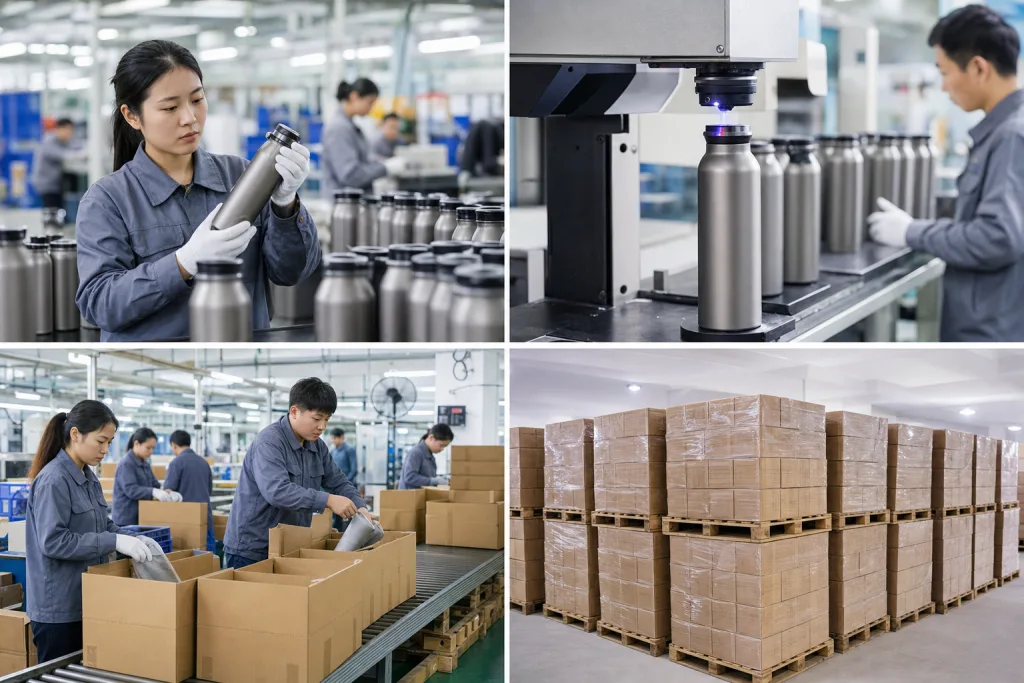
Key Takeaways
- Confirm stainless steel grade, wall thickness, and vacuum performance before approving a 3,000 pcs MOQ
- Logo failures usually come from wrong artwork format, coating mismatch, or curved-surface distortion
- Use AQL 2.5 for major defects and 4.0 for minor defects on most custom drinkware inspections
- Packaging must pass a 1.2 m carton drop test if you ship by courier, FBA, or distributor networks
A custom logo hydration flask looks simple on a quotation sheet: capacity, color, logo, carton size, FOB price. Then the 3D drawing turns into 8,000 physical bottles. That is when a 0.3 mm mouth tolerance, one rushed logo fixture, or a thin powder coat can become leakage claims, crooked printing, scratched paint, or cartons that fail a 1.2 m drop test.
If you buy custom drinkware from China, specify the failure points before production starts. Our Hangzhou, Zhejiang team sees the same issues repeat across distributor drinkware, promotional programs, and retail-ready launches: the buyer flags a color gap after PPS approval, QC pulls a leaking sample from the line, or the PO says “matte black” while the artwork file shows glossy black. A good canteen manufacturer should not just send a price. It should help remove risk before steel is cut, paint is sprayed, and cartons are sealed.
The bottle leaks after launch
Leaks are the failure buyers remember because one wet backpack turns into a one-star review with photos. For a custom logo hydration flask, we see the weak points at the lid gasket, thread tolerance, straw port, carry handle insert, and pressure change from hot-fill misuse. Do not accept “leakproof” as a slogan from a canteen factory. Ask how they test it, who records it, and whether QC uses the same approved lid sample on the line.
For standard stainless vacuum flasks, we run a 100% water leak test on the assembly line. Each unit is filled, inverted, and checked for visible dripping. Simple test. It works. For sport caps and straw lids, add a shake test, because static inversion misses some cap designs with silicone vents or flip straws. Our line usually checks 30 seconds inverted, then 10 hard shakes by hand before packing. If the product is intended for carbonated drinks, say so before tooling or sampling. Most hydration flask lids are not built for pressure from soda, beer, or kombucha, even when the buyer wants to sell the same item as a custom growler or customized growler. We have seen this go sideways when marketing changed the use case after PP samples.
Thread tolerance matters more than buyers expect. A lid that feels smooth in the sample room can fail when mass production runs across 4 injection mold cavities. Ask your canteen supplier to mark the mold cavity number on first production samples if the lid is complex. QC pulled one straw-lid sample last year where cavity 3 gave a slightly oval thread, only 0.18 mm out, but it leaked after shaking. Catch that before 10,000 pcs are packed, not after Amazon returns start.
For B2B orders, write the leakage requirement into the purchase specification: no visible leakage after 30 seconds inverted at room temperature, gasket seated correctly, cap torque within approved sample range. This is practical language a China factory QC team can follow with a torque meter and a signed golden sample. If you leave it as “good quality lid,” the math does not work. You have specified nothing.
Vacuum performance is oversold
Insulation claims get padded in marketing briefs. A canteen vendor may quote “keeps hot 12 hours, cold 24 hours,” but the result moves with bottle volume, mouth diameter, lid structure, wall thickness, copper plating, and the test room. A wide-mouth 950 ml flask will not hold heat like a narrow-mouth 500 ml flask; we have seen a 38 mm mouth beat a 58 mm mouth by 6°C after the same 6-hour bench test. This is the wrong question to ask if the quote does not say how it was tested.
For a custom logo hydration flask, ask for the actual temperature test method. A normal factory test fills the flask with 95°C water, closes the lid, and records the remaining water temperature after 6 hours at 20°C to 25°C room temperature. Simple setup. Calibrated probe, timer, and a rack number on the worksheet. For double-wall stainless flasks, a realistic target is above 55°C after 6 hours for 500 ml to 750 ml models, but the shape and cap change the result. Cold retention is harder to compare because one buyer uses 30% ice, another uses 50% ice, and the starting water temperature is often missing from the PO.
Vacuum failure usually comes from poor welding, damaged base sealing, or contamination during the vacuum process. Better canteen manufacturers run vacuum detection on the line, not just final random inspection. At BottleForge Industrial in Zhejiang, typical monthly capacity for stainless hydration flasks is 300,000 units, with line checks at welding, polishing, vacuuming, coating, and packing. QC pulled the sample. If the base plug shows heat discoloration or the vacuum needle record is out of range, that carton should not reach packing. Capacity only matters when each stage has a gate.
If you sell to retail chains or premium distributor canteen channels, request a pre-shipment insulation test from random finished goods. Do not rely only on golden samples. Samples are often made slower and cleaner than mass production; we have seen this go sideways when a buyer approved 3 perfect samples, then flagged a 7°C drop on the first container inspection. Your contract should state the test temperature, duration, sample size, and rejection rule. That turns a sales claim into an inspection item.
Your logo looks cheap
Logo execution is where a custom drinkware order loses brand value fast. We see the same 6 defects on the line: crooked placement, weak contrast, rough laser edges, ink bleed, stretched artwork on the curve, and cap-body color mismatch. A custom canteen is a moving cylinder, not a flat brochure. Last month QC pulled 32 samples from a 5,000 pcs run because the logo sat 3 mm off center after the jig clamp was set wrong.
Choose the marking method by coating and actual use. Laser engraving holds up well on powder-coated stainless steel, but the logo color comes from the metal or underlayer exposed, so “gold logo” on a PO is not enough. Silk screen printing works for bold one-color artwork and lower-cost promotional runs; fine text below 6 pt can break or fill in when the mesh is wrong. Heat transfer and UV printing give you more colors, but adhesion testing matters if the bottle goes through daily washing. For high-volume canteen promotional programs, we usually push buyers to keep the printable logo area simple and cut hairline gradients. The math doesn't work when a 12-color logo is squeezed onto a 45 mm print window.
Artwork should be supplied as AI, EPS, or vector PDF. PNG files copied from a website are not production artwork. Send real vectors. Ask the canteen manufacturer to provide a print proof showing logo size in millimeters, distance from base, distance from seam if any, and orientation relative to the lid handle or spout. On cylindrical products, a 60 mm wide logo may look normal on a 900 ml bottle but too dominant on a 350 ml kids-style flask. We had one buyer flag this after seeing the sample in hand; the PDF proof looked fine, but the logo wrapped too far around the body.
Specify adhesion testing. A common practical test is 3M tape pull after curing, plus alcohol rub for printed logos. For laser engraving, inspect edge clarity and position tolerance, often ±1.5 mm for mass production. If your order is for a North American distributor growler program or EU corporate gift campaign, approve one physical pre-production sample with final coating and final logo method before releasing bulk production. We ship bulk only after the signed sample matches the work order, because one typo in the logo color code on a PO can turn a clean 12-day print schedule into 18 days with rework.
Coating fails in the carton
Powder coating failures often show up before the consumer opens the flask. We have opened a master carton at final QC and found 7 out of 80 bottles with rub marks where the PE bag was too thin and the divider board had folded during vibration. Caps scratch bodies. Bottles rub inside cartons. Moisture marks can appear after 28 to 35 days on ocean freight if the carton spec is vague. The defect may look like rough factory handling, but the real problem is usually a packaging spec that stopped at “standard export carton.” That is the wrong question to ask.
For stainless custom drinkware, powder coating sells well because it gives a matte hand feel and deeper color than spray paint. But not all powder is equal. Ask whether the coating can pass cross-cut adhesion, 3M tape pull, and a scratch check using the same key or coin method your retailer uses at incoming inspection. On our line, QC pulled the sample after 24 hours curing and checked adhesion before the carton test, not after shipment complaints. If you need EU compliance, discuss REACH requirements for coating and plastic parts. For US children’s or family retail programs, confirm whether ASTM or CPSIA-related testing applies to your exact product category and age grading.
Color needs control. Use Pantone references, but powder coating on stainless steel will not always match a paper Pantone chip under office light. A responsible canteen supplier should send a coated metal chip or finished bottle sample for approval before mass production. For repeat orders, keep one approved sample in your office and one sealed sample at the China factory, with the PO number and approval date written on the label. We have seen this go sideways when a buyer approved “blue” by email, then flagged the next batch as 5% warmer under a D65 light box.
Packaging should match the route. Bulk cartons work for local repacking, but e-commerce and FBA-style handling need stronger protection. A 1.2 m drop test on the export carton is a practical minimum. For heavier 1.2 L or 1.9 L customizable growler items, use thicker dividers, 5-layer outer cartons, and individual kraft boxes if units will be reshipped one by one. The math does not work if you save USD 0.18 on packaging and eat 3% coating claims later. If your canteen distributors split cartons and reship single units, retail packaging must survive a second logistics cycle, not just the container ride from Ningbo or Shanghai.
Compliance is checked too late
Many buyers treat compliance as paperwork after production. That is too late. We have seen a lid PP batch pass, then the silicone gasket change get flagged at carton check. Material, coating, lid plastic, silicone gasket, straw, ink, and even carton glue can decide whether a custom logo hydration flask clears your market. A flask for Germany often needs a different file set from one going to Canada, and US online channels usually ask for cleaner traceability.
For food-contact stainless steel, 304 inner wall is the standard, and the outer wall is often 201 or 304 depending on price target. If the brand is premium, write 304 inner and 304 outer into the spec sheet. If you accept 201 outer to hit a lower FOB, say it plainly in the listing and the PO. The wrong question is whether one report can cover every build. For plastics, buyers usually ask for BPA-free PP, Tritan where applicable, and food-grade silicone. On the line, we check wall thickness with a caliper at 0.6 mm or 0.8 mm, then match the test file to the exact build. Documentation often includes LFGB, FDA food-contact related testing, REACH, or other market-specific reports.
Factory audits matter when you sell to larger retailers. BSCI, ISO 9001, Sedex, or customer-specific audits do not guarantee perfect bottles, but they show whether the supplier runs basic controls. We once saw a 6,000 pcs order from a small canteen vendor priced well on FOB, then the buyer's compliance team rejected the file because the factory could not show a traceable ink batch. If you are a distributor serving 8 or 12 accounts, build one document pack: business license, audit status, material declarations, test reports, product photos, carton marks, and inspection records.
Do not assume one old test report covers a new design. Change the coating, straw material, lid, or ink, and the report can be dead. The safe move is to lock compliance scope during sampling, before mass production. In our shop, QC pulled the sample apart, checked the lid torque at 1.2 N·m, then matched that to the revised BOM. Serious factories in Zhejiang and across China handle this every week; the weak ones push back because they do not control their own material chain. We've seen this go sideways when the buyer flagged a PO typo on the straw material and the lab report no longer matched the spec.
Price cuts remove hidden controls
FOB price pressure is normal. The problem is where the cut comes from: stainless steel rolled down by 0.03 mm, carton board changed from 5-layer to soft 3-layer, one QC person removed from the line, cheaper silicone gaskets, coating cure cut from 28 minutes to 18 minutes, or lids mixed from a subcontractor. A quotation that is USD 0.18 lower can cost more if 4% of units turn into claims. We have seen this go sideways when QC pulled the sample and found a 0.6 mm lid gap after the supplier “matched price.” The math doesn't work.
For a 500 ml to 750 ml stainless custom logo hydration flask, typical order discussions include MOQ from 1,000 to 3,000 pcs per color, depending on stock body availability and custom color needs. New tooling, special lids, or a fully customized canteen shape may push MOQ to 5,000 pcs or more. Lead time is commonly 25 to 35 days after deposit and sample approval for regular models; before summer and Q4 promo shipments, we often quote 38 to 45 days because powder coating, logo printing, and carton packing all queue up. Shortcuts show up fast. One buyer once flagged a PO typo that changed “matte black” to “black,” and the line almost ran gloss black bodies.
When comparing canteen suppliers, make the quotation table boring and precise. Include steel grade and body weight tolerance in grams, then spell out wall construction, lid material, gasket material, coating type, logo method, packing method, carton size, inspection standard, spare parts, FOB port, payment terms, and lead time. Only then can you compare canteen manufacturers fairly. Otherwise, one canteen factory may quote a stronger product while another quotes a lighter version that looks identical in a PDF. Ask for the unit weight. If a 750 ml flask drops from 315 g to 282 g, our caliper usually finds the answer in the body wall.
Use AQL inspection instead of emotional quality judgment. For most distributor drinkware orders, AQL 2.5 major and 4.0 minor is a reasonable starting point, with critical defects at 0. Define critical defects as leakage, unsafe sharp edges, severe contamination, wrong material, or wrong logo. If you need a lower defect rate, pay for stricter inspection and leave enough production time. Quality control is not magic; it is paid labor and rejection authority. On our floor, a leak test rack with 30 samples tells the truth faster than a nice pre-shipment photo.
Sampling approval is too casual
The quickest way to create a production dispute is to approve a sample without writing down what passed. The buyer emails “sample approved.” The factory reads that as “all details accepted.” Three weeks later, both sides are arguing over a 3 mm logo height difference, cap PMS color, rim polishing, or the carton label layout. We have seen this happen with first-time hydration flask buyers and canteen distributors placing their 8th repeat order.
Use a signed sample approval sheet. It should list model number, capacity, measured weight, dimensions, steel grade, lid version, coating color, logo size, logo method, packaging, barcode or FNSKU if needed, and any known deviations. Add real measurements: 500 ml, 286 g, 72 mm body diameter, 210 mm height, logo 38 × 52 mm. QC pulled the sample should not be a sentence in WeChat; it should be tied to photos from the front, side, bottom, lid open, lid closed, and packed carton. Keep one sealed sample at your office and one at the China factory.
If you ship to Amazon-style warehouses, confirm labeling before mass packing. FNSKU labels, suffocation warnings for polybags, carton labels, country of origin marking, and master carton weight limits must be handled before cartons are sealed. We run into trouble when a buyer approves the bottle but leaves the shipping label “for later.” Later means the line has packed 1,200 cartons, the tape is closed, and someone now wants a new 100 × 150 mm label on two sides. A good canteen supplier asks these questions early. A weak canteen vendor waits until the forwarder rejects the cargo.
For new buyers, start with a controlled first order instead of customizing every part. Pick an existing bottle body, change the coating and logo, then test sell-through with 500 or 1,000 pcs before paying for lid tooling. This is the wrong question to ask: “Can we make every component unique on the first order?” The better question is whether the math works after mold cost, sample lead time, AQL 2.5 inspection, and rework risk. Once sales are proven, move to custom lid tooling, a custom growler family, or a wider customizable drinkware range. It looks less exciting on a mood board, but it protects cash flow and gives the supplier clean production data for the next batch.
Send your flask spec before you request pricing
We will review capacity, logo method, MOQ, packaging, and compliance needs before quoting your custom drinkware order.
Frequently asked questions
What MOQ should I expect for a custom logo hydration flask?
For an existing stainless steel body with your logo, a realistic MOQ is usually 1,000 pcs per design, with 3,000 pcs per color for custom powder coating. If you need a custom lid, special mold, or unique canteen customized shape, expect 5,000 pcs or more. Some China suppliers offer 500 pcs, but the unit price, logo cost, and color options are usually less favorable. For distributor programs, we normally suggest starting with 1,000 to 3,000 pcs so inspection, carton marking, and freight cost make sense.
Which logo method is best for stainless hydration flasks?
Laser engraving is the safest choice for durability on powder-coated stainless steel, especially for corporate and outdoor use. Silk screen printing is cheaper for simple one-color logos, but it is more sensitive to scratches and artwork detail. UV printing or heat transfer works when you need multi-color branding, but you should require adhesion and rub testing. For most B2B custom canteen orders, avoid tiny text under 6 pt and keep placement tolerance around ±1.5 mm to ±2 mm in the signed specification.
How do I compare quotes from different canteen suppliers?
Do not compare only FOB unit price. Ask each canteen manufacturer to quote the same steel grade, capacity, body weight, lid material, coating, logo method, packaging, AQL standard, lead time, and FOB port. A USD 3.20 flask and a USD 3.38 flask may not be the same product if one uses thinner steel or weaker cartons. For Zhejiang or other China production, also check audit status, test reports, monthly capacity, and whether the supplier controls coating and vacuum testing in-house.
What quality inspection standard should I use?
For most customized drinkware shipments, AQL 2.5 for major defects and 4.0 for minor defects is practical. Critical defects should be set at 0, including leakage, sharp edges, wrong material, contamination, and unsafe broken parts. Inspection should include carton count, appearance, logo position, coating defects, leak test, cap fit, barcode scan if used, and packaging drop test when relevant. For a 3,000 pcs order, a third-party or factory final inspection before balance payment is much cheaper than handling claims after delivery.
Can one hydration flask be sold as a canteen, tumbler, or growler?
Sometimes, but be careful with function claims. A hydration flask for water may not be safe for carbonated drinks or beer, so calling it a custom growler can create pressure-related complaints if the lid is not designed for it. A canteen promotional item may only need basic leak resistance, while a customized growler should handle heavier use, larger capacity, and clearer filling instructions. Tell your supplier the real use case before sampling, not after production starts.