Key Takeaways
- A practical custom logo hip flask MOQ starts at 1,000 pcs for standard shapes and 3,000 pcs for new color finishes
- Laser engraving is cleaner for stainless steel flasks, while pad printing suits lower-cost promotional logos
- A good PO should lock capacity, wall thickness, leak test method, logo size, packaging, AQL level, and FOB port
- Sampling usually takes 7-12 days; bulk production from China normally needs 25-40 days after approved sample
A custom logo hip flask looks simple until the first RFQ comes back with five prices for the same 6 oz item. One supplier quotes 0.6 mm 304 stainless, one leaves wall thickness blank, and one adds a 12 g funnel that bends during a carton drop test. QC sees it fast.
If you buy custom drinkware for a brand, distributor, or promotion program, the job is to turn a nice-looking flask into a controlled SKU. From our Zhejiang factory floor, the safer orders start with PO language that names the steel grade, wall thickness, logo position in mm, packing method, and AQL 2.5 inspection level. Catalog photos don’t hold the line. Specs do.
Start with the RFQ truth
Your RFQ should kill guesswork. If you write only “6 oz stainless flask with logo,” a China hip flask supplier can quote the cheapest possible version and still claim they answered the request. We see this every month. The gap is usually in 7 places: steel grade, body thickness, cap type, surface finish, packaging, logo process, and inspection level. Last March, QC pulled a 6 oz sample with a 0.38 mm body against a buyer’s expected 0.50 mm, and the price looked good only until the dent test failed. For distributor drinkware, those details decide whether the product sells through cleanly or turns into a claims file.
For a custom logo hip flask RFQ, set the baseline first: capacity in oz and ml, body shape, 201 or 304 stainless steel, target wall thickness, surface finish, cap attachment, funnel requirement, and retail box style. Be blunt about the finish. Mirror polish and matte powder coat do not run the same way on the line, and the fixture marks show if the supplier guesses. If you are comparing against a custom canteen, custom growler, or other customizable drinkware program, send separate RFQs. A hip flask and a customized growler do not share the same tooling, polishing wheels, or leak test setup. Mixing them in one sheet is the wrong question to ask.
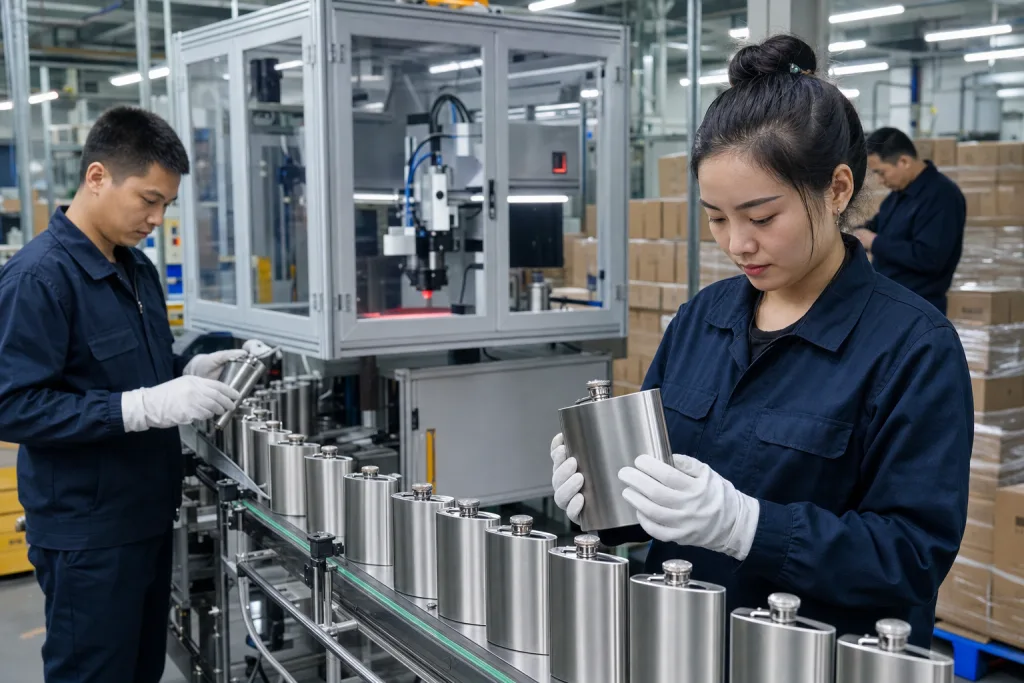
At BottleForge Industrial in Hangzhou, Zhejiang, we usually quote standard stainless hip flasks from 1,000 pcs per logo, with monthly drinkware capacity around 600,000 units across flasks, bottles, tumblers, and canteen customized lines. For a stock silver flask with laser engraving, we run the job faster because the jigs are already on the shelf. A new powder-coated color or embossed body normally pushes MOQ to 3,000 pcs because coating and fixture setup need a larger batch. The buyer flagged this once after sending a PO for 1,200 pcs in PMS 186C; the math did not work after spray loss and line cleaning.
RFQ line items to include:
- Capacity: 6 oz / 177 ml or 8 oz / 237 ml, with the fill volume checked by measuring cup, not just stamped on the box
- Material: 304 stainless steel preferred for higher perceived quality; state it if you do not want 201 quoted
- Wall thickness target: 0.45-0.60 mm depending on budget, because 0.10 mm changes both feel and dent resistance
- Logo method: laser engraving, pad print, silk screen, or debossed gift box; send artwork in AI or PDF before pricing
- Incoterm: FOB Ningbo or FOB Shanghai, not vague “delivered price,” and list carton marks if your warehouse needs them
Lock the design before sampling
Sampling is not the time to keep changing the product. Before you ask a canteen factory or hip flask line to cut samples, decide what you are selling: a corporate gift set with EVA insert, a retail liquor accessory with barcode box, a festival merchandise item, or a premium membership product with numbered engraving. Pick the channel first. Last month the buyer flagged this exact issue after our line had already set the 95 mm box height, and the new gift-set tray pushed the flask neck too close to the lid.
For most stainless flasks, laser engraving is the safest mark. It does not peel, keeps the metal look, and usually passes a 3M tape pull better than low-cost ink. Pad printing is acceptable for one-color canteen promotional orders where price beats permanent branding. Silk screen works on larger flat panels but needs proper curing; our QC checks it after 24 hours, not straight off the dryer. For a matte black flask, white pad print looks sharp, but test alcohol rub and tape adhesion before bulk approval. We have seen this go sideways when a buyer approved the photo and the ink softened after two wipes with 75% alcohol.
Your sample PO should be small but formal. Do not approve a sample by WeChat photo only. Ask for 2-3 physical samples with the correct logo size, logo position, cap assembly, funnel, and box. Check the cap. A loose hinge pin by 0.3 mm is enough to make the flask feel cheap in hand. If the project is linked to a canteen distributor or distributor canteen catalog, ask for a blank reference sample too, so your sales team can photograph it before logo approval.
Sample PO line items should state: sample quantity, unit sample fee, courier account, logo artwork file name, Pantone color if printed, engraving area in mm, packaging dieline version, and target bulk order quantity. Typical sample lead time is 7-12 days after artwork confirmation. If a canteen supplier promises 3 days for a decorated flask, ask whether they are using stock blanks instead of your final specification. The math often does not work: engraving 2 samples from stock can ship in 3 days, but a new cap color, revised box dieline, and logo jig usually push it closer to 10 days.
Build a PO buyers can audit
A purchase order should be boring, detailed, and hard to argue with. In our flask orders, 7 out of 10 disputes start from friendly email notes that never made it into the PO. When the cartons land with 0.40 mm steel instead of 0.50 mm, loose caps, or the wrong insert card, the factory can say it was never specified. Put it in writing. A proper PO protects both sides, especially when QC pulled the sample and the buyer flagged the same issue two weeks later.
For a custom logo hip flask, write the PO so a third-party inspector can work from it at the packing table without calling your merchandiser. Include SKU number, approved sample reference, product drawing, capacity tolerance, material grade, logo process, surface finish, accessories, packaging, carton mark, AQL level, and required compliance documents. If you also buy customized drinkware such as a customizable canteen or distributor growler, keep the same PO discipline across every SKU; we have seen mixed carton marks go sideways because one PO said “black box” and the artwork file said “kraft box.”
A practical PO might state: “6 oz hip flask, 304 stainless steel inner and outer body, 0.50 mm nominal wall, brushed finish, captive screw cap, laser engraved logo 38 x 22 mm centered on front face, one stainless funnel, one black gift box, 100 pcs/master carton, FOB Ningbo, AQL II 2.5 major / 4.0 minor.” Not glamorous. It saves money. On the line, one missed logo position can mean repolishing 2,000 front faces, and the math does not work once gift boxes are already sealed.
Payment terms should also be written clearly. For new buyers, 30% deposit and 70% before shipment is common in China. Established distributor drinkware buyers with repeat orders may negotiate better terms after 3 to 5 clean shipments, not after one trial order with two PO revisions and a typo in the consignee name. Do not treat payment and inspection as separate topics; final payment should be tied to passed inspection or approved corrective action, with the recheck photos showing cap torque, carton weight, and logo size against a steel ruler.
Check compliance before deposit
Hip flasks touch beverage, so compliance is not decoration. For Europe, ask for LFGB or the relevant food-contact migration test, plus REACH restricted-substance checks when the sales channel asks for them. For the United States, FDA food-contact expectations and California Proposition 65 screening often sit on the retailer checklist. We had a buyer approve artwork on Monday, then stop the deposit on Friday because the cap liner was not covered in the report. Retailers do not forgive that.
Ask your canteen manufacturer or flask supplier which parts are actual food-contact surfaces. Stainless steel body, cap liner, funnel, inner weld area, ink, coating, and packaging inks can all get questioned by QC. If you are sourcing a canteen custom range alongside flasks, do not copy test reports blindly. A powder-coated customized canteen and a bare stainless hip flask fail for different reasons; on the line, QC pulled one sample where the funnel edge had burrs over 0.3 mm, while the flask body passed.
Factory audits also matter. BSCI, Sedex, ISO 9001, or a customer-specific audit can be required by European and North American retailers. BottleForge Industrial works from Zhejiang, China, where more than 40 drinkware-related forming, polishing, coating, and packaging partners sit within a half-day truck run of Hangzhou. That cluster helps us move samples fast, but it does not replace documentation. This is the wrong question to ask: “Can you ship without it?” Ask what the retailer will reject at receiving.
Compliance PO line items to request:
- Food-contact test report issued within the last 24 months for the same material family
- Ink or coating declaration for printed or painted flasks, with color name matching the approved artwork
- Factory audit report if your retailer requires social compliance, not just a factory profile PDF
- Material declaration naming 304 or 201 stainless steel, and matching the PO specification line
- Pre-shipment inspection allowed by buyer or appointed agency, with AQL level written before production starts
If a canteen vendor refuses basic paperwork, the low price is not worth the risk. We have seen a $0.18 saving turn into a full shipment hold.
Control bulk production early
Bulk production should not start with silence and end with a surprise inspection. After deposit, ask for a dated production schedule covering material purchase, forming, welding, polishing, decorating, packing, and inspection. For a standard 1,000-5,000 pc hip flask order, we normally run 25-40 days after approved sample and deposit. Q4 gifting season often adds 7-15 days, mainly when paper gift boxes, EVA inserts, or printed sleeves wait behind other jobs at the packing supplier. Get dates in writing. We have seen a PO typo change “matte black” to “black,” and the line followed the PO until the buyer flagged it on day 12.
For stainless hip flasks, the main production risks are body dents, rough weld grinding, cap leakage, uneven brushing, logo misalignment, and packaging scuffing. AQL inspection catches some of these, but the math doesn't work if the defect list is soft. Define major and minor defects before the first carton is packed. Leakage, sharp edges, wrong logo, wrong material, and heavy dents should be major defects. Tiny polishing marks can stay minor if you set a limit, such as no more than 2 marks under 3 mm on the back face. QC pulled the sample under a 600 lux inspection lamp last month and found brush lines running two directions on the same 6 oz body; that needs a clear reject rule.
If your order sits inside a larger customizable growler, canteen customizable, or custom drinkware program, combine factory updates but inspect by SKU. A 64 oz custom growler and a 6 oz flask do not fail in the same way. The growler needs handle strength and insulation testing if vacuum insulated; the flask needs pocket-fit finish, smooth cap threading, and small-area logo accuracy. This is the wrong question to ask: “Did the drinkware pass?” Ask whether each SKU passed its own checklist. On our side, we use a thread gauge for flask caps and a drop test setup for boxed growlers because one shared inspection sheet misses too much.
Ask for mid-production photos when 20-30% of goods are completed. Better, request an inline inspection for large orders above 10,000 pcs. Catching a logo position error at 2,000 pcs is painful. Catching it at 20,000 pcs is a margin killer. We’ve seen this go sideways when a laser jig shifted by 1.5 mm after lunch break, and nobody checked the next tray. Ask for front, back, cap, logo, inner carton, and master carton photos with a ruler in the frame.
Price the landed order honestly
FOB unit price is one line in your margin sheet. A flask quoted at USD 1.80 FOB Ningbo often lands at USD 2.30-2.80 after ocean freight, duty, customs brokerage, inland trucking, pre-shipment inspection, finance cost, and carton handling, with the final number tied to CBM, gross weight, and destination port. Do the math. On one 5,000 pcs rush order, the buyer asked for air freight after logo approval slipped by 4 days; the line shipped on time, but the landed cost jumped because metal drinkware is dense and the cartons hit 13.5 kg each.
Typical FOB pricing from China for a standard 6 oz stainless custom logo hip flask sits around USD 1.40-2.60, based on steel grade, finish, logo method, gift box type, and order quantity. A premium gift set with funnel, PU wrap, insert tray, and rigid box can move beyond USD 3.50. A canteen promotional item may look cheaper for its size, while a customized growler costs more and can still carry better retail value. Compare landed margin, not the prettiest factory quote. We’ve seen this go sideways when a buyer approved a mirror-polished sample, then changed to matte black after mass production plates were already fixed.
Your commercial PO should name the currency, Incoterm, port, carton dimensions, gross weight estimate, payment schedule, spare parts if any, and penalty or remedy for late shipment if your retailer imposes chargebacks. For Amazon or marketplace channels, add barcode, FNSKU label placement, master carton limits, and drop test expectations. QC pulled one sample last month where the FNSKU was placed 18 mm too close to the carton seam, so the scanner missed it after tape sealing. About 7 out of 20 canteen distributors and distributor growler buyers we review lose money not on unit price, but on rework, relabeling, and missed delivery windows.
Ask your canteen suppliers to quote optional packaging separately. This shows whether the gift box adds USD 0.25 or USD 0.90. Packaging is where margin quietly disappears. We run separate cost lines for white box, color box, EVA insert, and rigid box because a 1.5 mm thicker tray can change both carton size and freight cost.
Approve shipment with evidence
Before balance payment, ask for evidence, not a “don’t worry, boss” message. A finished-goods inspection should check order quantity against the PO, workmanship under normal light, key dimensions with a caliper, capacity by water fill, logo position, Pantone color, inner box fit, carton marks, barcode readability with a scanner, and basic function. For hip flasks, add a leak test on at least 20 pcs from different cartons. We fill them with water, close the cap, shake for 30 seconds, then place them upside down on absorbent paper. It is not a laboratory test, but it catches loose cap assemblies and bad silicone gaskets fast. QC pulled one sample last year with a wet neck after 8 minutes. That carton did not ship.
Use AQL General Inspection Level II for normal retail orders unless your customer specifies another plan. Common settings are 2.5 for major defects and 4.0 for minor defects. For premium gift programs, you may tighten to 1.5 major. If your buyer is a strict North American retailer, match the inspection checklist to their vendor manual before production starts, not after 186 cartons are taped shut. We have seen this go sideways when a buyer flagged a missing suffocation warning after packing. The math does not work when the line has to reopen every inner box for a 0.03 USD label.
Your shipment approval should include photos of packed cartons, close-ups of carton marks, the pallet plan if used, container loading photos, and the final packing list with gross weight and carton count. If you work with multiple canteen vendors, canteen manufacturers, or a mixed custom drinkware supplier base, standardize the evidence format. Use the same file names, same photo angles, and the same carton mark layout each time. Small thing. Big difference. When a PO has a typo like “matte balck” and the buyer flags it, clean records make the claim easier to close and the repeat order faster to release.
A reliable canteen supplier or hip flask factory will not be offended by inspection. Serious factories in Zhejiang and broader China expect it; we run AQL checks with carton scales, barcode scanners, 3M tape, and simple leak-test paper on the QC table. Clear checks reduce arguments, protect your launch date, and give both sides a real defect history for the next order. Once the first shipment is stable, repeat POs become easier: confirm the approved sample, update artwork or packaging, lock the production slot, and keep the same inspection rules. Do not change the rules after the goods are finished. That is the wrong time to negotiate quality.
Send us your hip flask RFQ for review
Share capacity, logo artwork, packaging target, MOQ, and destination market. We will return a practical China factory quote with clear assumptions.
Frequently asked questions
What is a realistic MOQ for a custom logo hip flask?
For a standard stainless steel shape, 1,000 pcs per logo is realistic. Some suppliers quote 500 pcs if they have stock blanks, but decoration cost and freight per unit are usually worse. For custom color coating, special packaging, or a new mold shape, expect 3,000-5,000 pcs. If you need a full gift set with funnel, box, and insert, 1,000 pcs can work, but the box supplier may charge a setup fee. For distributor programs, we normally recommend testing one SKU at 1,000 pcs, then moving to 3,000 pcs once sell-through is proven.
Is 201 or 304 stainless steel better for hip flasks?
304 stainless steel is the safer choice for higher-quality custom drinkware because it has better corrosion resistance and stronger buyer confidence in Europe and North America. 201 stainless steel can reduce cost, sometimes by USD 0.10-0.25 per flask, but it is less attractive for premium retail or long-term brand programs. If the flask will contact spirits and may sit unused for months, 304 is worth specifying. Whatever you choose, write the grade into the PO and request a material declaration. Do not accept “stainless steel” as the full specification.
Which logo method works best on a hip flask?
Laser engraving is usually best for stainless steel hip flasks because it is permanent, clean, and does not require ink adhesion. It is ideal for corporate gifts and premium distributor drinkware. Pad printing costs less and works for one-color promotional campaigns, but you should require tape testing and alcohol rub testing before mass production. Silk screen is possible on larger flat areas, though registration must be controlled. For a 6 oz flask, a logo around 35-45 mm wide often looks balanced. Very large logos can distort visually on curved bodies.
How long does sampling and bulk production take?
A decorated sample normally takes 7-12 days after artwork approval. If you need a new box dieline, add 3-5 days for packaging proofing. Bulk production for 1,000-5,000 pcs usually needs 25-40 days after approved sample and deposit. During peak gifting season, especially August to November, allow another 7-15 days. Ocean shipping to North America or Europe can add 25-45 days depending on port pair and congestion. If your launch date is fixed, place the PO at least 90 days before the goods are needed.
Can one factory supply flasks, canteens, and growlers together?
Yes, but you should still treat each item as a separate controlled SKU. A canteen manufacturer may also handle hip flasks, sports bottles, and custom growler orders, but the processes differ. Flasks need small metal forming, polishing, cap fit, and logo alignment checks. A customizable canteen may need coating tests and strap checks. A customizable growler may require insulation, handle, or lid testing. Combining orders can improve freight efficiency and supplier management, but your PO, sample approval, and AQL checklist should remain product-specific.