Key Takeaways
- A 64 oz stainless custom logo growler usually lands at USD 4.80-8.90 FOB China depending on steel, finish, cap, and packing
- Practical MOQ starts at 500 pcs for laser logo, 1,000 pcs for color coating, and 3,000 pcs for molded or private cap changes
- Normal lead time is 25-40 days after sample approval, with 7-12 days for logo sampling
- For distributor growler programs, order 5-8% extra units to cover inspection rejects, retail samples, and carton damage
A custom logo growler looks simple on a quote sheet: capacity, stainless steel grade, logo, carton quantity, FOB price. The trap is comparing USD 5.20 with USD 6.10 as if they are the same growler. They are not. One quote might be 0.45 mm body steel, a light cap, no air-pressure test, and a plain export carton. The other might cover 18/8 stainless steel, powder coating, laser logo, inner box, and AQL inspection; our QC team checks body thickness with a digital caliper before the line runs.
If you buy custom drinkware for a brewery, outdoor brand, promotion agency, or distributor drinkware program, tie cost to lead time before you chase the lowest FOB. We see 7 out of 10 early problems start before production: artwork sent as a low-resolution JPG, MOQ assumed at 500 pcs when the coating line needs 1,000 pcs, or packaging confirmed 3 days after the PO. China factories can move fast. Spec must be locked. In Hangzhou, Zhejiang, we ship faster when the buyer signs off the logo position, Pantone code, cap type, and carton mark before we book stainless steel sheet and powder coating time.
Start With The Real Specification
Before you ask a canteen manufacturer or growler factory for price, lock the spec. “64 oz stainless growler with logo” leaves too much room. Put capacity, body diameter, mouth size, stainless grade, wall construction, lid type, finish, logo process, packaging, and compliance market in the RFQ. On our line, a 1,900 ml single-wall growler for cold beer runs through a different welding and polishing setup than a vacuum insulated customized growler for outdoor retail. Different product. Different cost.
Most B2B buyers choose 18/8 stainless steel, also written as SUS304, for food contact surfaces. For a cost-sensitive canteen promotional order, 201 stainless sometimes gets requested on the outer wall; we push back on that for premium retail because corrosion complaints kill repeat orders. Typical wall thickness is 0.5-0.6 mm for single-wall bodies and 0.4-0.5 mm per wall for vacuum insulated construction. A small change of 0.1 mm looks minor on a drawing, but on a 3,000 pcs PO the material cost can move by 4-8%. QC checks this with a digital thickness gauge, not by eye.
Capacity matters more than buyers expect. Common growler sizes are 32 oz, 40 oz, 64 oz, and 128 oz, but the 64 oz format is the main one for brewery and outdoor distributor canteen channels because the retail value still makes sense after freight. A 64 oz vacuum custom growler normally packs 12 pcs per export carton; a single-wall version may pack 24 pcs if no retail box is used. We’ve seen this go sideways when a buyer compares unit price only, then flags the carton cbm after booking space.
If you are comparing canteen suppliers in China, make each one quote the same written spec. Include: FOB port, carton dimensions, gross weight, logo method, packaging, sample fee, production lead time, and inspection standard. Without these, the lowest quote is often just the least complete quote. Ask for the carton size in cm and gross weight in kg; one missing line on the PI can turn a clean 12 days sample plan into 18 days of back-and-forth.
Where The Unit Cost Moves
The biggest cost drivers are not always the logo. For a custom logo growler, the metal body, vacuum line, surface finish, lid assembly, and packaging decide about 80% of the price. A basic 64 oz single-wall stainless growler with laser logo may quote around USD 4.80-5.80 FOB Ningbo or Shanghai at 1,000 pcs. A vacuum insulated version with powder coating and retail box often sits around USD 6.80-8.90 FOB China, depending on order size and cap quality. We run wall-thickness checks with a digital caliper; if the buyer asks for a heavier handfeel, the cost moves before the logo artwork is even opened.
Powder coating normally adds USD 0.35-0.80 per unit compared with brushed stainless. Gloss spray paint can be cheaper, but it scratches in transport and on retail shelves. We have seen this go sideways. QC pulled 32 samples from one trial carton last year, and 5 had rub marks near the shoulder after a basic carton shake test. Full-color heat transfer or water transfer can add USD 0.60-1.50 per unit because of film setup, extra labor, and higher rejects. If your brand color must match Pantone within a tight tolerance, plan for one or two extra sample rounds.
Lids are another hidden cost. A simple screw cap may cost under USD 0.40. A leak-resistant cap with silicone gasket, stainless cover, carry handle, or pressure-relief design can move to USD 0.80-1.60. For beer growlers, ask whether the cap has been leak tested after carbonation pressure simulation. This is the wrong place to save USD 0.20. Not every canteen factory runs this test unless it is requested, and the line will not add it after packing unless someone pays for rework.
Packaging can swing the landed cost more than buyers expect. A white box may add USD 0.18-0.35. A printed retail box can add USD 0.35-0.90 at 1,000 pcs, plus plate or digital proof cost. For Amazon or retail distribution, inner box strength matters; 250 gsm paperboard may be too weak for a heavy 64 oz growler. We ship growlers in 5-layer export cartons for safer handling, and the buyer flagged corner crush on a 3-layer test carton after only one drop. Our Zhejiang production line can produce about 280,000 stainless drinkware units per month, but carton and color-box approval still need a slot before mass packing.
Logo Methods And Setup Charges
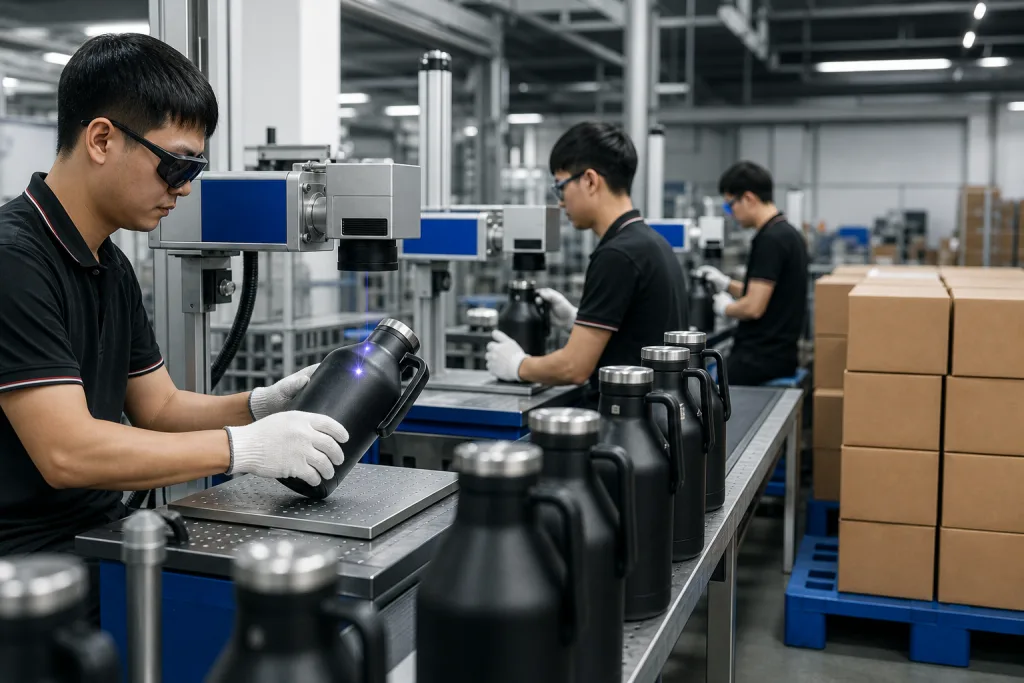
Laser engraving is the safest starting point for a custom logo growler. It gives a clean mark, survives washing, and keeps setup cost under control. On stainless or powder-coated bodies, laser usually costs USD 0.10-0.35 per unit, with a sample setup fee around USD 30-80 depending on artwork size. We run the logo file through CorelDRAW first, then the laser operator checks the mark width on a scrap body; thin lines under 0.25 mm often disappear on matte black powder coat. The result is one-color by nature: silver mark on coated bottles or etched tone on raw stainless. For brewery logos, outdoor club marks, and distributor growler programs, this is usually enough.
Silkscreen printing is better when the buyer needs solid brand color, especially a Pantone logo that sales teams will compare against a label or keg wrap. It works well for one to three colors on a straight or gently curved body. Expect USD 0.15-0.45 per unit for one color, plus screen charges of USD 30-60 per color. The weak point is registration and durability. If the bottle surface has heavy texture, print edges can look soft; QC pulled one sample last month where a 1 mm white outline shifted enough for the buyer to flag it. We normally run tape adhesion and rub testing before mass production.
For a customized canteen or customizable growler with large wraparound graphics, heat transfer gives stronger shelf impact. It fits promotional campaigns and retail collections, but the MOQ is usually higher because film setup is inefficient below 1,000 pcs. Full wrap artwork also increases reject risk at the seam. This is where the math doesn't work for small test orders. A realistic reject allowance is 2-4% for simple laser orders and 4-7% for complex color decoration, and we check the seam area with a 30 cm visual inspection on the line before cartons are closed.
Embossed logos, debossed caps, and private molds move the project into a different cost class. Mold charges can run from USD 600 for a simple silicone insert to USD 3,000-8,000 for a custom lid or body component. This makes sense for established canteen distributors, not for a first 500 pc test order. We've seen this go sideways when the PO says “custom cap” but the artwork only shows a printed lid logo. If you need a canteen customizable program with multiple clients, keep the base growler standard and change the decoration only.
MOQ Tiers That Actually Work
MOQ is where 6 out of 10 new buyers hit the first price shock. A factory can decorate 100 pcs, yes, but the setup sheet, laser fixture, QC time, and export packing still have to be done. For BottleForge Industrial in Zhejiang, we run 500 pcs per design as the practical MOQ for laser logo stock-shape growlers. For powder-coated custom colors, 1,000 pcs per color is a cleaner floor because the coating line loses time during color change and oven temperature checks. For printed retail packaging, 1,000-2,000 pcs is where the plate cost and carton MOQ stop hurting the unit price.
At 500 pcs, you are buying flexibility, not the best price. This is the wrong question to ask if the buyer only says, “What is your lowest MOQ?” The factory still needs sample work, artwork checking, production line cleaning, inspection, and export cartons; last month QC pulled the sample because a 0.3 mm logo line filled in after laser marking. The FOB price may be 8-15% higher than at 1,000 pcs. At 3,000 pcs, material purchasing improves and color coating loss spreads across more units. You may see another 5-10% reduction if the specification stays locked before the PI is issued.
For a canteen vendor or distributor canteen buyer managing several end customers, mixed designs can work, but the split has to be sensible. For example, 1,000 pcs total with two laser logos of 500 pcs each is realistic. But 1,000 pcs split into five powder colors of 200 pcs each is inefficient and likely expensive; we have seen this go sideways when the buyer flagged the surcharge after the PO was already typed. Color changes create line downtime, extra spray-gun cleaning, and higher scrap from the first 20-30 pcs after restart.
A typical MOQ structure for a 64 oz custom canteen or growler looks like this:
- 500 pcs: stock color or stainless finish, laser logo, bulk or plain box packing; the line uses an existing jig and standard export carton.
- 1,000 pcs: custom powder color, silkscreen logo, simple retail box; better for buyers who need one Pantone color and stable artwork.
- 3,000 pcs: stronger price negotiation, multiple carton marks, customized cap color; purchasing can book material in one batch.
- 5,000 pcs and above: annual distributor drinkware program, possible reserved capacity and scheduled shipments; we ship these best with a 2-3 month rolling forecast.
Sample To Shipment Timeline
A normal custom logo growler project takes 35-55 days from confirmed artwork to FOB shipment, as long as the specification does not change halfway. First comes technical confirmation: 1-3 days to check artwork, bottle drawing, packaging request, and compliance needs. We run the logo through Adobe Illustrator and compare it with the bottle curvature on the drawing, usually around a 70-90 mm print height on a 64 oz body. If the logo file is a low-resolution JPG, add time. Factories need AI, PDF, EPS, or CDR vector files for clean engraving or printing.
Pre-production sampling usually takes 7-12 days for laser or silkscreen on an existing bottle. Custom powder color samples need 10-18 days because the coating supplier has to match the color, spray test panels, and run a small batch. Real shop-floor delay: the color plate looks fine under office light, then QC pulls the sample under the light box and the black logo reads grey. If you also need a printed box, allow 5-8 days for digital proofing after dieline approval. About 2 in 10 buyers approve the bottle sample but forget the box; then the line waits with cartons unconfirmed.
Mass production lead time is usually 25-40 days after sample approval and deposit. Single-wall growlers sit at the shorter end. Vacuum insulated bodies are slower: welding, vacuuming, temperature testing, coating, curing, logo decoration, assembly, and packing all have to pass before cartons move to the finished-goods area. On one recent 3,000 pcs order, the buyer flagged a tiny lid color difference after sample approval; the math did not work, because changing lids at that point would have pushed shipment from 35 days to 47 days. During peak China export periods before summer and before Q4 retail, add 5-10 days of buffer.
Inspection and shipping documents need another 2-4 days. QC checks carton marks, barcode scans, drop-test cartons, and AQL paperwork before we release the booking details. For North America, ocean freight commonly takes 25-40 days port to port depending on routing. For Europe, Ningbo or Shanghai to major ports often takes 32-45 days. If you are supplying a dated event, do not plan backward from the event date using only production days. Use sample approval, production, inspection, vessel booking, customs, inland delivery, and a 7-day safety buffer.
Quality Checks Buyers Should Specify
Write quality control into the purchase order before we cut steel or print film. Do not leave it for the first defect email. For custom drinkware, we run AQL inspection at general inspection level II, with critical defects at 0, major defects at 2.5, and minor defects at 4.0 unless your retail channel sets tighter limits. Critical defects cover sharp rim edges over our hand-feel limit, leakage at the lid thread, unsafe material, broken welds, or visible contamination inside the bottle. Major defects cover dents seen at 50 cm, logo position off more than 2 mm from the approved artwork, color mismatch against the signed sample, or failed vacuum performance. QC pulled one sample last month where the PO said “matt black” but the approved sample was gloss black. That small typo stopped 3,000 pieces.
For a vacuum customized growler, specify the temperature retention test. A common internal method is filling the body with 95°C water, closing the lid, and reading the temperature after 6 or 12 hours at room temperature with a K-type probe. The pass standard depends on wall thickness, lid design, and capacity, but the method must stay the same from pre-production sample to final inspection. For leak testing, we fill random units, invert them for 30 seconds, then shake them 10 times over white tissue. Simple test. It catches bad gaskets. For coated bodies, ask for cross-hatch adhesion with 3M tape, alcohol rub for 100 cycles, and a drop check from the agreed height, because weak powder coating looks fine in photos and fails after the first warehouse handling.
Compliance depends on the sales market. For the EU, buyers usually ask for LFGB food-contact testing plus REACH screening on coating, silicone, and plastic lid parts. For the US, FDA food-contact expectations and California Proposition 65 assessment may be needed. Kids’ products can involve ASTM or CPSIA concerns, but most growlers are adult drinkware. A serious canteen supplier should show which reports already exist and which items need fresh testing for your exact materials, color, and lid structure. We had QC pull a PP lid gasket once because the old report covered black silicone only. The buyer flagged it, and they were right.
Factory audits matter once the order moves past a trial run. BSCI, ISO 9001, or similar documentation does not guarantee every unit is perfect, but it shows the factory has written controls, training records, and traceable inspection sheets. If you are choosing between canteen manufacturers in China, ask for the latest audit date, daily line capacity, and internal inspection records for the last 5 orders. Our growler line ships about 8,000 standard pieces per day when coating is not the bottleneck. A cheap canteen factory with no incoming material check, no torque test on lids, and no final AQL record will wipe out the saving in chargebacks. We have seen this go sideways.
Building A Distributor-Friendly Program
If you are a canteen distributor or promotional drinkware reseller, the best margin comes from a tight base range, not open-ended customization. Lock the range first: 32 oz and 64 oz growlers. Run matte black, white, and brushed stainless only after the line has passed color-board approval. Keep decoration to laser engraving or one-color silkscreen, with a 0.2 mm logo-position tolerance checked on the first printed sample. This setup lets your team quote in 20 minutes, hold real sample stock, and avoid a new engineering round every time a buyer asks for “just one small change.”
For distributor growler orders, build your quote with replacement and sampling units already inside the PO. A 1,000 pc order should not allocate exactly 1,000 pcs to customers. Keep 2-3% for sales samples, 2% for possible inspection sorting, and 1-3% for transit damage or retailer requests. If your customer needs exactly 1,000 sellable retail units, ordering 1,050 or 1,080 pcs is more realistic. We have seen this go sideways when QC pulled 26 pcs for logo scratches under AQL 2.5, and the distributor still had to ship full counts to three retail doors.
FOB pricing is fine for supplier comparison, but landed cost decides profit. Count ocean freight and duty first, then customs clearance, inland trucking, warehouse handling, relabeling, and the 30-45 days your cash sits in stock before the buyer pays. A heavier customizable canteen can look safe at FOB USD 7.20, then lose margin because each carton contains only 12 pcs and the gross weight hits 16.8 kg. Ask for carton size and gross weight before you quote. The math does not work if your warehouse bills by pallet position and the buyer only approved the FOB line.
China canteen vendors can move fast when the data is clean. Send one spreadsheet with SKU code, body color, logo file name, logo size, logo position, packaging type, barcode or FNSKU if needed, carton mark, and delivery address. Our Hangzhou team has had 5-day delays from mixed email instructions, including one PO where “mat black” was meant to be matte black but purchasing read it as material black. Production was ready; the artwork file was not. Treat the custom logo growler like an engineered retail SKU, and the project stays under control.
Send Your Growler Spec For A Factory Quote
Share quantity, logo file, finish, packaging, and delivery market. We will return a practical MOQ, FOB price, and lead-time range.
Frequently asked questions
What is a realistic MOQ for a custom logo growler?
For a stock-shape stainless custom logo growler, 500 pcs is a realistic MOQ if you choose laser engraving and an existing finish. For custom powder coating, plan on 1,000 pcs per color. For private cap colors, molded parts, or printed retail boxes, 1,000-3,000 pcs is more practical. A factory may accept 100-300 pcs, but the unit price can be 20-40% higher because setup, sampling, coating loss, and export packing do not shrink in proportion. If you are testing a new channel, start with 500 pcs laser logo and keep the bottle construction standard.
How much should I budget for a 64 oz customized growler?
A basic 64 oz single-wall stainless customized growler with laser logo often quotes around USD 4.80-5.80 FOB China at 1,000 pcs. A vacuum insulated version with powder coating, leak-resistant cap, laser logo, and individual box commonly sits around USD 6.80-8.90 FOB. Printed retail packaging, full-color graphics, upgraded lids, and stricter testing can add USD 0.50-2.00 per unit. These are factory-side ranges, not landed cost. You still need to add freight, duty, customs clearance, inland delivery, warehousing, and any third-party inspection fee.
Can I split one MOQ across several logos?
Sometimes, yes. For laser engraving, splitting 1,000 pcs into two logos of 500 pcs each is usually workable because setup is simple and there is little line loss. Splitting into five logos of 200 pcs each may still be possible, but expect extra handling cost. For powder coating or silkscreen, splitting becomes harder because color changes, screen changes, and curing schedules create downtime. If you are a canteen distributor handling several end customers, use one bottle color and change only the laser logo. That keeps cost and lead time under control.
How long does sampling take before mass production?
For an existing growler body with laser logo, sampling normally takes 7-12 days after artwork confirmation. Silkscreen samples are similar, usually 8-14 days if the artwork is simple. Custom powder color samples can take 10-18 days because the coating supplier must match the Pantone color and run test spraying. A printed box adds another 5-8 days after dieline approval. If you need compliance testing on the exact sample, add 7-15 working days depending on the lab and test scope.
What files and details should I send for a fast quote?
Send capacity, preferred material, single-wall or vacuum insulated construction, finish color, logo file, logo size, logo position, packaging type, target quantity, destination country, and required compliance. Vector artwork in AI, PDF, EPS, or CDR format is best. Also state whether you need FOB Ningbo, FOB Shanghai, EXW, or delivered terms. If you have retail requirements such as barcode, FNSKU, drop test, REACH, LFGB, or Proposition 65, mention them at the quote stage. Complete information can reduce quoting time from 3 days to 24 hours.