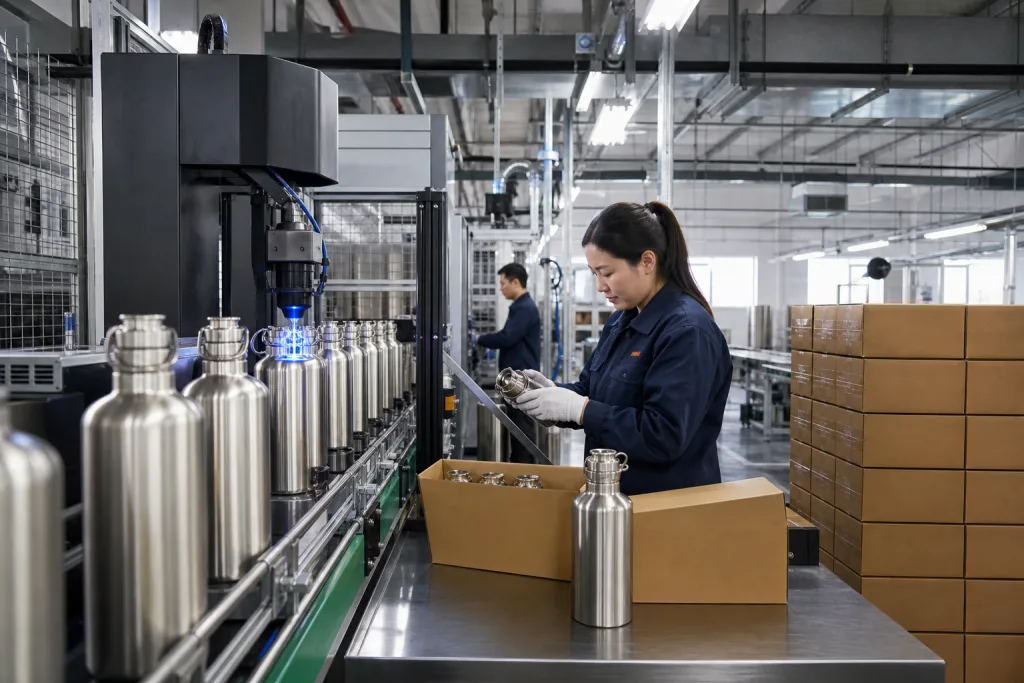
Key Takeaways
- A 64 oz stainless custom growler usually needs 0.6-0.8 mm body steel to avoid a cheap, flexible feel
- Laser engraving is durable but less visible on matte black than white silkscreen or pad print
- Our Zhejiang line can produce about 180,000 stainless drinkware units/month with typical growler MOQ from 1,000 pcs
- For Europe and North America, plan 35-50 days production plus sea freight after sample approval
A custom logo growler bottle looks simple on a quote sheet: capacity, color, logo, carton. Then the first sample lands on your desk and the lid has 0.6 mm play, the powder coat fails after 30 rubs on a 3M tape test, or the 64 oz body pushes the filled weight past your retail target. For B2B buyers, the expensive mistakes sit in the spec details, not the artwork file.
From our factory in Zhejiang, China, we run 12 to 20 growler RFQs a month from brand owners, beer distributors, outdoor retailers, and promotional agencies. You need a growler that prints your logo cleanly, ships without dents, passes basic compliance, and still leaves margin after freight. QC pulled one 64 oz sample last month because the buyer flagged carton dents after a 76 cm drop test. That is the right question to ask before tooling, MOQ, or a production deposit: where will this bottle fail in real handling?
Spec table before unit price
Most buyers ask for the FOB price before the spec is locked. That is the wrong question to ask. A custom logo growler bottle can be quoted at USD 4.80 or USD 9.20 FOB Ningbo, and both prices can be clean quotes. The gap comes from material gauge, vacuum structure, cap tooling, coating, logo process, test scope, and carton pack. Last month our caliper showed 0.48 mm on one buyer’s “same as last order” sample, while their PO called out 0.6 mm. If your RFQ only says “64 oz stainless growler with logo,” each canteen supplier will fill the blanks in a different way.
Build a head-to-head spec table before you contact a canteen factory in China. Keep it plain. One page is enough, but it should force clear decisions:
- Capacity: 32 oz, 40 oz, 64 oz, or 128 oz. For retail and brewery merchandise, 64 oz is still the common custom growler size we ship most often.
- Construction: single-wall stainless, double-wall vacuum insulated, or glass insert with outer shell. Do not compare these as if they are the same product.
- Steel grade: 304 inside is standard for food contact; 316 is possible, but for normal beer, coffee, and cold brew drinkware, the math usually does not work.
- Wall thickness: 0.5 mm is light and cheaper; 0.6-0.8 mm gives a firmer hand feel and survives more carton-drop abuse.
- Finish: brushed steel, powder coating, spray paint, or electroplated color. Powder coating usually needs a color chip, not just a Pantone code on email.
- Logo: laser engraving, silkscreen, heat transfer, embossing, or full wrap print. For curved 64 oz bodies, artwork distortion must be checked before bulk print.
- Compliance: FDA/LFGB food contact, REACH for coatings, CPSIA if positioned for children, and Prop 65 review for California sales.
Put the custom canteen, customizable growler, and insulated growler on the same sheet, then the cheapest line item stops looking so attractive. We have seen this go sideways: QC pulled the sample after the leak tester showed a slow drip at 30 kPa, but the buyer had already approved the gift box artwork. A distributor growler for brewery refill programs needs closure integrity before decoration. A premium customized drinkware SKU for retail shelves needs a clean surface finish, tight color control, and packaging that supports the shelf price.
Stainless versus glass growlers
The first real comparison is material. Stainless steel is the better call when the program needs drop resistance, fewer breakage claims, and a clean surface for laser engraving or 1-color screen print. Glass still has a place when the buyer wants that brewery-counter look, wants to see the fill level, or is chasing a lower first quote. For most North America and Europe B2B growler projects we ship from Hangzhou, stainless is safer. Cartons get tossed. End users are not gentle. Last month QC pulled a 64 oz glass sample after a 76 cm corner-drop test and found two cracked necks in one master carton.
A 64 oz single-wall stainless growler works for short cold-fill use, event giveaways, and canteen promo campaigns where the target price is tight. We run these on standard 304 stainless bodies with a basic screw cap, and the line can keep the cost under control when the logo stays to one position. A double-wall vacuum insulated model costs more, but the sales story is cleaner: cold retention measured in hours, less sweating on the table, a better grip, and a retail feel buyers can justify. If you sell into outdoor shops, corporate gifting, or club merchandise, vacuum insulation gives you margin that is easier to defend. The cheap unit is not always the cheaper program.
Glass growlers are not wrong. They are less forgiving. Carton drop testing matters more, the inner dividers need stronger board, and parcel delivery breakage can wipe out the USD 1.00-2.00 saved on unit price. We have seen this go sideways when a buyer approved thin E-flute dividers to save USD 0.18, then flagged 4 cracked bottles in the first 96-piece warehouse check. Some canteen vendors quote glass hard, but ask for drop-test history, carton compression data, and the exact logo method: fired decal with kiln curing, screen print with its ink spec, or adhesive label that may peel in ice buckets.
Our opinion: if the growler will ship through e-commerce or distributor warehouses, stainless is the default. Use glass only when the brand story requires it and the packing budget is accepted upfront.
For stainless production in Zhejiang, China, a practical MOQ is usually 1,000 pcs per color for standard body shapes. Custom tooling, custom caps, or a non-standard silhouette may push the MOQ to 3,000-5,000 pcs because forming dies and sample rounds have to be paid for somewhere. On our floor, a new cap mold review starts with calipers on the thread pitch and a leak test after assembly; if the PO has one typo in the cap color code, the sample clock can move from 12 days to 18 days fast.
Logo methods face off
Your logo method should match the finish, the sales channel, and the abuse level. A custom logo growler bottle used by brewery members every Friday needs different decoration than a 1-day conference giveaway. This is where buyers get burned. We see 6 or 7 projects each month where the logo was approved from a PDF mockup, then the buyer flagged the production sample because the real bottle did not look as saturated as the render under the QC light box.
Laser engraving is the toughest option on stainless. It does not peel, and it survives dishwashing better than ink. The trade-off is contrast. On raw stainless it looks clean and industrial. On black powder coating, the laser cuts through to metal and leaves a sharp silver mark; our line usually runs a 20W fiber laser with a 0.08 mm line tolerance for this job. On white, cream, or pale blue coating, the logo can look too quiet on a retail shelf. Laser works best for distributor drinkware programs where the buyer cares more about 18-month wear than bright color.
Silkscreen printing gives stronger color and keeps unit cost under control for one- or two-color logos. It works well on powder-coated growlers and promotional programs. The weak point is curvature. A large wrap on a tapered body can stretch at the shoulder if the supplier does not lock the bottle into the right jig; QC pulled one sample last quarter with a 2.5 mm logo drift from left to right. For most orders, expect a printing setup charge around USD 50-120 per color per artwork, depending on the canteen manufacturer.
Heat transfer and full wrap printing create the strongest shelf impact. We run these for retail collections, sports-team drops with player numbers, tourism merchandise with skyline artwork, and seasonal custom growler campaigns where the artwork covers most of the body. They cost more and need stricter adhesion testing. Ask for 3M tape test, cross-hatch test, and 24-hour water soak on coated samples before production approval, and do not skip the curved-area check near the bottom radius.
Embossing or debossing is premium but only makes sense with tooling. It is the wrong question to ask for a 500 pc trial because the math does not work. If you want a canteen customized with a molded badge, shaped plate, or raised logo, plan 25-35 days for tooling and sampling instead of the usual 7-10 days for a printed sample, with a higher deposit before the first mold cut. We have seen this go sideways when the PO says “debossed” but the artwork file shows a separate metal badge.
Caps, seals, and leak claims
The cap is where a lot of growler jobs fail quietly. Buyers stare at the body because that is where the logo sits, then the buyer flags leakage after a week in transit. For a custom logo growler bottle used for beer, cold brew, kombucha, or water, the seal has to match the liquid and the way the bottle gets handled.
On stainless growlers, we run four common cap builds: screw caps with a silicone gasket, swing-top lids, stainless loop caps, and plastic threaded caps with a handle. A screw cap with a food-grade silicone gasket is the safest bet for volume runs. It assembles cleanly, swaps out fast, and holds up in leak checks. Swing-top lids look right for brewery buyers, but they bring extra parts and need tighter control on torque and alignment at the line. On one 750 ml sample run, QC pulled the sample after the hinge sat 1.5 mm off center.
If the bottle may hold carbonated drinks, do not promise pressure performance unless the model has been tested for it. Standard drinkware growlers are not pressure-rated kegs. That is the wrong question to ask after the PO is signed. A responsible canteen manufacturer should state the limit upfront. For normal refill use, we leak test each production lot with water inversion, then sample extra units for 30-minute side-lay testing. If you need pressure testing, put the target, such as 30 psi, in the RFQ. Do not add it after the purchase order. We had one buyer try that on a 2,000 pcs order, and the math did not work.
Specify the gasket as food-grade silicone, not generic rubber. Ask if spare gaskets can be packed at 1-2% of order quantity. The cost is small, and it saves distributors from shipping replacement caps from China one by one. On a recent export carton check, we found 48 spare gaskets short because the packing list had a typo.
Thread quality matters too. Bad threads feel gritty, cross-thread fast, and come back as returns. On pre-production samples, open and close the cap 30 times, then test for leakage again. That simple check catches problems before 5,000 pcs go into export cartons. We have seen this go sideways on a 304 stainless run where the thread pitch was off by 0.2 mm and the cap started biting after the tenth turn.
Use-case fit by channel
The right customized growler depends on where it will be sold or handed out. A 2,000-piece brewery order is not the same as a 300-piece corporate gift run or a 48-SKU outdoor shelf placement. We set specs by channel, not by taste. If a buyer wants one bottle to cover every use, we push back. The math does not work. QC pulled the sample at AQL 2.5 and the first carton test already showed which route made sense.
Brewery and beverage refill programs
Choose 64 oz, stainless or amber glass, tight leak control, and a logo method that survives repeat handling. Laser engraving on powder-coated stainless is the cleanest call for most refill programs. We run a 24-hour inverted leak test on the line before release. If the growler gets filled at a bar counter, skip finishes that scratch when dragged across metal rails or tapped beside a kegerator.
Outdoor and camping retail
For a canteen customizable program in outdoor stores, double-wall vacuum insulation, a carry handle, and a 304 stainless interior are worth the extra cost. Customers expect a hard-use bottle, not a desk accessory. A 0.6 mm body thickness is a good floor; 0.8 mm feels more solid, but it adds grams fast and the freight quote will show it. We had one buyer flag a 520 g sample because the pack-out jumped over their target by 3 kg per carton.
Corporate gifting and events
For canteen promotional work, the logo has to read at arm’s length. Silkscreen or heat transfer can beat laser engraving here, especially when the artwork needs color. Gift box printing, barcode label, and carton drop performance matter because a lot of orders get redistributed to employees or clients. This is the wrong question to ask if the client wants a premium look on a low-cost budget. On one 500-piece event run, a PO typo put the logo 8 mm too low, and the buyer flagged it before we boxed the lot.
E-commerce and marketplace sales
If you sell through online channels, define packing from day one. A white box plus EPE bag may not survive parcel shipping. You may need a color box, honeycomb sleeve, or 5-layer mailer. If you need FNSKU labels, carton labels, or suffocation warning bags, tell your canteen supplier before the first quote. Reworking labels in a China warehouse costs more than doing it on the packing line. We have seen a 76 cm drop test turn a clean carton into a corner-crushed mess, and then the buyer comes back asking why the rework bill is so high.
One model rarely serves every channel well. A serious canteen vendor should help you split a retail-grade SKU from a low-cost promotional SKU instead of pretending one quote covers all uses. We ship different box structures for the same bottle all the time, and that is the smarter move. One quote for every channel is a lazy quote.
MOQ, lead time, and pricing
For standard stainless growlers from our Zhejiang facility, our normal MOQ is 1,000 pcs per model and color. Use our existing body, standard cap, and one-color logo, and sampling usually takes 7-10 days after artwork confirmation. We run the logo film, make the screen, then QC checks logo position with a 0.5 mm tolerance before we call it a golden sample. Bulk production is commonly 35-50 days after deposit and golden sample approval. Before Q4 retail shipments, plan 10-15 days of buffer; last October, one buyer lost 6 days because the PO had “matte balck” instead of matte black and the carton mark had to be revised.
Pricing moves with steel cost, exchange rate, coating process, and carton specification, but practical FOB China ranges help you reject offers that do not make sense. A 64 oz single-wall stainless growler may sit around USD 4.50-6.50 FOB depending on thickness and finish. A 64 oz double-wall vacuum insulated customized growler often lands around USD 7.20-11.50 FOB. Full wrap printing, custom cap tooling, retail color box, or individual drop-safe mailer can add USD 0.30-1.80 per unit. The math does not work when a supplier quotes USD 5.80 for a 64 oz vacuum growler with powder coating and retail box; we have seen that go sideways at pressure test or carton drop test.
When comparing canteen manufacturers, ask each one to quote the same Incoterm. FOB Ningbo or FOB Shanghai is cleaner for comparison. EXW may look cheaper but can hide local trucking, export declaration, and port handling. On one 1,200 pcs order, the buyer flagged a USD 0.22 gap between two quotes, then found the EXW supplier had left out Ningbo port fees and 3.5 cbm of local trucking. If you need DDP to a US or EU warehouse, separate the product quote from freight and duty so you can see what changed.
Payment terms for new buyers are usually 30% deposit and 70% before shipment after inspection. For repeat distributor drinkware accounts with stable volume, terms can improve after several clean orders. We ship after QC releases the batch under the agreed inspection level, and the buyer normally gets photos of the packed cartons, shipping marks, and random unit checks before balance payment. Do not ask a serious factory in China to start custom production without deposit. Coated bodies, logo screens, and printed cartons have limited resale value, especially when the logo is locked to one retailer.
QC checkpoints you should require
Quality control is not one final inspection photo sent on WeChat at 10 p.m. For custom drinkware, set QC gates before the goods are sealed in export cartons. We usually write four checkpoints into the PO: incoming material inspection, first-article approval, in-process checks after logo work, and final random inspection under AQL. For most B2B orders, AQL 2.5 for major defects and 4.0 for minor defects is a practical baseline. For premium retail, tighten cosmetic limits by SKU, not by feeling. QC pulled one 64 oz sample last month with a 0.8 mm pit near the handle weld; the buyer accepted it only because the defect limit had been agreed before production.
On a custom logo growler bottle, define defects before the line starts. Is a 1 mm black dot on a white powder-coated body acceptable? Is a slight laser shade variation acceptable? Can the logo shift 2 mm vertically? If these points are missing, factory QC and your receiving warehouse will make two different calls. We have seen this go sideways: a PO said “logo centered,” but the approved artwork did not show the 3 mm tolerance from the bottom curve, so the buyer flagged 600 pieces after delivery.
Useful tests include leak test, coating adhesion test with 3M tape, alcohol rub test for print, dishwasher simulation if claimed, salt spray for plated parts if used, and vacuum performance test for insulated models. For vacuum growlers, check temperature retention with a defined method, such as filling with 95°C water and measuring after 6 or 12 hours at room temperature. “Keeps cold all day” is the wrong inspection language. The math does not work. Put the test method, room temperature range, lid status, and pass/fail number on the QC sheet, or the inspector will be guessing with a thermometer and a stopwatch.
Compliance paperwork should match your market. For the EU, ask for LFGB or relevant food-contact test reports and REACH review for coatings. For the US, request FDA food-contact confirmation, and if your customer sells in California, discuss Prop 65 risk before carton printing. Factory social audits such as BSCI can matter for larger retailers. BottleForge Industrial runs export production in Zhejiang, China, with monthly stainless drinkware capacity around 180,000 units, but capacity only helps if QC gates are written into the order. We ship from Hangzhou and Ningbo often; a missed report number on the booking file can hold a pallet longer than a small production delay.
Before shipment, request production photos, carton marks, gross weight, net weight, and a packing list. Ask for close-up shots of the logo, lid seal, inner wall, and master carton label, not just 6 pretty bottles on a table. Better still, use a third-party inspection when order value justifies it. A USD 250-350 inspection is cheap insurance against a container of avoidable claims. One inspector with a caliper, water tank, barcode scanner, and AQL table can catch what the sales sample never showed.
Send your growler RFQ for a factory quote
Share capacity, logo file, quantity, and target market. We will return practical specs, MOQ, lead time, and FOB pricing.
Frequently asked questions
What is the best MOQ for testing a custom logo growler bottle?
For a real market test, 1,000 pcs is usually the practical MOQ for stainless growlers using an existing mold and one standard color. Below that, unit price rises because coating setup, logo fixtures, carton printing, and export handling are spread over too few pieces. Some canteen suppliers may accept 300-500 pcs, but often only for blank stock with simple laser engraving. If you need custom powder coating, retail box artwork, or a new cap color, plan for 1,000-3,000 pcs. For custom tooling or a unique body shape, 5,000 pcs is a more realistic starting point.
Should I choose laser engraving or silkscreen for my growler logo?
Choose laser engraving if durability is the priority. It works especially well on powder-coated stainless because the laser exposes the metal underneath and will not peel. Choose silkscreen when visibility and brand color matter more, such as event merchandise or corporate gifting. A one-color silkscreen logo is usually economical at 1,000 pcs and above, with setup charges often around USD 50-120 per color. For multi-color artwork or retail graphics, heat transfer may be better. Always approve a physical sample, because logo contrast on curved matte surfaces can look different from the digital mockup.
Can a stainless growler safely hold carbonated beer or kombucha?
It depends on the cap system and whether the model has been tested for pressure. Many stainless drinkware growlers are designed for short-term transport, not long-term pressure storage. If your program is for breweries or kombucha brands, state the expected pressure requirement in psi before quotation. A normal leak test is not the same as a pressure test. We usually recommend screw caps with silicone gaskets for consistent sealing, and we avoid making pressure claims unless the specific model is tested. For carbonated use, also include warning text in packaging and user instructions.
How long does custom growler production take from China?
For an existing stainless growler model, expect 7-10 days for sample preparation after artwork approval, then 35-50 days for bulk production after deposit and golden sample approval. Add sea freight time depending on destination: roughly 25-35 days to many North American ports and 30-40 days to many European ports, before local customs and inland delivery. Air freight is possible for urgent replenishment but usually too expensive for 64 oz growlers because of volume weight. If your launch date is fixed, start development at least 90 days before the required warehouse arrival date.
What information should I send to get an accurate growler quote?
Send capacity, material, insulation type, target finish, logo method, order quantity, destination port or warehouse, packing requirements, and compliance needs. Include artwork in AI, EPS, or high-resolution PDF format. If you sell online, mention FNSKU labels, barcode labels, carton drop needs, and whether each unit needs a mailer box. If you need FDA, LFGB, REACH, BSCI, or retailer-specific documents, list them before pricing. A clear RFQ lets canteen manufacturers quote the same product instead of guessing. It also reduces the chance of a low first quote becoming expensive after sampling.