Key Takeaways
- A 500 ml stainless custom logo drink bottle usually starts around USD 2.20-4.80 FOB China at 1,000-3,000 pcs
- Laser engraving is slower but more durable than 1-color silkscreen on powder-coated bottles
- For EU and North America, confirm LFGB, FDA, REACH, CA Prop 65, and food-contact test reports before deposit
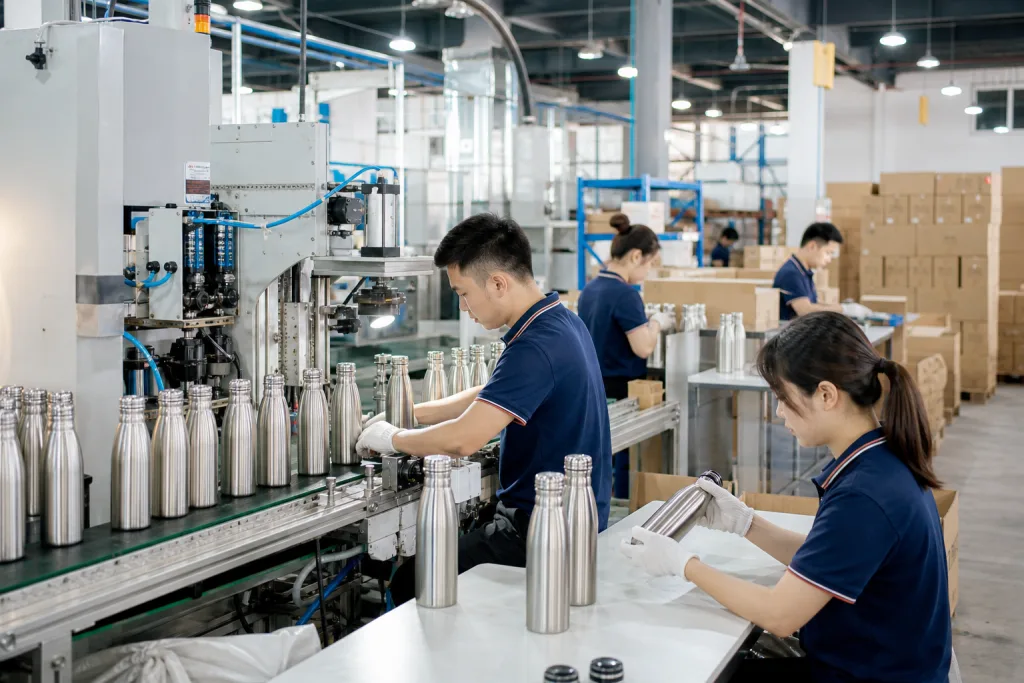
- Our Zhejiang line can produce about 450,000 stainless units/month with standard lead time of 25-35 days after sample approval
A custom logo drink bottle looks simple until stainless steel, plastic, glass, and growler-style items land on the same purchase order. Then the trouble starts. We have seen a 420 g stainless sample look perfect in photos but kill the retail margin after the buyer checked freight, while a 500 ml plastic bottle was too small for a gym promo that needed 750 ml printed on the carton.
We manufacture drinkware in Zhejiang, China, and we see the same buying mistake about 6 times a month: buyers chase the lowest unit price before they confirm capacity, decoration method, carton strength, and compliance. This is the wrong question to ask first. If you are choosing a canteen supplier, distributor drinkware line, or a custom growler program, start with the use-case, then talk price; QC pulled one sample last week where the PO said matte black, but the approved artwork file said gloss black, and that kind of 1-line mismatch slows the line faster than a price negotiation.
Spec table before price talk
Ask three canteen manufacturers for “a custom logo drink bottle” and you can get three different quotes: a 0.45 mm single-wall sports bottle with a push-pull cap, a double-wall vacuum flask with a threaded lid, or a wide-mouth canteen with two D-rings and a shoulder strap. All take a logo. They do not carry the same landed cost, shelf story, or failure risk. We see this go sideways when the buyer sends only a logo file and a target price.
Use this head-to-head table before you collect quotes from canteen suppliers or a canteen factory in China. Send the same spec sheet to each factory. Capacity, material, lid type, carton pack, and logo size should be fixed before price talk; our QC team checks the first sample with a digital caliper before the line opens.
| Product type | Best use-case | Typical capacity | FOB China range | Logo method | Risk to watch |
|---|---|---|---|---|---|
| Vacuum stainless bottle | Retail shelf, corporate gift box, outdoor shop program | 500-1,000 ml | USD 2.20-6.80 | Laser, silkscreen, UV print | Lid leakage after pressure test, coating scratch at carton rub points |
| Single-wall sports bottle | Events, gym chains, school campaigns with tight budgets | 600-750 ml | USD 1.20-3.20 | Silkscreen, heat transfer | Denting during packing, thin wall feel when the buyer expects retail weight |
| Plastic bottle | Mass promotion, kids’ packs, orders where freight weight matters | 500-1,000 ml | USD 0.80-2.60 | Silkscreen, in-mold label | Material claims, odor after sealing in polybag |
| Glass bottle | Wellness brand launch, office desk set, premium gift pack | 350-750 ml | USD 1.50-4.50 | Silkscreen, decal, sleeve | Breakage in 1.2 m drop test, weak inner carton design |
| Custom growler | Breweries, camping retail, refill programs with repeat use | 1.2-2.0 L | USD 6.50-14.00 | Laser, emboss, large print | Cap seal torque, unit weight pushing freight cost up |
For a distributor canteen range, one hero model is not enough. Build the line with one canteen promotional item under USD 2.00, one mid-range customized drinkware SKU around USD 3.00-5.00, and one premium vacuum model for retail or corporate accounts with a cleaner box finish. MOQ matters here: we run most logo colors cleaner at 1,000 pcs per SKU, while 300 pcs often means hand alignment, slower output, and a higher reject rate.
Stainless versus plastic versus glass
Material decides the buyer’s first impression and the complaint pattern after delivery. For most B2B custom drinkware orders we ship, stainless steel is the safer default because it gives better dent resistance, higher shelf value, and more logo choices than plastic or glass. On vacuum bottles, we normally run 304 stainless steel inside, 201 or 304 outside depending on target price, and wall thickness around 0.4-0.5 mm on standard models. Premium models may use 0.5-0.6 mm outer walls for a firmer hand feel. QC checks this with a digital thickness gauge before polishing, because one batch at 0.36 mm will feel cheap in the buyer’s hand.
Plastic wins when freight cost, event budget, or children’s use matters more than insulation. Tritan is popular because it is clear, tough, and BPA-free, but buyers still need food-contact reports before placing a PO. PP is cheaper and works for squeeze bottles or school bottles, but it feels lower grade on the shelf. Ask the resin. If a canteen vendor quotes a low price, confirm whether the body is Tritan, PETG, PC, or PP; the difference affects clarity, smell, impact test results, and buyer complaints. We once had a buyer flag “Tritan” on the artwork sheet while the PO said “PETG,” and that typo stopped the line for 2 days.
Glass is attractive for wellness sets and office gifts. It also needs tighter packaging control. A 500 ml borosilicate bottle may require an inner sleeve, molded pulp tray, or 5-layer export carton if you want it to survive courier handling. That adds cost. On our drop test bench, a single bottle packed in thin white box looks fine at 80 cm, then cracks at the shoulder after the third corner drop. A glass bottle that looks cheap in the quotation can become expensive after drop testing, so asking for the lowest unit price is the wrong question to ask.
For a customizable canteen or custom canteen aimed at outdoor use, stainless usually beats glass and most plastics. For a disposable-feeling event giveaway, plastic is honest. For a spa, yoga, or clean-label retail line, glass can work if your buyer accepts higher damage risk and slower inspection. We normally add 1 extra inspection step for glass, with QC pulling samples from the packed cartons instead of only from the assembly table. The math does not work if the buyer wants glass, gift-box packaging, courier delivery, and a claim rate under 1% without paying for better packing.
Logo methods compared honestly
The logo method has to fit the surface, order size, and how hard the bottle will live. On the line, we sort jobs by neck size and cap type first—28 mm sports mouths behave differently from 38 mm tumblers. A custom logo drink bottle for a 24-month retail program is a different order from 500 pcs for a one-day conference.
Silkscreen printing is the usual pick for 1-2 color logos on stainless, plastic, and glass. It is fast and keeps cost down. On a powder-coated bottle, a 1-color logo at 1,000 pcs usually adds USD 0.08-0.18 per unit on a 120T mesh setup. The weak point is wear. If the bottle gets thrown into backpacks every day, the print will scratch. We have had a buyer flag that after a 3-week carry test.
Laser engraving burns away the coating and shows the metal below. It looks clean, works well for corporate marks, and does not peel. On our 20W fiber laser, a mark on 304 stainless usually adds USD 0.12-0.35 per unit, depending on logo size. It is slower than printing and poor for bright full-color artwork. Some buyers ask for “laser in color.” The math does not work.
UV printing fits full-color graphics, gradients, and small retail collections. The result can be sharp, but surface prep decides the outcome. We cure under a 395 nm lamp, then QC pulled the sample and ran a tape test plus an alcohol rub test on the approved piece. If you are building customizable drinkware for an online store, UV printing handles 300-500 pcs runs better than a multi-color screen setup.
Heat transfer and wrap printing give a bigger design area, especially on sports bottles and canteen customizable products. They carry lifestyle graphics, not just a logo. We use a heat tunnel on wrap jobs, and the setup takes longer because the film has to sit flat before transfer. The buyer often wants retail visuals on day one, but the sample round adds time.
Do not approve logo placement from a flat PDF alone. Ask for a photo or video of the actual pre-production sample, measured from the bottle base or centerline. A 5 mm crooked logo will stand out to your end customer even if the bottle clears AQL 2.5. We have seen this go sideways on a PO with the logo typo fixed, but the placement still got rejected.
Use-case fit for each channel
A canteen distributor selling to schools, retailers, breweries, and corporate gift agencies should not push one bottle across all channels. The spec follows the buyer’s selling model, not the factory’s favorite mold. We see this mistake in RFQs every month: one PO line asks for a school bottle, a brewery growler, and an office gift set, all under the same lid drawing.
For corporate gifting, choose vacuum stainless bottles in 500-750 ml. They fit standard gift boxes, stack cleanly in a 48 x 32 x 28 cm master carton, and give enough flat area for laser engraving without clipping the logo curve. Matte black, white, navy, and brushed steel still outsell seasonal colors; our line usually runs those four colors with fewer powder-coating rejects. If you need a customized canteen for a 2,000-piece employee program, keep the lid simple. Every extra spring, hinge, or silicone plug is another failure point QC has to pull during the leak test.
For sports clubs and gyms, single-wall stainless or Tritan bottles often work better. Insulation is the wrong question to ask here. The buyer cares about low weight, one-hand opening, and drinking flow after a workout. A 700 ml sports cap bottle with a carabiner or carry loop can beat a heavy vacuum flask because members throw it into a gym bag and refill it twice. For a canteen promotional campaign, we usually cut cost by using a standard mold and holding the logo to one color; the pad-printing fixture is faster, and the math doesn't work if you open a private mold for 1,000 pcs.
For breweries, outdoor retailers, and refill programs, a custom growler or customized growler makes sense. Capacity and cap sealing matter more than chasing the lowest FOB price. A 1.9 L stainless growler must be checked for thread fit, gasket compression, and odor after washing; QC pulled one sample last season because the silicone ring picked up a sour smell after a 60°C wash cycle. A customizable growler with a large laser logo supports premium positioning, but expect higher carton weight and freight cost. We’ve seen this go sideways when the buyer approved the bottle but forgot the loaded carton reached 18 kg.
For Amazon, DTC, or retail-ready distributor drinkware, packaging is not optional. You need barcode labels, FNSKU stickers, suffocation warnings for polybags, and carton dimensions that fit warehouse rules. At least 6 out of 10 first-time canteen vendors quote only the bottle, then add the retail box after the buyer flags it. Ask for the retail box, master carton, label, and pallet plan in the same quotation; also check the PO spelling, because one “matte balck” typo has delayed artwork approval by 2 days in our office.
MOQ, pricing, and lead time
MOQ is driven less by the bottle shape and more by the change you ask the factory to make. For a standard stainless custom logo drink bottle with one logo and existing color stock, 500 pcs can be possible; we run these on shared color batches when the powder booth already has black, white, navy, or silver loaded. For custom powder coating, molded lids, Pantone-matched silicone, or retail packaging, 1,000-3,000 pcs is a more realistic MOQ because the line needs a separate spray setup, silicone mixing, or carton knife plate. A full private mold usually starts from 5,000-10,000 pcs plus tooling cost, and this is where the math doesn't work for a trial order.
At our Zhejiang, China facility, standard production capacity is about 450,000 stainless units per month, depending on bottle mix and decoration load. Normal lead time is 25-35 days after deposit and sample approval; if QC pulled the sample on a Friday and the buyer approves artwork on Monday, we count from Monday, not from the PO date. During March-May and September-November, add 7-10 days because 30-plus North American and European programs often overlap on the same coating and laser marking lines.
FOB pricing should be broken into visible parts: bottle body and lid, coating and logo, packaging, test cost if any, and export carton. If a canteen manufacturer gives one low lump-sum price, you do not know what was removed. We have seen this go sideways: 0.45 mm steel quoted instead of 0.50 mm, no PE inner bag, or a 5-layer carton changed to a softer 3-layer carton that fails the drop test at the corner.
For budgeting, a common 500 ml vacuum stainless bottle with powder coating and 1-color logo may land around USD 2.50-4.20 FOB Ningbo or Shanghai at 3,000 pcs. A 750 ml Tritan sports bottle may run USD 1.30-2.40. A 1.9 L distributor growler can range from USD 7.50-13.50 depending on wall thickness, handle design, cap sealing, and packaging; last month the buyer flagged a USD 0.18 gap that came from switching the handle pin from zinc alloy to 304 stainless.
Payment terms for new buyers are usually 30% deposit and 70% before shipment. For larger repeat programs, some factories may discuss 20/80 or partial balance after inspection, but do not expect open account terms on the first order from China. Simple reason: material suppliers want cash before they release steel coils, and one typo on a PO, such as “matte black” versus “black gloss,” can lock up 3,000 pcs of the wrong finish.
Quality checks buyers should require
Quality control is where a custom drinkware order becomes boring or expensive. Boring is better. Your purchase order should name the inspection standard, not just say “good quality.” AQL 2.5 for major defects and 4.0 for minor defects is common for drinkware, with critical defects set at 0. We usually see buyers allow 1 pre-shipment inspection per order, using cartons pulled from the packed goods area, not samples handed over by the sales team. If your market is strict retail, tighten the levels before pricing is finalized.
For stainless bottles, require leak testing, vacuum insulation testing, coating adhesion testing, internal cleanliness check, and lid assembly check. On the line, we run leak tests with bottles inverted after filling, and QC pulled the sample again if a silicone ring sits even 1 mm proud. A typical insulation test may use 95°C water and measure temperature drop after 6 hours or 12 hours, depending on the model. For coating, cross-hatch adhesion and 3M tape testing work well. For logos, add a rub test and visual alignment tolerance, for example plus or minus 2 mm from approved placement.
For plastic bottles, confirm BPA-free material and food-contact testing. For Europe, ask about LFGB and REACH where applicable. For the United States, FDA food-contact compliance and CA Prop 65 review may be needed. For children’s drinkware, ASTM and CPSIA-related requirements may apply. Do not assume a canteen supplier has the right report for your exact material color and component; we have seen this go sideways when the PO said “blue,” but the approved report covered only clear Tritan and a black PP lid.
For glass bottles, carton drop testing matters. A beautiful sample does not prove the export carton survives mixed container loading. Ask for carton burst strength, gross weight, packing method, and drop-test photos if courier or e-commerce fulfillment is planned. This is the wrong question to ask: “Is the glass strong?” The better question is whether a 15 kg master carton can pass corner, edge, and face drops after sitting in the warehouse for 24 hours.
Factory audits also matter when you sell to larger accounts. BSCI, ISO 9001, or customer-specific audits are common requests. A canteen factory in Zhejiang or elsewhere in China should be able to explain its audit status clearly, not hide behind vague “passed 10 audits” language. The buyer flagged it once when a supplier sent a BSCI cover page with the factory name cropped off; that kind of shortcut kills confidence fast.
How to choose your supplier
The best canteen manufacturer for your order is not always the cheapest canteen vendor. You need a supplier that understands your sales channel, asks the awkward questions before deposit, and can prove control over logo process, carton packing, and AQL 2.5 inspection. We have seen a USD 0.18 cheaper quote turn into a claim because the logo sat 3 mm off-center on the powder-coated body.
When comparing canteen distributors, factories, or trading companies, ask for five items before deposit: a spec sheet with material grades, a decoration proof, a packaging dieline, relevant test reports, and a production timeline with the sample approval date. No documents, no real quote. If they cannot send these, the low price is a guess written on PI paper. Last month a buyer flagged a PO typo: 304 stainless in the email, 201 stainless on the proforma invoice.
Use samples properly. Buy one standard sample to check shape and weight, then approve one pre-production sample with your real logo, color, lid, and packaging. Do not treat a catalog sample as approval for mass production. If your order is over 3,000 pcs or the product is retail-facing, book a final random inspection before balance payment; QC should pull cartons from sealed stock, not from the 12 clean pieces sitting on the office table.
You should also decide whether you need a canteen supplier for one promotion or a long-term customized drinkware platform. For one promotion, standard molds and simple printing are fine. For a distributor canteen program, consistency matters more: repeatable colors with a ΔE reading, stable lid supply, spare parts, carton markings, and reorder control after 6 or 12 months. We run repeat jobs better when the buyer keeps the same lid code, not “similar black lid” on the next PO.
A practical supplier will tell you when a custom request is not worth it. A new lid mold for 1,000 pcs rarely makes sense. Pantone coating for 500 pcs can cost more in line cleaning than the buyer expects; the line may lose half a shift just flushing spray guns and checking the first 30 bodies. A heavy custom growler may look premium but ruin your freight budget. Good canteen manufacturers protect your margin, not just their order book.
Send your bottle spec and target landed cost
We will check material, logo method, MOQ, packaging, and realistic FOB pricing before you commit to a production schedule.
Frequently asked questions
What is the normal MOQ for a custom logo drink bottle?
For a standard bottle with an existing mold and one logo, the practical MOQ is usually 500-1,000 pcs. If you need custom powder coating, Pantone-matched parts, gift box packaging, or multiple SKUs, plan on 1,000-3,000 pcs per color or design. Private mold projects normally start from 5,000-10,000 pcs because tooling, testing, and setup time must be spread across enough units. Some China suppliers will accept 300 pcs, but the unit price and decoration cost often increase sharply.
Which logo method lasts longest on stainless drink bottles?
Laser engraving is usually the most durable because it removes the coating rather than adding ink on top. It is a good fit for corporate gifts, distributor drinkware, and outdoor bottles that will see daily use. Silkscreen is cheaper and works well for simple 1-color logos, but it can scratch over time. UV printing is better for full-color artwork, but you should require tape and alcohol rub tests. For premium stainless bottles, many buyers choose powder coating plus laser engraving.
Can I mix bottle colors or models to reach MOQ?
Sometimes, but not always. If the factory already has stock bodies in black, white, and navy, it may allow mixed colors under one 1,000-piece order. If each color needs a separate powder-coating run, the MOQ may apply per color. Mixing different models is harder because each model needs separate lids, cartons, inspection setup, and sometimes different logo fixtures. For a new buyer, it is safer to start with 1-2 models and 2-3 colors rather than a wide range.
What compliance documents should I request for Europe or North America?
For Europe, ask for food-contact testing such as LFGB where relevant, plus REACH review for coatings, plastics, and silicone components. For North America, request FDA food-contact documentation and CA Prop 65 review if selling into California. Children’s bottles may need CPSIA and ASTM-related checks. Make sure the reports match the actual material: 304 stainless body, PP lid, silicone gasket, Tritan body, or coating system. A general old report from another model is not enough for strict retail buyers.
How long does production take after I approve the sample?
For a standard customized canteen or stainless bottle, 25-35 days after deposit and approved pre-production sample is normal in Zhejiang, China. Add 7-10 days for busy season, complex packaging, multi-color printing, or special testing. Sea freight to North America often takes another 25-40 days depending on port and routing, while Europe is commonly 30-45 days. If your event date is fixed, work backward and approve the sample at least 70-90 days before you need goods in your warehouse.