Key Takeaways
- A 500 ml stainless custom logo coffee tumbler usually needs 0.45–0.55 mm inner wall steel for stable vacuum performance
- MOQ is normally 1,000 pieces per color for powder coating and 3,000 pieces for custom molded lids
- Laser engraving is durable, but screen print or UV print is better for multi-color brand artwork
- Ask for AQL 2.5/4.0 inspection, LFGB or FDA food-contact reports, and one pre-production sample before deposit
A custom logo coffee tumbler looks simple on a quotation sheet: capacity, color, logo, carton quantity. Then the problems show up. We have seen 7 out of 80 pre-shipment samples lose heat faster than the approved sample, and QC pulled one batch last year because the powder coating measured 42 μm on the body but only 18 μm near the bottom curve.
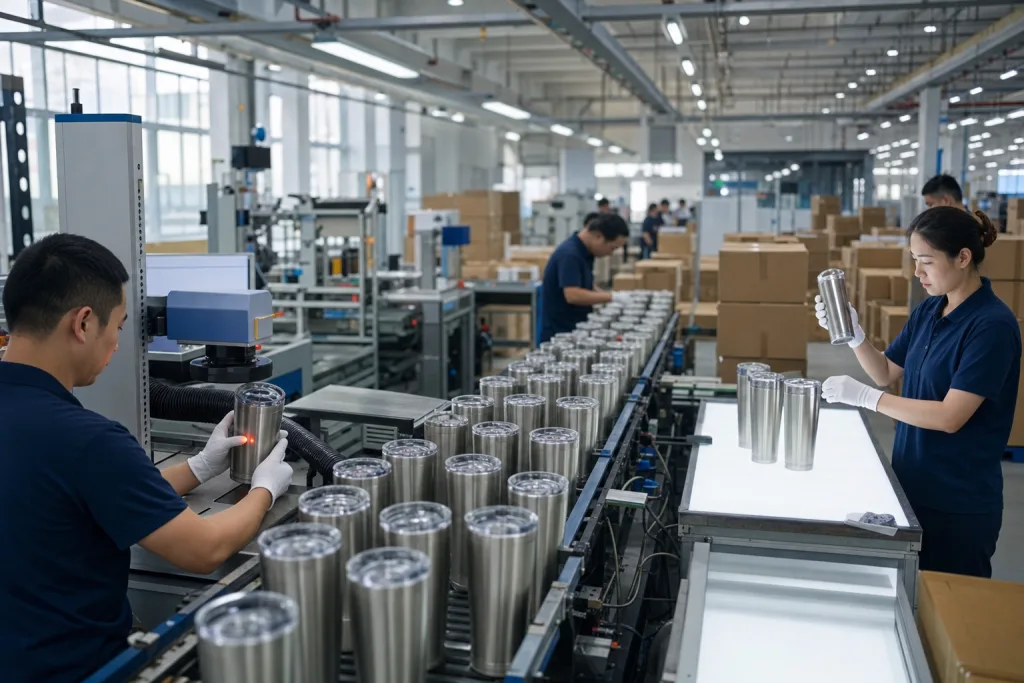
If you buy from a coffee mug factory in China, “what is your best price?” is the wrong question to ask. Ask what is inside the spec: 304 stainless thickness, lid seal material, logo process, carton drop test, and AQL 2.5 inspection terms. Our Zhejiang line runs about 420,000 stainless travel tumblers per month, with typical MOQ from 1,000 pieces per color and 30–45 days lead time after sample approval; we ship faster only when the buyer signs off artwork before the line locks the color batch.
Capacity Is A Retail Decision
The capacity line on your spec sheet affects shelf appeal, shipping cost, cup-holder fit, and how your customer uses the tumbler. For coffee brands, the practical sizes are 350 ml, 450 ml, 500 ml, and 600 ml. A 350 ml custom logo coffee tumbler fits espresso-based takeaway drinks and gift boxes. A 500 ml bulk coffee travel mug is the safer choice for corporate gifting because it feels solid without turning into a brick. We run that size a lot for chain cafés, and the buyer usually comes back asking for the same body on the second PO.
Do not approve capacity by catalog photo. Ask for brimful capacity and practical drinking capacity. A 500 ml tumbler may hold 520 ml to the rim but only 470–480 ml when used with a press lid. QC pulled the sample from the line, filled it with a graduated cylinder, and the numbers matched that gap. That matters when your product page says “16 oz” and the buyer tests it at home.
Diameter matters just as much. For North America and Europe, we normally keep the lower body diameter between 68 mm and 74 mm so it fits most car cup holders. We check that with a 72 mm ring gauge before we sign off the mold. If you choose a wide 900 ml bulk travel tumbler for a campaign, check the base diameter before you check the color chart. A pretty tumbler that misses the cup holder is a complaint waiting to happen, and we have seen that go sideways more than once.
For coffee mug promotional products, weight also hits freight. A 500 ml stainless tumbler usually lands around 260–340 g depending on wall thickness, lid structure, and coating. One powder coat change added 38 g on our scale, and the buyer flagged it before packing started. Across 10,000 pieces, a 50 g difference is 500 kg of extra cargo. That is not a small line item when you ship FOB Ningbo or FOB Shanghai from Zhejiang, China.
Steel Grade And Wall Thickness
For a coffee mug manufacturer, stainless steel grade is the first quality gate. The common build is 304 stainless steel inside and 201 or 304 outside. For coffee, tea, milk, and acidic drinks, we run 304 inner steel as the baseline. If the buyer only wants the cheapest shell, that is the wrong question to ask. On our line, the handheld XRF gets pulled before release, and for stricter retail channels we ask for 304 inside and 304 outside, with LFGB, FDA, or REACH-related supporting documents based on the target market.
Wall thickness is where low-price quotes hide risk. A normal vacuum coffee tumbler uses around 0.45–0.55 mm inner wall and 0.45–0.60 mm outer wall stainless steel. We have seen quotes drop the gauge to 0.35 mm on paper. The sample can still look clean in the hand, then the dent shows up after a 1 m carton drop test. The math does not work. For a coffee mug custom made program, that trade is poor.
Vacuum insulation depends on forming accuracy, welding, vacuum pumping, and copper lining if specified. For a 500 ml double-wall tumbler, we test with 95°C water, lid closed, room temperature around 20°C. In a good batch, 30 pieces should stay above 55–60°C after 6 hours. We log the curve with a thermocouple on the bench. If your packaging says “12 hours hot,” define the test method before mass production starts. Marketing copy without a test condition is not a specification.
As a coffee mug oem manufacturer in Zhejiang, we also check the mouth rim carefully. A thin or sharp rim feels cheap and can expose coating weakness after repeated lid opening. QC pulled a sample last month where the rim had a burr you could catch with a cotton swab. For retail-grade coffee mug private label projects, we prefer a rolled or well-polished rim, especially on sip-lid tumblers where the consumer touches the edge every day.
Lid Design Changes The Complaint Rate
The lid is usually the No. 1 complaint part in a bulk coffee tumbler order. Buyers spend 20 minutes on body color and logo position, then pick the cheapest lid in the catalog. That is how leakage shows up in backpacks, sliders feel loose after 500 open-close cycles, silicone smells after hot-fill testing, or lids crack after winter truck transport. QC pulled one sample last December at -8°C; the cup body passed, the clear lid split near the drinking slot.
Start with the real use case. Desk use? A push-on sip lid is fine for office coffee and takeaway counters. Commuting needs a threaded lid because the seal has more bite, usually 1.5–2.0 turns on our line. A flip lid feels convenient, but it brings hinge pins, springs, plugs, gaskets, and more inspection points. If your campaign copy says “leakproof,” this is the wrong place to save USD 0.18. Use a threaded structure and run the inversion test. If the tumbler is only splash-resistant, say that clearly in your product copy.
For lid materials, PP is common and cost-effective. Tritan looks clearer and feels more premium, but the price jumps. Silicone gaskets should be food grade, removable, and tight enough that they do not fall out during dishwasher cycles. Ask your coffee mug supplier for gasket hardness, spare gasket policy, and dishwasher or odor test results. We run gaskets at Shore A 50–60 for most coffee lids; softer rings seal well but can stretch after two weeks of coffee oils and dish soap. The buyer flagged this once after a 10,000-piece order because the lid looked fine on day one, then started smelling in customer returns.
Custom molded lids are possible, but they change the project economics fast. A new lid mold can cost USD 3,000–8,000 depending on structure, and the MOQ is often 3,000–10,000 pieces. For most corporate-gift buyers, an existing proven lid is the better bet. The math doesn’t work if the order is only 2,000 pieces and the PO still has a typo in the Pantone code. Put the customization budget into coating, logo placement, packaging, and insert cards instead.
Logo Method Is Not Decoration Only
A custom logo coffee tumbler lives or dies by the logo finish. For a one-color mark, silk screen printing stays the lowest-cost clean option. On our line, a 120T mesh with one Pantone color runs well on powder-coated bodies, and setup is around USD 30–60 per color. On large runs, unit logo cost often drops below USD 0.15. If the artwork is flat, screen print is the right call. Buyers sometimes ask for full color on a simple logo. The math does not work.
Laser engraving cuts through the coating and exposes the stainless steel below. It fits corporate logos, premium coffee subscriptions, and coffee mug customized gifts when the buyer wants a mark that stays put. We run 20W fiber laser heads for this job. A 0.2 mm beam gives a sharp edge on 304 stainless. The limit is color: laser gives you silver or darkened metal, not full-color branding.
UV printing handles gradients, small text, and multi-color artwork better. It works when your coffee mug customizable design has a mascot, QR code, or retail illustration. The weak point is adhesion. On powder coating, cure time and surface energy have to be controlled, or the ink peels. We ask QC to pull a tape test or cross-hatch report before mass production. Last month the buyer flagged a QR code that broke at 3 mm line width. That kind of miss gets expensive fast.
Full-wrap designs need more care than a small front logo. Registration tolerance, seam alignment, and artwork distortion around tapered bodies all matter. If you are building a coffee mug private labeling line, request a printed pre-production sample, not only a digital mockup. On a curved 500 ml tumbler, a 1 mm logo tilt is visible on the retail shelf. We once caught a PO typo on the wrap width at 228 mm, and the proof did not line up. Catch it before the line starts.
Finish, Color, And Packaging Specs
Powder coating is the default finish we run for bulk travel mug orders because it gives a matte or satin hand feel, holds up better in a bag, and covers a broad color card. Standard colors usually start at 1,000 pieces per color. Custom Pantone powder usually needs 2,000–3,000 pieces because the coating supplier will not open a small batch for one tumbler order. Watch this one. If a coffee mug factory direct quote says 300 pieces in any custom Pantone, ask for the coating process and a scratched cross-hatch sample; we have seen “powder coat” turn out to be spray paint after QC pulled the sample from the line.
Surface defects need inspection words, not soft comments like “good finish.” Dust points over 0.5 mm, orange peel on the front face, visible color drift between lid and body, and bottom scratches are the usual rejection points. We use AQL 2.5 for major defects and AQL 4.0 for minor defects on most export orders. For premium retail, you can tighten the limit, but the math changes fast: one recent 3,000-piece order needed an extra 2 workers for hand sorting after the buyer flagged tiny black specks on cream powder coating.
Packaging is not just a box. For corporate gifts, a white box with insert card may be enough. For retail coffee mug bulk programs, quote the color box, barcode, carton drop test, and master carton marks from day one. For marketplace sellers, add FNSKU labeling and carton dimensions early, or the warehouse will send it back. A common 500 ml tumbler color box is around 90 × 90 × 180 mm, with 24 or 30 pieces per export carton depending on the body shape; on the packing table we check this with a tape measure before carton artwork is locked.
If you are comparing a coffee mug supplier directory or coffee mug supplier list, make every vendor quote the same packaging spec. A USD 0.25 difference per unit may simply be a thinner box, no polybag, no silica gel, or weaker carton. That is the wrong place to save money. We have seen this go sideways after a container spent five weeks moving from China to a North American warehouse, then arrived with crushed corners because the PO said “standard carton” and nobody defined 5-layer carton strength.
Pricing, MOQ, And Factory Control
For a standard 500 ml stainless custom logo coffee tumbler, factory pricing usually sits around USD 2.80 to USD 5.20 FOB China. Steel grade, lid type, coating, logo method, and packaging all move the number. A 304 inner/201 outer cup with screen print lands near the low end. A 304/304 body, powder coating, laser logo, premium lid, and color box pushes it up fast. That is the math.
MOQ is not just a sales number. The line has its own limits. Body forming can run flexible, but powder coating, logo setup, packaging print, and carton planning all need a base volume. In our Hangzhou-area supply chain in Zhejiang, standard MOQ is 1,000 pieces per color for existing shapes, 2,000 pieces for custom Pantone coating, and 3,000 pieces or more for deeper structural changes. We can take a trial order, but the unit price climbs because setup cost gets spread across fewer pieces. Buyers often push for 500 pcs. The price jump usually kills that plan.
Lead time should be split into sample and bulk. A logo sample usually takes 7–12 days after artwork confirmation. Bulk production normally takes 30–45 days after deposit and sample approval. Add 5–10 days if you need third-party inspection, FBA labeling, or special retail packaging. During peak gifting season from August to November, we ship earlier or the slot is gone. One buyer once sent a PO with the lid code typed wrong, and QC pulled the sample before coating. Better to catch that on day 1 than on day 21.
Factory control is about traceability. Ask who runs vacuum testing, coating inspection, lid leak testing, and final carton inspection. A real coffee mug factory should show line photos, inspection records, and material test reports. We keep a vacuum gauge on the bench and check the seal on every lot before packing. A trading company can still help, but the buyer should know who makes the call when a defect shows up. If nobody owns the final pass, the claim lands on your desk.
Compliance Before Deposit
Before paying a deposit, tie compliance to the market printed on your carton label. For the EU, we usually see LFGB food-contact testing, REACH screening for coating and plastic parts, plus BSCI or Sedex audit records when the buyer has a retail chain behind them. For the United States, FDA food-contact expectations and California Proposition 65 review may apply. Children’s drinkware is a different file: ASTM and CPSIA questions get sharper, while most adult travel tumblers do not sit in that category. Last month QC pulled a 40 oz tumbler sample because the silicone gasket material on the lid did not match the LFGB report.
Do not accept a random test report without checking model coverage. Match the report against the material, coating, lid plastic, silicone gasket, and sometimes the exact color code. A black powder-coated body and a white spray-painted body are not automatically covered by the same chemical report. Retail buyers often ask for reports issued within 12 months, and we have seen orders held for 9 days because the buyer flagged an old coating report. The math doesn't work if you save three days before deposit and lose your vessel booking later.
A good purchase order for coffee mug in bulk should spell out capacity, steel grade, wall thickness target, lid type, logo method, logo size, coating color, packaging, inspection standard, and shipment term. “Same as sample” is not enough. Factories change sub-suppliers when the spec is not written, especially for lids and color boxes. We once received a PO with “304 stainless” in the email but “201” in the attachment; the line stopped until the buyer corrected the typo. Write the boring details.
For coffee brands and corporate-gift buyers, the safest path is boring: approve one physical sample, freeze the spec sheet, run production, inspect by AQL, then ship. That process removes most arguments. We run this sequence because it catches real problems, such as a 0.2 mm logo shift on laser engraving or a lid that feels loose after three open-close checks. Whether you call it bulk coffee mug, bulk coffee travel mug, coffee mug custom, or coffee mug factory direct sourcing, the buyer impact is the same: clear specs protect your margin.
Send Us Your Tumbler Spec For Review
Share capacity, logo artwork, target price, and delivery market. We will return a practical factory quote with MOQ, lead time, and risk notes.
Frequently asked questions
What is the best size for a custom logo coffee tumbler?
For corporate gifts and coffee brand merchandise, 450 ml to 500 ml is usually the safest range. It fits most car cup holders, feels valuable in hand, and keeps carton weight under control. A 350 ml tumbler is better for café retail packs or espresso-based drinks, while 600 ml works for commuters who want a larger serving. Before ordering, ask for both brimful capacity and practical drinking capacity with the lid installed. A tumbler sold as 500 ml may only hold 470–480 ml comfortably during daily use.
What MOQ should I expect for coffee mug custom made orders?
For existing stainless travel tumbler shapes, a realistic MOQ is 1,000 pieces per color with a standard powder coating and one logo. Custom Pantone powder coating often starts at 2,000–3,000 pieces because the coating supplier has minimum batch rules. If you need a new lid mold or special body tooling, expect 3,000–10,000 pieces depending on the design. Small trial orders are possible in China, but setup charges for printing, coating, and packaging make the unit price noticeably higher.
Is laser engraving better than screen printing for a coffee mug promotional order?
Laser engraving is better for durability because the mark will not rub off like surface ink. It is a strong choice for executive gifts, private label merchandise, and simple one-color logos. Screen printing is better when you need a specific brand color at a lower cost, especially on 2,000 pieces or more. UV printing is the better option for full-color artwork, gradients, or QR codes. For any method, approve a physical sample and request an adhesion or rub test before bulk production.
How long does bulk coffee tumbler production take?
A normal timeline is 7–12 days for a logo sample after artwork approval, then 30–45 days for mass production after deposit and sample confirmation. Add time for custom packaging, third-party inspection, and ocean freight. If you ship from Zhejiang or nearby ports in China, FOB Ningbo and FOB Shanghai are common. During the August to November gifting season, production slots tighten quickly, so corporate buyers should confirm artwork and deposit at least 60–75 days before the required warehouse date.
How do I compare coffee mug manufacturers without choosing only by price?
Give every supplier the same spec sheet: capacity, 304 or 201 steel structure, wall thickness, lid type, logo method, coating, packaging, inspection level, and shipment term. Then compare the line items, not only the final FOB price. One coffee mug supplier may include LFGB reports, AQL inspection support, thicker cartons, and removable silicone gaskets, while another quote may exclude them. For a 5,000-piece order, a USD 0.30 saving can disappear quickly if 4% of lids leak or boxes arrive crushed.