Key Takeaways
- A practical custom logo coffee mug MOQ starts at 500-1,000 pcs for stock color laser engraving and 3,000 pcs for custom color coating
- Typical FOB China pricing runs USD 2.20-6.80 depending on capacity, steel gauge, lid structure, coating, and packaging
- Normal production lead time is 25-40 days after sample approval; complex private label packaging can add 7-12 days
- AQL inspection, LFGB/FDA food-contact testing, and carton drop tests should be agreed before deposit, not after production
A custom logo coffee mug looks simple until you need 3,000 pieces on site before a launch or sales conference. Then the small stuff decides the order: 304 stainless, lid fit, powder coat thickness, logo method, carton drop test, barcode labels, and whether the quote is FOB Ningbo or door delivery. The wrong question is whether it looks nice. On our line, the leak tester and 1.5 m drop check catch more issues than the sales sample ever does.
If you buy for a coffee brand, HR gift program, or distributor catalog, you need a price band, lead-time risk, and a real MOQ of 500 pcs, not decoration talk. We had a buyer flag a PO once because “mug” was typed as “much” on the carton mark; that sort of typo slows customs down fast. We manufacture travel tumblers and coffee mugs in Zhejiang, China, with monthly capacity around 450,000 units across stainless drinkware lines, and QC pulls one sample from every 5,000 pcs run.
Start with the real buying unit
Most buyers search for a custom logo coffee mug, but we quote the real buying unit: the cup body with its steel grade, the lid with its gasket fit, the surface finish with scrap allowance, the logo process with setup charge, the packing method with carton drop risk, plus inspection and export handling. Shape alone is the wrong comparison. Last month QC pulled 32 pcs from a 1,200 pcs pre-shipment lot and found 5 lids with loose sliders; the low quote looked fine until the buyer flagged leakage in the warehouse.
For travel tumbler programs, start with capacity. Common sizes are 12 oz, 16 oz, 20 oz, and 30 oz. A 20 oz stainless tumbler for office coffee gifting is the safest SKU in most programs because it fits standard car cup holders around 72-76 mm and still leaves enough straight wall area for a 45 mm corporate logo. A 12 oz unit works better for coffee roasters selling at retail counters, where the buyer cares about shelf space more than drink volume. Larger 30 oz models suit outdoor users and drivers, but the math often turns bad on freight because cartons cube out before they hit weight limits; we have seen 30 oz cartons fill a 40HQ with 18,000 pcs while 20 oz cartons can ship closer to 24,000 pcs on the same booking.
At our Zhejiang facility, a standard double-wall stainless bulk travel tumbler normally uses 304 stainless steel inside, 201 or 304 outside depending on the target price, and wall thickness around 0.4-0.5 mm. We check that with a digital thickness gauge on the cut sample before mass production. A heavier body improves dent resistance but can add USD 0.18-0.45 per unit. On a bulk coffee tumbler order of 10,000 pcs, that is USD 1,800-4,500 before freight. Small change? Not on a promo budget.
If you are a coffee mug distributor, define the sales channel before asking for a quote. A retail coffee mug private label project needs UPC, color box, care card, and shelf-ready appearance; we also need the PO to spell out barcode size, because one buyer once sent “UPC 35 mm” and meant 35 mm wide, not 35 mm high. A coffee mug promotional products order may only need a clean logo, individual polybag, and safe master carton. Those two projects can look similar in a photo and differ by USD 0.60-1.20 per unit landed.
What actually moves the unit price
The biggest cost drivers are not always visible in catalog photos. For a coffee mug custom made project, body construction and lid tooling move the price more than the logo. A simple press-fit clear AS lid is cheaper. A slider lid with silicone gasket, textured grip, and spill-resistant parts can add USD 0.25-0.75. A leakproof flip lid can add more, and it needs tighter tolerance control; last month QC pulled the sample because the lid gap measured 0.6 mm over our drawing. Ask for the lid drawing first. Chasing the cheapest logo price is the wrong question to ask.
For FOB China pricing, we run these working ranges for a double-wall stainless coffee mug in bulk, based on normal 304 stainless inner walls, carton packing, and AQL 2.5 inspection before shipment:
- Basic 12-16 oz tumbler: USD 2.20-3.40 FOB Ningbo, stock colors, simple lid.
- Mid-range 16-20 oz bulk coffee travel mug: USD 3.20-4.90, powder coating, better lid, laser or screen logo.
- Premium 20-30 oz bulk travel mug: USD 4.80-6.80, heavier gauge, handle or advanced lid, custom packaging.
Surface finish is the next lever. Raw stainless or stock powder coating saves cost. Custom PMS powder coating often needs 3,000 pcs per color because the coating line setup, spray-gun cleaning, and color matching waste are real. Gloss paint can look bright but scratches faster than a good matte powder coat; we have seen buyer samples fail after 30 cup-holder rubs in a simple abrasion check. If your customer will use the mug daily in a car cup holder, pay for coating adhesion, not just color.
Decoration changes cost as well. Laser engraving is durable and clean for stainless or powder coat, usually USD 0.08-0.25 depending on logo size. One-color silk screen is often USD 0.06-0.18, but curved surfaces and registration matter; on a 92 mm diameter tumbler, a 0.5 mm logo drift is easy to spot. Full-wrap heat transfer or UV printing can reach USD 0.35-1.20. For a coffee mug customized with two logos, individual names, or QR codes, ask if variable data is included before you approve the quote. We’ve seen this go sideways when the PO said “logo print” but the artwork file had 480 different names.
MOQ tiers that make commercial sense
A serious coffee mug manufacturer can quote small runs, but some MOQs make no commercial sense. Below 300 pcs, the unit price gets eaten by freight, logo setup, sample courier fee, and office handling. We see this on DHL bills every week: one carton sample can cost USD 85-120 before the buyer has even approved the logo. Fine for executive gifts. Bad for resale.
For stock models, our normal MOQ in Zhejiang, China is 500 pcs per SKU for laser engraving on existing colors. The laser jig is simple, and the line can finish a 500 pcs logo run without tying up the workshop for half a day. For silk screen printing, 1,000 pcs is usually cleaner because screen setup and color testing are spread over more units; QC pulled one sample last month where the Pantone red shifted after 80 pcs, so we had to stop and wash the mesh. For custom powder coating, plan on 3,000 pcs per color. For a new lid mold or body tooling, expect 5,000-10,000 pcs as a practical first production run, plus tooling cost.
Here is how we usually advise buyers:
- 500-999 pcs: works for corporate gifts, pilot retail runs, or event merchandise. Use a stock color, laser logo, and plain carton unless the buyer has budget for box artwork setup.
- 1,000-2,999 pcs: fits coffee brand seasonal drops. Screen printing starts to make sense, an upgraded box can be costed properly, and two body colors are possible if the PO does not split into too many tiny lines.
- 3,000-9,999 pcs: proper private label range. Custom coating, insert card, barcode sticker, and carton mark control make sense; at this level we run pre-production color panels and check coating thickness in μm before mass production.
- 10,000 pcs and up: factory direct optimization starts. You can negotiate component planning, annual blanket pricing, and split shipments, but the forecast must be real—if 10,000 pcs becomes 2,000 pcs after sampling, the math does not work.
If you are building a coffee mug supplier list or checking a coffee mug supplier directory, ask each supplier to quote the same MOQ, same packaging, and same Incoterm. A quote for 1,000 pcs in a white box cannot be compared with 3,000 pcs in a printed retail box. We have seen buyers flag a USD 0.42 gap that was only a packaging difference: E-flute color box versus plain white tuck box. Coffee mug factory direct pricing only helps if the specification is locked.
A realistic timeline from artwork to shipment
Lead time is where a lot of custom logo coffee mug projects get into trouble. Buyers often count 25-40 production days and miss artwork approval, DHL sample transit, FDA or LFGB lab testing, AQL 2.5 inspection booking, and vessel space. For North America and Europe, a workable schedule is 7-9 weeks by sea from approved artwork to warehouse arrival; we usually see 12 days spent before bulk production even starts, not 2 days. Air freight can pull the date forward, but the math often fails on a bulk coffee mug order. Last March, a buyer asked us to air 3,000 stainless tumblers to Chicago after approving artwork late by 6 days. Freight cost more than the mugs.
A normal timeline looks like this:
- Artwork and quotation: 1-3 working days if you provide AI, PDF, or vector logo files; a low-resolution JPG usually adds one revision cycle because the logo edge looks jagged on the laser jig.
- Pre-production sample: 5-10 days for stock color laser or screen print; 10-15 days for custom coating, since the line needs a separate color card and spray test panel.
- Sample shipping: 3-6 days by express courier, assuming the consignee name and phone number on the courier form match the PO.
- Mass production: 25-40 days after sample approval and deposit; for a 5,000 pcs run, we lock printing film, coating batch, and carton spec before the first day on the line.
- Inspection and export loading: 2-5 days, depending on AQL schedule and container booking; QC pulled the sample last week because 4 lids had loose silicone rings.
- Ocean freight: roughly 18-35 days to major North American or European ports, before local customs and trucking; LA is not the same as Hamburg, and buyers should not plan both with one date.
If your order includes coffee mug private labeling, add time for packaging die-lines and barcode approval. FNSKU labeling for marketplace fulfillment can add 2-4 days if each unit needs exact label placement; we run a 30 mm label-position check on the packing table before cartons are sealed. For corporate-gift buyers, the common mistake is approving the mug sample but delaying carton marks, delivery address, or gift-message insert. Production may finish on time. Packing still waits. We have seen a shipment sit 3 days because the PO said “New York warehouse” while the carton mark file showed “NJ-02”.
A reliable coffee mug oem manufacturer should tell you which approvals sit on the critical path. If the supplier says every custom job takes 15 days, be careful. That is the wrong question to ask. Ask whether coating, printing, leak testing, packing, and final inspection are in one production plan, because a missed handoff between spray room and screen-print table is where we’ve seen this go sideways.
Decoration choices for coffee brands
For coffee brands, the mug is not just a container. It sits beside a 250 g coffee bag, a subscription box insert, or a café counter display under warm light. The decoration has to survive dishwashers, key scratches on a desk, and a commuter tossing it into a backpack at 7:30 a.m. Cheap logo first? Wrong question. We have seen a buyer save USD 0.18 per piece on printing, then lose margin when QC pulled 64 scratched samples from a 3,000 pcs repeat order.
Laser engraving is the safest choice for stainless and powder-coated tumblers. It marks the cup by removing or changing the surface layer, so the logo will not peel after a tape test or normal washing. It suits clean logos, café names, and small corporate text down to about 0.8 mm stroke width on our fiber laser line. The tradeoff is color. Most marks come out metallic silver, dark gray, or the contrast from the coating underneath. If your brand book needs exact PMS 186C red, laser alone will not carry it.
Silk screen printing works for one or two solid colors. It keeps cost sensible for coffee mug promotional orders and shows brand colors better than laser. The weak point is ink adhesion on curved powder-coated cups when the curing oven is set wrong or the jig is loose by 1 to 2 mm. Ask for a 3M tape test and rubbing test on the approved sample. We run both before packing for repeat café programs. For REACH-sensitive European programs, confirm ink compliance before mass production, not after the buyer flags the test report.
UV printing and heat transfer handle gradients, illustrations, and full-wrap artwork. They make sense when you need a coffee mug customizable design for seasonal drops or influencer kits. They need tighter line control, though, and reject rates can rise from 2% to 5% if the artwork has a 360-degree seam or thin vertical registration marks. We have seen this go sideways on PO files where “matte black” was typed as “matt back.” For coffee mug distributors selling multiple logos, we usually suggest one proven tumbler body, two stock coating colors, and a matched logo method for each end customer instead of rebuilding the product every order.
Quality checks you should price in
Quality is not free. Bad mugs cost more. For stainless travel tumblers, price the checks for food contact, insulation, leakage, coating adhesion, logo wear, and carton strength. Last month QC pulled 32 samples from a 5,000 pcs run and found 3 lids with slight seepage after a 180-degree inversion test. If a coffee mug supplier does not talk about these checks before quoting, the quote is missing money somewhere.
For Europe, buyers often request LFGB, REACH, and BPA-free confirmation for plastic lid parts. For the United States, FDA food-contact expectations and California Prop 65 screening may apply depending on your sales channel. If the product is for children, ASTM and extra migration testing can come into play, although most coffee travel mugs we ship are adult-use products. The wrong question is “do you have certificates”; ask which exact cup, lid, gasket, straw, and coating were tested, because one shared PDF from 2021 will not cover a new PP lid mold.
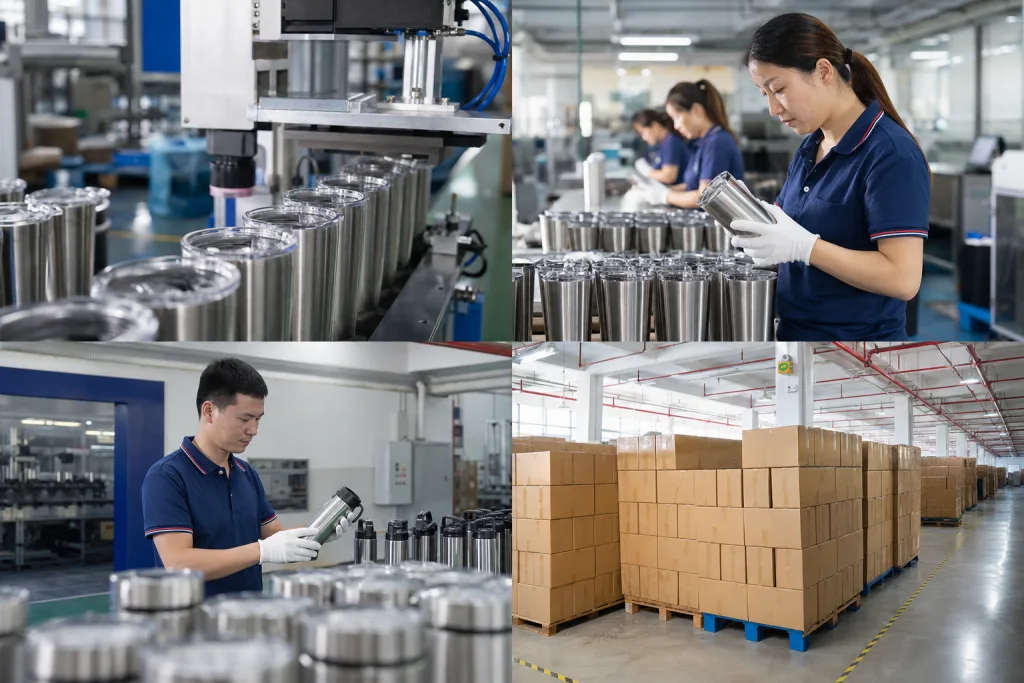
On the factory floor, we run simple checks that catch most problems: vacuum performance in a water bath, lid fit with a go/no-go feel, visual defect grading under a 600 lux lamp, logo position tolerance within 1.5 mm, coating cross-hatch adhesion with 3M tape, plus a carton drop test. For finished goods inspection, AQL Level II with critical 0, major 2.5, minor 4.0 is a common starting point. For high-visibility corporate campaigns, you may tighten major defects to 1.5, but budget for hand sorting; the line slows down, and someone has to open cartons, wipe cups, and re-pack them.
Packaging deserves attention. A 20 oz bulk coffee travel mug in a thin white box can pass sample approval and still arrive dented after 28 days of ocean freight. Master cartons should normally use 5-ply export cartons, and inner protection should stop lid scuffing. If your warehouse uses conveyor systems, ask for carton weight under 15 kg where possible. We have seen this go sideways: the buyer flagged crushed gift boxes at inbound, but the mugs were fine. That is usually a packaging specification failure, not a mug manufacturing failure.
How to compare factory quotes fairly
Contact coffee mug manufacturers with a short RFQ that still gives the factory enough to quote the same item. List capacity in ml, material preference, lid type, coating color, logo size in mm, logo method, packaging, delivery country, target quantity, and required certificates. Send a drawing if you have one. If the inquiry only says “best price for coffee mug custom,” our merchandiser has to guess 8 or 10 details, and the quotes will not line up.
Use one comparison sheet with these columns: FOB unit price, MOQ per color, sample cost, sample time, production lead time, packaging type, carton quantity, carton size, gross weight, testing included, inspection standard, and payment terms. Freight forwarders need carton data to estimate landed cost; last month a buyer flagged a USD 0.18 lower FOB offer, but the carton held 24 pcs instead of 36 pcs and added about 12% to sea freight. Cheap on paper. Bad in the container.
Be careful with broad claims from a coffee mug factory. “Any color, any logo, any quantity” often means the supplier has not checked the line, the coating MOQ, or the fixture for the logo position. A professional China factory will push back on bad assumptions. We may tell you that a 500 pc order should stay with stock coating, or that a large wrap print needs a flatter body shape so the screen print does not stretch near the curve. QC pulled the sample for this exact issue before. That is not resistance; it is how a factory protects your delivery date.
For coffee brands and corporate-gift buyers, the best path is usually not the lowest first quote. That is the wrong question to ask. You need a controlled specification, one approved pre-production sample, clear AQL rules, and a production slot reserved after deposit. If you want coffee mug factory direct economics, give the manufacturer enough detail to remove cost from tooling, packing, and print setup without quietly reducing quality.
Send your logo and target delivery date
We will return a practical MOQ, FOB price range, decoration option, and lead-time plan for your custom travel tumbler project.
Frequently asked questions
What is a normal MOQ for a custom logo coffee mug?
For a stock stainless travel tumbler with laser engraving, 500 pcs per design is a realistic starting MOQ. For silk screen printing, 1,000 pcs is more efficient. If you need custom PMS powder coating, plan for 3,000 pcs per color because coating setup, powder waste, and line cleaning are not economical at very small runs. New mold projects usually start at 5,000-10,000 pcs plus tooling. If you are testing a coffee brand retail item, start with 1,000-2,000 pcs in stock colors before moving to a full coffee mug private label program.
How much should I budget per unit FOB China?
For a double-wall stainless custom logo coffee mug, a practical FOB China range is USD 2.20-6.80. A basic 12-16 oz tumbler with stock color and simple lid may land at USD 2.20-3.40 FOB Ningbo. A mid-range 20 oz bulk coffee tumbler with powder coating and laser logo is often USD 3.20-4.90. Premium models with handles, heavier steel, advanced lids, full-wrap decoration, or printed gift boxes can reach USD 4.80-6.80. Testing, inspection, FNSKU labeling, and retail packaging should be shown as separate line items when possible.
Which logo method is best for corporate-gift mugs?
Laser engraving is usually the safest choice for corporate gifts because it is durable, clean, and fast. It works well at 500-5,000 pcs and normally adds about USD 0.08-0.25 per unit depending on logo size. Silk screen printing is better when you need exact brand color, usually adding USD 0.06-0.18 for one color, but adhesion testing matters. UV or heat transfer is better for full-color artwork and may add USD 0.35-1.20. For tight event deadlines, choose a stock color mug with laser engraving and standard white box packaging.
How long does a bulk coffee travel mug order take?
After artwork is ready, allow 5-10 days for a pre-production sample on stock colors, or 10-15 days for custom coating. Mass production normally takes 25-40 days after sample approval and deposit. Inspection, export documents, and loading add 2-5 days. Ocean freight then takes roughly 18-35 days to major European or North American ports, plus customs and local trucking. For a fixed event date, start the project 9-12 weeks ahead if shipping by sea. Air freight can work for 500-1,000 pcs, but it raises landed cost sharply.
How do I choose between a trading company and a factory?
A trading company can be useful for mixed small orders, but for a repeat coffee mug in bulk program, factory direct control is usually better. Ask whether the supplier controls forming, coating, decoration, and packing, or only coordinates outside workshops. Request production photos, BSCI or ISO audit status if required, monthly capacity, and the exact inspection standard. A capable coffee mug manufacturer should discuss steel grade, lid tolerance, coating adhesion, carton strength, and AQL, not only show catalog pictures. For private label programs above 3,000 pcs, factory communication usually reduces mistakes.