Key Takeaways
- For most custom logo canteen projects, a realistic MOQ is 1,000-3,000 units per color and logo method
- 304 stainless steel at 0.45-0.55 mm body thickness is a common B2B baseline for durable canteens
- Laser engraving is safer for long-life logos, while silk screen is better for larger promotional graphics
- AQL inspection, REACH/LFGB or FDA contact tests, and 1.2 m carton drop tests should be agreed before deposit
A custom logo canteen looks simple on a quotation sheet: capacity, color, logo, carton quantity, FOB price. Then the sample lands on your desk and the story changes. The cup feels too light, the powder coat scratches after one rub, the logo sits 4 mm off center, or the retail box cracks on a 1.2 m drop test. We see that on the line all the time. If you are buying for a brand, promotion, distributor catalog, or corporate program, those small misses turn into margin loss fast.
As a canteen manufacturer in Zhejiang, China, we hear the same questions from European and North American buyers every week. What is a fair MOQ? Which logo method still holds up after dishwasher use? Should you choose a custom canteen, a travel tumbler, or a custom growler? The wrong question is usually just price. A better one is where the risk sits before mass production. We run that check through construction, finish, compliance, and packing, and QC pulled the sample if the weld seam or cap torque is off by even 2 N·m.
What are you actually buying?
A buyer says custom logo canteen, but that word is not tight enough for quoting. In Europe, we usually see it used for a stainless steel water bottle with a screw cap. In North America, buyers may mean a flat outdoor bottle, a military-style flask, or a wide-mouth insulated bottle. Write the format on the RFQ before you ask any canteen supplier for pricing. We have lost 2 days on one quote because the PO said “canteen” while the buyer’s photo showed an insulated bottle with a 58 mm mouth.
Your procurement checklist should lock down capacity, insulation, lid type, mouth diameter, body shape, and sales channel, with photos if possible. A 750 ml single-wall canteen for a school fundraiser is not the same job as a 1,000 ml vacuum insulated customized canteen for outdoor retail. Material cost changes. So does the production route. Logo method and testing plan change too. On the line, QC will treat a powder-coated outdoor bottle with laser logo differently from a plain brushed bottle packed in a white box.
- Single-wall stainless steel: lighter and lower cost; not suitable for hot drinks unless the warning label is clear.
- Double-wall vacuum insulated: higher unit price and stronger shelf value; we run vacuum retention testing before packing.
- Aluminum canteen: low weight, but beverage contact usually needs an internal coating.
- Tritan or plastic canteen: fits kids or sports programs; ask for BPA-free documents and drop-test records.
If you are a canteen distributor, the safer first project is usually a 600-750 ml stainless steel model in 304 food-grade steel with a proven lid. This gives enough branding area for canteen promotional work without paying for a new body mold. For the first 3,000 units, a canteen customizable by color, logo, lid strap, and packaging makes more sense than a fully new body shape. We have seen this go sideways when a buyer approves a new mold before checking carton weight; one 24 pcs master carton came out over 18 kg, and their retailer flagged it at inbound.
MOQ, pricing, and real factory limits
Most canteen vendors can quote a low MOQ when they use stock bodies and standard colors. That does not mean every detail stays open at 300 units. On our laser line, the tip change alone adds time. For a normal custom logo canteen from our Zhejiang, China production network, the real floor is 1,000 units for laser engraving on existing stainless steel stock, 2,000-3,000 units for custom powder coating, and 5,000 units or more for a new lid color with dedicated plastic injection. We once had a PO typo that said 300, then the buyer flagged the lid spec and the quote had to be reset.
A 750 ml single-wall 304 stainless steel canteen may land around USD 2.20-3.60 FOB Ningbo or Shanghai depending on 0.45 mm or 0.50 mm body thickness, a flat cap or loop cap, and whether the logo is laser engraving or pad print. QC pulled the sample and checked the weld seam under a 10x loupe before we released the batch. This is the wrong question to ask if you only want the cheapest line on paper.
A 750 ml double-wall vacuum insulated canteen often sits around USD 4.80-7.50 FOB. The vacuum leak tester, the welding loss rate, and the carton cube all hit the cost. A custom growler or customized growler in 1.9 L capacity can move above USD 9.00 because the shell uses more steel, the weld seam is longer, the vacuum rejection rate rises, and the outer carton takes more space on the pallet.
Our standard factory output for stainless bottles and canteens is about 450,000 units per month across mixed SKUs, but that capacity is not evenly available every week. One powder coating booth can hold 18,000 pcs, and when the hanging racks fill up, the line backs up fast. Powder coating lines, laser rooms, and packing labor create the bottlenecks. A realistic production lead time is 25-35 days after pre-production sample approval for standard items, and 45-60 days if you need a new cap mold, color-matched coating, or custom retail packaging.
Do not compare quotes only by FOB unit price. Ask what steel grade and wall thickness are in the shell, what gasket and carton spec are packed, and whether the logo process and inspection level match your channel.
If a canteen factory quotes 15% lower than other canteen manufacturers, check whether they changed 304 stainless steel to 201, cut body thickness from 0.50 mm to 0.38 mm, or removed individual polybags and drop-test cartons. We have seen this go sideways on the first pallet. Those savings are real, but they may not be acceptable for your channel.
Logo decoration choices that last
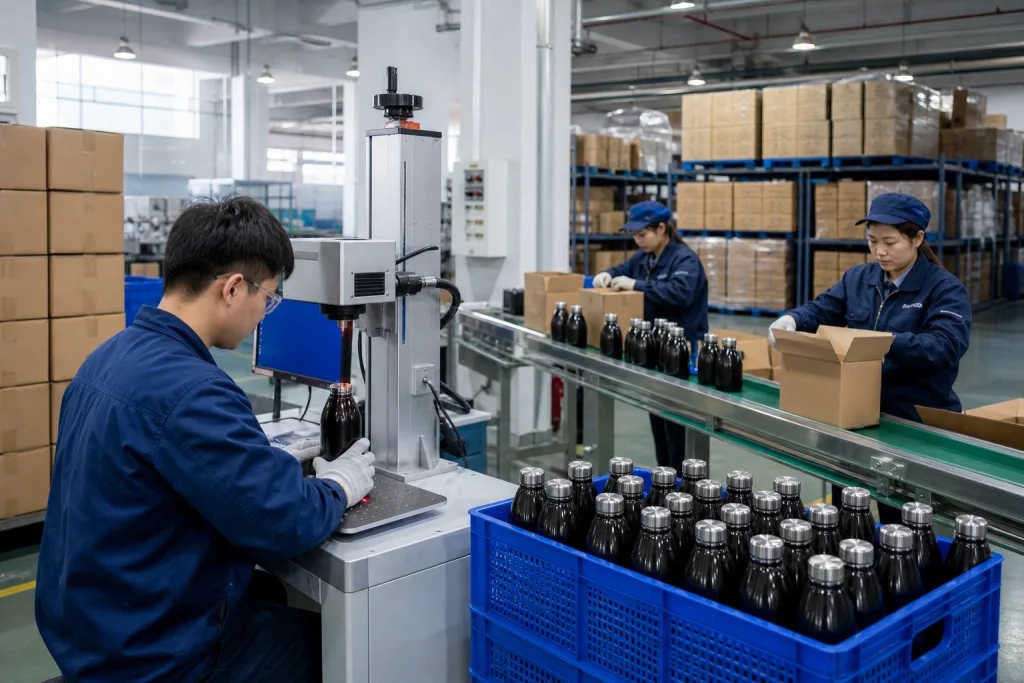
Your logo is the reason the project exists, so decoration should sit near the top of the quotation, not buried after carton marks. For custom drinkware, we run laser engraving, silk screen printing, heat transfer, UV printing, water transfer, and embossed or debossed tooling on the line. Each method has its own setup fee, curing time, abrasion risk, and artwork file requirement; last month QC pulled 6 samples because a buyer sent a 72 dpi JPG instead of vector art.
Laser engraving is the safest choice for a premium custom logo canteen with powder coating. It removes the coating and exposes the stainless steel beneath. Small text holds better than screen printing; 3 mm letters are still readable if the artwork is clean. It does not peel. The tradeoff is color: the mark is usually silver or dark grey depending on the base finish, and the buyer flagged it once because they expected Pantone 186C on an engraved logo. The math doesn't work that way.
Silk screen printing works well for one or two solid colors, mostly on canteen promotional orders where the budget is tight and the MOQ is 1,000 pcs or more. It is not a good pick for full-wrap art on tapered bodies because registration can drift when the fixture grips the curve. We normally allow ±1.5 mm logo placement tolerance on curved drinkware, and buyers should accept that before signing the artwork proof. We measure it with a steel ruler on the first 20 pcs, not by eye.
UV printing can show more colors and gradients, but it needs adhesion testing on the exact coating. A good canteen vendor should run a cross-hatch tape test and alcohol rub test on the decorated sample. We use 3M tape, 100-grid cuts, and 95% alcohol for 50 rubs before we approve the sample. For outdoor or dishwasher-positioned goods, do not rely on a glossy catalog photo; we've seen this go sideways after 2 weeks in a hot warehouse.
If your program needs a canteen customized with individual names, laser is the cleanest route. If your distributor drinkware catalog needs 12 standard logo areas for 40 or 50 end customers, keep the decoration zones simple: front center, 60-80 mm wide, away from vertical seams and shoulder curves. It saves time during artwork approval and cuts rejection disputes. One PO came in with “front logo 90 mm” while the approved proof said 70 mm, and that typo cost 3 days before we could ship.
Materials, compliance, and buyer paperwork
A capable canteen manufacturer should tell you exactly what touches the drink, not just write “food grade” on the quotation. For stainless steel canteens, the usual inner wall is SUS304. Some premium models use 316 stainless steel, but the extra cost often does not pay back unless the item is for acidic drinks, coastal use, or a top outdoor line. For lids, check PP, Tritan, stainless steel inserts, silicone gaskets, and any internal coating. On our line, QC pulls the first 20 pcs after lid assembly and checks gasket fit with a 0.2 mm feeler gauge because one loose ring can cause a full carton of complaints.
For European buyers, ask for food contact testing against LFGB or EU Regulation 1935/2004, and REACH for restricted substances where relevant. For the United States, FDA food contact compliance is the usual baseline. If the product is for children, add CPSIA, lead, cadmium, and small parts review. For retail chains, you may also need BSCI, ISO 9001, Sedex, or factory audit records. We had one buyer flag a report because the PO said “matte army green” while the lab photo showed black powder coating. Small mismatch. Big delay.
A practical compliance file for a customizable canteen order should include:
- Material declaration for steel, lid, gasket, coating, and ink, with grade names shown exactly as they appear on the BOM.
- Recent third-party food contact test report, preferably less than 24 months old, with the tested model number matching your canteen body and lid.
- Coating adhesion test result for your chosen color and logo method, checked by cross-cut tape test before bulk packing.
- Vacuum insulation test for double-wall models, such as 95°C water measured after 6 and 12 hours, with at least 5 pcs recorded from the same production run.
- Final inspection report using AQL, commonly critical 0, major 2.5, minor 4.0, plus carton drop result if the order ships to retail DCs.
China has 300+ canteen suppliers quoting online, but paperwork discipline varies a lot. A trading company may send you a certificate from a similar bottle, not your exact SKU. That might pass a 1,000 pcs giveaway order, but it is weak protection for a distributor canteen program going into national retail. Ask for the test report model number, material description, and photos to match the production item. This is the wrong place to save two days. We have seen orders go sideways when the buyer approved artwork fast, then found the lid resin was not covered by the report.
Sampling questions before deposit
Sampling is where we kill assumptions. A sample cannot just look good on a buyer’s desk; it needs to answer questions you can measure. Before paying a 30% deposit, ask for an existing stock sample or a pre-production sample with your logo, coating, lid, and packing method. For urgent jobs, stock samples can ship in 3-5 days from Zhejiang; we usually send them by DHL from Hangzhou after QC signs the sample card. A true pre-production sample normally takes 7-12 days after artwork confirmation, and the clock starts only after the AI file, Pantone code, and logo position are confirmed.
Use a checklist. Casual comments get missed on the line. Measure the capacity to the brim and to the recommended fill level. Weigh the bottle on a 0.1 g scale. Check wall thickness if you have a gauge; for stainless canteens, we often see buyers flag a 0.1 mm difference once they compare it with their old supplier’s bottle. Fill with water, invert for 30 minutes, then shake horizontally for 1 minute to test leakage. On powder coating, run a 3M tape pull test over a cross-hatch cut. For printed logos, rub with a cloth and 70% alcohol for 30 seconds. This is not a full lab test, but it catches weak decoration before 3,000 pcs are already packed.
For vacuum insulated canteen customized orders, test temperature retention on the exact sample you approved. Fill with 95°C water, close the lid for 6 hours, and measure again with the same thermometer, not a phone app or a kitchen guess. Many acceptable 750 ml bottles retain above 60°C after 6 hours, but exact performance depends on size, neck width, lid structure, and ambient temperature. We have seen this go sideways when a buyer approved a narrow-mouth sample, then switched to a wider sports lid after deposit and expected the same heat result.
If you are buying for Amazon FBA or another marketplace, add barcode, FNSKU, suffocation warning, carton marks, and master carton weight to the sample review. A good-looking custom canteen can still create warehouse chargebacks if the packaging is wrong. The math does not work if you save USD 0.03 on a polybag and then get hit with relabeling fees. Ask the canteen factory to photograph the inner packing layout before mass production, not after the container is booked; QC should pull one packed sample with carton size, gross weight, and label position shown clearly in the photos.
Packing and shipping details buyers miss
Drinkware damage usually starts with packing, not the canteen body. We see dents at the shoulder, lid, and bottom edge when the master carton is soft or the inner cells leave 3-5 mm of shake room. For export orders from China, we specify five-layer corrugated master cartons, individual polybag or tissue wrap, and egg-crate dividers for painted stainless steel. QC pulled a matte black sample last month where the paint was fine, but the retail box corner crushed after stacking 6 cartons high. For retail boxes, the box has to survive warehouse handling, not just look clean in a product photo.
A basic export carton for a 750 ml stainless canteen may hold 24 units, with gross weight around 8-11 kg depending on construction. A custom growler may ship 12 units per carton because of weight and volume. Keep carton gross weight under 15 kg when possible for North American distribution centers; 2 buyers we ship for cap manual-handling cartons at 13.5 kg. The math doesn't work if you save USD 0.08 on thinner cartons and then pay claims on dented lids. We run carton weighing on a bench scale before sealing the first 3 cartons.
Ask for a 1.2 m drop test on the packed master carton: one corner, three edges, and six faces. Do the ugly test. If the item has retail packaging, also test the retail box inside the master, because a clean master carton can still hide a crushed gift box. For distributor growler and distributor canteen orders, carton labels should include SKU, color, quantity, PO number, country of origin, and barcode if required. One buyer flagged a PO number typo after 86 cartons were already labeled, and the line lost half a day relabeling with a handheld scanner and thermal printer. Do not leave this to the packing line supervisor on the final day.
Shipping terms matter too. FOB Ningbo or FOB Shanghai is common for Zhejiang factories. EXW can look cheaper, but it shifts local trucking, export declaration, and terminal costs to you. DDP works for 100-300 unit trial orders, but for ongoing distributor drinkware programs, FOB plus your own forwarder usually gives better control over sailing date and carton count. Decide early whether you need palletization, mixed-SKU loading, or container photos, because these affect cost and loading time. We ship mixed-color canteen orders with loading photos by layer when the buyer asks before production; asking at 5 p.m. on loading day is how this goes sideways.
Final checklist for supplier approval
Before you approve a canteen supplier, make the decision boring. That is the point. A clean order file should let your colleague pick up the job while I am in the QC room with a caliper, not call five people to guess the lid gasket. Lock the 2D drawing, approved sample, signed artwork, compliance papers, packing specs, inspection standard, payment terms, and shipment plan in writing. If it is still only in WeChat voice notes, it is not controlled.
Use this final buyer checklist; we keep the same sheet beside the digital torque tester before mass production starts:
- Capacity in ml and material grade confirmed; wall thickness measured at rim and body, lid structure checked, gasket material named on the drawing.
- MOQ and unit price written in the proforma invoice; tooling cost, sample cost, and FOB port listed on separate lines so nobody hides a charge later.
- Logo size with mm measurement, Pantone color, position tolerance, and decoration method approved. If the buyer accepts ±1 mm, write ±1 mm.
- Pre-production sample signed by photo set, 15-second video, or physical sample kept in the sample room rack.
- AQL inspection level agreed before production starts, not after QC pulled the sample and found logo scratches on 8 pcs.
- Food contact, REACH, FDA, LFGB, or ASTM requirements listed by sales market; do not ask for every certificate if the math does not support the order value.
- Carton size, unit packing, barcode, warning label, and country-of-origin marking confirmed against the PO. We have seen one “Made in Chine” typo hold a shipment for 2 days.
- Lead time stated from sample approval and deposit receipt, usually 25-35 days for standard models. For a new mold, ask for the tooling days separately.
China has 200+ canteen manufacturers and canteen vendors that can produce a decent bottle. The real gap is control of the small items that hit your margin: steel grade, coating adhesion, vacuum loss, logo durability, carton strength, and document accuracy. Treat a custom logo canteen as a controlled manufactured product, not a cheap giveaway. You will get fewer surprises, and the reorder will not turn into a rescue job.
Send us your canteen spec for a factory quote
Share capacity, logo artwork, target market, quantity, and packaging needs. We will return practical options with MOQ, FOB price, and lead time.
Frequently asked questions
What MOQ should I expect for a custom logo canteen order?
For an existing stainless steel canteen body with laser engraving, expect 1,000 units as a realistic MOQ. For custom powder coating, most canteen factories prefer 2,000-3,000 units per color because coating line setup, color loss, and QC sorting take time. New lid colors often need 5,000 units or more, especially if plastic injection is dedicated to your order. Very small runs of 300-500 units are possible from stock, but unit prices are higher and color choices are limited.
Which logo method is best for a canteen promotional project?
If the project is price-sensitive and uses one or two solid logo colors, silk screen printing is usually the most economical. For a 60 mm wide logo, it works well on straight bottle walls and short promotional schedules. If you want a more durable mark, especially on powder-coated stainless steel, laser engraving is better because it will not peel. UV printing is useful for multicolor artwork, but you should require adhesion testing on the exact coating before mass production.
How long does production take after sample approval?
For a standard custom logo canteen using existing molds, normal mass production takes about 25-35 days after deposit and approved pre-production sample. Add 7-12 days for sampling before that. If you need a new cap mold, special Pantone powder coating, custom retail box, or multiple SKUs packed in sets, plan for 45-60 days. Shipping time is separate: ocean freight to Europe or North America commonly adds 25-40 days port to port, depending on route and season.
What inspections should I require before shipment?
Use a final random inspection based on AQL, commonly critical 0, major 2.5, minor 4.0. The inspection should check appearance, logo position, capacity, leakage, lid fit, coating scratches, barcode scan, carton marks, and packing method. For insulated models, include a temperature retention check on selected units. For painted items, add tape adhesion and rub tests. If your order is over 5,000 units or going to retail, an inline inspection during production is also worth the cost.
Can I use one supplier for canteens, tumblers, and growlers?
Yes, if the supplier has stable stainless steel sourcing, welding, polishing, coating, decoration, and packing control. A canteen manufacturer that only handles single-wall bottles may not be strong on vacuum insulated tumblers or custom growler production. Ask for monthly capacity by product type, not only total factory capacity. For example, 450,000 mixed drinkware units per month sounds strong, but you still need to know how many are insulated canteens, travel tumblers, and growlers.