Key Takeaways
- A realistic MOQ for stainless custom logo beer growlers is usually 1,000-3,000 pcs per color and size
- Laser engraving is durable, but 1-color screen print is often cheaper above 2,000 pcs
- Ask for AQL 2.5/4.0 inspection plus leak testing, not only photos from the production line
- FOB China lead time is commonly 35-55 days after artwork and deposit approval
A custom logo beer growler looks simple until you quote it: 64 oz or 2 L, single wall or vacuum insulated, swing cap or screw lid, laser logo or full-wrap print, carton drop test or only visual inspection. On our line, QC pulls one sample from every 200 pieces and checks cap torque with a wrench, because a loose lid turns into a claim fast. If you buy for a brewery, outdoor retailer, distributor drinkware program, or corporate gift channel, these choices set your landed cost and your return rate.
We manufacture drinkware in Zhejiang, China, and the costliest growler mistake we see is vague spec, not price. A buyer says “custom growler,” three canteen suppliers quote three different constructions, and the samples show it later. We had one PO with “steel lid” typed as “seal lid”; the line stopped for a day while we checked the drawing. Asking for the lowest quote first is the wrong question. The checklist below is for that first sourcing conversation, before you send a PO.
Start with the exact use case
Before you compare prices, decide what the growler has to survive. A brewery counter-fill growler, a retail camping growler, and a canteen promotional gift need different specs. Same 64 oz capacity, different job. On the line, a 0.48 mm body that passes for a gift order can come back dented after a camping retailer’s 80 cm carton drop test, while a brewery buyer will care more about cap torque and whether the gasket smells after hot-water rinsing.
For beer, start with seal integrity, odor control, and cold retention. For outdoor retail, add dent resistance and handle comfort after a loaded carry test. For an event merchandise distributor, the math often points to lower unit cost and a clean front logo instead of 24-hour thermal performance. Asking a canteen manufacturer for “best quality” is the wrong question; last month QC pulled a sample with a beautiful powder coat, but the lid leaked at 35 kPa because the buyer never defined the filling method.
Use this short intake checklist with your internal team. Put it on the PO, not only in email; we once saw “64 oz” typed as “46 oz” on a revised PO, and the tooling engineer caught it only during the 2D drawing check.
- Channel: brewery merchandise, outdoor retail, corporate gift, online marketplace, or distributor drinkware catalog.
- Capacity: 32 oz, 40 oz, 64 oz, 1 L, or 2 L. In North America, 64 oz is still the standard beer growler size.
- Thermal target: single wall, double wall, or vacuum insulated. Do not write “keeps cold long time”; write “6 hours below 10°C” if you need testing.
- Logo area: one-side logo, two-side logo, wraparound artwork, or retail brand plus brewery co-branding.
- Compliance market: EU, UK, US, Canada, or mixed export.
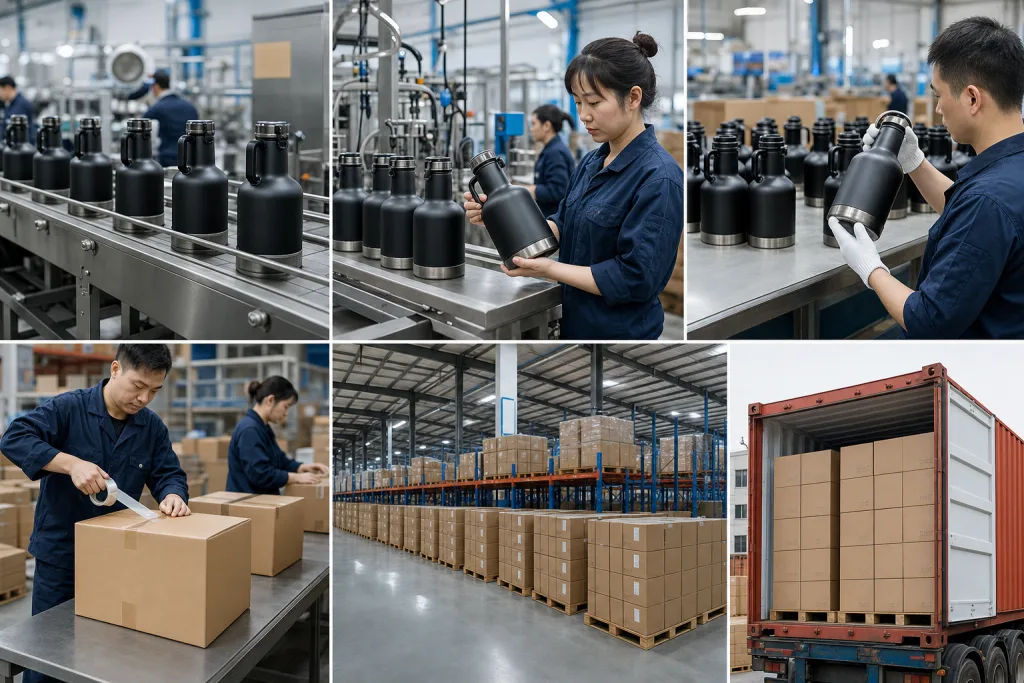
At BottleForge Industrial in Zhejiang, we run drinkware orders from 1,000 pcs trial production up to 420,000 units/month across stainless bottles, tumblers, and growlers. That does not mean every custom logo beer growler should start at high volume. It means the spec needs to be stable before you scale; changing the lid thread after 5,000 pcs have passed incoming inspection is where we’ve seen this go sideways.
Which material and construction fit
Most B2B buyers we work with choose stainless steel for a customized growler because it survives cartons, truck loading, and taproom handling better than glass. It also gives you more logo options: laser, silk print, powder coat with decal, or embossing if the tooling budget is there. The standard inner material is 304 stainless steel. Some buyers ask for 316, but for beer growlers the math usually does not work unless the brand needs marine-grade corrosion resistance or a premium story that covers the added cost. Last month QC pulled 48 samples from a 3,000 pcs run, and the issue was not steel grade. It was a cap thread burr.
For the body, check both grade and thickness. A cheap sample can look fine on a buyer’s desk, then dent after one pallet move from warehouse to forwarder. For vacuum insulated growlers, we usually discuss an inner wall around 0.4 mm and outer wall around 0.5 mm, depending on shape and tooling. For single-wall canteen customized products, the thickness may be different. Ask your canteen factory to state the gauge or millimeter thickness in the quotation, not only “304 stainless steel.” Simple request. We have seen this go sideways when a PO said “same as sample” but the approved sample had no caliper record attached.
Construction choices affect cost more than 7 out of 10 first-time growler buyers expect:
- Single wall: lower cost and lighter weight, with no insulation. It fits some brewery promo runs where the buyer cares more about MOQ, logo size, and a 25-day ship window than cold retention.
- Double wall without vacuum: better hand feel than single wall, but limited insulation. We rarely push this for premium beer growlers because buyers often compare it with vacuum units at retail.
- Vacuum insulated: higher cost with better cold retention and stronger retail value. It needs vacuum testing on the line; we run hot water checks and pull failed pieces before packing.
- Powder coated finish: strong shelf look and better grip. Color matching matters, and scratch testing with a cross-cut knife will expose weak coating faster than a nice showroom photo.
- Brushed or polished steel: clean metal look with fewer color variables. Polished surfaces show fingerprints, so the buyer may flag marks during pre-shipment inspection even when the steel is fine.
If your program is a canteen customizable line with several bottle types, keep materials consistent across SKUs where possible. A custom canteen, a travel tumbler, and a custom growler using similar 304 stainless specs are easier for compliance teams to approve and easier for canteen distributors to sell. We ship mixed-container programs like this, and the cleanest ones use one shared material sheet, one FDA/LFGB file, and one finish standard for the full range.
Logo method is not just decoration
The logo method drives appearance, wear life, unit cost, and lead time. On a custom logo beer growler, we usually quote laser engraving, silk screen printing, heat transfer, or powder coating with a printed logo. The choice comes down to color count and how rough the bottle will be handled on the line. We run sample checks with a caliper and a 24-hour tape pull before we lock it.
Laser engraving is the cleanest call when the buyer wants a mark that will not peel. On 304 stainless with powder coat, our fiber laser cuts through the coating and leaves the steel or a contrast layer showing. It is one-color only, so if the brand needs red, blue, and gold in one logo, this is the wrong method. We had a brewery buyer push back on that after his artwork carried three shades; the sample looked sharp, but the math did not work.
Silk screen printing fits when the art needs a fixed Pantone color and a flat, clean edge. Above about 2,000 pcs, it is cost-effective for 1-color or 2-color work, but curved growler bodies need a proper wrap jig and a print line checked within 5 mm of the seam. If a supplier says yes to a full wrap without asking for artwork width, we have seen that go sideways. One PO even came in with “grower” typed instead of “growler” in the logo note, and QC pulled the sample before plate making.
Heat transfer and UV print handle gradients, fine text, and mixed artwork better than screen printing, but they need proof before release. We run an alcohol rub test, a cross-hatch cut with a 3M tape pull, and, when the buyer asks for it, 20 dishwasher cycles in a basket. Many stainless growlers are still hand-wash only, even if the end user ignores the care card. For EU and North American orders, spell that out on the spec sheet. The buyer flagged it for a reason.
Procurement note: send vector artwork, Pantone codes, logo size in millimeters, and exact placement from the base or shoulder. “Same as picture” is not a production spec.
A good canteen supplier should send a pre-production sample with the actual logo method. A digital mockup only settles layout; it will not show engraving depth, print opacity, or how the logo sits on a textured powder coat. We had one 500 pcs order where QC found the logo 8 mm too high near the shoulder. The mockup passed. The sample saved the run.
What MOQ and price are realistic
For a new custom logo beer growler project from China, a realistic MOQ is usually 1,000 to 3,000 pcs per model, color, and logo method. We do see 500 pcs offers from some canteen vendors, but the math is not friendly: the powder coating line still needs setup, the pad-printing jig still takes time, and the carton factory still charges for a short run. Last month QC pulled a 500 pcs matte black sample batch and the color drift between cartons was about 1.5 Delta E higher than the approved swatch. Small runs expose that problem faster.
As a rough FOB China range, stainless steel vacuum insulated growlers often sit around USD 6.80-11.50 depending on capacity, lid, finish, carton packing, and testing level. Single-wall promotional growlers can be lower. A premium 64 oz vacuum insulated customized growler with powder coating, laser logo, individual box, and heavier lid assembly will not price like a basic promotional bottle. We run laser logos on a rotary fixture, and a deep engraving on a curved 64 oz body takes more line time than a small one-color print near the base.
When comparing quotations from canteen manufacturers, line up the details:
- Capacity and actual fill volume tolerance, such as 64 oz nominal with a checked fill range in ml.
- 304 stainless inner and outer material, with wall thickness in mm.
- Lid material, gasket material, and whether spare gaskets are included in each carton.
- Finish type: powder coat, spray paint, electro-polish, brushed steel, or raw stainless, with the approved color chip named on the PO.
- Logo method, logo size, number of positions, and number of colors, not just “custom logo” written in the quote.
- Packing: egg crate bulk pack, white box, kraft box, retail color box, or gift box, with drop-test expectations if retail boxes are used.
- Inspection standard, test reports, and who pays for third-party inspection, including AQL 2.5 if that is your buying rule.
For budgeting, do not ask only for the product price. Ask for carton size, gross weight, units per carton, and estimated CBM per 1,000 pcs. Freight can change the landed cost by a painful percentage, especially for 64 oz stainless growlers. Zhejiang is close to Ningbo and Shanghai ports, which helps export timing, but ocean freight still needs to be calculated from real carton data. We have seen this go sideways when a buyer used old 12 pcs/carton data, while the final gift-box packing only fit 8 pcs/carton and added 0.9 CBM per 1,000 pcs.
Compliance and testing buyers overlook
Drinkware touches food, so compliance is not optional. For the US market, we usually see buyers ask for FDA food contact material compliance, and about 3 out of 10 retail programs also ask for California Proposition 65 screening because the growler goes into chain stores or Amazon. For the EU, you may need LFGB, EU 1935/2004 food contact documentation, REACH declarations for coatings or plastic parts, and sometimes specific migration testing. If the growler is sold for children or packed with kid products, ASTM or CPSIA topics can come up, but most beer growlers stay in adult merchandise. Ask this before tooling. Last month QC pulled a pre-production sample where the PO said “304 stainless,” but the buyer’s compliance file only covered the inner liner, not the powder coating.
The lid is where problems usually hide. Silicone gaskets, polypropylene or stainless cap parts, handle components, and paint coatings need to match the destination market requirements. A canteen manufacturer that only tests the stainless body is giving you half a report. We have seen this go sideways on a 2,000 pcs order when the body passed LFGB, then the black gasket failed odor review after 24 hours in hot water at 70°C.
For QC, use a written checklist rather than trust. A sensible inspection plan for a customized drinkware shipment includes:
- AQL: common levels are AQL 2.5 for major defects and 4.0 for minor defects, with critical defects at 0. We run this against the packed cartons, not just the clean samples from the showroom shelf.
- Leak test: filled and inverted testing on a defined sample size, not just empty cap fitting. Our line usually checks with water filled to 95% capacity, then turns the growler upside down for 30 minutes.
- Vacuum performance: hot water or cold retention test, with temperature reading after a defined number of hours. For double-wall growlers, QC should record the start temperature and the reading after 6 hours, using the same thermometer each time.
- Logo check: placement tolerance, color match, adhesion, and missing print. For laser or screen print, set a tolerance such as ±2 mm, because “centered by eye” always creates arguments.
- Carton drop test: especially for retail color boxes and e-commerce routing. A 15 kg master carton with 12 pcs inside does not behave like the single sample your buyer approved by DHL.
If you sell through online channels, discuss FNSKU labeling, suffocation warnings for polybags, master carton markings, and barcode scanning before mass packing. The math does not work if we finish 80 cartons, then the buyer flags a missing FNSKU or a barcode that scans as the wrong SKU. A distributor drinkware order can fail at the warehouse even when the growler itself is fine.
Sampling, timeline, and approval flow
A normal custom logo beer growler order should not jump from quote to mass production. Build a sample path first. For existing mold products, we can pull a blank sample from the sample room in 1-2 days if the shape is in stock; logo samples take more time because the artwork, screen jig, powder coating, and 180°C curing oven all touch the schedule. For new shape tooling, stop treating it like a repeat order. The math doesn't work, and the tooling job should sit on its own timeline.
A practical approval flow looks like this:
- Day 1-3: confirm capacity, wall construction, finish, target market, and rough order quantity; our sales team will usually ask for the mouth diameter in mm and the carton drop-test requirement at this stage.
- Day 4-7: receive quotation with FOB terms, carton data, and logo method; check whether the price includes the retail box or only the white inner box.
- Day 8-18: prepare logo sample or closest available decorated sample; QC pulled the sample last week for one buyer because the laser logo sat 4 mm too low.
- Day 19-25: buyer checks sample, requests minor adjustment, and approves artwork file; small text under 1.2 mm is where we see logos fail after coating.
- Day 26 onward: deposit received, materials booked, production scheduled; the line cannot reserve 304 stainless steel bodies on a verbal “go ahead.”
For mass production, 35-55 days after deposit and final artwork is a reasonable lead time for custom drinkware orders from China. Peak season, special colors, or third-party lab testing can add 7-14 days. If a canteen vendor promises 15 days for 5,000 vacuum insulated growlers with custom powder coating and retail box, ask what they are skipping. We've seen this go sideways: the buyer flagged it only after the PO said “matte black” while the approved sample was “black sand texture.”
Make approval responsibility clear. One person approves the physical logo sample, one person approves the carton marks, and one person approves compliance documents. Better still, name them on the approval email. When 5 stakeholders send comments through screenshots, the risk of producing the wrong customized canteen or growler climbs fast, especially when carton marks include a typo like “GROWER” instead of “GROWLER.”
Checklist before you issue PO
Before you send a PO to a growler supplier, put the commercial points and factory specs in writing. Procurement saves money here. “Customizable drinkware” sounds flexible, but our line runs from fixed AI/PDF files, fixed tolerances, and fixed carton instructions. Last April, QC stopped a 64 oz matte black growler order because the PO said “front logo,” while the approved drawing showed the logo 28 mm below the shoulder.
Your PO package should include the approved quotation, product specification sheet, vector logo file, Pantone color references, artwork placement drawing, packaging layout, barcode files, shipping marks, inspection requirements, and destination compliance requirements. If you work with 4 canteen distributors or regional sales teams, do not let each market change the file after production starts. We have seen this go sideways: one buyer asked for a 42 mm logo, another sent 45 mm, and the pad-printing plate was already made.
Use this final checklist:
- Model number, capacity, color, finish, and quantity per SKU. Match the PO to the sample tag on the approved growler, not to a photo in WeChat.
- Logo method, size, position, and approved sample reference. State laser, screen print, pad print, or powder-coat mark clearly.
- MOQ and over/under shipment tolerance, often plus or minus 3-5% for custom production. If your warehouse refuses extra cartons, say it before we run material.
- FOB port, payment terms, and expected ready date. Ningbo vs Shanghai can change trucking cost and booking time.
- Individual box, inner carton, master carton, pallet, and labeling requirements. Confirm carton size, gross weight, barcode, and “Made in China” mark before mass packing.
- Required reports: food contact, coating declaration, BSCI or factory audit documents if needed. Tell us whether the file is for Amazon, retail chain approval, or customs clearance.
- Inspection timing: during production, final random inspection, or both. For AQL 2.5, book the inspection when at least 80% is packed, not when lids are still on the bench.
For brand owners, the best supplier is not always the lowest quote. That is the wrong question to ask. The better canteen factory explains trade-offs before they turn into claims: logo rubbing after tape test, lid color mismatch under D65 light, or a carton bursting at 18 kg. For canteen vendors and distributor growler programs, repeatable specification lets you reorder 3,000 pcs in black this month and 5,000 pcs in navy next quarter without rebuilding the project from zero.
Send your growler spec before you quote
Share capacity, logo artwork, quantity, market, and packing needs. We will return a practical FOB quote and sampling plan.
Frequently asked questions
What is the usual MOQ for a custom logo beer growler?
For stainless steel growlers, a realistic MOQ is usually 1,000-3,000 pcs per size, color, and logo method. If you need a standard silver finish with laser engraving, 1,000 pcs may be workable. If you need a custom Pantone powder coat, retail color box, and multiple print positions, expect the factory to push closer to 2,000 or 3,000 pcs. Some canteen suppliers offer 500 pcs, but setup cost is spread over fewer units, so the FOB unit price can rise 15-35%. For a first order, we often suggest one hero color and one proven 64 oz model instead of four colors at weak quantities.
Is laser engraving better than screen printing for beer growlers?
Laser engraving is usually better for durability because it does not peel, fade, or depend on ink adhesion. It is a strong choice for brewery logos, outdoor retail, and long-life custom drinkware. Screen printing is better when you need a specific color, a larger logo, or lower cost on simple 1-color artwork at volume. Above about 2,000 pcs, 1-color screen print can be very cost-efficient. The weakness is that curved growler surfaces can distort large artwork, and poor curing causes rub-off. For premium powder coated growlers, laser is safer; for promotional campaigns with strict brand colors, printing may be the better fit.
How long does production take after sample approval?
For an existing stainless growler model, typical mass production lead time is 35-55 days after deposit, final artwork approval, and packaging confirmation. Add 7-14 days if you require third-party lab testing, special coating colors, or a complicated retail box. Logo samples normally take 7-15 days depending on the finish and decoration method. If you are shipping from China to North America or Europe by sea, also allow roughly 25-45 days for ocean transit, customs, and inland delivery. Air freight is possible for urgent samples or small replenishment, but 64 oz growlers are not cheap to fly.
What tests should I request before shipment?
At minimum, request final random inspection using AQL 2.5 for major defects and 4.0 for minor defects, with critical defects set at 0. For vacuum insulated growlers, add leak testing and thermal retention testing on defined samples. For logo quality, check placement tolerance, color match, adhesion, and abrasion resistance. For retail or e-commerce, include barcode scanning and carton drop testing. If you sell in the EU or US, ask for relevant food contact documentation and coating declarations before production, not after the goods are packed. Testing should cover lids and gaskets too, not only the stainless body.
Can I use the same supplier for growlers and other canteen products?
Yes, and it often helps if the supplier has a broad drinkware line. A canteen manufacturer that also produces custom canteen bottles, sports bottles, travel tumblers, and stainless thermos products can keep logo standards and packaging logic consistent across a program. That is useful for distributor canteen catalogs and brand merchandise ranges. Still, do not assume every factory is good at every item. Ask for production photos, capacity figures, and samples from the exact category. A factory strong in plastic promotional bottles may not be strong in vacuum insulated stainless growlers, and the reverse can also be true.