Key Takeaways
- Specify 304 stainless steel, 0.4-0.5 mm inner wall thickness, and 12-hour heat retention targets before quoting
- For bulk thermos orders, lid leakage and powder coating chips cause more claims than bottle body defects
- AQL 2.5/4.0 inspection with vacuum, torque, drop, and adhesion tests should be written into the PO
- Custom packaging for outdoor retail usually needs 5-ply export cartons and 80 cm carton drop testing
A custom insulated water bottle looks simple until the first container lands with leaking lids, weak vacuum, scratched powder coat, or logo colors shifting from PMS 186C to something closer to wine red. By then the deposit is paid, the artwork is signed, and the buyer is asking why QC did not catch 32 leaking lids in a 200 pcs pre-shipment pull.
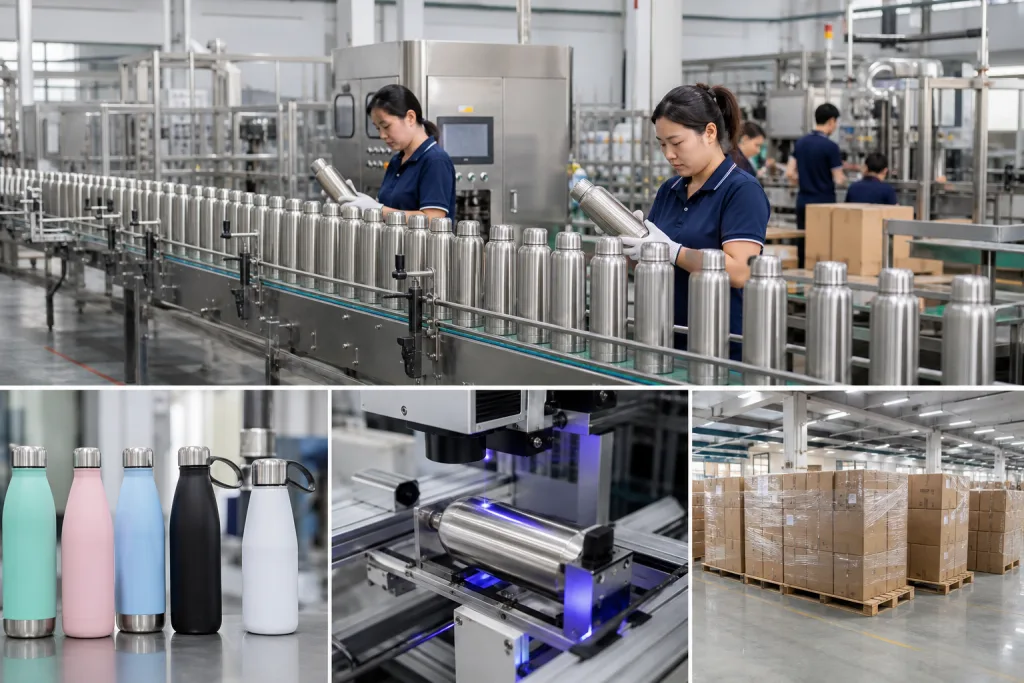
We manufacture stainless thermos orders in Zhejiang, China, and we see these problems on the line before they turn into customer claims. A normal custom thermos project is not just picking 500 ml or 750 ml; that is the wrong question to ask. You are buying 304 stainless steel, wall thickness in mm, vacuum sealing quality, lid tooling fit, powder coating thickness, carton drop strength, and inspection discipline under AQL 2.5. Our factory output is about 600,000 units/month, with typical MOQ from 1,000 pcs per color and 25-35 days production after sample approval. QC pulled one sample last month where the silicone ring was 0.4 mm undersized. It leaked on the tilt test.
Vacuum failure starts before assembly
The costliest defect in a custom insulated water bottle is weak insulation. You will not catch it with a 30-second visual check at the packing table. The bottle can look clean, pass logo review under a D65 light box, then drop heat after 3-4 hours because the vacuum gap leaked or the copper plating coverage was thin near the shoulder.
For a stainless factory thermos, the insulation result comes down to wall stock, pump time, and the bottom seal. We normally run 304 stainless steel on both inner and outer walls for outdoor retail and promotional thermos programs. Common wall thickness is 0.4 mm inner and 0.5 mm outer for a 500-750 ml bottle, checked with a digital micrometer before forming. Thinner material can reduce FOB cost by USD 0.10-0.25 per unit, but the math often fails after dents, complaints, and a bottle that feels cheap in hand.
Do not accept “keeps hot all day.” Put the target in the spec sheet. For example: 95°C water filled to capacity, cap closed, ambient temperature 20°C, temperature after 6 hours not lower than 65°C, after 12 hours not lower than 45°C. Cold retention can be tested with 4°C water under the same room conditions. We use a probe thermometer and a time-stamped QC sheet; one buyer once flagged this because their PO said “hot 24H” but gave no test temperature.
For a thermos manufacturer, vacuum failure below 1% is normal. If a supplier thermos quote does not include a heat retention test plan, you are not comparing the same product.
Ask for test data from pre-production samples and mass production. In our Zhejiang line, vacuum performance is checked after welding, then checked again before final packing on higher-spec orders. QC pulled the sample bottles from the line, not from a polished showroom set. That extra checkpoint adds about 12-18 hours to release, but it catches dead bottles before they become retail returns in Europe or North America.
Leakage is usually a lid problem
Most buyers blame the bottle when a customized thermos leaks. On our line, 7 out of 10 leakage complaints we review start at the lid, not the stainless body. A push-button lid, straw lid, flip lid, screw lid, or carry-loop cap each has its own gasket compression, thread tolerance, and closing torque. QC checks the lid with a torque meter and a 0.05 mm feeler gauge around the sealing face. Change the lid to make the bottle look more “retail,” and you change the risk profile.
For a promotional thermos, the safer lid is usually a simple screw cap with a silicone gasket. Fewer moving parts. Better under carton pressure. We have seen 24 pcs cartons arrive with the top layer pressing hard on straw lids during a 32 kg stack test. For outdoor retailers, a straw lid or one-hand flip lid may sell better, but the math does not work unless you pay for extra testing. Specify food-grade silicone, gasket hardness around Shore A 50-60, and a lid torque range that warehouse staff can close by hand, such as 0.6-0.9 N·m on a sample run. Too loose and it leaks. Too tight and the buyer gets reviews saying the cap is hard to open.
A proper leakage test is simple. Fill the custom thermos with room-temperature water, close the lid, invert it for 30 minutes, then shake it horizontally for 30 seconds. We run this on pre-production samples before mass production, using a white tissue under the cap so even one drop shows. For straw lids, test with the straw open and closed, because some designs are only “spill resistant,” not leakproof. If you sell through outdoor retailers, do not call a bottle leakproof unless it passes bag-carry conditions. We have seen this go sideways after a buyer used “100% leakproof” on packaging while approving a spill-resistant straw lid.
- Thread mismatch: happens when body and lid tooling are adjusted separately, often after a 0.2 mm mold correction on only one side.
- Gasket deformation: often caused by poor silicone curing or storage under heavy cartons for 12 days instead of the planned 3 days.
- Vent hole leakage: common on flip and straw lids if the valve is undersized, especially below a 1.5 mm opening.
- Handle cracking: appears after drop tests or low-temperature use, and QC pulled the sample at -10°C more than once for this issue.
If you are choosing between several thermos suppliers in China, ask each one to send the exact lid drawing or at least a lid component breakdown. A thermos vendor that cannot explain the gasket structure will not help much when claims arrive. Ask for the exploded lid view, gasket material spec, and last leakage test record. If they only send a nice product photo, push back.
Coating defects hurt retail value fast
Powder coating and spray painting turn a plain customizable thermos into something a buyer will put on a shelf. This is also where margin disappears. On one 8,000 pcs bulk thermos order, QC pulled 32 bottles from the first coated batch and found pinholes near the shoulder, orange peel on the logo side, and thin coating around the base ring. The line had skipped enough surface cleaning time, and the parts went into the oven with oil marks still on the body.
For outdoor brands, powder coating is usually the safer choice because it gives better grip and scratch resistance than standard spray paint. Typical coating thickness is 60-90 microns. Too thin, and sharp edges chip around the bottom and shoulder. Too thick, and lid fit or cup holder size can shift by 0.3-0.5 mm. For a matte black or dark green custom insulated water bottle, small scratches show fast, so require adhesion and abrasion testing before mass production. We run this check before printing, not after, because rework after logo printing is where the math doesn't work.
Use a cross-hatch adhesion test, similar to ASTM D3359, on coated samples. A 3M tape pull should not remove coating squares. For transport simulation, ask for a carton drop test and a bottle-to-bottle rub test, especially for retail gift boxes without protective sleeves. We usually test 6 filled cartons from 76 cm, then open the corners and check the shoulder area under a light box. If the bottle is packed in only a thin polybag, expect scuffing during sea freight.
Color control should be based on a Pantone reference or a physical color chip. Digital artwork is not enough. A good thermos factory will make a color panel or painted bottle sample for sign-off. Keep one approved sample in your office and one at the factory in Zhejiang. This stops the usual argument: a distributor thermos order arrives, the buyer flags the beige as too yellow, and the factory points to a screen file from the PO. We have seen this go sideways over one typo, “7502C” written as “7520C.”
Do not chase the lowest coating price. Saving USD 0.08 per unit on finish can create USD 2.00 of retail discounting if the product looks used before it reaches the shelf. A better ask is simple: show the coated sample, thickness reading, tape test photo, and packing test result before you approve the run.
Logo methods fail in different ways
Thermos custom branding looks simple on a sales sheet. On the line, it is not. The right decoration method depends on the coating spec, logo size in mm, how the bottle will be used, and the order quantity. A one-color logo for a 3,000 pcs corporate promotional thermos is a different job from a full-wrap graphic for an outdoor retailer that wants retail-shelf color matching. We had one buyer flag a 2 mm shift on a navy powder-coated sample because their logo sat too close to the cup seam.
Silkscreen printing is cost-effective for simple logos. It works best on straight bottle sections, and the usual setup cost is USD 40-80 per color. Its weak point is abrasion resistance, especially on textured powder coating; QC once pulled 12 pcs from a 500 pcs print batch after the 3M tape test lifted a thin white stroke. Laser engraving lasts longer because it removes the coating and exposes stainless steel underneath. It suits distributor thermos programs when the design is small and premium, but it will not reproduce full-color artwork. Heat transfer and water transfer can handle larger graphics, but the math does not work if the buyer expects low MOQ, tight wrap alignment, and cheap unit cost at the same time.
For a custom insulated water bottle, review the artwork against the actual printable area, not only the flat PDF. Curved shoulders, tapered bodies, and weld lines cut usable space fast. A 70 mm wide logo may look fine on a flat PDF and then stretch on a 600 ml bottle with a slight taper. Ask your thermos supplier for a 1:1 dieline, then confirm the logo centerline from the bottle seam or front-facing reference point. We run this check with a caliper and a paper wrap before mass print, because a 1.8 mm error is easy to miss on screen and obvious in a carton of finished goods.
Logo QC should be measurable
Write these checks into the inspection sheet: logo position tolerance within ±1.5 mm for standard front logos, color deviation within agreed Pantone tolerance, no broken lines visible at 30 cm distance, and no ink peel after tape test. For thermos promotional orders, we suggest checking at least 20 pcs per color from the beginning, middle, and end of the print run. One practical detail: mark the sample numbers on the QC sheet, such as Red-01 to Red-20, so the print operator cannot swap a borderline piece back into the pass pile.
If you need personalization, such as names or club numbers, keep it separate from mass logo production. Variable laser engraving needs a clean data file and barcode control, or cartons can contain mixed names and create expensive sorting work after import. We have seen this go sideways from one Excel typo on a PO, where “Micheal” and “Michael” both appeared in the same 240 pcs club order. QC pulled the sample, but the rework still cost one extra day before we could ship.
Packaging breaks before the bottle does
A strong manufacturer thermos can still land damaged when packaging is treated as a line item. We have seen 304 stainless bottles pass the pressure test and fail in a thin export carton. On one run, the buyer pushed the carton spec down by USD 0.08, and QC pulled the sample with base dents before the first pallet left the dock. Packaging is part of the product, not a bonus.
For e-commerce or outdoor retail, use an individual kraft box or printed color box with a molded insert or paper divider. For promo wholesale, a white box can work, but the bottle must sit tight; if we shake it and hear movement, the spec is wrong. Movement leaves coating rub marks and dents at the base. On our packing table, 3 mm EPE around the body stops most rub marks. A 5-ply export carton is standard for sea freight. Keep carton gross weight under 15 kg when warehouse staff handle it by hand.
If the bottle goes to an Amazon-style FBA warehouse, ask for FNSKU labeling, carton labels, suffocation warnings on polybags where needed, and barcode scan testing. A thermos distributor shipping to multiple retail DCs may need carton marks split by SKU, color, and lid type. We had one PO where the buyer flagged a lid code typo, "LID-B" printed as "LID-8", and the cartons sat in receiving until someone sorted it by hand. Do not leave this to the end. Label mistakes look small at the factory gate. They turn into chargebacks at the warehouse.
Carton drop testing should match the route. For standard export, we run an 80 cm drop test on corners, edges, and faces for packed cartons. Glass-lined sets or kits with a straw brush, spare gasket, or carabiner need a tighter pack and a checklist. QC pulled one sample last month and found a missing gasket in 1 of 20 sets; that is the kind of miss that gets expensive after arrival. Small accessories disappear fast during high-speed packing.
Packaging adds USD 0.15-0.60 per unit depending on box type, insert, barcode, and carton requirements. On a 3,000-unit run, that is cheap compared with claims from damaged bottles or retailer chargebacks. We do not call that waste. It keeps the line moving and protects the margin.
Compliance is not a PDF collection
About 7 out of 10 new buyers ask a thermos manufacturer for “certificates” before they confirm the exact bottle material, powder coating, lid resin, and packaging. Wrong order. Certificates matter, but a random PDF from last year does not prove your production batch is compliant. Last month QC pulled a 500 ml sample from the line and the lid insert was different from the approved sample, even though the file name on the certificate looked correct. For Europe and North America, compliance needs to match the materials touching food or skin.
For stainless steel, 304 is the standard choice for inner walls. For lids and straws, confirm PP, Tritan, or other plastics by grade, not just by name. Silicone gaskets should be food-contact grade, and we normally check gasket hardness with a Shore A durometer because a loose ring becomes a leak complaint fast. For EU distribution, buyers often request REACH and LFGB-style food contact testing depending on the sales market. For the United States, FDA food-contact expectations and California Proposition 65 risk review apply to the actual construction, coating, and decoration. For kids' bottles, ASTM and CPSIA considerations become more important, especially with small parts, coatings, and lead limits.
Social compliance is also part of sourcing. Some retailers require BSCI, Sedex, or similar audit access. If you need this, say it before quotation. Not every thermos factory in China has the same audit readiness, and arranging documents after the PO can delay shipment by 10-20 days. We have seen a PO with “Sedex required” typed into the remarks box after deposit; the math did not work, and the vessel closing date moved from May 12 to May 28.
For QC, use AQL instead of emotional inspection language. A common setup is AQL 2.5 for major defects and 4.0 for minor defects, with critical defects set to zero tolerance. Critical defects include leaking, sharp edges, unsafe odor, wrong material, and serious contamination. Major defects include poor insulation, logo misplacement beyond tolerance, coating peel, missing accessories, and wrong barcode. Minor defects include small cosmetic marks within the agreed viewing distance. On our line, a 1.5 mm logo shift is acceptable only if the approved artwork tolerance says so; otherwise the buyer flagged it, and rightly so.
If a supplier thermos quote is USD 0.30 cheaper but excludes third-party inspection, compliance support, and batch testing, you are not saving USD 0.30. You are moving that cost from the PO to the claims department. We ship containers, not PDFs, and a failed batch test on 3,000 pieces costs more than checking the material before mass production.
Spec the order before negotiating price
Price negotiation matters only after the bottle is defined. On our line, a 750 ml custom insulated water bottle can change in cost just because the wall is 0.45 mm instead of 0.50 mm, or the lid gasket is one grade better. Ask ten thermos manufacturers for the same spec and you often get ten quotes that look close on paper but hide different steel thickness, coating, lid quality, packaging, inspection, and sample assumptions. The cheapest quote is usually the least specified quote.
Start with a short technical brief. Put down capacity, dimensions, target retail price, insulation target, steel grade, lid type, coating color, logo method, packaging, compliance market, order quantity, and required delivery date. For most outdoor retail projects, 1,000 pcs per color is a workable MOQ for standard molds. For a fully customized thermos body or private mold, tooling usually lands from USD 2,000-8,000, and MOQ moves closer to 5,000-10,000 pcs depending on size. The math does not work if the buyer wants a private mold at stock-item volume.
Sampling normally takes 7-12 days for existing mold bottles with logo and color confirmation. Mass production is usually 25-35 days after deposit and final sample approval. Add 3-7 days for inspection, repacking, and export paperwork. FOB Ningbo or Shanghai is common for Zhejiang factories, with sea freight timing depending on destination and season. Last week QC pulled the sample, and the cap print matched, but the carton mark needed one correction before release.
A good thermos supplier should push back when the brief conflicts with the product. A very wide logo on a tapered 500 ml bottle, a soft-touch coating for rough outdoor use, or a straw lid sold as fully leakproof all need a second look. We’ve seen this go sideways. On the transfer machine, a 65 mm logo panel can warp on the curve, and the buyer usually notices only after the first sample. That pushback is engineering discipline, not resistance.
When you compare a factory thermos, supplier thermos, or distributors thermos offer, build a line-by-line sheet. Put FOB unit price next to material, wall thickness, coating, lid test, logo method, packaging, AQL level, sample fee, MOQ, lead time, and payment terms. We once caught a PO that said “cooting” instead of coating, and the buyer flagged it before the line started. Then you know whether you are buying the same bottle or just the same capacity number.
Send your thermos spec before you request pricing
Share capacity, lid type, logo, MOQ, and target market. We will return a practical FOB quote and production risk notes.
Frequently asked questions
What MOQ should I expect for a custom insulated water bottle?
For an existing stainless thermos mold, a realistic MOQ is usually 1,000 pcs per color for powder coating and logo printing. Some factories will offer 500 pcs, but the unit price can increase by USD 0.30-0.80 because coating, setup, and packing losses are spread across fewer units. For a private mold or special lid, MOQ often moves to 5,000-10,000 pcs, plus tooling cost. If you are testing a new outdoor retail SKU, start with a standard body, customize color, logo, and packaging, then invest in custom tooling after sales data proves demand.
How much does a bulk thermos order cost from China?
A standard 500-750 ml stainless steel bulk thermos with 304 inner wall, powder coating, one-color logo, and individual box often ranges from about USD 3.20-6.50 FOB China, depending on lid design, wall thickness, coating, and packaging. A simple screw lid is cheaper than a straw or flip lid. Laser engraving can add around USD 0.15-0.40 per unit. Premium retail packaging may add USD 0.30-0.60. Be careful with quotes below the market range, because they may use thinner steel, weak coating, lower-grade lids, or skip heat retention testing.
Which logo method is best for a promotional thermos?
For a simple corporate logo, silkscreen printing is usually the best value at 1,000-5,000 pcs, especially for one or two colors. For a premium promotional thermos, laser engraving is more durable and has fewer ink adhesion risks, but it only shows the exposed metal color. For full-wrap designs, heat transfer or water transfer can work, but you need stronger alignment and adhesion checks. If the bottle will be used outdoors, handled with gloves, or clipped to backpacks, avoid delicate large-area printing unless the supplier proves it passes tape and rub testing.
How do I know if a thermos supplier is reliable?
Ask for more than a catalog. A reliable thermos supplier should provide material specs, insulation test method, lid leakage test, coating process, packaging plan, MOQ, lead time, and AQL inspection standard. They should be able to explain the difference between 304 and 201 stainless steel, show current production photos, and confirm whether they control coating in-house or outsource it. For larger orders, request pre-production samples and third-party inspection. If the supplier cannot define critical defects such as leaking, odor, wrong barcode, or coating peel, they are not ready for retail programs.
What lead time should I plan for a customized thermos order?
For existing mold bottles, plan 7-12 days for sample production and 25-35 days for mass production after sample approval and deposit. Add time for inspection, carton labeling, and export booking. During peak seasons before summer promotions or Q4 gifting, lead time can stretch by 10-15 days. A customized thermos with a new lid, private mold, or unusual coating can take longer because tooling and testing are involved. If your delivery date is fixed, lock artwork, Pantone colors, packaging files, and barcode data before the deposit is paid.