Key Takeaways
- Set capacity, steel grade, wall thickness, cap type, and logo tolerance before sampling; MOQ is usually 3,000 pcs per flask shape
- For a 10,000 pc custom hip flask order, realistic production time is 25–35 days after approved pre-production sample
- Use AQL inspection with leak testing, logo position checks, carton drop review, and food-contact documentation before shipment
- FOB China pricing can change by 8–15% depending on steel grade, packaging, coating, and engraving depth
A custom hip flask order looks simple until the pre-production sample passes on the desk, then the cartons arrive with weak welds, logos 2 mm off center, or caps that start leaking after three turns on the torque tester. For a B2B buyer, the problem is not the flask. It is loose specs, rushed logo approval, and no AQL 2.5 inspection line written into the order before balance payment.
Here is one real order flow: 10,000 stainless steel hip flasks for a European distributor drinkware program. BottleForge Industrial manufactures custom drinkware in Hangzhou, Zhejiang, and our normal flask MOQ starts at 3,000 pcs per shape, with production lead time around 25–35 days after artwork and deposit. We run this on the line with a welding jig, logo positioning film, and 100 ml leak-test water fill before packing. The same process applies if you are comparing a canteen supplier, canteen manufacturer, or broader canteen factory in China, but asking only for the cheapest unit price is the wrong question to ask; we have seen that go sideways on cap fit and carton drop tests.
The order starts with usage
The buyer scenario is clear: you need a custom hip flask for a holiday gift set, sold through distributors in Germany and Canada. The retail pack is one 6 oz flask, two cups, one funnel, and a printed gift box. You want brushed stainless, a laser logo, and no plastic smell inside the cap. On one 2024 PO we received, the buyer typed “brushed sliver” instead of “brushed silver”; QC still matched the finish against our sample plate before the line started.
The first decision is not the logo. It is usage and channel. A spirits-brand promo flask can run with lighter packaging and a sharper FOB price. A gift retail flask needs cleaner brushing, stronger 350 gsm box board, correct barcode placement, and tighter control on scratches around the cap neck. We have seen this go sideways when a buyer approved a cheap promo pack, then asked why the Germany distributor rejected 38 boxes for corner crush. If the same buyer also sources custom canteen, custom growler, or general customizable drinkware, the logic is similar: define how the end user will handle it, then write the specification around that use.
For hip flasks, common capacities are 4 oz, 5 oz, 6 oz, and 8 oz. The 6 oz size is the safest for gift programs because it feels substantial without becoming bulky. For body material, 304 stainless steel is the standard recommendation for export drinkware. Some buyers ask for 201 stainless to cut cost; we only suggest it for non-food-contact outer components, not for liquid-contact interiors. The math does not work if a claim wipes out the saving. For wall thickness, 0.4–0.5 mm is normal on flask bodies; thinner steel may cut a few cents, but QC pulled samples with small dents after the crimping station and again after a 10 kg carton drop test.
At this stage, write a one-page spec sheet. Include capacity, dimensions, grade, finish, cap style, logo method, logo size, packaging, test standards, carton limits, and market compliance. A serious canteen vendor or flask factory in Zhejiang should work from this document, not just from a catalog picture. We run pre-production against the spec sheet with a caliper, color chip, barcode scan, and an AQL 2.5 checklist, because “same as photo” is not a specification.
Turn the quote into a spec
We have seen 14 bad orders start from a quote that says only “6 oz flask, logo, gift box.” Purchasing cannot buy from that. The quote needs to read like a working spec, so QC can check it line by line at sample approval and again on the final AQL table.
For this 10,000 pc order, a realistic FOB Ningbo or Shanghai estimate might sit around USD 1.45–2.40 per set, based on surface finish, accessory count, and how the gift box is built. A plain brushed flask with laser logo sits near the lower end. Add two 15 ml cups, a stainless funnel, a custom insert tray, 350 gsm printed box, and individual polybag, and the cost climbs fast. Color coating, mirror polish, debossing, or premium rigid box packaging may push the price another 12–30%. The math doesn't work if the buyer expects a USD 1.60 set with a rigid box and clean mirror finish.
Your quote should state whether tooling is needed. Existing molds normally avoid tooling fees, while a new flask curve or customized canteen cap may require USD 800–2,500 in tooling depending on complexity. If you are building a family line with canteen customizable shapes, a customizable growler, and a flask, ask the factory to split shared packaging costs from product-specific costs. We run this on separate cost lines because one PO typo, such as “same insert for all SKUs,” can block packing for half a day.
Define commercial terms early:
- MOQ: 3,000 pcs per existing flask shape; 5,000 pcs is more efficient for coated colors.
- Payment: usually 30% deposit, 70% before shipment after inspection.
- Lead time: 7–10 days for sample, 25–35 days for mass production.
- Incoterm: FOB Ningbo or Shanghai is common for Zhejiang factories.
- Inspection: AQL 2.5 for major defects, 4.0 for minor defects unless your brand requires stricter levels.
If a canteen distributor or distributor growler buyer needs mixed SKUs in one container, confirm carton label layout, SKU separation by carton count, and pallet height in cm before production. Fixing labels after packing costs time and creates fresh mistakes. We have seen QC pull a packed carton because the side mark showed the right item code but the wrong color name.
Sampling should find problems early
A pre-production sample is not a souvenir. It is the contract sample. For a custom hip flask, check it the same way our warehouse team checks the final cartons under AQL 2.5. Fill it with water to confirm capacity, put the empty flask on a 0.1 g scale, measure the logo with a digital caliper, inspect the weld line under a white LED bench lamp, then open and close the cap 20 times. Simple work. If the sample leaks after being inverted for 30 minutes, do not approve it with a polite note saying “please improve in bulk.” Reject it and ask for a corrected sample. We have seen this go sideways: one buyer approved a leaking 6 oz flask sample, then QC pulled 312 leaking pieces during final inspection.
Logo approval needs close attention. Laser engraving on brushed stainless is durable and clean, but visible contrast changes with the surface finish and engraving power. Silkscreen gives stronger color when the buyer needs red, black, or gold, but it scratches if ink adhesion is not controlled; we run a 3M tape test before packing when the logo area is large. For premium gift sets, etching or deeper laser can look better, though it adds cost and usually adds 2 days to sampling. On curved flask bodies, allow a logo position tolerance of about ±1.5 mm for normal mass production. Asking for zero movement on a curved, manually loaded surface is the wrong question to ask. The fixture has a stop block, but the operator still loads each flask by hand.
Packaging samples should be approved together with the flask. A 0.5 mm dent on a flask may start at packing, not stamping. For export from China to Europe or North America, we normally suggest a snug insert, individual polybag or paper wrap, and a master carton under 15 kg. Our packing table uses a 5-layer K=A carton for most gift-box orders, and the line records carton weight before sealing. If you sell through online channels, add a basic carton drop test from 76 cm on corners, edges, and faces. Cheap inserts save a few cents, then the math does not work when Amazon returns start.
For buyers also handling canteen promotional programs or customized drinkware sets, do not approve artwork only by PDF. Ask for a physical decorated sample or at least a production-line decoration proof. Colors on coated metal rarely match screen colors perfectly. State the Pantone code, acceptable Delta E if needed, and whether slight batch variation is acceptable. We had one PO where “PMS 186C” was typed as “PMS 168C,” and the buyer flagged it only after seeing the first red sample on a video call. A PDF would not have caught that.
Compliance is not optional paperwork
Hip flasks touch alcohol and other liquids, so food-contact compliance is not paperwork to leave for later. For the EU, buyers usually ask for LFGB or the right EU food-contact declarations, plus a REACH review for coatings, inks, and packaging materials. For the United States, FDA food-contact expectations and state-specific rules can apply. If the flask ships with a funnel, cup, or painted accessory, QC has to check every liquid-contact part on the line with the right sample and a 0.2 mm coating check where the build calls for it.
A good supplier should hand over material declarations, old test reports if they still match the build, and a clear sample submission plan before you place the order. Old reports are where things go sideways. We’ve seen a buyer flag a 2021 report for one coating color, then ask why it did not cover a 2026 matte black flask. It did not. If your retailer wants third-party testing, build 7–12 days into the schedule and budget USD 250–800 per test package, depending on lab scope. On our side, QC pulled the sample tag against the BOM before booking the lab.
Factory audits matter too. Some brand owners ask for BSCI, Sedex, ISO 9001, or a customer-specific social audit. BottleForge Industrial runs in Zhejiang, China, with monthly drinkware output capacity around 500,000 units across flasks, bottles, tumblers, and canteen customized programs. That number helps, but the line still needs traceability checks; we have seen a 304 stainless lot mixed with the wrong carton mark, and that sort of mistake spreads fast. High output does not fix a bad traveler card.
For gift and alcohol-related items, labeling is a quiet risk. You may need country of origin marking, importer details, recycling symbols, batch codes, warning text, or FNSKU labels if the stock goes to marketplace warehouses. A canteen supplier that also handles packaging coordination can keep the file stack moving, but the buyer should still send final label files. We print on a Zebra ZT411 and cross-check the PO against the art file; one typo in the importer name can trigger a warehouse rejection. Factories should not guess legal text for your market. This is the wrong place to improvise.
Mass production needs checkpoints
After the deposit lands and the pre-production sample is signed, we move the order through material purchase, forming, welding, polishing, decoration, assembly, and packing. Stay involved. Do not go silent for 30 days and expect perfect cartons at the end. The cleanest time to catch trouble is when 5–10% of production is complete, while the line still has open WIP trays and the polishing wheels have not finished the full batch.
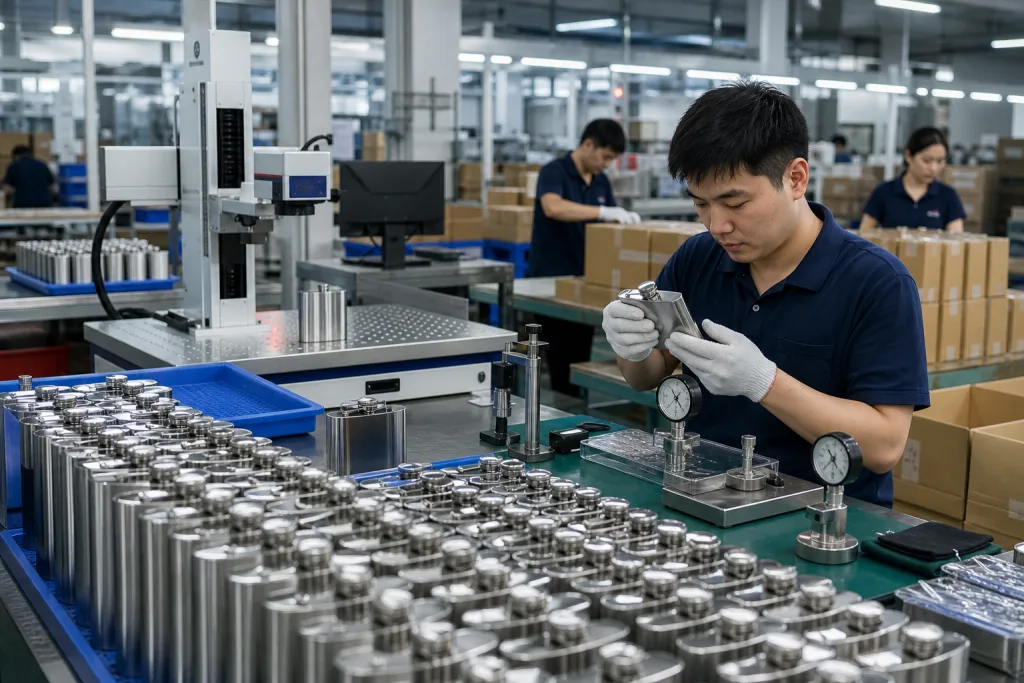
For a 10,000 pc custom hip flask order, we run three checkpoints. First, confirm raw material grade and thickness before forming; QC should put a micrometer on the sheet, not just read the supplier label. Second, check semi-finished bodies after welding and polishing, especially the shoulder seam and bottom radius. Third, inspect decorated and packed goods before balance payment. On the line, operators should pull out sharp-edge defects, visible dents, poor cap threading, and unstable base shape into a red reject bin. A flask that rocks badly on a table will still bring complaints, even if it passes a leak test. We have seen this go sideways.
Practical production checks include:
- Capacity test: fill to nominal level with a graduated cylinder and compare against the approved sample.
- Leak test: invert filled units for 30 minutes, then check again after 20 cap open-close cycles.
- Logo test: check size, position, clarity, and scratch resistance with the same tape test agreed before mass production.
- Odor check: inspect silicone or PE sealing parts before assembly; one bad gasket bag can taint a full packing table.
- Carton check: verify SKU, barcode, gross weight, and carton count against the PO, including small mistakes like “matte balck” on a shipping mark.
If you buy from multiple canteen manufacturers or canteen suppliers, use the same inspection checklist across vendors. One factory calling a visible scratch “minor” and another calling it “major” gives you mixed stock and awkward warehouse sorting. For distributor canteen and distributor drinkware programs, batch consistency usually beats shaving USD 0.03 off the unit price. The math does not work if your buyer flags 600 pcs for mixed logo position.
At BottleForge, our QC team keeps sealed approval samples at the inspection table. Basic, yes. Useful every week. If the approved sample has a 35 mm logo and bulk production shows 41 mm, QC pulled the sample can show the gap in 10 seconds with a caliper, before anyone starts arguing over photos in a chat group.
Inspection before the balance payment
Run final inspection after at least 80% of the cartons are packed and 100% of the hip flasks are finished. For most B2B custom drinkware orders, AQL Level II is the working default we use on the line. Set critical defects at 0, major at 2.5, and minor at 4.0. Critical defects cover leakage on a 10-minute water test, unsafe sharp edges found with a cotton wipe, wrong material, mold contamination, and missing required labels. Major defects cover wrong logo position, severe dent over the approved limit, loose cap fit checked by hand torque, and incorrect packaging. Minor defects cover small scratches inside the signed sample limit.
For a 10,000 pcs order, the inspector can pull 200 samples from the selected AQL table. Do not let anyone check only the top cartons. Pick cartons from the front, middle, and back pallet rows, then cross-check production dates on the outer carton stickers. QC pulled the sample from one Hangzhou shipment last year and found the PO number was typed wrong on 32 cartons. If the goods ship with a customized growler, customizable canteen, or other gift items in the same container, inspect each SKU separately. A pass on the flask says nothing about the funnel or box insert.
Buyers ask if they need a third-party inspection. For orders above USD 10,000, my answer is yes unless your own China staff can stand in the factory for the day. A third-party inspection in Zhejiang or nearby provinces costs about USD 250–350 for one man-day, and the inspector should bring a barcode scanner, caliper, 3M tape, and the approved golden sample. The math doesn't work if you skip it. One rejected holiday delivery can cost more than 20 inspections once air freight and retailer chargebacks hit the file.
When defects show up, use the count sheet, not feelings. If 3% of units have light cosmetic scratches inside the accepted zone, accept with a discount or rework the worst cartons. If 8% leak during the water test, stop shipment. We run cap and seal rework before export even when it adds 2 days, because customer returns in Europe or North America are slower, messier, and harder to explain to a retailer buyer.
Shipping and reorder planning
After inspection passes, confirm the packing list, commercial invoice, HS code, carton dimensions, and shipping marks. Do this line by line. Stainless steel hip flasks do not add much gross weight, but rigid gift boxes eat space fast. For 10,000 pcs of 6 oz gift sets, you may need roughly 12–18 CBM depending on box size and accessory layout. We run a carton drop check on the packed sample, then measure L × W × H with a tape and update the CBM before booking. Ask for a carton mock-up early if container utilization matters; guessing from a PDF box dieline is the wrong question to ask.
If your warehouse needs palletized cargo, state pallet size, maximum height, and whether fumigation-free plywood pallets are required. For marketplace or retail distribution, carton labels must match routing instructions. FNSKU, SKU, PO number, carton count, and country of origin should be printed or labeled before the goods leave China. QC pulled the sample carton last month because the PO number had one missing zero, and the buyer flagged it before loading. Relabeling in a destination warehouse can cost USD 0.20–0.60 per carton, plus delays.
Reorder planning should start before the first shipment sails. If the product is seasonal, keep the mold, coating recipe, logo file, and packaging dieline locked. A reorder placed 60 days before your selling season is safer than a reorder placed when stock is already gone. We ship repeat orders faster when the approved flask body, cap gasket, spray color chip, and 300 gsm box paper are still on file. For canteen vendors and hip flask lines alike, small changes in coating, cap gasket, or box paper can make the second batch look different from the first. We have seen this go sideways.
If you are comparing a canteen manufacturer, flask factory, and distributor canteen partner in China, do not judge only by the first FOB number. Ask who owns the QC checklist, who stores the approved sample, who controls packaging files, and who answers when a retailer sends photos of defects. On our line, the signed sample sits in the QC room with the AQL file, not on a salesperson’s desk. A dependable supplier will discuss these details before you issue the purchase order, not after the claim.
Send your flask spec before you request pricing
BottleForge can review capacity, branding, packaging, MOQ, and inspection points before your next custom drinkware purchase order.
Frequently asked questions
What is a realistic MOQ for a custom hip flask order?
For an existing stainless steel hip flask shape, a realistic MOQ is usually 3,000 pcs per design. If you need a custom coating color, 5,000 pcs is more practical because paint setup and color loss are not efficient on tiny runs. For a new mold or special curved body, expect 10,000 pcs or a tooling fee around USD 800–2,500. Accessories such as funnels, cups, and gift boxes may have their own MOQ, especially for printed packaging. If you are testing a market, start with an existing 6 oz shape, laser logo, and standard box to keep cost and lead time under control.
How long does production take after sample approval?
For a normal custom hip flask order from Zhejiang, China, sample development takes about 7–10 days after artwork confirmation. Mass production usually takes 25–35 days after deposit and approved pre-production sample. Add 7–12 days if new food-contact or coating tests are required. If the order includes a printed gift box, accessories, and retailer labels, artwork approval can become the longest part of the schedule. During peak season from August to November, build in another 5–10 days because polishing, coating, and packing lines are busier.
Which branding method is best for stainless steel flasks?
Laser engraving is the safest default for stainless steel hip flasks because it is durable, clean, and suitable for MOQ from 3,000 pcs. Silkscreen is better when you need a solid color logo, but it requires adhesion testing and can scratch if the ink or curing is weak. Full-color heat transfer is possible on coated surfaces, but it adds cost and has tighter artwork limits. For premium gift sets, deep laser or etched effects look more expensive. Always approve a physical decorated sample, not only a PDF proof, because curved metal changes the visual result.
What defects should we check before shipment?
The main defects are leakage, poor cap threading, sharp edges, dents, weak welding, wrong logo position, scratches, odor from the seal, and incorrect packaging. For inspection, use AQL Level II with critical defects at 0, major defects at 2.5, and minor defects at 4.0 unless your retailer specifies another standard. Leak testing should include filled and inverted samples for at least 30 minutes. Logo position should be checked against the approved sample, with a normal tolerance around ±1.5 mm on curved bodies. Carton labels, barcodes, and country of origin marking also need inspection.
Can the same supplier handle flasks, canteens, and growlers?
Yes, but check actual production capability instead of accepting a catalog claim. A supplier that handles custom hip flask orders may also offer custom canteen, customized growler, and other customizable drinkware, but the manufacturing processes are not identical. Vacuum growlers need insulation testing and more welding control, while flasks focus on body forming, cap sealing, and finish quality. Ask for monthly capacity, product-specific QC records, material grade, and recent export documentation. If you are a canteen distributor or distributor growler buyer, shared packaging control and consistent inspection standards across SKUs are especially important.