Key Takeaways
- A practical custom drinkware MOQ starts around 1,000-3,000 pcs per color for factory-direct production
- Plan 7-12 days for pre-production samples and 30-45 days for mass production after approval
- Use AQL 2.5/4.0 inspection, vacuum testing, coating adhesion checks, and carton drop tests before shipment
- USA buyers should confirm FDA food-contact, CPSIA when relevant, Prop 65 review, and Amazon FNSKU packing if needed
Your USA customer asks for a 20 oz insulated tumbler, a 32 oz custom canteen, or a 64 oz custom growler with a logo that still looks clean after 200 dishwasher cycles. They also want landed pricing, carton dimensions, compliance notes, and a delivery date before the first PP sample comes off the line.
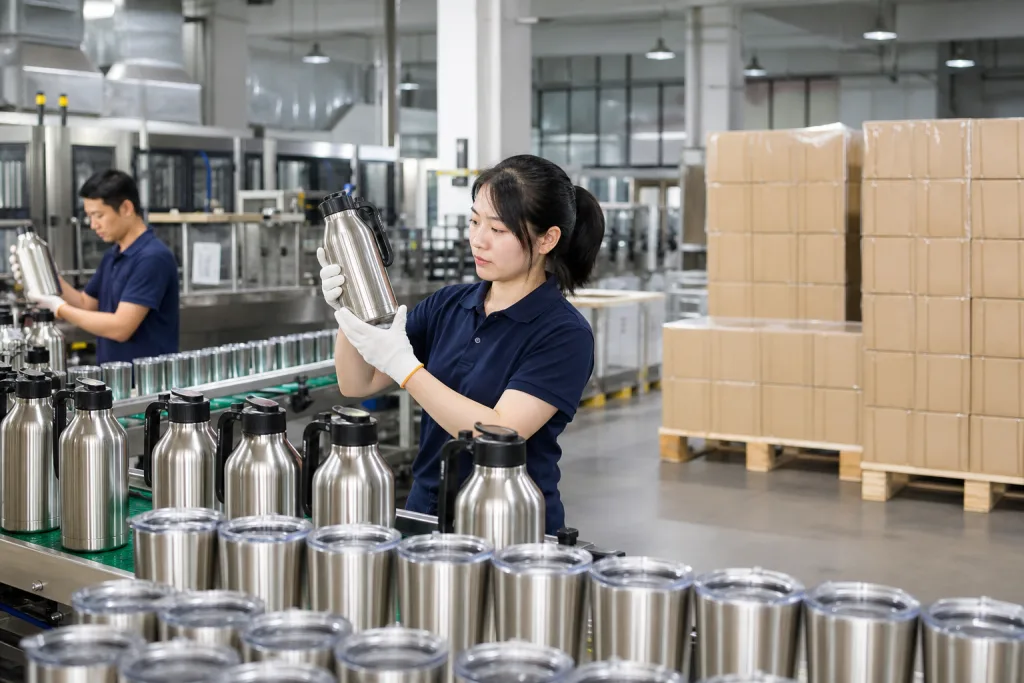
Normal request. We see custom drinkware usa orders go sideways when the buyer treats the bottle like a blank promo giveaway, not a manufactured product with steel grade, lid fit, coating thickness, print adhesion, and packing risk. From our Zhejiang, China factory floor, we run the order from brief to final inspection; last month QC pulled a tumbler with a 0.6 mm rim gap, and that single finding changed both the lid spec and the carton drop-test result.
Start With The Actual Sales Channel
Before you ask any canteen manufacturer for a quotation, decide where the drinkware will be sold or handed out. Channel first. A distributor drinkware order for a 5,000 pcs corporate wellness campaign is not the same product as a retail line for outdoor stores. Buyers describe both as custom drinkware usa, but the factory needs a tighter brief before the line opens a mold file or pulls a 0.5 mm steel sample from the rack.
For a typical USA promotional order, we run a 24 oz single-wall stainless customized canteen, powder coated, one-color silkscreen logo, packed in a plain white box. The budget is often USD 2.20-3.80 FOB Ningbo depending on steel grade, cap, coating, and quantity. For retail, the same canteen customized for shelf sales may need 18/8 stainless steel, double-wall vacuum insulation, retail color box, UPC sticker, warning label, and better carton protection. That pushes FOB pricing to USD 5.20-8.50. The math doesn't work if a buyer asks for retail packaging but keeps a promo giveaway target price.
If you are a canteen distributor or distributor growler buyer, tell the canteen factory the channel at the start. Include whether the goods go to a 3PL warehouse, Amazon FBA, club store, event agency, or your own distributor network. For FBA, we usually pack with FNSKU labels, 5-layer export cartons, and carton weight below 15 kg when possible. QC pulled one sample last month where the FNSKU was 3 mm too close to the box edge, and the buyer flagged it before shipment. For retail, we design the inner box around shelf presentation and barcode scanning, not just freight efficiency.
A useful first brief includes capacity, material, finish, logo method, target FOB, destination port or warehouse, compliance requirements, and required delivery week. If you do not know the exact model yet, say that. A good canteen supplier should give two or three model paths instead of forcing one stock shape onto every buyer. We’ve seen this go sideways when the PO says “blue bottle” but the approved sample card says Pantone 286C.
Choose The Bottle Specification Carefully
The bottle spec drives price more than the logo. We still see buyers spend 3 days moving artwork 8 mm left, then approve steel thickness, cap material, and mouth diameter in 5 minutes. Wrong priority. For customized drinkware, those small engineering calls decide whether the cup feels solid or cheap when QC pulls the sample from the line.
For stainless models, common choices are 201, 304, or 316 stainless steel. For USA retail, 304 food-contact stainless is the safe default we run most often. A double-wall vacuum bottle normally uses 0.4-0.5 mm inner wall and 0.5-0.6 mm outer wall depending on shape; our thickness gauge checks this before polishing. A low-cost canteen promotional item may use thinner walls, but dents and coating pinholes show up faster, sometimes before carton drop testing. For a 64 oz customized growler, we prefer a stronger body and reinforced base because the filled weight is high. The math doesn't work if the buyer wants a premium feel at the lightest promo spec.
Plastic lids need the same attention. Ask whether the lid is PP, Tritan, or another material, and whether the sealing ring is silicone. If the buyer wants a canteen customizable with straw lid, handle lid, and chug lid options, confirm thread compatibility before production; we check it with a go/no-go thread gauge, not by hand feel. A lid that works on one mold may leak on another bottle mouth by only 0.2-0.3 mm tolerance difference. We have seen this go sideways when a PO says “same lid as last order,” but the bottle mold code changed by one digit.
For insulation claims, reject vague wording like “keeps cold all day.” Ask for a test condition. One practical test is 95°C hot water in a 20-25°C room, measured after 6 hours and 12 hours. Cold retention can be tested with 4°C water. For retail packaging, use conservative claims unless your canteen manufacturers can show repeatable lab records; one USA buyer flagged a carton claim after their warehouse test showed 12 hours performance, not the 18 hours printed on the box.
Good sourcing is not asking for the cheapest custom canteen. It is deciding which compromises your USA customer will never notice, and which ones will become returns.
Build The Decoration Plan Early
Decoration is where custom drinkware turns into brand merchandise, and it is also where the delays start if the art file is weak. A low-res JPG does not give us a clean edge on the line. Send AI, PDF, or EPS vector files for silkscreen, and lock the Pantone call before we run the sample. For laser engraving, say whether you want bare stainless steel showing through powder coat or a softer tone-on-tone mark. We had a buyer flag a logo copied from a website screenshot at 96 dpi; the proof looked fuzzy on the Epson plotter, so we stopped it before screen prep.
For a one-position, one-color logo on a 3,000 pc custom canteen order, silkscreen is usually the cheaper route. A normal setup charge is USD 40-80 per color, and the run cost stays low after that. The wrong question to ask is whether a logo looks good on a PDF alone. On a tapered tumbler, it can stretch. Keep a front logo within 55-75 mm wide on many 20-32 oz bottles unless the buyer signs off on wraparound distortion. We check that width on a caliper at the sample bench before the screen frame is burned.
Laser engraving gives a cleaner result for premium distributor canteen programs, and there is no ink adhesion problem, but the contrast depends on the coating color. Dark powder coating gives stronger bite than pale beige or silver. Full-wrap heat transfer and water transfer handle complex graphics, yet MOQ goes up and rejects climb with it. A full-wrap customizable growler can look excellent, but we still budget extra sampling time and a tighter visual check. QC pulled one batch under the light box last month because the seam line wandered 1.5 mm.
USA buyers also need to think about brand hierarchy. If the item is a canteen promotional giveaway, the logo can sit large and direct. If it is a retail customized canteen, the mark often needs to stay smaller, with the box artwork doing more of the selling. Ask your canteen vendor for a 1:1 print-position mockup before tooling or screens are opened. It saves a lot of back-and-forth when the production sample lands, and it avoids the usual PO typo fight over “front center” versus “center front.” We run that check on the line with a steel ruler, then ship once the placement is locked.
Quote MOQ, Price, And Lead Time
A factory-direct quote should break out product cost, decoration cost, packaging, testing, and freight terms. If a canteen vendor sends one blurred line, you have no way to see what changes when the order moves from 1,000 pcs to 5,000 pcs. Bad start. At BottleForge Industrial in Hangzhou, Zhejiang, we run about 600,000 stainless drinkware units per month, but capacity does not fix messy order data; last week our merchandiser had to stop a quote because the PO showed “mat black” while the artwork file said matte blue.
For most custom drinkware orders we see from USA buyers, practical MOQ is 1,000 pcs per model per color for stock mold decoration, and 3,000 pcs gives the line better room for powder coating colors and sharper unit cost. A private mold canteen customized from scratch usually starts much higher, often 10,000-30,000 pcs depending on mold complexity. If your USA customer is testing a new program, use an existing mold first and put the budget into decoration and packaging. This is the wrong question to ask: “Can we open a new mold for 800 pcs?” The math does not work once CNC tooling, sample fitting, and lid leak testing are counted.
Lead time has layers. Digital mockup takes 1-2 working days after artwork. A physical pre-production sample normally takes 7-12 days for existing molds and standard coating. Mass production is commonly 30-45 days after sample approval and deposit. Peak season before summer and Q4 can add 7-15 days, especially for powder coating and retail box printing. We’ve seen this go sideways when a buyer approved the cup body but forgot the retail box dieline; QC pulled the sample, the box barcode was 2 mm too close to the fold, and printing lost 4 days.
For Incoterms, FOB Ningbo or FOB Shanghai is common for China export orders. If you need DDP to a USA warehouse, ask for a separate freight quote because duty, tariff classification, port congestion, and inland trucking change fast. For a distributor drinkware buyer, FOB is usually cleaner for repeat programs. For a first-time brand owner, DDP is easier on paper, but you still need carton size, HS code, and packing list accuracy. We ship both, but if the master carton says 12 kg and the warehouse scale reads 13.6 kg, the buyer flagged it and somebody pays the adjustment.
Approve Samples Without Being Casual
The pre-production sample is not a souvenir. It is the production standard the line will follow. Once you approve it, the canteen factory will chase that sample within normal tolerance, usually ±1 mm on logo position and ±3% on capacity. If your approval email only says “looks good” and skips logo size, color, coating feel, lid fit, and packaging, you are leaving the argument for later. We’ve seen this go sideways over a 2 mm logo shift that nobody wrote down.
Check the sample like QC does. Use a digital scale, caliper, and thermometer. Measure capacity to the fill line and brimful capacity. Weigh the bottle. Check mouth diameter, lid thread, gasket position, straw length if used, and whether the base sits flat on a glass plate. For vacuum insulated items, fill with hot water at 95°C and record the temperature drop after 6 hours. Shake the closed bottle upside down for 30 seconds. Simple test. It catches real leaks, loose gaskets, and lids that feel fine until the buyer’s warehouse opens 200 cartons.
Color approval needs discipline. Powder coating can shift between lab sample and bulk run, especially on matte finishes where oven temperature and line speed change the surface. If the color is critical, use a physical Pantone chip or approved metal color plaque, not a phone photo from a desk lamp. For customizable drinkware with multiple colors, approve each color as its own item. A black lid on a navy bottle can look clean; the same black lid on a pale pink bottle can look like someone cut the BOM by 8 cents. The buyer flagged that exact issue on a 3,000 pcs order last spring.
Packaging samples matter too. Ask your canteen suppliers to send the color box dieline, carton layout, barcode placement, suffocation warning if polybags are used, and any Prop 65 or California warning language your legal team requires. Check the barcode with a scanner, not your eyes. One PO typo, “matte balck” instead of “matte black,” made it onto a carton mark before QC pulled the sample. If the goods are for children, review CPSIA and ASTM requirements early. A kids bottle is not just a smaller sports bottle in the USA market; the math, labeling, and testing rules are different.
Run QC Before The Balance Payment
Do not wait until the container lands in California, New Jersey, or Texas to find a leaking lid or weak coating. Bad timing. Final random inspection in China usually costs less than sorting 80 cartons in a USA warehouse at USD 35 per hour. For most B2B drinkware orders, we run ANSI/ASQ Z1.4 with AQL 2.5 for major defects and AQL 4.0 for minor defects. Critical defects should be zero. Last month QC pulled the sample with a torque gauge on the flip lid, and 6 lids failed before the balance payment was released.
A practical inspection plan for custom drinkware covers visual checks, capacity checks with a measuring cylinder, print adhesion, coating adhesion, leak testing, vacuum performance sampling, barcode scanning, carton drop testing, and carton mark verification against the PO. For silkscreen, a 3M tape test catches weak ink adhesion before the buyer’s logo starts peeling in a dishwasher claim. For powder coating, cross-hatch testing can be used on retained samples. For vacuum bottles, we test a small sample from production for heat retention, then isolate any abnormal batch on the line with a red “HOLD” tag. Do not skip this step.
Define defects before inspection. A 1 mm dust point on the underside of a bottle may pass for a canteen promotional order of 3,000 pcs. A scratch across the front logo should fail. Color variation between two production batches can pass if it stays inside the approved limit, but mixed shades inside one retail carton look cheap and are preventable. We have seen this go sideways when the PO says “Pantone Black C” with two spaces, and the buyer flagged the shade after packing.
Your canteen manufacturer should send production photos, but photos are not QC. They are status updates. If the order is over USD 10,000, use your own inspector, a third-party inspection company, or a documented factory inspection report with photos, caliper readings, lid fit results, and carton weights in kg. Pay the balance after the goods pass, not because the vessel closing date is near. The math does not work if a USD 120 inspection saves you from reworking 5,000 bottles in Dallas.
Ship With Documents That Match
The last step is boring until it costs USD 600 in extra warehouse labor. Commercial invoice, packing list, bill of lading, carton marks, and product labels must match line by line: PO, SKU, color, capacity, barcode. If you are importing custom drinkware usa inventory for multiple distributors, do not mix PO numbers or carton marks to “save time.” We saw one PO with SKU T20-BLK typed as T20-BLK2; the buyer flagged it at receiving, and 38 cartons sat aside for relabeling. Paperwork beats rework.
For USA customs, confirm HS classification with your broker before we book the vessel. Stainless steel vacuum bottles, plastic sports bottles, glass bottles, and accessories may not share the same duty treatment. If you ship a mixed container with custom growler, sports bottle, and travel tumbler SKUs, the packing list should separate quantities, net weight, gross weight, and carton count by item. Our shipping clerk checks this against the weigh scale printout and carton list; if 516 pcs show on the invoice and 504 pcs show on the packing list, the line stops until someone fixes it.
Carton strength is another practical issue. A 32 oz customized canteen packed 24 pcs per carton can get heavy if the bottle has a thick body and lid set. We run most export cartons around 12-15 kg for safer handling, and our QC team still checks edge crush and tape seal after packing. For e-commerce, inner box strength and drop resistance matter more than squeezing every cubic centimeter. That math does not work. For distributor growler orders, we often use stronger partitions because a dented large growler is easy to see and hard to sell.
China factories can produce solid customizable canteen and customized drinkware programs, but only when the buyer controls the brief, approved sample, QC standard, and shipping data. Zhejiang manufacturing is fast; speed does not replace written specifications. On our floor, the sample room keeps the signed pre-production sample beside the caliper, color chip, and packing instruction during the run. Treat the order like a production project, and your USA customer receives drinkware that looks planned instead of patched together at the end.
Send Your Drinkware Brief For Factory Review
Share quantity, target price, artwork, and delivery date. We will reply with model options, MOQ, lead time, and practical risks.
Frequently asked questions
What is a realistic MOQ for custom drinkware usa orders?
For factory-direct China production, 1,000 pcs per model per color is a realistic starting point for many stock stainless bottles with a simple logo. At 3,000 pcs, pricing improves and powder coating options are easier to manage. Private mold work is different; a new canteen customized shape can require 10,000-30,000 pcs because tooling, testing, and production setup are heavier. If you are a canteen distributor testing a USA program, start with an existing mold, approved lid system, and custom decoration. You reduce both MOQ pressure and engineering risk.
How long does a custom canteen order take from China?
For an existing mold custom canteen, plan 1-2 working days for a digital mockup, 7-12 days for a physical pre-production sample, and 30-45 days for mass production after sample approval and deposit. Ocean freight to the USA often adds 18-35 days depending on port and service. Peak season can add 7-15 days, especially for powder coating, retail boxes, and multi-SKU orders. A canteen supplier promising 15 days for everything may be quoting only production, not sampling, packing, inspection, and export handling.
Which decoration method is best for customized drinkware?
It depends on the order goal. Silkscreen is cost-effective for one-color or two-color logos on 1,000-10,000 pc promotional runs. Laser engraving is better for a premium look and excellent durability, especially on powder coated stainless steel. Heat transfer or full-wrap printing suits retail artwork but needs more sampling time and closer QC. For customized drinkware sold in the USA, always approve a physical sample before mass production. Check logo size, position, Pantone match, adhesion, and whether the artwork distorts on the bottle curve.
What compliance documents should USA drinkware buyers request?
For stainless and plastic drinkware, ask for food-contact material declarations and relevant FDA/LFGB-style test reports where applicable. USA buyers should also consider Prop 65 review for California sales, CPSIA for children’s products, and ASTM testing when the item is designed for kids. For packaging, confirm barcode quality, suffocation warnings for polybags, and carton labeling. A responsible canteen manufacturer should provide material information, factory audit status such as BSCI if available, and production batch traceability. Do not wait until goods are finished to ask compliance questions.
Should I buy from canteen vendors, trading companies, or a factory?
A canteen factory is usually better when you need repeat production, tighter specifications, and direct engineering feedback. Trading companies or canteen vendors can help if you need many categories in small quantities. For distributor canteen programs above 3,000 pcs, direct factory communication often reduces mistakes because you can discuss mold, coating, lid tolerance, and AQL inspection with the people making the product. The main point is transparency. Whether you use canteen suppliers or canteen manufacturers, require written specs, sample approval records, production photos, and final inspection data before shipment.