Key Takeaways
- Plan around 3,000 units MOQ per model for reliable custom drinkware pricing
- Ask for LFGB, REACH, and food-contact declarations before approving bulk production
- For Britain, confirm carton marks, HS code, EORI details, and incoterms before deposit
- Logo method changes cost by USD 0.12-0.85 per unit depending on area and finish
Buying custom drinkware for Britain looks simple until the first quotation arrives with three steel grades, five lid options, unclear test wording, and a logo charge missing from the budget sheet. We see this on week one of RFQs. If you source for retail, corporate gifting, universities, outdoor clubs, or a distributor range, details like 304 stainless thickness at 0.5 mm, lid leak rate, carton drop test, and barcode placement decide whether the order sells cleanly or sits in a warehouse.
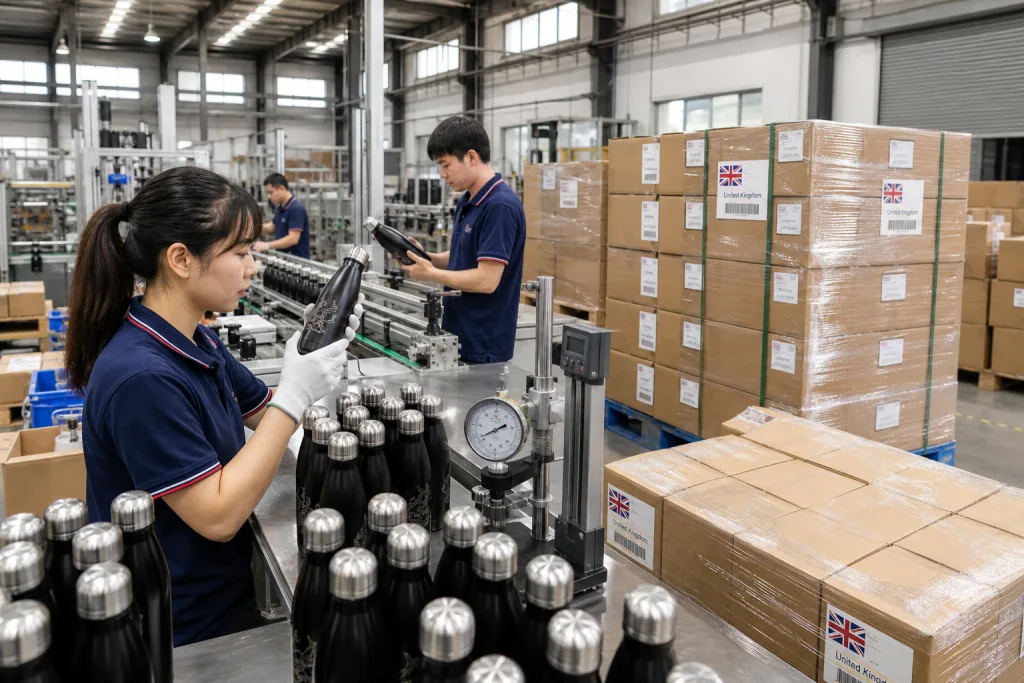
We manufacture in Zhejiang, China, and ship to UK and EU buyers every month. A typical custom drinkware order is 3,000 units per model, 35-45 days production after artwork approval, and AQL 2.5/4.0 inspection before shipment. QC pulled one bottle sample last month because the PO said “matte black” but the artwork file named “black glossy”; small typo, big delay. Use the questions below as a buying checklist, not theory.
Start with the use case
The first question is not stainless steel or plastic. It is where the bottle will be sold, used, and washed. A school canteen bottle faces different damage than a premium growler on outdoor retail shelves. One buyer sent us a PO that mixed 330 ml and 500 ml on the same line; the math did not work. A corporate canteen promo bottle may only need a one-colour logo and 500 ml, while a distributor growler range needs stronger cartons, spare lids, and colour control across 3 or 4 shipments.
For custom drinkware Britain buyers, split demand into four groups before you ask any canteen supplier for pricing:
- Retail drinkware: better shelf box, barcode, colour consistency, drop-test packaging, and clear compliance files.
- Promotional drinkware: sharp logo, stable delivery date, and simple polybag or white box packaging.
- Food service or canteen use: dishwasher expectations, lid hygiene, replacement parts, and lower unit cost matter more.
- Outdoor or sports drinkware: leak testing, powder coating adhesion, handle strength, and larger capacity are important.
Do not send a canteen manufacturer only a picture from the internet. Send capacity, lid type, target FOB price, market, packing style, and expected annual volume. This is the wrong question to ask if you start with colour only. On our line, we check cap torque at 18-22 N·cm before carton drop test, and that catches more bad lids than a pretty render ever will. If you can say, “We need a 750 ml custom canteen, double-wall 304 stainless steel inside, matt black powder coat, laser logo, individual kraft box, 6,000 units for UK retail,” a canteen factory in China can quote properly within 24-48 hours.
At BottleForge Industrial in Zhejiang, our monthly output is about 480,000 stainless bottles and tumblers across standard and customized drinkware projects. QC pulled the sample at AQL 2.5 before it left the packing table. That scale helps, but it does not replace a clean brief. Vague requests get safe, padded pricing. Clear briefs cut revision loops, and we ship with fewer surprises.
Material questions buyers should ask
Most UK buyers ask for “food grade stainless steel,” but that phrase is too loose for a PO. For insulated bottles and a custom canteen, we normally quote 304 stainless steel for the inner wall, 201 or 304 for the outer wall based on the target price, and PP or Tritan for lid parts. For acidic drinks, dairy, or holding times over 6 hours, keep the inner wall at 304. If a canteen vendor offers 201 inside to save USD 0.15, I would reject it for Britain; we had one buyer flag this after a magnet check at incoming QC, and the maths did not work after rework and air freight.
Useful specifications to request from canteen manufacturers include:
- Inner wall material: SUS304, usually 0.4-0.5 mm thickness, checked with a micrometer before forming.
- Outer wall material: SUS201 or SUS304, commonly 0.45-0.55 mm, with the grade written on the PI and carton spec sheet.
- Vacuum insulation performance: 6 hours above 60°C for hot water on 500 ml models, tested at room temperature with a calibrated probe.
- Coating: powder coating, spray paint, or electroplating, with cross-hatch adhesion test if possible and no flaking after 3M tape pull.
- Lid material: BPA-free PP, Tritan straw, silicone gasket, stainless carry handle where needed, with spare gasket MOQ confirmed before mass production.
For a custom growler or customizable growler, watch wall thickness and handle welding. A 1.9 L or 2 L growler filled with beer or cold brew is heavy; weak handle rivets or a thin outer shell create returns fast. QC pulled one 2 L sample last season where the handle weld showed a 4 mm gap after a 10 kg hanging test. Bad sign. For distributor canteen and distributor growler programs, ask whether the same mould will stay available for 12-24 months. A good canteen supplier should tell you if a lid is private mould, shared mould, or close to being discontinued.
For glass bottles, borosilicate is common for better thermal shock resistance, but packaging cost rises because breakage control matters. We run a drop check on the inner box and master carton before quoting sea shipment, and a 3 mm thinner divider can turn into cracked stock at the UK warehouse. If you are new to custom drinkware, stainless steel is usually the safer first China sourcing project because inspection criteria are clearer and replacement parts are easier to stock.
Logo and finish choices
Logo decoration is where 6 out of 10 custom drinkware Britain quotes start drifting over budget. The unit price looks fine, then the artwork calls for full-wrap print, Pantone matching, a special coating, and a retail gift box with barcode sticker. None of these are wrong. Cost them before the PO is issued. We have seen this go sideways when the buyer approved a GBP 2.10 target price, then sent a 360° gradient artwork after our line had already booked screen-print capacity.
For customized drinkware, these are the practical options we quote on the factory floor:
- Silkscreen printing: usually USD 0.12-0.25 per unit for a simple one-colour logo. Best for promotional runs and flat-ish surfaces; our screen jig starts to fight back when the logo crosses a hard shoulder or taper.
- Laser engraving: usually USD 0.20-0.45 per unit. It gives a clean, wear-resistant mark on stainless steel or powder coated bottles, and QC can check the position with a 0.5 mm tolerance gauge.
- Heat transfer: usually USD 0.35-0.85 per unit depending on area. Use it for complex colours and larger graphics, but ask for a rub test after 24 hours because cheap film can lift at the edge.
- UV printing: works for multi-colour logos, but adhesion must be checked on curved surfaces. We run tape tests on the first 20 pcs because glossy powder coat is not always friendly to UV ink.
- Embossed or debossed mould logo: higher tooling cost, normally only sensible above 10,000-20,000 units. Below that, the math usually does not work once the mould charge and sample revision time are included.
A canteen customizable program for a distributor often needs two decoration paths: laser logo for corporate buyers and full-colour print for retail buyers. Keep the base bottle identical if possible. Change decoration only. That lowers inventory risk and can cut reorder production from 18 days to 12 days when we already hold the same lid, body, and carton spec in the system.
Colour is another trap. Powder coating can be matched to Pantone, but the real surface finish changes how the colour looks under UK retail lighting. Ask for a colour chip or pre-production sample. For orders above 5,000 units, we normally recommend a signed golden sample. If the buyer approves only a digital mock-up, the factory and buyer can read the same colour two different ways; last season QC pulled a sample that matched Pantone on the spectrophotometer but looked too blue under a 4000K showroom lamp.
For canteen vendors and brand owners building a long-term range, specify logo size in millimetres, not “same as picture.” A 45 mm logo on a 500 ml bottle and a 45 mm logo on a 1 L bottle do not create the same visual balance. Your artwork file should be AI with outlined fonts, PDF with vector paths, or CDR saved in a production version we can open. Screenshots are not production artwork. The buyer flagged one PO because “logo as attached” referred to a WhatsApp image at 96 dpi, and the line had no usable file for plate making.
Compliance for Britain and Europe
For Britain, compliance is not a PDF we attach at the end of a sales email. You need the right test items for the material, the decoration, and the way the buyer will sell the bottle. A stainless custom canteen with a plastic lid can need food-contact checks on 304 stainless steel, silicone gasket, PP lid, outer coating, and printed decoration if the print area touches hands or mouth. We normally mark these parts on the BOM before sampling; last month QC pulled a 500 ml sample because the silicone ring spec on the PO said “food grade” but the supplier file only covered raw silicone sheet. For EU and UK buyers, LFGB food contact testing is often requested. REACH matters for restricted substances, mainly coatings, pigments, handle parts, and soft accessories.
For children’s bottles, ask tougher questions. This is the wrong place to save USD 80 on paperwork. If the product is clearly designed for children, check small parts, strap strength, sharp edges, and sometimes ASTM or EN-related toy-style risk assessments depending on the design. A kids bottle with a cartoon figurine lid is not the same compliance case as a plain school bottle. We have seen this go sideways when a buyer approved a 3D bear lid, then their UK retailer flagged the 18 mm nose piece as a detachable part during intake inspection.
Your checklist should include:
- Food-contact declaration for the finished product, not only raw material.
- LFGB or equivalent test reports from a recognised lab, issued within a reasonable period.
- REACH statement for coating and plastic parts.
- BPA-free statement for plastic lids and straws.
- Factory audit documents such as BSCI, Sedex, or ISO 9001 if your retailer requires them.
- Product warning text, care instructions, and country of origin marking.
China factories vary a lot here. Some canteen suppliers show a 2021 test report for a similar 600 ml model and call it done. The math does not work for retail. A small promotional order of 1,000 pcs might pass with a buyer waiver, but a UK retailer will usually ask for the exact model, exact coating, and current supplier name on the report. If you are importing into Britain under your own brand, your company carries responsibility. Budget USD 300-1,200 for updated third-party tests depending on the product and number of materials. On our line, one extra colour coating can add one report item and 5-7 working days at the lab.
A serious canteen manufacturer should welcome clear compliance requirements before sampling. Say it early. If testing comes up only after mass production, the project is already at risk. In Zhejiang, we prefer to confirm the compliance path before deposit because changing a coating, gasket, or straw after production starts wastes time and money. We had one PO where “black powder coat” became “soft-touch black” after sample approval; that small wording change meant a new REACH check, a new golden sample, and 12 days lost before packing.
MOQ, pricing, and payment reality
Custom drinkware pricing starts with material, capacity, decoration, packaging, order quantity, and production season. For a standard 500 ml double-wall stainless bottle, a realistic FOB China range may be USD 3.20-5.80 depending on lid, coating, logo, and carton requirements. A 900 ml sports bottle may sit around USD 4.20-7.50. A custom growler is higher because of capacity and metal usage, often USD 8.50-15.00 FOB for common insulated models. On the line, QC checks body weight with a 0.1 g scale; if the bottle is 18 g lighter than the approved sample, the cheap price has already explained itself.
MOQ is a factory cost issue, not a sales trick. It comes from coating line setup, carton printing plates, logo fixtures, and minimum stainless sheet purchasing. For BottleForge, a normal MOQ is 3,000 units per colour for standard stainless models, 1,000 units for stock-colour projects with laser logo only, and 5,000 units when the buyer asks for a Pantone coating, private lid, or retail box with insert tray. A new mould for a special canteen customized shape can require USD 3,000-12,000 tooling and 45-60 days before mass production. We once had a UK buyer push for 800 pcs in 4 colours; the math did not work because the powder coating oven loses almost half a shift on colour change and cleaning.
Payment terms for a first China order are usually 30% deposit and 70% before shipment after inspection. Established distributor drinkware buyers sometimes move to 30/70 against bill of lading copy after 3 or 4 clean shipments, but do not expect that on the first order. FOB Ningbo or FOB Shanghai are standard for Zhejiang factories. For smaller urgent orders, CIF or DAP can be quoted, but compare freight line by line; we have seen a PO where “FOB Shanghai” was typed while the buyer expected DAP Manchester, and that mistake changed the landed cost by more than USD 0.60 per bottle.
Cheap quotations usually hide something: thinner steel, weak coating, skipped inspection, soft carton board, or old test reports. Ask what changed, not why the price is lower. QC pulled the sample for a buyer last winter and found the carton was 5-ply on the quote but 3-ply in the pre-shipment photo.
For canteen distributors in Britain, calculate landed cost before approving design. Add duty, VAT cash flow, freight, inspection, testing, Amazon or retailer packaging, and a 2-3% allowance for spare parts or after-sales. A bottle that looks profitable at FOB level can turn average once UK warehousing and distribution costs are counted. This is the wrong question to ask: “Can you cut USD 0.10?” Ask whether the lid gasket, powder coating, and master carton will survive the actual route from Ningbo to a Birmingham 3PL.
Sampling and inspection checklist
Sampling should prove the product, not decorate your desk. One nice cup on a buyer’s desk means little when the PO says 10,000 units. Use samples to lock structure, lid fit, coating hand-feel, logo position, retail box, barcode, and user sheet before the line opens. For a customizable canteen project, we test the lid like a customer will use it: fill to 95%, shake 20 times, leave it upside down for 30 minutes, drop it into a loaded tote bag, then open it with wet hands. QC pulled one sample last month where the silicone ring sat 0.6 mm proud; it looked fine in photos but leaked in the shake test.
A practical sampling sequence is:
- Reference sample: stock model with close size and lid structure, usually 3-7 days if available; we check body diameter, lid thread match, and carton fit before quoting tooling changes.
- Logo sample: confirms decoration method and position, usually 7-12 days; the buyer flagged a 2 mm logo shift on a 500 ml bottle before, and he was right.
- Pre-production sample: final material, colour, logo, and packaging, usually 10-18 days after artwork and colour approval; this is where Pantone, barcode scan, and gift box dieline must match the approved file.
- Golden sample: signed or sealed sample used for mass production inspection; we keep one in the QC room and one beside the packing line.
Inspection should be booked before the goods leave the canteen factory. Do not ask “can we check it in the UK?” That is the wrong question to ask. Use AQL standards, commonly critical 0, major 2.5, minor 4.0 for drinkware. Critical defects include unsafe sharp edges, contamination, serious leakage, wrong material, or broken glass. Major defects include wrong logo, visible dents, poor coating adhesion, failed vacuum performance, or carton marking errors. Minor defects include small cosmetic marks within agreed limits, such as a 1 mm paint speck on the base outside the agreed viewing area. Our inspector uses a torque gauge, 3M tape test, barcode scanner, and vacuum thermometer; those four tools catch most problems before the pallet is wrapped.
For Britain-bound shipments, carton information matters. Confirm item number, quantity, gross weight, net weight, carton size, made in China marking, and any customer PO number. We have seen this go sideways over one PO typo: “B24-1178” printed as “B24-1187” on 86 cartons, which meant relabelling at the warehouse gate. If you sell through marketplace channels, FNSKU labels and outer carton labels must be checked during packing, not after pallets arrive in the UK. Scan 20 cartons from different stacks. It takes 10 minutes.
A good canteen vendor will send inline photos, packing photos, and final inspection support. Still, use a third-party inspection for first orders above USD 10,000. The fee usually hurts less than one rejected shipment, and the math does not work if you find mixed lids or wrong carton marks after arrival. Before we ship, we run a final photo set: open carton, inner polybag, colour comparison under the light box, carton mark, pallet height, and container loading shot. Buyers ask for fancy reports, but clear evidence from the line often saves the order.
Shipping decisions before deposit
Most buyers talk freight after the sample is approved. That is late. Drinkware eats space fast, and the box choice can move the landed cost more than the bottle itself. A 500 ml stainless bottle in a retail box usually gives 24 units per carton, about 46 x 32 x 28 cm, with gross weight around 9-11 kg. On the packing table, QC pulled the sample through a 1.2 m drop test, and the gift box with foam insert still cut carton fill by 15-25%. The line feels that change in container loading, pallet count, and courier rates inside Britain.
For normal custom drinkware Britain orders, sea freight is the sensible call. Production takes 35-45 days, then sea freight to the UK often runs 30-40 days port to port depending on route and season. Add customs clearance and inland delivery. If you need stock for a September university campaign, placing the PO in late July is a bad bet. We have seen buyers try to save it with air freight, and the math does not work once the cartons are heavy.
Before deposit, confirm these points with your canteen supplier and freight forwarder:
- Incoterm: FOB Ningbo, FOB Shanghai, CIF Felixstowe, or DAP warehouse.
- HS code and duty rate assumption.
- EORI number and importer of record.
- Pallet requirement, if any, including ISPM 15 wood packaging rules.
- Carton drop-test expectation for retail or e-commerce.
- Spare parts quantity for lids, straws, gaskets, and handles.
Distributor canteen and distributor growler buyers should also ask about reorder lead time. If the mould stays on the shelf and the standard material is ready, a repeat order can run in 25-35 days after deposit. If the colour is special, coating powder adds 7-10 days. Chinese New Year can push the schedule back 3-5 weeks, and that is where projects slip. We once saw a PO with the warehouse postcode typed wrong by one digit, and the booking sat for two days while the buyer fixed it. Plan annual programs backward from the shelf date, not from the day you remember to send the purchase order.
When the quotation, sample, compliance file, inspection plan, and freight assumptions all match, the project is ready for deposit. QC pulled the signed golden sample from the shelf, checked the print position against the ruler, and that was the green light. Until then, it is just a bottle on a screen. That is the wrong question to ask if you want stock on time.
Send your UK drinkware brief for a factory quote
Share capacity, quantity, logo, packaging, and delivery date. Our Zhejiang team will return a practical FOB quote and sampling plan.
Frequently asked questions
What MOQ should I expect for custom drinkware Britain orders?
For most stainless custom drinkware, expect 3,000 units per model and colour. Some stock models with a laser logo can start around 1,000 units, but the unit price will be higher and colour choice may be limited. If you want Pantone powder coating, retail box printing, or a special lid, 5,000 units is more realistic. A new custom canteen mould may need 10,000 units to make the tooling cost sensible. For canteen distributors testing a range, we often suggest starting with two proven models and two colours rather than six small runs that create high setup cost.
Which logo method is best for a customized canteen?
For long-life retail or corporate use, laser engraving is the safest choice on stainless or powder coated surfaces. It usually costs USD 0.20-0.45 per unit and resists scratching better than basic printing. Silkscreen is cheaper, often USD 0.12-0.25, and works well for simple one-colour promotional orders. Heat transfer or UV printing is better for full-colour artwork but needs adhesion testing, especially on curved bottles. If you are a canteen distributor building repeat orders, approve a golden sample with logo size in millimetres and keep the same artwork file for future batches.
Do UK buyers need LFGB or REACH testing?
Most serious UK and EU buyers ask for food-contact testing such as LFGB, plus REACH declarations for coatings, pigments, plastics, and accessories. The exact test depends on the product. A stainless bottle with PP lid, silicone gasket, straw, and exterior coating has several material contact points. Do not rely only on a raw stainless steel certificate. For private label retail, budget USD 300-1,200 for updated testing depending on the number of materials and lab scope. Ask the canteen manufacturer for recent reports before deposit, then decide whether your brand needs new tests under your item name.
How long does production and shipping from China to Britain take?
A normal timeline is 7-18 days for sampling, 35-45 days for mass production after deposit and final artwork approval, then about 30-40 days sea freight to a UK port. Customs clearance and inland delivery add more time. For repeat orders using the same colour and packaging, production can sometimes drop to 25-35 days. Chinese New Year can add 3-5 weeks because factories, coating suppliers, and carton plants close or slow down. If your goods are for a dated campaign, work backward from the required warehouse arrival date, not the event date.
How do I compare quotes from different canteen suppliers?
Put every quotation into the same format: capacity, inner and outer steel grade, wall thickness, lid material, logo method, packaging, MOQ, FOB port, lead time, test reports, and inspection standard. A USD 0.40 cheaper quote may use 201 stainless inside, thinner carton, no updated LFGB report, or weaker coating. Ask for net weight per unit and carton dimensions; these affect both quality and freight. For first orders above USD 10,000, require AQL inspection before balance payment. A reliable canteen supplier will explain cost differences clearly instead of only saying “best price.”