Key Takeaways
- Typical MOQ starts at 500-1,000 pcs for stocked stainless styles and 3,000-5,000 pcs for new mold custom drinkware
- FOB China cost often ranges from USD 2.20-8.50 depending on size, steel grade, lid structure, and decoration
- A normal custom drinkware America order needs 35-55 days after artwork approval, plus ocean or air freight time
- AQL 2.5/4.0 inspection, FDA/LFGB/REACH checks, and carton drop testing should be budgeted before mass production
If you buy custom drinkware for America, the bottle price is usually the wrong question to ask first. The real risk is the neat quote that changes after artwork setup, Pantone matching, FDA or LFGB testing, carton marks, barcode labels, and freight terms get added. We had a buyer flag this last March: a $3.20 tumbler moved to $4.10 landed after the PO missed the color box requirement and 3-side carton printing.
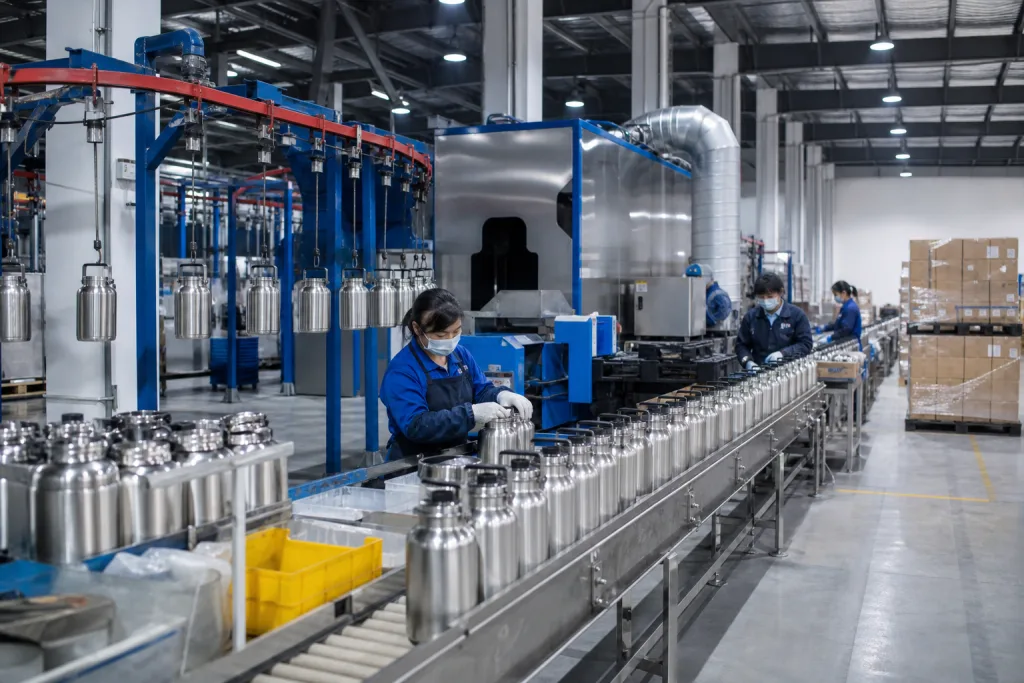
From our factory in Zhejiang, China, we see this pattern every season. Brand owners ask for retail-grade customized drinkware, distributors push for stable reorders, and procurement teams need a ship date they can defend to sales. We run the project by cost driver, MOQ tier, and a real 35-75 day schedule before tooling starts or the deposit lands; QC pulled one sample last week over a 0.4 mm logo shift, and that small miss is exactly how timelines slip.
Start With The Real Cost Stack
For custom drinkware America programs, the factory unit price is only line one on the cost sheet. A clean quote should break out material, decoration, packaging, testing, inland trucking to Ningbo or Shanghai, and export documents. We run quotes in RMB first, then convert to USD at the day’s rate; a 0.15 change in exchange rate can move a 3,000 pcs order by a few hundred dollars. If a canteen supplier sends one round number with no breakdown, that is not a quote. It is bait.
For a common 500 ml double-wall stainless custom canteen, the FOB China price usually sits around USD 3.20-5.20 at 1,000-3,000 pcs. A larger 40 oz travel tumbler with handle and straw lid may run USD 5.80-8.50. A single-wall aluminum promotional canteen can be lower, often USD 1.80-3.00, but it will not give the same insulation or retail feel. On the line, we check wall thickness with a digital caliper; 0.4 mm and 0.5 mm bodies do not feel the same in hand, and buyers notice when the sample feels lighter than approved.
Decoration is the next driver. One-color silk screen may add USD 0.08-0.18 per unit. Laser engraving is often USD 0.15-0.35 depending on logo size. Powder coating can add USD 0.35-0.90. Full-wrap heat transfer, water transfer, or UV printing can move the price by USD 0.50-1.20. For customized growler orders, the print area is bigger, so budget near the upper side of that range. We have seen this go sideways when a PO says “logo same as sample” but the artwork file is 62 mm wide instead of the approved 48 mm; QC pulled the sample, and the buyer flagged it before packing.
Packaging also changes the math. A plain white box may cost USD 0.12-0.25. A printed retail box is usually USD 0.28-0.65. Insert cards, barcode labels, FNSKU labels, and master carton changes look small on one piece, but at 10,000 pcs the math gets painful fast. One Amazon buyer pushed back on a USD 0.04 stronger carton upgrade; after the drop test, 11 cartons had crushed corners, so the cheaper carton was the wrong question to ask.
Ask for a line-item FOB quote. If you cannot see where the money goes, you cannot compare canteen vendors fairly.
MOQ Tiers That Actually Matter
MOQ is not a factory trick. It comes from steel coil purchasing, coating line setup, printing fixtures, carton production, and QC sampling under AQL 2.5. At BottleForge Industrial in Hangzhou, Zhejiang, we run about 600,000 stainless drinkware units per month, but the right MOQ depends on how far the order moves away from our standard parts. Last month QC pulled 32 pcs from a 1,200 pc logo order just to check engraving depth and rim finish. That labor is real.
For stocked shapes with your logo, 500 pcs can work for laser engraving or one-color print. For powder coated custom drinkware, 1,000 pcs per color is a better starting point because the coating line loses material during gun cleaning and color change; a 12-minute color swap still eats cups at the conveyor. For a canteen customized with a private lid, special cap color, silicone boot, or retail packaging, 2,000-3,000 pcs is usually safer. We have seen 600 pc “trial” orders go sideways when the buyer wanted four Pantone colors and individual barcode stickers.
New mold projects are different. A new custom canteen body, lid, handle, or customized growler shape normally starts at 3,000-5,000 pcs for the first order, sometimes higher if the part uses injection tooling. Mold cost can range from USD 800 for a simple silicone accessory to USD 5,000-15,000 for a more complex lid set. Stainless body tooling is often lower than buyers expect; lid tooling is where the bill hides, especially when the CAD shows a flip spout, gasket groove, and carry loop in one assembly. The math does not work for 500 pcs.
Distributor canteen and distributor drinkware programs should plan reorder tiers from day one. A 1,000 pc launch order is fine for market testing, but your cost improves at 3,000 pcs and again at 10,000 pcs. Canteen distributors in North America often place mixed-model containers, combining sports bottles with tumblers or growlers to improve freight efficiency while keeping item-level MOQ reasonable. We ship these as 20GP or 40HQ mixed loads, and the buyer often flags carton CBM before they flag unit price.
Lead Time From Artwork To Vessel
A clean timeline prevents most arguments. For standard customizable drinkware using an existing factory model, plan 7-10 days for sample preparation after artwork confirmation. If you need Pantone-matched powder coating, add 3-5 days for color panels. If you need a physical pre-production sample shipped to America, add 3-6 days by courier. On our line, QC pulls the first print sheet before we cut the sample sleeve.
Mass production usually takes 25-40 days after deposit and sample approval. The lower end applies to stocked stainless bodies with laser engraving or simple silk screen. The upper end applies to powder coating, multi-position printing, special packaging, or orders above 20,000 pcs. For a new mold custom growler or customizable canteen lid, add 25-45 days before mass production begins because tooling, T1 samples, and corrections take time. A 32-cavity lid mold does not turn in one afternoon.
Inspection and loading should not be squeezed. AQL inspection normally needs 1 day for 5,000-10,000 pcs, plus time to issue a report and handle any sorting. Ocean freight from Ningbo or Shanghai to Los Angeles is often 15-25 days port to port, while East Coast delivery can be 30-40 days. Air freight can be 5-9 days but may cost more than the product on bulky drinkware. We have seen a PO typo on carton count turn into a missed pallet, so the buyer flagged it before the truck left.
A practical schedule for custom drinkware America is 35-55 days FOB for existing models, then freight. For new molded projects, 70-110 days is more honest. When a canteen manufacturer promises 20 days for a complex new item, ask which steps they are skipping: sample, coating cure time, testing, inspection, or packing. The math does not work, and we have watched that shortcut go sideways at least 3 times this quarter.
Decoration Choices And Hidden Charges
Decoration is where a custom drinkware order makes margin or turns into rework. A 38 mm logo on a flat tumbler wall is easy. A 360° mountain graphic on a tapered canteen, with color registration over powder coating, is a different job. Before artwork approval, the canteen factory should give you the printable area in mm, curvature limits, registration tolerance, and scratch test method; on our line, QC checks the first 20 pcs with a 3M tape pull and a caliper, not just a photo.
Silk screen is still the lowest-cost decoration for promotional orders. It suits one to three solid colors and runs efficiently above 1,000 pcs, especially when the logo sits away from the shoulder radius. Laser engraving looks clean on stainless or coated bottles because ink adhesion is not involved, but it will not reproduce full-color artwork. UV printing handles detailed graphics, but it needs proper surface treatment and abrasion checks; we have seen nice-looking UV samples fail after 50 dry rubs. Heat transfer works for full-wrap designs, though setup is slower and QC must watch the seam. The math doesn't work if the buyer wants retail-grade full wrap at giveaway pricing.
Common one-time charges include screen fees of USD 30-80 per color, laser fixture fees of USD 50-150, and digital proofing fees when artwork needs adjustment. Pantone coating setup may be free at higher volume but can cost USD 100-300 for small runs. For canteen promotional projects, we see 6 out of 10 buyers forget barcode labels, individual polybags, carton shipping marks, or inner carton assortment rules until the PO is already issued. Small items. Real delays. Last month a buyer typed “matte black” on the artwork file but “gloss black” on the PO, and the line stopped while sales, coating, and QC matched the approved sample.
For customized canteen and customized growler items sold at retail, ask for cross-hatch adhesion testing, dishwasher guidance, and abrasion testing. No supplier can make every coating dishwasher-proof forever. A serious canteen manufacturer will state the expected result, such as hand-wash recommended or coating stable after a defined rub test, instead of hiding behind soft words like premium or durable. If QC pulled the sample and the coating lifted at the rim after tape testing, we should say so before the shipment leaves Hangzhou.
Compliance For American Buyers
For U.S. programs, lock the compliance plan before we cut steel or print artwork, not after 3,000 cartons land in your warehouse. For stainless drinkware, confirm food-contact safety, heavy metal limits, BPA status on plastic lids, and retail packaging rules. We usually see American buyers ask for FDA food-contact documentation; some also add LFGB for Europe-linked programs, plus REACH or California Proposition 65 screening when the sales channel requires it. QC pulled one sample last month where the silicone gasket was listed as “rubber” on the PO, and that small wording issue delayed the test booking by 2 days.
Kids items need a tighter file. A kids bottle may need CPSIA, lead and phthalate testing, ASTM-related checks, and tracking labels based on the product structure and selling channel. If your project is an adult custom canteen, the test plan is lighter, but the lid is still not a free pass. PP, Tritan, silicone, rubber seals, paint, and ink all need to appear on the bill of materials. We run into buyer pushback here: “It’s only the lid.” Wrong question. If the mouth touches it, the lab will care.
Quality control should cover incoming material checks, vacuum insulation testing for double-wall items, leak testing, coating inspection, logo position checks, and final AQL. A normal final inspection might use AQL 2.5 for major defects and 4.0 for minor defects, with critical defects set at 0. For insulated drinkware, we also run hot water temperature retention sampling, lid fit checks, and carton drop testing. Simple test. Real problems show up. On the line, a 0.3 mm lid thread mismatch can pass a quick glance, then fail after 20 open-close cycles.
BSCI, ISO 9001, and factory audit records matter when you sell to larger retailers or corporate programs. They do not replace product testing, but they show the canteen supplier has documented systems. Good canteen suppliers in Zhejiang and other parts of China already know this paperwork; we ship audit files, material declarations, and test reports before mass production photos go out. If a canteen vendor refuses basic material disclosure, slow down. We’ve seen this go sideways, and the math does not work once re-testing, air freight, and retailer chargebacks start stacking up.
Freight, Duties, And Landed Planning
Drinkware ships a lot of air. That is where landed cost gets messy. A 20 oz tumbler may look fine at FOB USD 4.20, but one thick color box can push a master carton from 0.052 CBM to 0.071 CBM and cut container loading by 18–22%. Before you confirm the PO, ask for unit weight, carton size, pcs per carton, gross weight, and estimated CBM. We run these numbers from the packing table after QC checks the inner box with a tape measure, because your forwarder cannot quote cleanly from a product photo.
For America-bound shipments, most B2B buyers use FOB Ningbo or FOB Shanghai when sourcing from Zhejiang, China. FOB keeps the factory responsible for export handling up to the vessel, while your forwarder controls ocean freight, customs entry, duty, and final delivery. DDP looks simple for a 300 pcs trial order, but it often hides freight and duty assumptions in one blended number. For larger distributor drinkware programs, FOB is cleaner. We have seen this go sideways when a buyer compared DDP against FOB without adding the 18 kg carton weight and U.S. final-mile charge.
Air freight fits samples, urgent launch quantities, or replacement lids. It rarely works for 5,000 pcs of stainless tumblers unless missing the retail date costs more than the margin. Ocean freight is slower but practical; Ningbo to a U.S. West Coast door might run about 18 days port-to-port, while East Coast routings can sit closer to 32–38 days depending on sailing and rail. If you sell through online fulfillment, confirm FNSKU labels, carton weight limits, pallet rules, and case pack requirements before production. QC pulled the sample carton last month because the FNSKU was 6 mm too close to the seam. Reworking labels in a U.S. warehouse is the wrong place to save planning time.
Duties vary by HS code, material, and policy changes, so your customs broker should verify the rate. A canteen distributor importing stainless bottles, glass bottles, and plastic lids in the same shipment may have multiple classifications. The factory can suggest typical codes, but the importer of record owns the final declaration. We ship mixed-material orders every week, and one PO typo, such as “plastic cup” instead of “304 stainless steel tumbler,” can trigger extra broker questions before customs release.
Choosing A Factory Without Guesswork
A good canteen manufacturer is not the cheapest name on a quote sheet. Ask for tolerance limits, reject rate, daily line capacity, and the backup plan when artwork fails on the first sample. We ask buyers for the same basics every week: monthly output, in-house processes, outsourced processes, and who owns the mold. On our Hangzhou line, QC pulled 32 samples from one 8,000 pcs run because the logo sat 1.8 mm off center after heat transfer. At BottleForge Industrial, we would rather tell buyers early that a design will add 3-5% scrap than pretend the job is easy.
Compare canteen manufacturers with one specification sheet. Put capacity, material grade, wall thickness, lid material, coating type, logo size, packaging, inspection standard, and Incoterm on the same page. No guessing. A 0.4 mm stainless wall and a 0.5 mm wall price out differently once you run the coil weight through the BOM. 304 stainless and lower-grade substitutes do not pass the same smell, rust, and salt-spray checks. A leak-resistant straw lid with silicone seals costs more than a basic screw cap because the mold has more parts and the assembly station runs slower. The math doesn't work any other way.
If you are a canteen distributor or buying from several canteen vendors, keep a golden sample and signed production file for every SKU. Include Pantone number, logo position tolerance, carton layout, barcode, and spare parts requirement. We run into trouble when a reorder PO says “same as last time” but the buyer’s team changed the barcode by one digit or forgot the lid gasket color. Small typo, big delay. A signed file stops every reorder from turning into another price fight.
The best custom drinkware America projects start with honest limits: target FOB price, target retail price, launch date, compliance market, and reorder plan. A strong canteen factory can then say whether you need a stocked custom canteen, a canteen customizable with color and logo changes, or a fully canteen customized mold. Those are not three versions of the same job. Stock color plus logo might ship in 12 days after sample approval, while a new mold can push the schedule to 35-45 days before mass production even starts. We have seen this go sideways when the buyer wants retail launch dates before confirming the lid drawing.
Send your drinkware spec for a real factory quote
Share quantity, market, artwork, and target FOB price. We will return MOQ, lead time, decoration options, and practical cost notes.
Frequently asked questions
What is the normal MOQ for custom drinkware shipped to America?
For existing stainless drinkware models, the normal MOQ is 500-1,000 pcs per design for laser engraving or simple one-color printing. Powder coated colors usually start at 1,000 pcs per color because coating line setup creates material loss. If you need a new lid, new body shape, or private mold custom canteen, expect 3,000-5,000 pcs for the first run. A canteen promotional project with low-cost single-wall bottles may be possible at 1,000 pcs, but retail-grade customized drinkware is more stable at 2,000 pcs and above. MOQ can also change if you require printed gift boxes, mixed colors, or special barcode labeling.
How much should I budget for a customized growler or canteen?
A stainless custom growler normally ranges from USD 6.50-12.00 FOB China depending on capacity, wall structure, cap design, handle, coating, and packaging. A 500-750 ml customized canteen can range from USD 3.20-6.00 for double-wall stainless, while single-wall promotional items can be lower. Decoration may add USD 0.10-1.20 per unit. Retail packaging can add USD 0.30-0.80. Testing, inspection, and freight are separate. If a canteen vendor quotes far below these ranges, check material grade, wall thickness, insulation performance, and whether the price includes logo, carton marks, and export packing.
Can I mix several colors or models in one purchase order?
Yes, but each color and model must still make production sense. For a 3,000 pc order, splitting into three colors at 1,000 pcs each is usually workable for powder coating. Splitting into six colors at 500 pcs each may raise cost or fail MOQ. Mixing a custom canteen, tumbler, and customizable growler in one container can improve freight efficiency, especially for canteen distributors, but each SKU still needs its own artwork approval, QC file, and packing details. If you want mixed cartons, tell the factory early because it affects barcode labeling, inner carton handling, and final inspection sampling.
How long does a pre-production sample take?
For an existing model with logo engraving or silk screen, a pre-production sample usually takes 7-10 days after artwork approval. Powder coating with a custom Pantone color may take 10-15 days because the factory needs color panels and curing checks. A new mold lid or body can take 25-45 days for tooling and first samples. Courier shipping from Zhejiang, China to the United States or Canada normally adds 3-6 days. Do not approve mass production from a digital mockup only if color, lid fit, or retail packaging matters to your customer.
Should I buy from a trading company or a canteen factory?
A trading company can be useful if you need many unrelated products, but for distributor growler and distributor canteen programs, a factory gives better control over material, decoration, inspection, and reorders. Ask whether vacuum testing, coating, printing, and packing are in-house. Some canteen suppliers are strong at stainless forming but outsource coating or UV printing, which is fine if they control QC. The key is transparency. You should receive a clear specification sheet, AQL standard, lead time, and FOB terms. If the supplier cannot explain wall thickness, lid material, or defect limits, price alone is not enough.