Key Takeaways
- For stainless custom drinkware, a realistic factory MOQ is 1,000-3,000 units per colour and shape
- UK buyers should check LFGB, REACH, BPA-free declarations, AQL level, and packaging labelling before deposit
- Laser engraving usually adds USD 0.12-0.35 per unit; full-wrap printing can add USD 0.45-1.20
- Normal lead time from China is 25-35 days after artwork approval, plus 30-40 days sea freight to the UK
Buying a custom drink bottle UK programme looks easy until you line up 12 quotes and find they are not selling the same thing. One supplier writes 201 stainless steel, another writes 304, one includes a kraft box, and one tucks the logo plate fee into the sample line. We see this on the line all the time, and the buyer usually catches it only after the PO is already drafted.
If you are a UK distributor, retail buyer, or brand owner, the real question is not “which bottle is cheapest.” It is which spec can pass UK compliance checks, survive repeat orders, hold up in carton drop tests, and still leave you margin. We run these jobs from Zhejiang every week, and the same mistake keeps showing up: people compare price before they compare MOQ, wall thickness, and print method. The math does not work. A bottle that looks fine at sample stage can turn into a headache on a 5,000-unit reorder.
Start with the buying decision
A clean custom drink bottle UK brief starts with four decisions: the bottle format, the exact material spec, the print process, and where the goods will be sold. Set those before asking a canteen factory for pricing. Otherwise you get five “cheap” quotes that cannot be compared, and QC pulled the sample tray last month for this exact reason: one supplier quoted bulk pack, another quoted retail box, and the buyer flagged a £0.18 gap that was not a real saving.
Product type is the first filter. A school or outdoor campaign often specs a 500 ml single-wall custom canteen with a carabiner lid. A retail gift set usually moves to a 750 ml vacuum bottle with powder coating. A brewery or outdoor lifestyle brand asks for a custom growler or customized growler in 1.2 L to 1.9 L capacity, and then the carton size changes fast. On our line, a 750 ml vacuum bottle packs 24 pcs per export carton, while a 1.9 L growler often drops to 12 pcs; that affects freight, pallet count, and the drop-test result.
Material is the second filter. For stainless bottles, 304 stainless steel for the inner wall is the normal export choice. Some low-cost quotes use 201 stainless steel outside and 304 inside, which works for certain promotional orders, but it must be written on the PI and PO, not agreed in a WeChat message. We have seen this go sideways when a UK buyer expected full 304 stainless and the incoming inspection report showed 201 on the outer shell with an XRF tester.
Branding is the third filter. A canteen customizable by laser, pad print, silkscreen, heat transfer, water transfer, or full-colour UV print will not carry the same unit cost or scratch resistance. A one-side laser logo on a 35 mm area is a simple job; a 360-degree retail design needs artwork separation, colour matching, and usually one extra pre-production sample. The wrong question to ask is “which print is cheapest?” Ask how it will look after 50 dishwasher-style rub cycles or a 3M tape test.
The fourth decision is channel. A canteen promotional order for an event can run with simple polybag packing and a plain carton mark. Distributor drinkware sold through UK wholesale accounts usually needs barcode labels, carton marks, spare lids, and repeatable colour control, down to the approved Pantone chip under a D65 light box. If you are a canteen distributor, your supplier must quote like a production partner, not just a sample seller; we ship repeat orders on this basis, and the math does not work if the first quote ignores labels, inserts, and 2% spare parts.
Choose material by use case
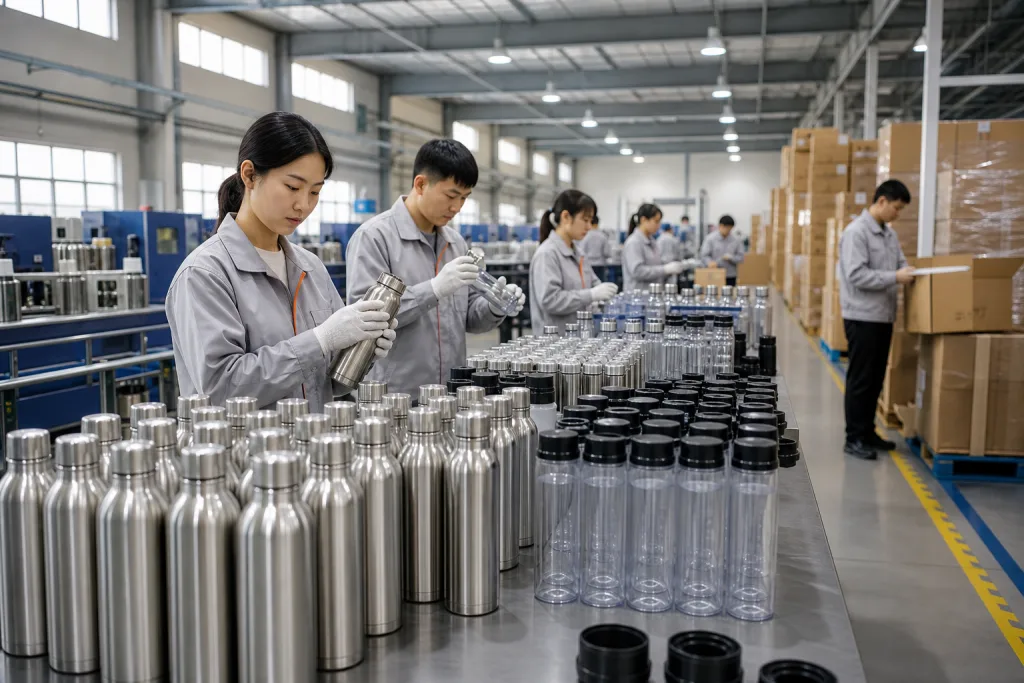
Start with the use case: how the bottle is filled, washed, dropped, packed, and sold. Stainless steel is still the safest choice for mid-range and premium custom drinkware because buyers understand the weight in hand, vacuum insulation works well, and the surface accepts laser engraving, powder coating, and 1-colour logo printing without drama. On our line, a common vacuum bottle uses 0.4 mm to 0.5 mm outer wall thickness and 0.4 mm inner wall thickness, with copper coating available for better heat retention; QC checks the cut rim with a digital caliper before welding.
For a customized canteen aimed at hiking, corporate gifting, or student use, 304 stainless steel inner wall is usually worth the small cost difference. The math doesn't work if you save USD 0.18 per unit and then deal with 2 cartons of rust complaints after the first rainy-week promotion. It gives you a cleaner compliance story and fewer complaints about rust. Aluminium can be cheaper and lighter, but it needs an internal lining and tighter migration testing; one UK buyer flagged this after their PO called for “food grade aluminium” but forgot to specify the coating. Plastic works for sports bottles, especially Tritan, but UK buyers check BPA-free wording closely and complain fast when a bottle smells after hot-water washing.
Glass bottles look clean and sustainable, but they are heavier and breakage risk changes your landed cost. A 550 ml borosilicate bottle may look attractive in a showroom, but the carton drop test matters if you ship to 6 canteen distributors across the UK. We run the test before mass packing, not after. Silicone sleeves help, but they add labour at the packing table and can create colour matching problems when the sleeve is Pantone 542C and the printed logo dries half a shade darker.
For a custom growler or customizable growler, stainless steel is normally the practical option. A 64 oz growler needs stronger welding, stable caps, and pressure-aware testing if buyers use it for carbonated drinks. Do not treat it like a tall water bottle. Ask your canteen manufacturer to confirm lid sealing structure, thread tolerance, and whether the item has passed a 24-hour leakage test; QC pulled the sample upside down in a 45°C water bath for one pub-chain order because the buyer had seen caps creep loose in transit.
Cheap material decisions usually cost money later: rust claims, odour returns, failed audits, or cartons that cannot survive UK distribution.
Branding changes cost and risk
Branding is where UK buyers lose control of cost. A plain bottle quote looks cheap, then the PO arrives for a canteen customized with logo, colour, barcode, swing tag, and retail box. That is no longer the same job. On one 5,000 pcs order last March, the buyer flagged a missing EAN sticker after carton artwork approval, and the line had to stop for half a day while QC checked every master carton.
Laser engraving is clean and hard-wearing on stainless steel. We use it often for corporate distributor canteen orders because there is no ink adhesion problem, and the logo does not peel in a tape test. The trade-off is colour. It usually comes out silver or dark grey, depending on coating and laser depth. Expect around USD 0.12-0.35 per unit for simple laser work at normal volumes. QC pulled the sample after 30 passes on the engraving jig once because a 0.4 mm stroke in the logo filled in.
Silkscreen printing works best for one or two colours on a flat or gently curved print area. Good for canteen promotional runs. The weak points are registration and scratch resistance, so your canteen supplier should run tape tests and abrasion checks before mass production. Full-wrap heat transfer or water transfer gives stronger retail shelf appeal, but setup costs more and a small dust spot shows up fast. We have seen this go sideways when a buyer approved artwork at 1:1 PDF size but never checked the seam position on the actual bottle.
Powder coating needs attention before you sign the PI. Matte black, navy, cream, and sage green sell well in UK custom drinkware, but colour tolerance must be agreed. We normally push for a Pantone target with a physical pre-production sample, not a screen image. Powder coating thickness often sits around 60-90 microns. Too thin and it chips; too thick and lids or handles may fit poorly. Our coating room checks thickness with a digital film gauge, and a 95-micron shoulder can already make a flip lid feel tight.
If you work with multiple canteen vendors, insist that each quote states the exact logo method, print area in millimetres, number of colours, packaging style, and whether artwork proofing is included. Otherwise, you are comparing guesses, not prices. This is the wrong place to chase the lowest line item; the math does not work after one rejected pre-shipment inspection under AQL 2.5.
Check compliance before artwork
For the UK and EU-facing market, check compliance before your designer spends 3 days placing logos and Pantone references. A serious canteen manufacturer in China should be able to send material declarations and matching test reports, but you still need to check the report against the exact material, coating, lid, silicone gasket, and colour. We have seen this go sideways when a buyer approved a report for a clear PP lid, then ordered a smoked black AS lid with a different gasket.
For stainless steel and plastic drinkware, UK buyers usually ask for LFGB or EU food contact testing, REACH for restricted substances, BPA-free declarations for plastic parts, and sometimes ASTM or CPSIA-related checks for children’s bottles. If the bottle is positioned for children, the bar is higher. A kids bottle with a straw, painted coating, and small accessories is not the same job as a basic adult flask. QC pulled one sample last year because the straw brush was 68 mm long and could be treated as a small part risk under the buyer’s own checklist.
Factory audits also matter. BSCI, ISO 9001, and internal quality systems do not guarantee a perfect order, but they show whether the canteen factory has process discipline. At our Zhejiang facility, standard drinkware output is around 450,000 units per month, with incoming material inspection, vacuum testing, leak testing, and final AQL inspection before shipment. We run vacuum checks on the line before packing, then the inspector opens cartons again with a caliper, torque tool, and water-fill test. For most export orders, buyers use AQL 2.5 for major defects and AQL 4.0 for minor defects, though stricter retail programmes may require different limits.
Ask your canteen suppliers for a compliance pack before deposit: material list and test reports, audit documents if available, product drawings with component names, and packaging specifications with carton size and gross weight. For UK Amazon or marketplace orders, you may also need FNSKU labels, suffocation warnings on polybags, carton weight control, and barcode scan checks. Small stuff matters. We once had a PO typo showing “FNSKU on inner box only,” while the buyer’s warehouse required one scan label on each retail carton, so the packing team had to relabel 1,200 cartons before loading.
Do not accept “we have certification” as an answer. This is the wrong question to ask. The correct question is: which lab, which standard, which product, which date, and which components were tested?
Price the landed order, not FOB
FOB China is one line on the quote, not the buying decision. It works for a quick check between canteen manufacturers, but it will not show your landed cost in Birmingham, Manchester, Bristol, or your 3PL warehouse. We have seen a USD 3.20 bottle lose to a USD 3.45 bottle once our carton tester showed the cheaper option needed bulky packaging and wasted pallet space.
For a typical 500-750 ml stainless custom drink bottle UK order, MOQ is often 1,000-3,000 units per colour, depending on shape, coating, and branding. A simple single-wall stainless custom canteen may start around USD 1.80-2.80 FOB at volume. A vacuum insulated bottle may sit around USD 3.20-6.50 FOB depending on capacity, lid, coating, and logo. A custom growler can range much higher because of size, steel use, and carton volume. On the line, we check body weight with a digital scale before quoting growlers; 40 g extra steel across 3,000 pcs is not a rounding error.
Packaging moves the number fast. White box, colour box, kraft box, display box, insert card, and gift tube each change unit price and how many cartons fit in a container. UK distributors often ask for individual colour boxes because they sell through trade customers. Fair request. It can still add USD 0.20-0.80 per unit and push carton cubic metres up by 10-25%. Last month QC pulled a sample where the colour box was 3 mm too tall, and that small miss cut one full layer from the export carton.
Freight timing is where the math often breaks. Normal production in Zhejiang, China is 25-35 days after sample and artwork approval. Sea freight to the UK commonly takes 30-40 days port to port, depending on season and routing. Air freight is faster, but stainless bottles are heavy, so the margin can disappear. We ship urgent samples by air, not 2,000 finished vacuum bottles, unless the buyer accepts the cost in writing.
When comparing canteen vendors, build one spreadsheet with FOB price, packaging cost, estimated CBM, carton quantity, duty, freight, customs clearance, inland delivery, inspection cost, and expected defect allowance. This is the wrong question to ask: “Who has the lowest FOB?” Ask what lands at your warehouse after AQL 2.5 inspection, duty, and delivery. We once had a PO with “Bristol” typed as “Bristoll”; small typo, slow clearance, annoyed buyer. That is the price you actually pay.
Sampling should prove production reality
A sample should not be a glossy one-off from the sample room. It should prove the canteen vendor can run the same item on the production line at 3,000 or 10,000 pcs without surprises. For customised drinkware, we usually push buyers through three sample stages: existing stock sample, logo sample, and pre-production sample. QC pulled a sample last month that looked perfect, then found the production lid used a 0.6 mm thinner gasket. That is exactly what sampling should catch.
An existing stock sample lets you check shape, grip, lid style, drinking flow, and general quality. It is fast and often available in 3-7 days. A logo sample confirms engraving depth, print colour, position, and artwork size; laser logos usually move faster than full-wrap screen print. It may take 7-12 days, or 14-18 days for full-wrap designs or custom powder coating after the colour card is approved. A pre-production sample should use the approved material, approved colour, approved logo, and approved packaging. This is the sample your purchase order should reference, down to the SKU, carton mark, and lid code on the packing list.
For a canteen customizable with multiple options, keep the approval record strict. Note the Pantone colour, print size, bottle weight tolerance, lid material, gasket colour, packaging dimensions, and carton mark. Use numbers, not memory. We run this on a simple approval sheet with bottle weight in grams, print area in mm, and carton size in cm. If you approve “black bottle with logo” by email only, you create space for arguments later. We have seen this go sideways when a buyer flagged matte black as “too grey” after 5,000 pcs were packed.
Physical testing during sampling is worth the time. Fill the bottle with hot water, invert it for 24 hours, run a dishwasher check if the claim is being made, test the lid after 50 open-close cycles, and scratch the print with a coin or 3M tape test. Simple checks work. For vacuum bottles, ask for heat retention data. A common test is 95°C water measured after 6, 12, and 24 hours at room temperature. On our line, QC also weighs the bottle on a digital scale and checks mouth diameter with a vernier caliper, because a 1 mm mismatch can make a sports cap feel loose.
Sampling costs are not wasted money. They are cheaper than air-freighting replacements to the UK after a distributor growler or bottle order fails at customer level. The math does not work: a £65 sample charge is nothing beside 12 cartons rejected by a corporate client before an event. We ship samples by DHL or FedEx because the buyer needs the real bottle in hand, not another polished render with perfect lighting.
Pick suppliers for repeat orders
The cheapest first quote is not the same as the best canteen supplier. Wrong question to ask. For a repeat custom drinkware programme, you need a canteen factory that locks the spec sheet, tracks artwork V2 versus V3, and flags risky artwork before the line starts. We run calipers on wall thickness, keep a signed Pantone chip with the golden sample, and check lid torque before packing.
Look for practical signals. Does the supplier ask where you sell, or do they only send a price? Do they state 304 stainless steel grade, inner and outer wall thickness in mm, PP or Tritan lid material, silicone gasket grade, and powder coating or spray painting method? Can they explain AQL and the inspection points they will check, not just write “QC passed”? For UK packaging, they should understand barcode labels, FNSKU labels, carton weight below 15 kg where possible, and mixed-SKU packing rules; we have had buyers flag a 17.8 kg master carton because their warehouse refused it.
A distributor drinkware buyer also needs continuity. If you sell a bottle successfully in spring, you may need 5,000 more units in autumn with the same colour and lid. Not every canteen manufacturer controls component supply well enough for that. Ask whether lids and silicone boots are standard warehouse stock, and whether straws, handles, or special coatings need a forecast. Special parts are fine, but the math does not work if the lid moulding shop needs 18 days and your buyer expects a 12-day refill order.
If you are comparing canteen suppliers in China, ask for a written quotation with specification sheet, MOQ, sample lead time, mass production lead time, payment terms, Incoterm, carton details, and inspection arrangement. A professional canteen vendor will not find this difficult. We ship better orders when the PO matches the quote line by line; one UK order came in with “mat black” on the PO, while the approved sample label said “matte black,” and QC pulled the sample before 3,000 bottles were sleeved.
For UK buyers, the choice is simple: pick a product your customer will actually carry, a material you can defend with test files, branding that survives carton rub and hand washing, compliance files that match the order, and a supplier who can repeat the same result three months later. Keep one signed golden sample, one approved artwork PDF, and one carton mark file. We have seen this go sideways when the buyer only saved a WhatsApp photo.
Send your bottle brief for a factory quote
Share capacity, material, logo method, quantity, and UK delivery deadline. We will return a practical specification and FOB pricing.
Frequently asked questions
What MOQ should I expect for custom drink bottles for the UK?
For most stainless custom drink bottle UK orders, a realistic MOQ is 1,000-3,000 units per colour and model. Simple logo engraving on an existing bottle can sometimes start at 500 units, but the unit price will be higher. Custom coating, full-wrap printing, custom lids, or retail packaging usually push MOQ to 3,000 units or more. For a custom growler, MOQ can also be 1,000-2,000 units because the product is larger and production setup is heavier. If you need mixed colours, ask whether the factory can split 3,000 units into 3 colours of 1,000 units each. Some canteen manufacturers will allow that; others will not because powder coating setup creates waste.
How long does production and delivery to the UK take?
A normal timeline from China is 7-12 days for a logo sample, 25-35 days for mass production after approval, and about 30-40 days for sea freight to the UK. That means a safe project timeline is usually 9-12 weeks from artwork approval to warehouse arrival. Peak season, Chinese New Year, port congestion, and custom packaging can add time. Air freight may reduce transit to 5-10 days, but stainless bottles are heavy, so the cost can be painful. If you have a fixed event date, tell your canteen supplier before sampling. A good factory will tell you whether the deadline is realistic instead of accepting the order and hoping.
Which branding method is best for a promotional canteen?
For canteen promotional orders, laser engraving and silkscreen printing are the two most common choices. Laser engraving is durable, clean, and good for stainless steel bottles with corporate logos. It normally costs about USD 0.12-0.35 per unit depending on logo size and quantity. Silkscreen printing is better when you need a one-colour or two-colour logo in a specific brand colour, but it needs adhesion testing on coated bottles. For full-colour retail artwork, heat transfer, water transfer, or UV printing can work, but costs are higher and defect control is stricter. The best method depends on logo complexity, order quantity, bottle coating, and how the product will be handled.
What compliance documents should UK buyers request?
At minimum, ask for food contact test reports matching the bottle materials, BPA-free declarations for plastic parts, REACH information for coatings or external components, and a material specification sheet. For stainless steel drinkware, confirm the inner wall grade, usually 304 stainless steel for export orders. For children’s products, request more detailed safety checks, including small parts review and coating safety. If your customer is a retailer, they may also require factory audit documents such as BSCI or ISO 9001. Do not rely on a generic certificate from a different bottle. The report should match your product type, lid material, gasket, coating, and ideally the colour being supplied.
Should I buy from a UK importer or directly from a China factory?
A UK importer is useful for small quantities, urgent orders, or buyers who do not want to manage compliance, freight, and inspection. Direct factory sourcing from China makes more sense when you need 1,000 units or more, custom packaging, repeat colours, or a better FOB cost base. The trade-off is that you must manage artwork approval, deposit payment, production follow-up, inspection, shipping, duty, and delivery. If you work directly with a canteen factory in Zhejiang or another China manufacturing area, ask for clear specs, AQL inspection terms, and pre-production samples. Direct sourcing can save margin, but only if you control the details.