Key Takeaways
- A realistic custom children water bottle MOQ starts at 1,000 pcs for existing molds and 5,000 pcs for custom color parts
- Lead time is usually 30-45 days after artwork approval, longer if third-party testing is required
- For school use, 350-500 ml is usually more practical than 600 ml for children under 10
- QC should include leak testing, cap torque, coating adhesion, drop testing, and AQL inspection before shipment
A school bottle order looks simple on paper. Then you quote it. You still need a leak-proof bottle that fits small hands, survives a 1-meter backpack drop, passes FDA or LFGB testing, takes the district logo cleanly, and arrives before the semester starts. For a custom children water bottle order of 3,000 to 50,000 students, the wrong cap or coating can trigger complaints fast. We have seen that go sideways on a 24-hour leak test, and the buyer always flags the same thing first: the lid looked good, but it did not seal.
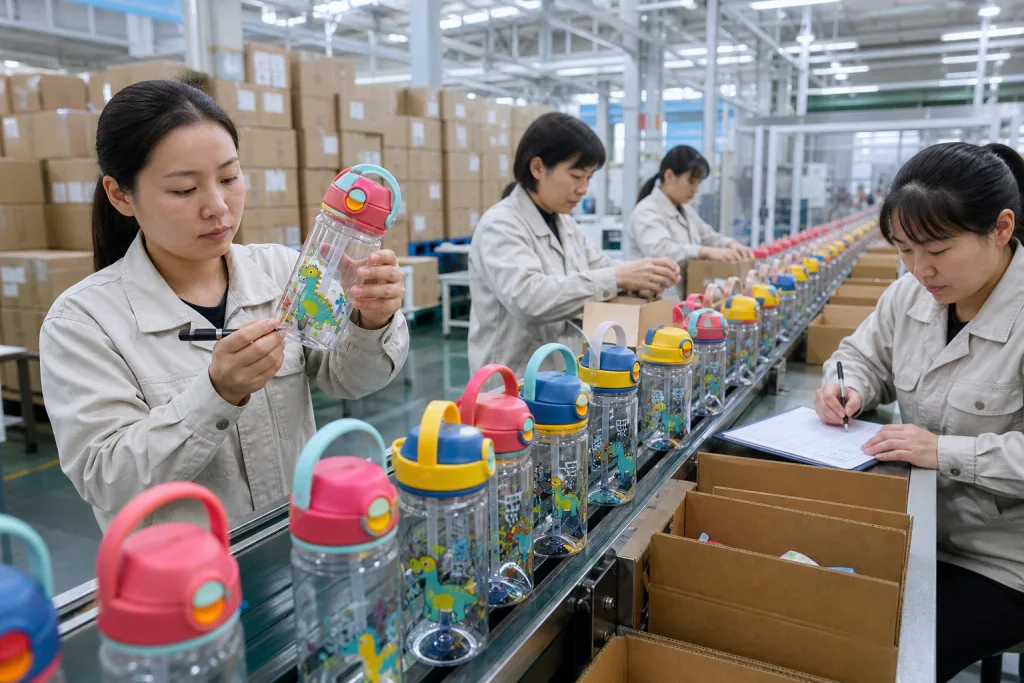
At our Zhejiang, China factory, we start with the practical pieces before the artwork: age group, capacity, lid type, drinking method, carton drop strength, and test standard. That is the right question to ask. A children water bottle custom project is not “put a logo on it.” It sets tooling cost, MOQ, unit price, lead time, and recall risk. QC pulled a sample from the line last week because the 500 ml spec on the PO was typed as 50 ml, and that kind of typo burns time on both sides.
Start with the school use case
Start with a real school order. The buyer sends: “custom kids water bottle, 10,000 pcs, logo printed, safe material.” We see this RFQ about 6 times a month, and it is too thin for a proper quote. Is it for a district wellness program packed in bulk cartons, or for an importer building a children water bottle wholesale line for back-to-school retail? Different job. Different cost. Last April, QC pulled a pre-production sample where the PO said “blue lid” but the artwork file showed navy; that 1-color mismatch delayed approval by 3 days.
The first specification is age. A bottle for 4-6 year olds is not the same item as a bottle for 10-12 year olds. Younger children need a lighter body, smaller diameter, and a lid they can open without a teacher. For preschool and lower primary school, we normally recommend 350 ml to 400 ml. For upper primary, 450 ml to 500 ml works better. A 600 ml bottle looks strong in a catalog, but fill it with water and you add about 0.6 kg to a child’s backpack. The math does not work. On the line, we check grip diameter with a caliper; 68 mm already feels bulky for small hands.
The second decision is drinking style. Straw lids are easy for younger children, but they bring extra parts: silicone straw and bite valve, plus a vent, hinge pin, and sometimes a spare straw set. That means more molds, more assembly points, and more spots for leakage during carton drop testing. Screw caps cost less and clean faster, but teachers complain when children forget to close them after lunch. Push-button lids look better on a retail shelf, yet the spring and lock need stronger QC because they take repeated pressing. We run 300 open-close cycles on samples before we trust that lid for school use.
For a custom made kids bottle supplied to schools, I would stay away from complex lids unless the order quantity pays for better testing. A simple flip straw lid with a locking button usually gives the best balance. For an importer selling through children water bottle distributors, two lid versions make sense: a lower-cost promotion lid for 5,000 pcs school giveaways and an upgraded retail lid for boxed shelf stock. We have seen this go sideways when a buyer used the retail lid for a tender order, then pushed back after the carton weight and spare-part cost came in higher than expected.
Choose material before decoration
8 of 10 buyers we talk to start with logo color. The factory starts with material. We run stainless steel, Tritan-style plastic, PP, and glass with silicone sleeve for custom children water bottle projects. For school district buyers, stainless steel and BPA-free plastic take most orders. Glass works for older children, but most public schools reject it after one sample drop from a 90 cm desk height. Fair pushback.
For stainless steel kids bottles, the common structure is 304 stainless steel inner wall, 201 or 304 outer wall, vacuum insulation, and a powder-coated exterior. Wall thickness is usually around 0.35-0.45 mm per layer for children’s sizes; QC checks it with a digital thickness gauge before the line opens. If you push the wall too thin to save USD 0.08, dent complaints increase. We have seen this go sideways on daily school-use orders, where bottles hit concrete, bus floors, and metal cubbies. The math does not work.
Plastic bottles cut weight and cost. A 450 ml plastic customizable children water bottle may price around USD 1.20-2.20 FOB Ningbo or Shanghai depending on lid, print, and packaging. A 400 ml insulated stainless custom kids bottle may sit around USD 3.20-5.50 FOB. These are not promises; resin prices, exchange rate, and packaging affect each quotation. Still, they are realistic planning numbers for Zhejiang export production, and we ship both options in 24-piece inner cartons when the buyer does not specify a shelf box.
Compliance matters more for children than for adult promotional drinkware. For Europe, ask about LFGB, REACH, and food-contact declarations. For the United States, buyers often request FDA food-contact compliance, CPSIA-related checks where applicable, and sometimes ASTM impact or mechanical risk review. If the bottle is marketed to children under a certain age, your importer obligations may be stricter. A serious children water bottle supplier should say what is already on file and what needs paid third-party testing; last month the buyer flagged a PO typo that said “adult tumbler,” and the lab would not accept the sample set until we corrected it.
Lock the design like an engineer
After material is fixed, lock the custom children water bottle design in a spec sheet, not just a nice mockup. Buyers often send a logo file and ask, “Can you make this?” For sales chat, yes. For the line, no. Production needs capacity, body diameter, height, lid material, silicone grade, Pantone color, logo size, print method, packaging, barcode, and carton dimensions. On one 400 ml school bottle job, QC pulled the sample and found the straw was 6 mm too short because the PO only said “kids bottle with flip lid.” That is how small gaps become rework.
For a custom logo kids bottle, decoration depends on the surface, the artwork, and the target cost. Silk screen printing works for clean one-color or two-color logos, and we run it often on powder-coated stainless bodies. Heat transfer is better for mascot artwork with gradients or small facial details. Laser engraving lasts well on 304 stainless, but it gives a metal-tone mark, not school-brand color. UV printing looks sharp on flat test plaques; on powder coating, we still do a cross-hatch adhesion test with 3M tape before we approve bulk production.
For school district orders, keep the imprint practical. This is the wrong question to ask: “Can we print a full wrap?” The better question is, “How many rejects can we afford?” A 60 mm wide logo on a curved 400 ml bottle is safer than a full wrap design because registration is easier to hold on the fixture. Full wrap artwork with thin lines can push rejects from 2% to 6% if the operator has to align front and back by eye. If you need a children water bottle customized with student names, classes, or campus logos, confirm the variable data file early. We have seen packing go sideways when the Excel sheet had “Class 3A” in the artwork but “Grade 3-A” on the carton label.
Color is the quiet risk. A bright red cap in the render can turn dull if the resin match is off by half a shade. Use Pantone references, then approve a physical color chip or a pre-production sample under D65 light. For 5,000 pcs or more, custom cap color makes sense. Below that, the math does not work for most school buyers; existing stock lid colors cut MOQ and shorten lead time, often 12 days vs 18 days on our side. Our Hangzhou-area China supply chain can support 1,000 pcs MOQ on existing bottle molds and stock lid colors, while customized plastic parts often start at 5,000 pcs.
Price the order with all extras
A bulk children water bottle quote should not stop at unit price. This is the wrong question to ask. School buyers and kids-product importers need the landed-cost items split out: bottle cost by material and capacity; logo cost by process, such as silk print or laser; packaging by box style and board gsm; testing, spare parts, inner cartons, export carton grade, and shipping term. On our quote sheet, even a 0.2 mm change in stainless wall thickness shows up. If the supplier hides everything in one number, you will not know why the price moved after QC pulled the sample and the buyer changed the lid color.
Packaging gets underestimated. A plain polybag works for some district giveaways, but 6 out of 10 North American school buyers we talk to now push back on extra plastic. A recyclable kraft box can add USD 0.12-0.35 per unit depending on board thickness and print coverage. Retail importers may need a color box with 350 gsm paper, warning labels, multilingual instructions, UPC or EAN barcode, plus an FNSKU label if the goods go into e-commerce fulfillment. That packing line labor can cost more than the logo itself, especially when the PO has one small typo in the barcode file and the line has to stop.
For a 10,000 pc bulk kids bottle project, expect a sample fee for custom decoration, often USD 50-150 per version. If you need new tooling for a cap, straw, or special bottle shape, tooling can run from a few hundred dollars to several thousand. We run existing molds first whenever the annual forecast is not firm. The math doesn't work for most school programs if they open a new mold for one back-to-school season, then reorder only 3,000 pcs the next year. Existing molds are faster to sample, cheaper to approve, and easier to validate with a caliper check on lid fit and straw length.
Payment terms affect risk. A common China export structure is 30% deposit and 70% balance before shipment, with FOB Ningbo or FOB Shanghai as the trading term. Larger importers with repeat orders may negotiate different terms after credit review. If you are a children water bottle distributor buying seasonally, map cash flow to the production calendar: deposit, sample approval, mass production, final inspection, balance payment, vessel departure, then customs clearance. We ship plenty of August school orders, and we have seen this go sideways when the balance payment lands 5 days late and the booked vessel is already full.
Build samples into the timeline
The costly mistake is approving production from a digital mockup only. For a children water bottle promotional order of 2,000 pcs, some buyers take that risk. For a school district rollout or retail import order, do not. This is the wrong place to save 7 days. A physical pre-production sample lets QC check lid fit with a torque gauge, drinking comfort, logo scale, coating feel, and carton packing quality before the line starts.
A typical timeline from Zhejiang, China looks like this: 3-5 days for artwork proof, 7-10 days for decorated sample, 2-3 days for buyer review if your team is organized, then 30-45 days for mass production after deposit and sample approval. Add 7-12 days if you need third-party lab testing before shipment. Before August, we usually add another 5-8 days because back-to-school orders fight for coating line slots, and one delayed Pantone approval can push a PO from vessel week 32 to week 34.
If your order is a bulk school water bottle program with delivery to multiple district warehouses, send the shipping plan before cartons are printed. Carton marks, pallet height, mixed SKU packing, and destination labels affect warehouse receiving, so our packing team needs those details before the carton die-line is locked. For importers, tell the factory if cartons must meet a maximum weight such as 15 kg or 18 kg. Kids bottles are light one by one, but a 24 pcs master carton gets awkward fast when the buyer asks us to “just pack more per carton.” We’ve seen this go sideways at receiving.
Our factory planning capacity for drinkware lines is about 450,000 units per month across stainless and plastic categories, depending on model mix and decoration. That does not mean every urgent order can be inserted tomorrow. Powder coating, printing, lid assembly, and final packing each have their own queue; last month QC pulled the sample because a silicone straw was 2 mm short after lid assembly. The buyer who approves samples on Tuesday usually ships earlier than the buyer who debates Pantone shades for two weeks.
Inspect what children actually break
Quality control for children’s bottles has to follow real use, not showroom photos. AQL visual inspection is still needed, but it will miss a weak flip hinge, a straw valve that weeps, or a handle pin that starts walking out after 300 open-close cycles on the line. For a children water bottle manufacturer serving schools, the checklist should include functional tests that match how children treat the product: dropped from a desk, tossed into a backpack, opened with wet hands, and left sideways for 20 minutes.
For leak testing, we fill bottles to the marked capacity, invert them, and shake them 10 times by hand before placing them on kraft paper. Some buyers specify 100% leak testing at the factory for straw lids; others use sampling based on AQL. For school programs, I prefer 100% basic leak check plus random extended testing, usually 32 pcs per color for a 3,000 pc order. It saves arguments. Cap torque should be checked with a torque meter so children can open the bottle, but lids do not loosen in backpacks. Silicone parts should seat tightly and carry no rubber smell after 24 hours out of the polybag. Straw length must match the bottle height, especially if several sizes share one lid design; we have seen a 6 mm short straw trigger buyer complaints because kids could not drink the last 40 ml.
Drop testing matters. A reasonable internal test is dropping filled or partially filled samples from 80-100 cm onto a hard surface at different angles. Stainless bottles may dent; the wrong question is “did it stay perfect?” The right question is whether the bottle still seals and remains safe. Plastic bottles should not crack at the base or thread. QC pulled the sample after one batch where the Tritan base split at the gate mark after the second corner drop, and the math does not work if that shows up after shipment. Coating adhesion can be checked by cross-hatch tape testing, and printed logos should be rubbed with water and mild detergent for 50 cycles to confirm durability.
For pre-shipment inspection, define AQL levels before production. 7 out of 10 importers we work with use AQL 2.5 for major defects and 4.0 for minor defects, with critical defects not allowed. Critical issues include sharp edges, loose small parts, severe leakage, broken lids, contamination, and incorrect safety labeling. A capable children water bottle supplier will accept a clear checklist because it prevents arguments after the goods reach your warehouse. We have seen this go sideways over one PO typo, “BPA fee” instead of “BPA free,” so artwork, carton marks, and warning labels need to be checked against the approved file, not memory.
Pick suppliers you can audit
China has at least 300 children water bottle vendors selling on B2B platforms, but they are not the same animal. A trading company may reply in clean English and still never touch the mold. A factory may write rough emails and still control welding, powder coating, assembly, and final QC on the line. Some children water bottle suppliers only print logos, then buy the bottle body from another workshop. For school district buyers and importers, ask who owns each step. Last month QC pulled a 12 oz sample where the cap came from Yuyao and the body came from Yongkang; the color mismatch was 1.5 mm off at the seam.
Ask direct questions. What is the MOQ for existing molds? What is the monthly output for this model? Can you provide BSCI or ISO 9001 documentation? Which lab handles LFGB, REACH, or FDA-related testing? Do you perform incoming inspection on silicone and plastic parts? Can you keep approved golden samples on the production line? A serious children water bottle vendor should answer with numbers: 3,000 pcs MOQ, 80,000 pcs monthly capacity, 0.6 mm stainless wall thickness, AQL 2.5 final inspection. “We have good quality” is not an answer. We run a digital caliper check on straw diameter before assembly because one soft straw batch once failed bite testing after 7 days in warehouse heat.
If you work through children water bottle distributors, make sure the technical requirements still reach the actual factory. Extra layers between buyer and production make small details disappear. The buyer flagged this on a PO once: cap color written as “blue,” while the approved Pantone was 2925C. Straw hardness and warning label wording need the same control, with photos signed off before mass production. Distributors can help with local service and small replenishment orders, but the spec sheet must stay locked.
For a children water bottle bulk order, I would rather see a 3–5% higher FOB price from a traceable Zhejiang factory than a low quote with vague material claims. Children’s products are unforgiving. Parents notice leaks. Teachers notice broken caps. Customs officers notice missing FDA or LFGB reports. The wrong question is “who can ship cheapest?” Ask who will stop the line when the push-button lid fails a 1.2 m drop test. Your best supplier is not the one who says yes fastest; it is the one who tells you when a design choice will cause complaints.
Send your school bottle specification for a factory quote
Share quantity, age group, material, logo artwork, delivery country, and testing needs. We will return a practical FOB quote and timeline.
Frequently asked questions
What MOQ should I expect for a custom children water bottle order?
For existing molds with standard lid colors, 1,000 pcs is a realistic starting MOQ at many China factories, including our Zhejiang production network. If you need a custom Pantone cap, special silicone color, or exclusive packaging, expect 3,000-5,000 pcs. New mold development usually only makes sense above 10,000 pcs per run or with repeated annual orders. For school districts testing a program, start with an existing 350-500 ml model and customize the logo and box first.
Which bottle size is best for elementary school children?
For children aged 4-6, 350 ml to 400 ml is usually the most practical size. It keeps the filled weight manageable and fits smaller hands. For ages 7-12, 450 ml to 500 ml works well for a school day without making the backpack too heavy. A 600 ml bottle can be acceptable for sports or older students, but it is often oversized for classroom use. Always check bottle diameter; around 65-72 mm is easier for children than a wide adult bottle body.
Can we print different school logos in one bulk kids water bottle order?
Yes, but it must be planned before production. If the bottle body, color, and packaging are the same, splitting 10,000 pcs into five school logos is normally manageable. Each logo version may require a separate screen, setup charge, sample approval, and packing list. You should define the quantity per logo clearly, such as 2,000 pcs each, and decide whether cartons are separated by school. Variable student names are possible, but they increase labor, checking time, and error risk.
What safety tests should importers request for children water bottles?
For Europe, buyers commonly request food-contact testing such as LFGB, plus REACH checks for relevant materials and coatings. For the U.S., FDA food-contact compliance is common, and children’s product rules may require additional review depending on age grading and marketing claims. Mechanically, you should test leakage, small parts risk, sharp edges, cap strength, drop resistance, and coating adhesion. Lab testing usually adds 7-12 days and should be budgeted before shipment, not requested after production is packed.
How long does a children water bottle customized order take?
A normal schedule is 7-10 days for a decorated sample after artwork approval, then 30-45 days for mass production after deposit and sample confirmation. If you need third-party testing, add about 1-2 weeks. Ocean freight to North America or Europe can add several more weeks depending on port and season. For back-to-school delivery, start sourcing at least 90 days before your required warehouse date. August delivery is risky if you approve samples in late June.