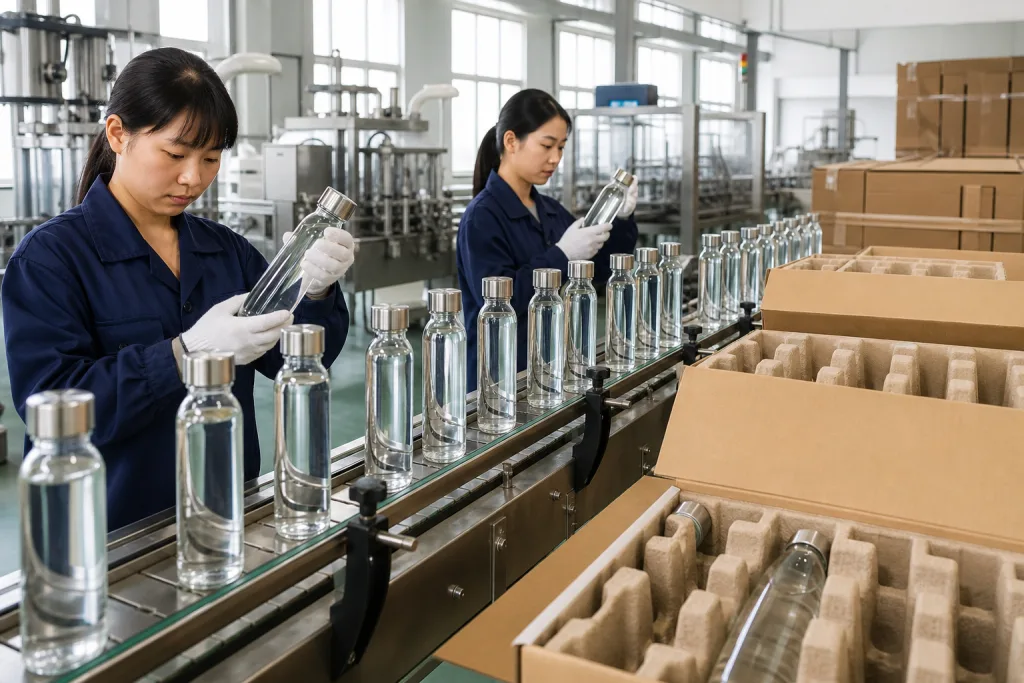
Key Takeaways
- Typical MOQ for a custom borosilicate glass bottle is 3,000 units per SKU, with 25-35 day mass production after sample approval
- Borosilicate glass handles thermal shock better than soda-lime glass, but packaging still needs 1.2 m carton drop testing
- For wellness retail, sleeve, lid, and logo decisions often affect return rate more than the glass tube itself
- FOB China pricing depends heavily on capacity, wall thickness, cap material, gift box structure, and decoration method
A custom borosilicate glass bottle looks clean on a product page. Sourcing it is less clean when you are buying 3,000 to 30,000 units for a wellness brand or a sustainable retail program. You are working around breakage rate, lid material, sleeve tolerance, logo rub resistance, carton drop testing, and a launch date the retail buyer already put on the calendar.
From our factory network in Zhejiang, China, we see the same problems on the line: the glass is not the real headache. The trouble usually starts with a vague drawing, a decoration method that does not suit the sales channel, or packaging cost cut by USD 0.18 per set until the math doesn't work. QC pulled one 550ml sample last month with a silicone sleeve 1.5mm too loose; it looked fine in the mockup, then twisted by hand during inspection. A good custom glass water bottle project starts with exact specifications, not a pretty rendering.
Start With The Real Use Case
Before you ask a borosilicate glass bottle supplier for a quote, pin down the job first. A yoga studio retail bottle, a corporate wellness gift, and a supermarket sustainable drinkware line need different specs, and we have seen a PO say only “custom bottle” before the buyer flagged the missing details. Capacity, lid type, sleeve material, decoration, retail packaging, testing, and delivery term all need to be written out.
For most wellness brands, the workable capacity range is 450 ml to 750 ml. A 550 ml bottle feels premium and still rides in a tote; a 750 ml bottle gives more shelf presence, but carton size, freight cost, and breakage risk all go up. Standard wall thickness is often around 2.0 mm to 2.5 mm for borosilicate bodies. We check that with a caliper on the line. Go thicker and the bottle feels heavier in hand, but packaging still has to do the real work.
Ask these buyer questions before you request borosilicate glass bottle bulk pricing:
- Retail or online fulfillment? E-commerce needs stronger individual packaging and tighter carton void control, or the customer gets a broken bottle at the doorstep.
- Cold drinks only, or tea and hot water? This changes the cap gasket choice and the warning copy on the carton. We had one buyer try to use the same lid for both, and QC pulled the sample.
- Adult wellness or family use? Family channels can trigger stricter impact testing and label checks, especially if the bottle goes near school or kid sports buyers.
- Minimalist logo or full-color branding? Screen print, decal, and laser all land at different unit prices and lead times, and the buyer usually wants one method but sends artwork for another.
At BottleForge Industrial in Hangzhou, Zhejiang, we push buyers to lock the use case before we talk price. That is the right order. On the packing bench, one wrong carton spec can turn a clean shipment into a claim, and a quote without channel details is just a guess.
What Makes Borosilicate Worth It
Borosilicate glass gets specified because it handles temperature swing better than ordinary soda-lime glass. For a custom borosilicate glass bottle used with hot tea, infused water, lemon water, or chilled drinks, that difference shows up fast: in our line checks, a 3.0 mm borosilicate body passes routine hot-fill handling that would make buyers nervous with standard glass. It is not unbreakable. It is still glass, and any honest borosilicate glass bottle manufacturer should say that before the PO is signed. The real value is steadier thermal shock performance, cleaner taste, and a sustainability claim that feels credible on the shelf.
A common buyer mistake is asking only, “Is it high borosilicate?” Wrong question. Ask for material confirmation, food-contact compliance, and a production sample from the same borosilicate glass bottle factory that will run the bulk order. We have seen this go sideways when the pre-production sample came from one workshop and the 10,000 pcs order came from another. For Europe, ask about LFGB or EU food-contact testing, plus REACH for relevant accessories such as coatings, silicone rings, and paint. For North America, FDA food-contact expectations and California Proposition 65 screening may apply depending on your sales channel. QC should pull the sample from packed goods, not from a manager’s drawer.
The body is only one part of the product. A bulk glass water bottle usually ships with a cap, gasket, sleeve, carrying strap, bottom pad, gift box, and master carton. Each accessory can create its own compliance or quality problem, so we check them as separate items on the inspection sheet. Bamboo-look lids can crack if the inner PP insert is off by even 0.3 mm. Stainless lids need passivation and clean edge finishing, or the buyer will flag brown spots after the first rinse. Silicone sleeves must be food-grade and should not smell strongly after 24 hours in a sealed PE bag.
Practical rule: if your bottle is sold as sustainable, do not let the cheapest cap material undermine the story.
For a borosilicate glass bottle wholesale program, the best specification is not the most expensive one. The math does not work if you overbuild a bottle for a discount channel, then lose margin on freight and replacement parts. Match the spec to the sales channel, MOQ, carton drop requirement, and warehouse handling. We ship glass by master carton for a reason: a good bottle still needs to survive the trip from Hangzhou to your warehouse without becoming a claims file.
Customization Choices That Actually Matter
Buyers asking for borosilicate glass bottle custom options often start with logo size. Fair question, wrong first question. The harder calls are print durability, color tolerance, and whether the same design still looks clean after the line runs 10,000 pcs. We have seen a hand-made sample pass the buyer’s eye, then QC pulled the sample from mass production and found the logo sitting 2 mm lower on the next carton.
For a custom glass water bottle, we usually run screen printing or heat transfer printing for body artwork, decal for more complex graphics, laser engraving on metal lids, and color coating when the retail shelf needs a stronger color block. Screen printing fits one-color or two-color wellness branding and normally makes sense at 3,000 units and above. Full-wrap artwork can work, but accept registration tolerance upfront; a glass cylinder does not behave like a stainless steel bottle in the jig, and the buyer flagged a 1.5 mm seam shift on one PO last spring.
Color coating gives a customized glass water bottle line a clean seasonal look. The tradeoff is scratch resistance and compliance testing. If the coating sits on the outside of the glass, ask for adhesion testing, cross-hatch testing, and abrasion checks before mass production. We use a 3M tape pull on coated samples, and the math does not work if the coating looks good in photos but fails after 200 rubs in a carton test. For a transparent wellness product, a silicone sleeve is often the safer choice. Better grip, small-knock protection, easy color change.
Useful customization checklist:
- Confirm the Pantone reference, then allow a workable tolerance because silicone, ink, and paper do not read color the same under a D65 light box.
- Keep logo height sensible; 35 mm to 70 mm often looks better than oversized branding, especially on 500 ml and 750 ml bottles.
- Ask for pre-production samples with final logo, final cap, final sleeve, and final packaging, packed the same way we ship the bulk order.
- Specify whether the barcode, FNSKU, warning text, and recycling marks go on box, label, or insert card; one buyer once sent a PO with “FNSK” missing the U, and Amazon receiving did not care whose typo it was.
A borosilicate glass bottle customizable program should be built for repeat orders. Exotic parts look attractive in the first sample room meeting, but we have seen this go sideways when a special lid spring needs 18 days instead of 12 days and holds the whole reorder.
MOQ, Pricing, And Lead Time
For a standard custom borosilicate glass bottle from China, we usually set the MOQ at 3,000 units per model or color. Some borosilicate glass bottle vendors will quote 1,000 units, but the math often breaks after color box printing, inland freight to Ningbo or Shanghai, export handling, and FDA/LFGB testing are added. For private-label wellness brands, 3,000 to 5,000 units is the practical starting range. We see buyers push for 1,000 pcs, then reject the revised unit price when the packaging line still needs the same print plates and setup time.
As a working reference, FOB China pricing for a 550 ml borosilicate bottle with silicone sleeve, PP or stainless cap, one-color logo, and color box may sit around USD 2.20 to USD 4.20 per unit depending on the sleeve weight, glass wall, cap structure, and carton spec. A bamboo-style cap, thicker glass, full-color box, molded sleeve logo, or individual mailer box can push the cost higher. If one quote is 25% lower than the others, check wall thickness with a caliper, carton burst strength, cap material, and whether testing is included. QC once pulled a sample that looked fine in photos, but the glass wall measured 1.6 mm instead of the agreed 2.0 mm.
Normal development timing looks like this, assuming the PO has the model number, Pantone code, logo file, and packing method correct. One typo on a cap color can cost 2 days.
- Specification confirmation: 2-4 days if drawings and packaging requirements are clear.
- Plain sample or available stock sample: 3-7 days.
- Custom logo sample: 7-12 days after artwork approval.
- Mass production: 25-35 days after deposit and sample approval.
- Inspection and export booking: 3-7 days depending on season.
Our Zhejiang production partners can handle about 300,000 glass bottle units per month across standard models, but capacity still gets squeezed by sleeve color changes, hand packing, and AQL 2.5 inspection time. The line slows down when 6 sleeve colors share one order. Around Chinese New Year, treating January or February like a normal production month is the wrong question to ask. Add at least 3 weeks of buffer if your delivery window falls near January or February.
Supplier Questions Before You Pay
A borosilicate glass bottle distributor or vendor might be a factory, a trading company, or a hybrid export office. That label does not decide the result. The key question is whether they control the risk points on the order: glass body forming, cap fit, silicone sleeve dust, logo printing, packing, and final QC. We see 6 or 7 suppliers quoting from the same glass body workshop in Zhejiang, but one runs a proper packing line with carton drop checks and another packs by hand with no torque check on the lid. Big difference.
Ask direct questions. Who makes the glass body? Who assembles the caps and sleeves? Where does final inspection happen? Ask for line photos with current date cards, not showroom pictures. If you are buying a distributor glass water bottle program for a retail chain, request a written specification sheet showing bottle weight tolerance in grams, capacity tolerance in ml, lid material, gasket material, sleeve hardness, carton size, and gross weight. One buyer flagged this after the PO said “500ml” but the approved sample filled only 470ml to the shoulder. Fix it before deposit.
Supplier checklist before deposit:
- Business license and export experience for Europe or North America.
- Food-contact test reports less than 24 months old, ideally for matching glass, silicone, plastic, or stainless-steel parts.
- BSCI, ISO 9001, or social audit status if your retailer requires it.
- AQL inspection agreement, commonly AQL 2.5 for major defects and 4.0 for minor defects.
- Clear defect definitions for bubbles, scratches, logo misprint, sleeve dirt, cap leakage, and box crushing.
- Incoterm agreement: FOB Ningbo or FOB Shanghai is common from Zhejiang, China.
If a borosilicate glass bottle manufacturer refuses to define defects before production, slow down. Glassware always has cosmetic variation; a 1 mm bubble near the base is not the same problem as a 4 mm bubble on the logo face. The wrong question is “will there be zero defects?” The better question is what QC will reject when pulled under AQL, and who pays if the line finds leakage, dirty sleeves, or crushed inner boxes before shipment.
Packaging Is Not A Side Detail
Packaging is where a lot of customized borosilicate glass bottle jobs bleed cash. The bottle leaves our line in good shape, then the courier crushes it, Amazon FBA rejects it, pallets get restacked, or retail cartons get beaten up in distribution. A thin color box can look fine in a quotation photo. It means nothing if the pack cannot take ocean freight and parcel drops. We saw one batch fail after a 6-drop check on the outer carton, and QC pulled the sample before we shipped the rest.
For a borosilicate glass bottle promotional order handed out at events, a plain white box with an inner partition is often enough. For e-commerce or retail shelves, we build stronger: corrugated insert, molded pulp tray, or a tight kraft mailer. Master cartons should normally use 5-ply corrugated board for export. For parcel channels, ask for a 1.2 m drop test on the final packed unit and a master carton drop test based on carton weight. This is the wrong question to ask if someone pushes a thinner box just to save a few cents.
Carton efficiency also hits landed cost. A 750 ml bottle with a thick sleeve and gift box may cut units per carton from 48 to 24. On one 40HQ booking, that pushed freight cost up by USD 0.20 to USD 0.60 per unit, depending on the route. If your sustainability claim says reduced packaging, be straight about the tradeoff: glass needs protection. The better move is recyclable protection, not weak packaging. We have seen that math go sideways fast.
For a borosilicate glass bottle supplier, packaging instructions should cover box dieline, paper weight, flute type, barcode location, country-of-origin marking, warning text, and pallet requirements. If you need retail shelf display, say it early. If you need FBA labels, FNSKU stickers, suffocation warnings on polybags, or carton content labels, put them in the purchase order. One PO typo that said carton 12 instead of carton 21 cost us a half-day on the line while we rechecked 1,200 units. That is the kind of mistake that turns into a claim.
Inspection And Reorder Control
A custom borosilicate glass bottle order needs inspection before shipment, even when the supplier is cooperative. Trust is not QC. Third-party inspection is normal B2B risk control, and buyers should treat it like checking a carton mark against the PO, not like blaming the factory. For glass bottles, we check appearance, key dimensions in mm with a digital caliper, capacity, unit weight, leakage, logo adhesion, cap fit, sleeve fit, packaging, barcode scanning, and carton drop results when the retail channel asks for them.
Use AQL sampling, then add checks that match the bottle. Fill bottles with water and invert them for 30 minutes. Check cap torque by hand; for orders above 5,000 pcs, use a torque gauge so the result is not just someone’s feeling on the line. Measure capacity to the stated fill line, not only brim capacity. Rub printed logos with wet cloth and dry cloth for a fixed cycle count, such as 20 wet rubs and 20 dry rubs. Open and close the cap 20 times on random samples to catch thread problems before QC pulls the carton.
For reorders, lock the golden sample. A good borosilicate glass bottle customized program should have a signed sample set: one with the buyer, one with the supplier, and one kept at the assembly site. Record the glass weight, sleeve color with Pantone code, logo position in mm from the base, cap structure, box paper, and carton packing method. We once saw a reorder fail because the PO said “grey sleeve” while the approved sample was Pantone Cool Gray 7C. Almost the same is not enough for retail shelves.
For borosilicate glass bottle manufacturers and suppliers in China, consistency comes from documentation as much as machinery. If you expect repeat orders across 12 or 24 months, ask your supplier to confirm which parts are standard stock and which require special procurement. Standard molds reduce risk. Unusual caps, rare sleeve colors, and special gift boxes need earlier planning; 12 days for a stock bamboo lid can turn into 18 days when the gasket size is non-standard. This is where we’ve seen programs go sideways, not at the glass furnace.
Send Your Glass Bottle Specification For A Real Quote
Share capacity, logo, packaging, target market, and order quantity. We will return a practical FOB China quote with production timing.
Frequently asked questions
What is the normal MOQ for a custom borosilicate glass bottle?
For most projects, the practical MOQ is 3,000 units per SKU. If you need a custom sleeve color, logo printing, and retail box, 3,000 units gives the factory enough volume to control setup cost. Some suppliers may accept 1,000 units, but the FOB unit price can rise by 20-40% because printing, packaging, and export handling are spread over fewer pieces. If you are testing a new wellness product, consider one capacity and one color first, rather than splitting 3,000 units across 4 colors.
Is borosilicate glass safe for hot tea and lemon water?
Yes, borosilicate glass is commonly used for tea bottles because it handles temperature change better than soda-lime glass and does not retain flavor. However, the complete bottle must be checked, not only the glass body. The cap gasket, sleeve, coating, and printed ink should meet relevant food-contact and chemical requirements. For Europe, ask for LFGB or EU food-contact test support; for North America, confirm FDA food-contact suitability. We also recommend clear user instructions, such as avoiding sealed shaking with boiling water.
Which logo method is best for a wellness retail bottle?
For a clean wellness look, one-color screen printing is usually the best balance of cost, durability, and appearance. At 3,000 units, it is economical and repeatable. Laser engraving works well on stainless steel lids but not on the glass body in the same way. Heat transfer or decal can handle more complex artwork, but it may cost more and needs stronger abrasion testing. If your product will be sold online, test the logo after simulated rubbing and normal washing before approving mass production.
How should I compare quotes from different glass bottle suppliers?
Do not compare only the headline FOB price. Put each quote into a table with capacity, glass weight, wall thickness, cap material, gasket material, sleeve type, logo method, box structure, carton quantity, testing, MOQ, lead time, and Incoterm. A bottle quoted at USD 2.10 may be worse value than one at USD 2.65 if the cheaper option uses weak cartons or a low-grade cap. Ask each supplier to confirm whether pre-shipment inspection and compliance documents are included or charged separately.
Can I order a fully customized shape for borosilicate glass bottles?
Yes, but it changes the project economics. A fully custom glass shape usually requires mold development, longer sampling, and a higher MOQ than standard cylinder models. For many wellness brands, a standard bottle body with custom sleeve, cap, logo, and retail packaging is the smarter first launch. It can keep MOQ near 3,000-5,000 units and lead time around 35 days after approval. A new mold makes more sense when you expect repeated orders above 20,000 units per year.