Key Takeaways
- A practical custom blender bottle MOQ starts at 3,000 units per color for molded plastic bodies
- Allow 7-10 days for sampling and 30-40 days for mass production after artwork approval
- Check lid torque, shaker ball fit, leak testing, logo adhesion, carton drop strength, and AQL results before shipment
- FOB Ningbo or Shanghai is usually cleaner than chasing the lowest EXW unit price
You are not just buying a bottle with a mixing ball. You are buying a product that has to survive 30 g scoops of protein powder, 65°C dishwasher cycles, sweaty gym bags, retail shelves, and one-star reviews. A custom blender bottle looks simple until the lid leaks at the silicone gasket, the logo scratches off after 20 tape tests, or QC pulls a crushed master carton after a 76 cm drop test. We’ve seen this go sideways.
Here is a real buyer case: 5,000 units for a North America fitness brand launch, split into two colors, one logo, and delivery before a trade show date that cannot move. The buyer flagged the first quote because the math didn’t work: air freight saved 6 days but added USD 0.84 per bottle. BottleForge Industrial in Hangzhou, Zhejiang handles orders like this for custom drinkware buyers who want clear answers on MOQ, print method, lead time, and carton strength before sending a deposit to China.
Start With The Actual Use Case
The first question is not “what is your cheapest custom blender bottle?” The first question is who will use it, where it will be sold, and what failure would hurt you most. A gym chain selling at reception needs a different bottle from an online supplement brand shipping through FBA. A canteen distributor selling to schools may care more about cap tether strength and carton labeling. A promotional buyer may want low unit cost and fast logo approval. On our lid bench, QC checks the flip-spout hinge before the first carton leaves the line.
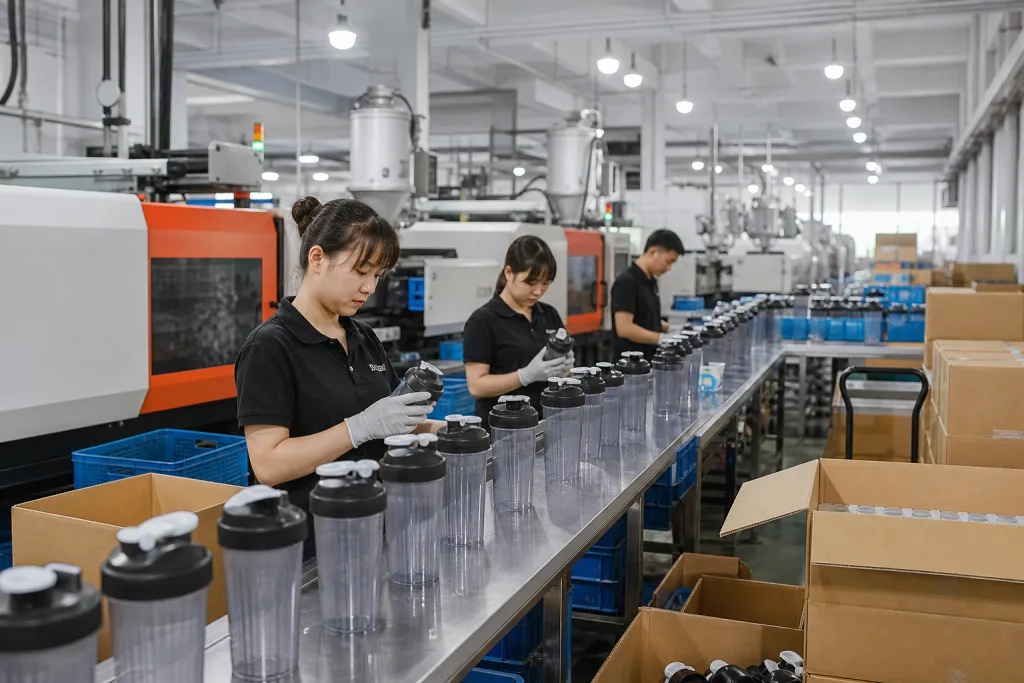
For a 5,000-unit order, a clean starting spec is a 600 ml or 700 ml PP body, screw lid, flip spout, 304 stainless steel mixing ball, and silicone seal ring. PP is common because it is lighter than Tritan and usually costs less per unit. Tritan costs more, but it gives clearer walls and a more premium shelf feel. If you are running a custom canteen, custom growler, or standard sports bottle in the same campaign, match the colors and cartons so the range does not look like three separate buys. We run a 12-cavity injection mold for this kind of bottle, and mixed packaging will show up fast.
For Europe and North America, ask your canteen manufacturer to confirm food-contact compliance before artwork starts. For plastic blender bottles, the conversation should include LFGB or EU food-contact requirements, FDA food-contact expectations, BPA-free material declarations, and REACH checks for colorants and coatings. In China, a serious canteen factory should know these papers without a lecture. We usually ask for the colorant SDS before QC pulls the pre-production sample for a 95°C water test. Saving two days here is the wrong trade.
At BottleForge in Zhejiang, a typical blender bottle project starts at 3,000 units per color, with 5,000 units giving better control over color batching and carton cost. Our monthly drinkware capacity is about 600,000 units across plastic, stainless steel, and glass lines, but small specification changes still matter. A 0.3 mm change in seal fit can decide whether your customer gets a dry gym bag or a refund request. We have seen a buyer flag a PO because the cap color code was one digit off, and that typo would have sent the line the wrong resin. The math does not work if you treat that detail as minor.
Lock The Physical Specification
Once the use case is clear, write the specification like a purchase order, not a mood board. For a custom blender bottle, put the body capacity, brimful capacity, material grade, wall thickness, lid structure, seal material, ball diameter, and packing method on paper. “700 ml bottle” is not enough. We have seen one buyer’s RFQ say 700 ml, while the factory drawing showed 700 ml brimful and only 620 ml practical fill; QC caught it with a graduated cylinder at the sample bench.
A workable specification might read: 700 ml PP body, 1.8-2.2 mm body wall, PP screw lid with flip spout, food-grade silicone gasket, 304 stainless steel mixing ball, 52 mm mouth opening, matte body texture, one-color silkscreen logo on one side, individual polybag, white inner box optional, 24 units per export carton. This gives your canteen supplier a fair basis for pricing. On our line, the difference between 1.8 mm and 2.2 mm is not a footnote; the injection machine cycle, resin weight, and carton gross weight all move.
If you are comparing canteen suppliers, do not let them quote different products under the same name. One canteen vendor may offer a thin promotional wall at 1.4 mm. Another canteen vendor may quote a heavier body at 2.2 mm. The second price looks worse until you test drop resistance and squeeze feel. We run a simple 1.2 m drop test on a filled sample, and thin PP bodies often show stress whitening around the base ring. For distributor drinkware, especially products sold under your own brand, shaving 8-12% from resin weight can create more complaints than profit. The math does not work.
Color also needs discipline. For a canteen customized in two brand colors, provide Pantone references and accept that plastic color matching has tolerance. Ask for a pre-production color chip. It costs a few days, often 3-5 days in our sample room, but it prevents the old argument where the buyer says “navy” and the molded part comes out closer to royal blue. If your order includes canteen promotional items for an event, agree whether a Delta E tolerance is required or whether commercial matching is enough. Put it on the PO, not in a chat screenshot.
Buyers who also source a customizable canteen, customizable growler, or stainless sports bottle should not assume every material behaves the same. Laser engraving works beautifully on powder-coated stainless steel. It does not help on PP plastic. Silkscreen, heat transfer, and in-mold labeling each carry different cost, durability, and MOQ pressure. We have seen this go sideways when a buyer approved a stainless sample with laser logo, then expected the same sharp edge on a PP blender bottle. QC pulled the PP sample under a 10x loupe and the logo edge was soft, exactly as the process allows.
Build The Cost Sheet Correctly
A clean quote for a custom blender bottle should break out the bottle cost, logo cost, packaging cost, mold or setup cost, testing cost, and freight term. One lump price hides the real discussion. For a 5,000-unit order, a basic PP blender bottle may sit around USD 1.20-1.85 FOB depending on gram weight, lid structure, logo method, and packing style. Tritan may push that higher, often into the USD 2.10-3.20 range for similar capacity. On our line, a 7 g heavier lid and an extra silicone gasket can move the quote by several cents before anyone talks about profit.
FOB Ningbo or FOB Shanghai is usually the practical choice for buyers sourcing from Zhejiang, China. EXW looks cheaper on the first sheet, but then you own the Hangzhou-to-port truck, export handling, and document work. We have seen buyers save USD 0.03 on EXW and lose it twice on local charges. If you are new to China sourcing, ask your canteen manufacturer to quote FOB and show carton dimensions, gross weight, and CBM at the quotation stage. Check the port name too; one PO typo changed “Ningbo” to “Nimbo,” and the forwarder kicked it back the same day.
Here is what commonly changes the price:
- Material: PP is lower cost; Tritan gives better clarity and a more premium shelf feel, but the resin price moves faster.
- Logo: one-color silkscreen is cheaper than full-wrap heat transfer, especially when the artwork needs tight registration around the bottle curve.
- Packaging: polybag only is cheaper; printed retail box adds cost and lead time because the box proof, barcode, and drop-test fit all need checking.
- Testing: third-party LFGB, FDA-related, or REACH testing is not free; the lab also needs extra samples from the same production batch.
- MOQ: 3,000 units per color is realistic; 1,000 units often means stock colors or a surcharge, since the color masterbatch and machine cleaning still cost money.
For canteen distributors, the landed cost matters more than the factory unit cost. A carton that packs 24 units efficiently may reduce ocean freight per unit. A slightly smaller bottle profile can save 5-8% CBM. We measure this with a tape on the packed carton, not from a drawing, because a 10 mm bulge from loose lids changes the CBM calculation. Small space savings add up. If you sell distributor canteen products across multiple accounts, that saving repeats across every replenishment order.
Do not ask five canteen manufacturers for the “best price” without sharing a proper spec. That is the wrong question to ask. You will get five shortcuts: thinner wall, weaker spring ball, cheaper carton, stock cap color, or no testing line item. Ask for a costed specification instead. The honest supplier will tell you which detail is pushing up the price. We have seen this go sideways when QC pulled the sample and the buyer flagged that the quoted bottle was 620 ml, while the sales image showed 700 ml.
Approve Samples Without Guesswork
Sampling is where custom drinkware jobs either get locked down or start sliding. For this buyer scenario, plan 7-10 days for an existing mold sample with logo, or 20-30 days if a new lid mold or body shape is required. If we already have the bottle body and lid tooling on the rack, your real decisions are body color, logo method, lid hand-feel, and packing. The wrong question is “Can you send a sample fast?” Ask whether the sample uses the same PP, Tritan, gasket, shaker ball, and color masterbatch planned for bulk production.
Ask for at least three sample types. First, get a blank physical sample to check grip, capacity, lid fit, and shaker performance; we usually measure capacity on a scale, not by eye. Second, get a logo sample to confirm size, position, color density, and scratch resistance after a quick 3M tape pull. Third, get a packing mockup if you are using retail boxes, FNSKU labels, hang tags, or barcode stickers. For Amazon or marketplace programs, carton labels and inner packing are not decoration. They are receiving requirements, and we have seen a PO delayed because one FNSKU digit was typed wrong on the artwork file.
When you receive the sample, fill it with water, shake it hard for 30 seconds, leave it upside down for 4 hours, and then put it in a backpack with paper towel around the lid. Simple test. It is not a laboratory test, but it catches obvious gasket, thread, and flip-cap problems before the line runs 5,000 pcs. Test with warm water at about 60°C, not boiling water, unless the product is specified for high heat. Most blender bottles are not built for boiling liquids, and your instruction sheet should say that clearly; the buyer flagged this once after customer service got three leak complaints from hot pre-workout use.
For a canteen customizable with multiple logo areas, check whether the curved body distorts the artwork. A 65 mm wide logo may look fine on a flat proof and look stretched on the bottle, especially near the waist radius. Our pad-print operator checks this with a film ruler and a marked centerline before making the screen. For customized drinkware sold retail, approve the actual physical logo sample, not only a PDF. PDFs lie. Plastic curves do not.
Keep one signed approval sample at your office and one at the factory in Hangzhou, Zhejiang. During production, that sample becomes the standard for color, print sharpness, lid closing force, and packing layout. QC pulled the sample from our sealed cabinet more than once when a buyer said the blue looked “off” under warehouse lighting. Without that signed piece on the table, every discussion becomes personal opinion, and the math does not work once cartons are already packed.
Control Production Before It Runs
After sample approval and deposit, the factory should issue a pre-production file before the line buys resin or opens the mold schedule. We run this as one locked PDF plus source artwork: confirmed specification, Pantone colors, artwork file, packaging file, carton marks, order quantity, acceptable tolerance, and inspection standard. For a 5,000-unit custom blender bottle order, normal mass production is about 30-40 days after all approvals, assuming no new mold work and no delayed packaging artwork. One common delay is simple: the PO says “black lid,” the approved sample has a smoke-gray flip cap, and the buyer only flags it after our injection team has already mixed 80 kg of masterbatch.
Do not wait until the final inspection to ask how the product is being controlled. That is the wrong question at the wrong time. A good canteen factory checks incoming resin, color masterbatch, injection parameters, lid assembly, gasket placement, print curing, and packing line output while the order is moving. For stainless items like a customized growler or custom growler, weld quality and vacuum performance become major checks; our QC team usually pulls weld samples under a bench light before vacuum testing. For plastic blender bottles, leakage and lid function carry more risk, especially if the shaker ball, flip cap, and silicone seal are packed on separate stations.
A practical in-line control plan includes:
- First-article approval before full injection molding starts, with cavity number, part weight, and lid fit recorded.
- Color comparison under a light box or agreed lighting condition, not beside a sunny window on the packing floor.
- Seal ring placement check every production batch, especially after lunch break when the line restarts.
- Random leak test from each shift, not only at the end; we usually shake filled samples for 30 seconds and lay them sideways.
- Logo adhesion test after curing, using 3M tape or an agreed method, with curing time written on the QC sheet.
- Carton weight and packing count verification before sealing, because one missing instruction sheet can change the gross weight by less than 0.1 kg.
For B2B buyers, AQL inspection is the language everyone understands. A typical final inspection might use AQL 2.5 for major defects and 4.0 for minor defects, with critical defects at 0. Critical defects include unsafe sharp edges, contamination, serious leakage, or wrong material. Major defects include poor lid fit, obvious logo misplacement, or missing gasket. Minor defects include small cosmetic marks within an agreed limit, for example a 1 mm black dot on the bottle base that is outside the logo viewing area. We have seen this go sideways when a buyer accepts the pre-production sample, then asks the inspector to reject all 5,000 units for a tolerance that was never written down.
China production can be consistent when the control points are agreed early. The math does not work if the buyer approves a sample casually and then tries to redefine the product after mass production has started. By that stage, cartons are printed, gaskets are counted, and QC has already pulled samples from the first two shifts.
Inspect, Ship, And Reorder Smarter
Before shipment, choose one route: factory internal QC, your own inspector, or a third-party inspection company. For a first order with a new canteen supplier, pay for third-party inspection. The math is simple: one inspector day in Yongkang or Hangzhou is cheaper than opening and sorting 5,000 bottles in your warehouse. We usually see Zhejiang inspections booked within 3-5 working days, but only when the line has finished packing and the cartons are sealed. QC will ask for the packing list, carton count, and at least 80% finished goods before they touch the AQL table.
For the custom blender bottle scenario, the inspector should check quantity, workmanship, barcode scan, carton marks, product dimensions, logo position, capacity, leak performance, assembly function, odor, and packaging. Make them use a caliper for mouth diameter, a scale for unit weight, and a water fill test instead of just “visual checking.” Carton drop testing is useful if you ship e-commerce or use mixed pallet handling; we have seen a 12 kg master carton split at one corner because the buyer chose thin B-flute board to save USD 0.06. If the order is for FBA, confirm FNSKU placement, suffocation warnings on polybags where applicable, master carton limits, and pallet instructions before goods leave the factory.
Shipping should be planned before production ends. Do it early. Ocean freight to the U.S. West Coast may take about 18-25 days port to port, while Europe can be 30-40 days depending on route and congestion. Air freight saves time, but for low-price promotional bottles the margin often disappears after volumetric weight is calculated. For distributor growler, distributor canteen, and larger customizable drinkware orders, carton CBM can matter as much as unit price; one 40HQ usually holds around 2,400 cartons if the bottle box is not oversized. The buyer flagged freight last month after approving a gift box that added 18 mm to the carton height.
After the shipment, keep a defect log. If 37 customers complain about a tight flip cap, that is not random noise. It is feedback for version two. Good canteen vendors will use the reorder to improve cap torque, gasket hardness, carton board strength, or print position. Bad canteen vendors ask about problems only when the balance payment is due. We’ve seen this go sideways: QC pulled the sample, the cap passed the leak test, but end users still hated the opening force because nobody recorded the first batch complaints.
A reorder should be easier than the first order. Keep the approved sample, inspection report, artwork files, testing documents, and carton specifications together. Tape a golden sample label on the bottle and write the PO number clearly; one buyer once sent us artwork named “final-final-new.ai” and the old logo almost went back on the line. When your next canteen promotional program or customized canteen order comes up, you will not be starting from zero.
Send Your Blender Bottle Spec For A Factory Quote
Share quantity, capacity, logo artwork, target market, and delivery date. We will return a practical FOB quote and sampling plan.
Frequently asked questions
What is a realistic MOQ for a custom blender bottle?
For a molded plastic custom blender bottle, 3,000 units per color is a realistic MOQ if you want custom body color and logo printing. Some factories may accept 1,000 units using stock colors, but the unit price usually rises and color control is weaker. For a 5,000-unit order, you can usually split into two colors if the canteen manufacturer has flexible production planning, but expect a surcharge if each color is below 3,000 units. New molds change the equation completely. A new body or lid mold can require USD 2,000-8,000 in tooling and 20-30 extra days before sampling.
Which logo method works best on blender bottles?
For PP or Tritan blender bottles, one-color silkscreen is the most common choice because it is cost-effective and works well for logos around 50-80 mm wide. Heat transfer is better for multi-color or gradient artwork, but it costs more and needs careful adhesion testing on curved surfaces. In-mold labeling can look premium but usually needs higher MOQ and more setup work. Laser engraving is not suitable for plastic bodies, though it works on stainless steel custom growler or customized growler products. Always approve a physical printed sample and run a tape adhesion test before mass production.
How long does a custom blender bottle order take from China?
If you use an existing mold, plan about 7-10 days for sampling and 30-40 days for production after sample and artwork approval. Add time for testing if you need LFGB, FDA-related documentation, REACH screening, or retailer-specific reports. Ocean freight adds roughly 18-25 days to the U.S. West Coast and 30-40 days to many European ports. New tooling can add 20-30 days before the first usable sample. A safe commercial timeline is 60-80 days from confirmed specification to arrival, not counting your internal approval delays.
What QC checks should I require before shipment?
At minimum, require AQL final inspection with critical defects at 0, major defects at 2.5, and minor defects at 4.0. For a custom blender bottle, the inspection should include leak testing, lid thread fit, flip cap function, gasket presence, mixing ball material, capacity check, logo position, print adhesion, odor check, barcode scan, carton count, and carton drop condition. If you sell through e-commerce, also check polybag warnings, FNSKU labels, and carton dimensions. For a first order from any canteen supplier, third-party inspection is worth the cost.
Can I order blender bottles together with other custom drinkware?
Yes, and it often makes sense for a brand launch or distributor drinkware program. You can combine a custom blender bottle with a custom canteen, stainless sports bottle, travel tumbler, or customizable growler, but each product may have a different MOQ, logo method, and production line. Shared Pantone colors and similar packaging can make the range look consistent. Do not assume one test report covers every material. PP plastic, Tritan, stainless steel, silicone, and coatings may need separate compliance documents for Europe or North America.