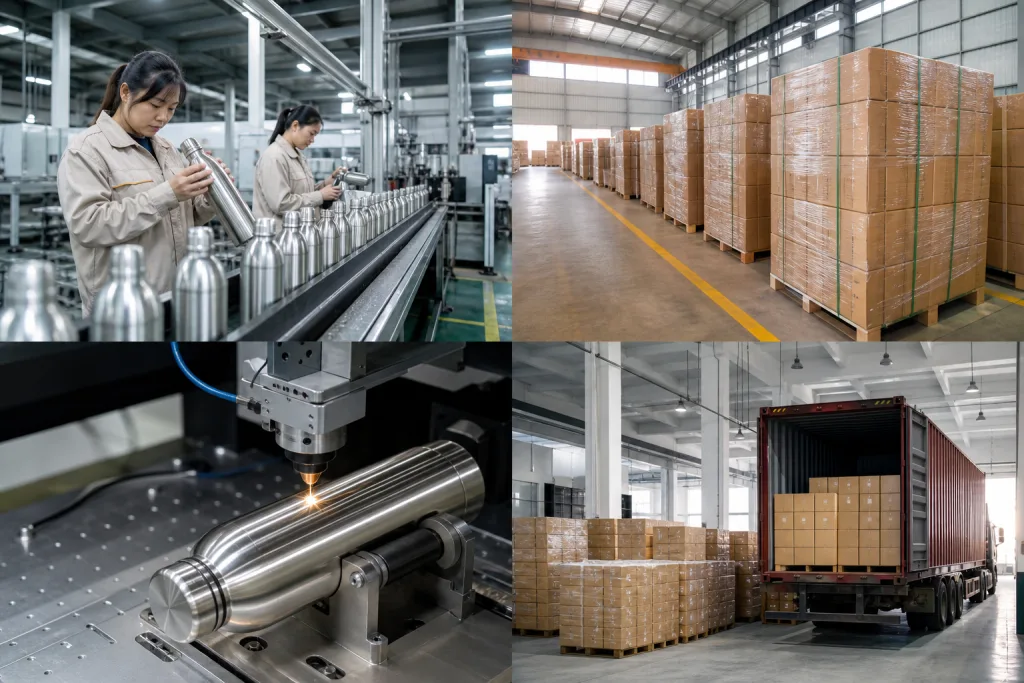
Key Takeaways
- A practical MOQ is 1,000 units per color or size, while 3,000-5,000 units usually unlock better FOB pricing
- A 500 ml double-wall 304 stainless steel thermos often lands around USD 3.20-6.80 FOB depending on lid, finish, and packaging
- New mold or lid tooling can add USD 800-3,500 and 15-25 days before mass production starts
- Plan 35-55 days for sampling and production, then 25-40 days for ocean freight to North America or Europe
If you want to create vacuum bottle wholesale for an outdoor line or a promotional campaign, the risk is not the bottle shape. The risk is quoting a custom thermos before the steel grade, wall thickness in mm, lid tooling, logo process, carton spec, AQL 2.5 inspection level, and ship date are locked. We’ve seen this go sideways: a buyer approved a 500 ml sample, then asked for a cheaper lid after tooling started, and the math stopped working.
At our Zhejiang, China factory, we quote stainless thermos programs every week for outdoor retailers, event agencies, and distributor thermos buyers. A normal MOQ starts at 1,000 units per size, monthly capacity is about 600,000 units, and a clean reorder can run in 12 days vs 18 days for a new customized thermos project. QC pulled a sample last month where the PO said “matte black” but the artwork file showed gloss black; that small typo held the line for half a shift.
Start with the real bottle spec
Most create vacuum bottle wholesale mistakes start with a loose RFQ: '500 ml stainless bottle with logo.' Too thin. We cannot price a factory thermos cleanly from that line. A 500 ml bottle can be a 65 mm slim cycling shape, an 82 mm wide-mouth model for ice cubes, or a short 310 g retail-style body with more shelf weight. Each version changes steel usage, lid tooling, master carton size, and sea freight per unit. Last month a buyer sent this exact spec, then flagged the carton after PI because the bottle did not fit their display tray.
For a standard custom thermos, we define the body first: 304 stainless steel inner wall, 201 or 304 outer wall, 0.4-0.5 mm wall thickness, double-wall vacuum insulation, and copper coating if the buyer wants stronger heat retention. A typical 500 ml bottle may weigh 280-360 g before packaging. On the line, our QC checks body thickness with a digital caliper before vacuum testing; a 0.35 mm body saves a little money but loses shape fast after drop impact. If you want a premium outdoor product, do not cut too much steel weight. The math does not work when the bottle dents in the first shipment review.
The lid is the second major choice. A simple screw lid costs less and usually passes leak testing with fewer surprises. A push-button lid, straw lid, carry loop, or cup lid adds USD 0.25-1.20 per unit depending on parts and silicone quality. For promotional thermos orders, the cheapest lid is not always the safest choice. We run 100% lid assembly checks on orders with button lids, because one weak silicone ring can turn into a wet backpack complaint. If the event audience throws bottles into backpacks, leak testing matters more than saving USD 0.15.
When you compare thermos suppliers, send one clear spec sheet: capacity and body size, lid type with photo, steel grade, finish, logo process, packaging, and target certification. Without that, one thermos manufacturer may quote a thin 201 outer wall while another quotes 304 outer wall, and the lower price is not a true saving. We have seen this go sideways: a PO said matte black powder coating, but the artwork file named “black rubber paint,” so QC pulled the sample before mass production. Better to lock the spec before the quote, not after the deposit.
FOB price drivers you can control
FOB pricing for a customized thermos is not a mystery, but it is not one fixed number either. For common 350-750 ml stainless models from China, a realistic FOB Ningbo or Shanghai range is USD 2.80-7.50 per unit. Bigger growler-style bottles, cup-lid designs, and gift-box sets can move above USD 9.00. On our costing sheet, the first check is still simple: body diameter, steel thickness, and actual gram weight from the electronic scale beside the line.
The cost drivers you can control are steel weight, lid structure, surface finish, printing, packaging, and order quantity. Do not treat them as equal. Powder coating usually costs more than plain brushed steel, but it sells better for outdoor retail because the buyer gets grip and shelf color. A single-color silk screen logo may add USD 0.06-0.18. Laser engraving is often USD 0.10-0.35, depending on logo size and position. Full-wrap heat transfer or water transfer printing can add USD 0.45-1.20 and needs more setup time; last month QC pulled the sample because the wrap seam was 2 mm off-center on a 500 ml bottle.
Packaging is the quiet cost buyers forget. A plain white box may be USD 0.12-0.25. A printed retail box with 350 gsm paperboard may be USD 0.35-0.80. If you need barcode labels, FNSKU labels, warning inserts, master carton marks, or drop-test cartons, put them on the first PO, not after the pre-production sample. We had one order where the buyer added FNSKU labels after artwork approval, and the line lost 1.5 days waiting for revised carton marks. Around 7 out of 10 promotional brands ask about bottle price first and packaging second; that is the wrong question if Amazon or club retail is involved.
For outdoor retailers, I would rather see you spend USD 0.30 more on powder coating and a better silicone seal than spend the same money on over-designed packaging. Leaks kill reorders. A bottle that fails the inverted leak test for 30 minutes creates returns and angry photos from end users. A box that is too fancy only adds carton weight, and the freight math does not work when we ship 24 pcs per master carton.
MOQ tiers and what changes
MOQ is where about 6 out of 10 custom thermos projects become workable or stop at the costing sheet. For an existing model in one body color, our normal MOQ in Zhejiang is 1,000 units. If you need two colors, expect 1,000 units per color because the powder coating line needs a stable batch; changing from matte black to cream white means cleaning the spray booth, checking the curing oven at 180-200°C, and redoing the color card. For a fully customized thermos shape, new lid, or private mold, MOQ usually rises to 3,000-5,000 units.
At 500 units, some thermos vendor quotes may still come back, but the unit price will look heavy, color choice will be narrow, and packaging options will be basic. The factory still has to set up polishing wheels, vacuum brazing, powder coating, screen printing, packing, and AQL inspection. No magic here. Small orders carry those setup costs badly, and the math doesn't work if the buyer wants a gift box, logo print, and PMS coating at the same time. At 1,000 units, a bulk thermos order becomes manageable. At 3,000 units, the FOB price may drop 5-12%. At 5,000-10,000 units, you can negotiate better carton design, spare lids, or tighter production scheduling; our planner can usually hold the line 2-3 days earlier when the order fills one clean production slot.
For distributor thermos programs, mixed models are common: 1,000 units of 500 ml, 1,000 units of 750 ml, and 1,000 units of 1,000 ml. This is much easier to run than 300 units across ten colors, which often leaves half-used coating powder and messy warehouse labels. We have seen this go sideways when a PO listed “olive green” but the buyer’s artwork file said “army green”; QC pulled the sample before mass coating, but it still cost 2 days. If you sell to outdoor shops, cut the color spread and hold deeper stock. Black, white, navy, olive, and stainless steel cover most wholesale demand.
Ask your thermos supplier to separate the quote by MOQ tier: 1,000, 3,000, and 5,000 units. You will see the real break point fast. A good manufacturers thermos team should show which cost drops at each tier, such as coating loss, carton printing, lid injection, or packing labor, not just send three neat prices in a PDF. If the quote only says “best price,” push back; we ship better orders when the buyer can see where each RMB is being saved.
Tooling, samples, and approval time
If you choose an existing manufacturer thermos model, sampling moves fast. We run stock blanks with laser logo in 5-7 days when the logo file is clean and the cup is already in our warehouse. A powder-coated sample with silk screen or heat transfer is more realistic at 10-15 days because the line has to spray, bake, cool, then QC checks adhesion with 3M tape. New lid mold? Add tooling time first. A new bottle body or an odd capacity like 420ml on a 500ml diameter tube needs drawing review before anyone should discuss mass production dates.
Typical tooling ranges are simple silicone gasket mold at USD 150-400, plastic lid mold at USD 800-2,500, and stainless body tooling at USD 1,500-3,500 or more depending on shape. Tooling time is usually 15-25 days for a lid and 20-35 days for a body. Last month QC pulled a lid sample where the drinking spout was 0.6mm off-center; that small miss still meant one more mold correction. If you are building a thermos customizable range for several seasons, tooling can pay back. If the order is a one-time promotional thermos campaign, the math usually does not work. Use an existing mold and spend the budget on coating quality and branding.
Sample approval should be strict. Check color under daylight, measure real capacity with a scale, test lid fit, confirm logo position, then pour boiling water into the bottle. We also check the mouth thread with a go/no-go gauge because buyers usually flag leaks after packing, not during the video call. A good vacuum bottle should show limited exterior temperature rise after filling with hot water. For retail claims, ask for a simple heat-retention curve, such as 95°C water still above 60°C after 12 hours, depending on capacity and construction.
One practical warning: do not approve a digital mockup as if it were a production sample. Pantone colors on a screen do not equal powder coating on steel; we have seen “matte sand beige” turn into a grey cup under warehouse LED lights. For China production, physical pre-production samples reduce arguments later, especially when the PO has one logo size and the artwork file shows another.
Mass production lead time math
For an existing stainless thermos with custom logo and standard packaging, mass production usually runs 25-35 days after deposit and sample approval. Add 5-10 days before summer, Christmas, and the big corporate gifting window, because coating ovens and silk-screen rooms get booked first. For new tooling or complex full-wrap artwork, 45-60 days is the safer plan. We check this against the production board, not a nice-looking promise in a quotation.
The production flow has 12 gates: steel cutting, forming, welding, vacuuming, polishing, coating, logo application, curing, assembly, leak testing, final inspection, and packing. One weak weld, one coating scratch under the handle area, or one lid gasket sitting 0.5 mm off can stop the line. QC pulled the sample. That is why a serious thermos factory will not promise 12-day mass production for 5,000 units unless 304 stainless steel, lids, cartons, and inserts are already sitting in the warehouse.
Our Zhejiang plant runs about 600,000 drinkware units per month across stainless thermos, travel tumbler, and sports bottle lines, but capacity is scheduled by coating color and lid type first, then by carton plan. A black 500 ml thermos bulk order moves faster than six matte colors with individual gift boxes and Amazon labels, because every color change means gun cleaning, oven slot changes, and another first-piece check. The buyer flagged this last March: “same bottle, why 8 days longer?” The answer was simple. Six colors are not one production run.
For Europe and North America, add logistics time. Ocean freight is often 25-40 days port to port, plus customs and inland delivery. Air freight can be 5-10 days, but the math does not work for heavy stainless bottles unless the order value is high or the launch date is already at risk. If your launch date is fixed, count backward from the delivery date, not from the day you want to place the PO. We have seen this go sideways when a PO had the right SKU but the wrong carton mark, and that small typo cost 3 days before packing could restart.
Quality checks before the balance
A stainless thermos looks simple, but one leaking lid after import gets expensive fast. Lock the inspection standard before the line cuts steel or sprays powder. For most wholesale orders, we run AQL Level II, with critical defects at 0, major defects at 2.5, and minor defects at 4.0. Critical defects mean leakage under inversion test, sharp rim burrs over 0.2 mm, wrong food-contact material, lid button failure after opening and closing, or oil, dust, and unsafe contamination inside the cup. QC pulled a sample last month where the silicone ring was seated 1.5 mm off-center. It looked fine in a photo. It leaked in 30 seconds.
Ask for material declarations for every food-contact part: inner wall, lid plastic, silicone gasket, straw, and coating if it touches the mouth area. For European buyers, REACH and LFGB-related testing may apply depending on market and claim. For North America, buyers often request FDA food-contact compliance, plus ASTM-related packaging or safety checks when the bottle is sold through retail chains. If your customer requires BSCI, ISO 9001, or social audit records, ask before deposit. Audit files are not something a thermos suppliers team should invent one week before shipment. We have seen this go sideways when a PO says “BSCI needed” in a tiny note at the bottom, after 3,000 pcs were already packed.
Inspection should cover vacuum performance sampling with a 95°C hot-water hold test, lid torque checked by torque meter, leak testing upside down for 30 minutes, coating adhesion, print rub test, carton drop check, barcode scan, and quantity count. For powder coating, use a cross-hatch adhesion test with 3M tape and a basic abrasion check on the shoulder area, where scratches show first. For logo work, confirm size tolerance, placement tolerance, and Pantone color before mass printing. Small shift, big complaint. A 2 mm logo shift may not matter on a giveaway bottle, but it can matter on a premium retail line where the buyer checks shelf samples with a ruler.
Do not pay the final 70% balance only on factory photos. Photos show the best 6 cartons, not the defect rate across 80 cartons. Use your own China inspector or ask your supplier thermos partner for a formal pre-shipment inspection report with photos, measurements, and AQL result. This is the wrong place to save USD 180. We ship clean orders faster when the inspector signs off on carton marks, gross weight, barcode scan, and random bottle measurements before the balance is released.
Landed cost and reorder planning
FOB is just the factory gate number. I tell buyers to price landed cost first. On a 500 ml custom thermos at USD 4.20 FOB, you still need to add ocean freight, duty, customs broker, inland truck, inspection, financing cost, and warehouse handling. We once saw a buyer try to hold freight at USD 0.12 per unit, and the import sheet still landed at USD 0.45-1.20 per unit by sea depending on carton volume and destination. Air freight can add several dollars per unit. That is the wrong question to ask if your margin is tight.
Carton efficiency moves the number fast. A 500 ml bottle may pack 24 pieces per master carton, with carton weight around 9-11 kg. At the packing table, QC pulled one carton at 10.8 kg, then the buyer flagged the bulkier handle lid because it cut the count and pushed freight per unit up. A retail box with extra insert, or a lid shape that sticks out, can do the same. If you sell through distributor thermos channels, check pallet height, carton strength, and label layout before you place the PO. Warehouse teams do not forgive weak cartons or unreadable marks.
Reorders go smoother when you lock the bill of materials. Keep the same powder code, lid mold, silicone color, box dieline, and logo file. Our mold room keeps the lid insert record on file, and that saves days when the next order lands. A repeat thermos manufacturer order can often ship in 25-30 days if materials are ready. Change one small part, such as a lid loop color, and you can trigger fresh sampling and slow the whole line. We have seen this go sideways for a 3 mm color tweak.
For outdoor retailers, I would launch with one or two capacities and three proven colors. Three is enough. A buyer once asked for six shades, and the carton mix turned messy before we even started print setup. For promotional brands, keep one steady model ready for fast logo changes. That gives you a cleaner manufacturer thermos base, better pricing, and fewer surprises when the next campaign brief comes in from your customer.
Send your thermos spec for a factory quote
Share capacity, lid, color, logo, packaging, MOQ, and target delivery date. We will return a practical FOB and lead-time plan.
Frequently asked questions
What MOQ should I expect for create vacuum bottle wholesale?
For an existing stainless thermos model, expect 1,000 units per size or color as a practical MOQ in China. Some factories may accept 500 units, but the FOB price is usually higher and color options are limited. For a new body shape, new lid, or fully customized thermos mold, 3,000-5,000 units is more realistic. If you need three colors, calculate MOQ per color, not only total order quantity. A clean first order might be 1,000 black, 1,000 white, and 1,000 olive units.
How much does a 500 ml custom stainless thermos cost?
A standard 500 ml double-wall stainless thermos usually costs around USD 3.20-6.80 FOB China, depending on steel grade, lid structure, coating, logo, and box. A simple screw-lid model with one-color print may sit near the lower end. A powder-coated bottle with carry lid, laser engraving, retail box, barcode label, and stronger insulation will be higher. If a quote is far below USD 3.00, check steel weight, 304 inner wall claim, vacuum performance, and lid seal quality before you compare it seriously.
How long does a customized thermos order take?
For an existing model, allow 10-15 days for a physical pre-production sample and 25-35 days for mass production after approval and deposit. If you need new tooling, add 15-35 days depending on whether it is a lid, gasket, or body mold. Ocean freight to North America or Europe often adds 25-40 days port to port, plus customs and inland delivery. For a fixed retail launch, a safe calendar is usually 75-100 days from first sample request to warehouse arrival.
Which logo method is best for a promotional thermos?
For promotional thermos orders, silk screen printing is cost-effective for simple one- or two-color logos, often adding USD 0.06-0.18 per unit. Laser engraving costs more, commonly USD 0.10-0.35, but it is durable and looks cleaner on powder coating or stainless steel. Full-wrap transfer printing is better for retail artwork or lifestyle graphics, but it can add USD 0.45-1.20 and needs more approval time. If the bottle will be handled outdoors, prioritize adhesion and scratch resistance over very fine artwork.
What quality tests should I require from thermos manufacturers?
Require leak testing, vacuum performance testing, coating adhesion, logo rub testing, lid function checks, and carton drop checks. For order inspection, AQL Level II is common, with critical defects at 0, major defects at 2.5, and minor defects at 4.0. Ask for food-contact material declarations for stainless steel, silicone, and plastic parts. European buyers should consider REACH or LFGB-related requirements, while North American buyers often ask for FDA food-contact compliance. If your retailer requires BSCI or ISO 9001 documentation, confirm it before deposit.