Key Takeaways
- A practical MOQ for custom thermos production is usually 1,000 units per shape and 3,000 units for private mold color sets
- 304 stainless steel at 0.4-0.5 mm inner wall thickness is the normal baseline for retail-grade vacuum bottles
- Laser engraving is slower but cleaner for 1-color premium logos; silk screen is cheaper for large promotional runs
- AQL 2.5/4.0 inspection plus 24-hour leak testing catches most defects before FOB shipment
If you want to create thermos flask wholesale, the hard part is not finding a glossy sample. The hard part is choosing the construction, lid, coating, logo method, carton plan, and test standard that still make sense when 5,000 units land in your warehouse. We had a buyer catch a PO typo on the packing list at the line—“500 pcs” typed as “5,000 pcs”—and that is the kind of mistake that turns into a freight headache. Outdoor retailers and promotional brands often chase unit price first and ask about thread fit, gasket material, and drop test too late.
From our Zhejiang factory side, bulk thermos buying should start with use case, not catalog photos. A 500 ml hiking flask, a 1 L distributor thermos, and a low-cost promotional thermos can look close online, but QC pulled the sample with a caliper at 0.02 mm and the lid tolerance told a different story. Steel grade, vacuum retention, lid tolerance, and packaging cost can move your landed price by 15-35%. This is the wrong question to ask: “Which one is cheapest?”
Start with the buying situation
A custom thermos is not one product. It is a spec sheet tied to your sales channel. Outdoor retailers usually ask us for 6-12 hour heat retention test data, a handle that survives a 15 kg pull test, spare lids packed by SKU, and a retail carton that does not crush after 2 rounds of shelf handling. Promotional brands push on logo area, ship date, unit price, and whether the bottle photographs cleanly under campaign lighting. A thermos distributor or thermos vendor sits between those two buyers and needs a middle spec that will not create after-sales noise.
The common mistake from buyers in Europe and North America is simple: they send “500 ml stainless flask with logo” to 5 thermos suppliers in China, then compare FOB prices only. Wrong question. That quote can hide a 0.35 mm body versus 0.42 mm, a thin powder coat, PP lid material instead of Tritan, missing copper plating, weak K=A carton paper, or no clear AQL 2.5 inspection term. QC pulled one sample last month where 3 caps leaked out of 100 after the inverted water test. Cheap factory thermos gets expensive fast when the logo scratches during local distribution.
For a serious create thermos flask wholesale project, define 4 points before price negotiation: who buys it, expected retail price, hot coffee or cold water use, and how much decoration the bottle needs. If you sell to outdoor shops at USD 19.99-29.99 retail, a USD 4.20-6.80 FOB customized thermos can make sense with 304 stainless, copper coating, and a sturdier lid set. If it is a conference giveaway, USD 2.60-4.20 FOB may be the right lane. The math does not work if you also ask for gift-box packaging, laser logo, spare cap, and 18-day delivery on a 1,000 pcs MOQ.
Our Hangzhou, Zhejiang team normally sorts buyer requests into 3 tracks: retail outdoor, corporate promotional, and distributor replenishment. We run them on separate costing sheets because the line setup, carton drop-test requirement, and logo process are not the same. That keeps the discussion honest. You can still upgrade or downgrade, but one manufacturer thermos spec will not serve every buyer equally well.
Spec table: three common builds
Before we cut a sample, we compare a bulk thermos order on this kind of sheet. It is not every build we can run, but it shows where the cost goes: steel grade, wall thickness, lid fit, coating loss, and logo process. Ask for this before the glossy photo. On our line, QC checks the first sample with a digital caliper and a 100°C hot-water hold test, because a 0.08 mm wall difference can change both dent rate and price.
| Spec item | Outdoor retail flask | Promotional campaign flask | Distributor stock flask |
|---|---|---|---|
| Common capacity | 500 ml, 750 ml, 1,000 ml | 350 ml, 500 ml | 500 ml, 750 ml |
| Steel grade | 304 inner / 304 outer | 304 inner / 201 or 304 outer | 304 inner / 304 outer |
| Wall thickness | 0.45-0.50 mm | 0.35-0.42 mm | 0.40-0.45 mm |
| Insulation target | 6 hours at 65°C+, 12 hours warm | 6 hours at 55-60°C+ | 6 hours at 60-65°C+ |
| Logo method | Laser, powder coat, debossed sleeve | Silk screen, pad print, UV print | Laser or 1-color silk screen |
| Typical FOB China | USD 4.20-7.80 | USD 2.60-4.50 | USD 3.50-6.20 |
| Best fit | Outdoor retailers, gear shops | Events, gifts, loyalty packs | Regional distributors thermos programs |
The outdoor version is the safer choice when the buyer’s name is printed on the box. It uses heavier stainless steel, a tighter lid fit, and cleaner surface finishing after polishing. The promotional version is for a fixed budget and a fixed event date. No mystery there. The distributor version sits in the middle for repeat thermos bulk sales, where the buyer cares more about steady USD pricing and fewer after-sales emails than chasing the thinnest possible quote. We have seen this go sideways when a PO says “304 stainless” but the approved quote allowed 201 outer; the buyer flagged it only after the pre-shipment inspection.
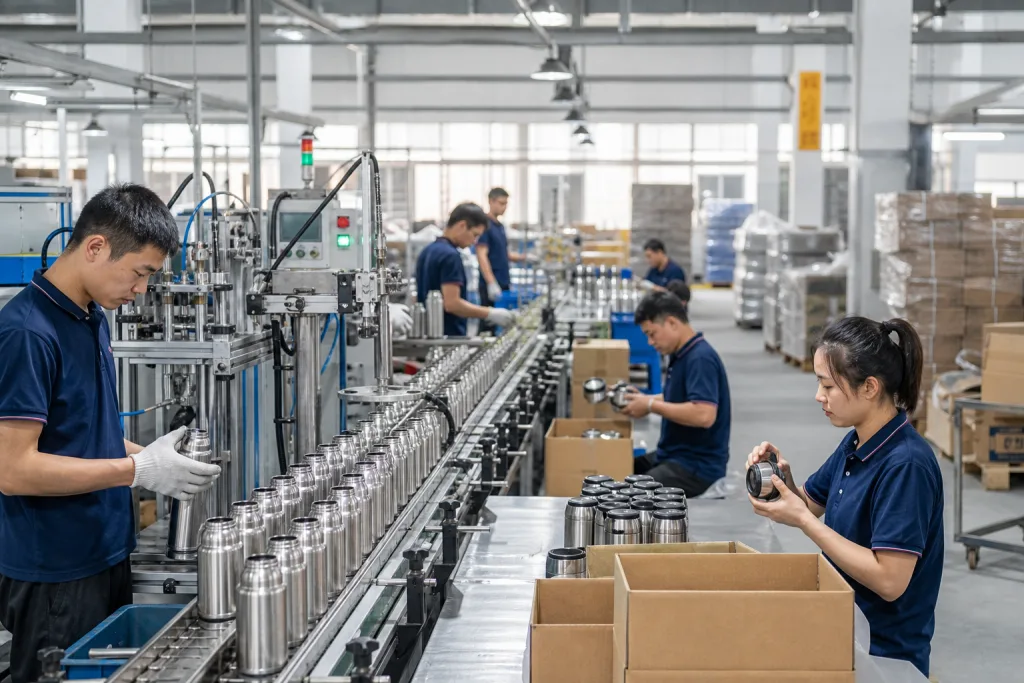
For our own production planning in Zhejiang, a normal MOQ is 1,000 units per existing shape and color, with 25-35 days for mass production after sample approval. We ship faster on repeat colors because the powder supplier has the code on file, but a new matte Pantone can still add 3-5 days if the first spray panel fails the tape test. Our stainless thermos line can produce about 300,000 units per month across bottles, mugs, and food jars, but capacity gets tight before Q4 and before large European seasonal campaigns. Book early. The math does not work if a buyer asks for 18,000 custom flasks, new mold lid, gift box, and delivery in 12 days instead of 25-35 days.
Retail outdoor versus promotional use
Outdoor buyers should be strict about the parts users touch every day. A cap with 0.5 mm side play, a handle that flexes under load, or powder coating that chips at the bottom ring will kill repeat orders. If you want a custom thermos for hiking packs, camping kits, fishing shops, or winter commute ranges, write drop resistance, cap torque, and coating adhesion into the spec sheet. On our line, QC uses a cross-hatch cutter after curing, then does the 3M tape pull before cartons are sealed. For leak testing, every unit should be inverted or pressure checked. Sampling only is the wrong question to ask for outdoor retail.
Promotional brands carry a different risk. Your customer may never test insulation with a thermometer, but they will flag late delivery, wrong logo color, or cartons that look mixed. For a thermos promotional order, confirm Pantone tolerance, print position tolerance, and packing sequence before we run the first 50 pcs trial print. We have seen a buyer reject goods because PMS 186C looked closer to 185C under warehouse light. If the bottles are going into gift sets, the factory needs the insert dimensions before mass production. A 2 mm change in bottle diameter can affect thousands of paper trays.
A distributor thermos program needs boring reliability. Boring is good. Choose two or three capacities, two core colors, and one decoration process. Keep replacement lids available for at least 12 months, with the silicone ring code matched on the spare-parts list. If you sell through multiple thermos distributors, avoid too many exclusive colors unless the order volume supports it. Customizable thermos options sound attractive, but every added color and logo plate adds QC checks and makes the warehouse bin labels easier to misread. We have seen this go sideways on a PO where “matte black” and “black gloss” were swapped by one clerk.
For retailers, I would spend the extra USD 0.30-0.60 on better coating and lid material. For giveaways, I would put that money into cleaner logo execution and stronger export cartons, usually 5-ply with edge-crush strength checked before loading. For a thermos supplier in China, both choices are easy to make. You need to tell the factory which failure costs you more: a product performance complaint after 30 days, or a campaign presentation problem on delivery day.
Logo and finish head-to-head
Decoration is where 6 out of 10 thermos custom projects get messy. The buyer signs off a PDF mockup, we run the sample, then bulk production comes out with softer logo edges because nobody checked the body curve, powder texture, or jig position early enough. We measure the print area with a caliper and fix the bottle in a 3D-printed fixture before sampling. Cheap logo pricing alone is the wrong question to ask; the method has to match the surface, artwork, and order quantity.
- Laser engraving: Best for premium retail, stainless finish, and powder-coated bottles where the buyer wants a clean permanent mark. It works well for names, simple icons, and 304 stainless bodies, but multi-color artwork is a bad fit. Setup is low; unit cost is often USD 0.08-0.25 depending on logo size.
- Silk screen printing: Good for one or two colors on straight bottle bodies, especially when we ship 1,000+ units from the same artwork. It is cost-effective, but curved shoulders and tapered cups can distort the edge. Unit cost can be USD 0.05-0.18.
- UV printing: Useful for colorful logos and short promotional thermos runs, especially dealer names or event graphics under 500 pcs per design. It looks sharp, but QC should run a tape test and cross-cut adhesion test on the actual coating before bulk printing.
- Powder coating: Better grip and shelf appeal, common for outdoor lines where buyers ask for a soft-touch feel. Expect higher cost than spray paint, but scratch resistance is better when the oven temperature and curing time are controlled on the line.
If you want a thermos customizable program with 20 dealer logos, laser is usually easier to control. If you want 10,000 units for one campaign, silk screen moves faster and the math works better. For a customized thermos with retail ambitions, ask for a pre-production sample from the same coating batch planned for mass production; last month QC pulled a sample where the showroom piece passed, but the bulk matte black batch failed tape adhesion after 24 hours. Hand samples help. They are not production-line proof.
Check logo placement against carton dividers and bottle curves before signing the final artwork. A logo set 18 mm too low can rub against the kraft divider during a 12-day sea shipment, and the buyer will flag scuffs before they even test heat retention. On matte coating, use polybags or tissue wrapping if abrasion risk is high. It adds USD 0.02-0.04 per unit, but it can save a claim on the first master carton inspection.
Compliance and QC are price items
Buyers often talk price first and compliance later. That order is backwards. If you sell into Europe, LFGB, REACH, and food-contact declarations need to be on the table before you compare unit prices. For the United States, ask for FDA food-contact materials and, when the channel needs it, California Proposition 65 screening. For kids or school buyers, ASTM-related expectations can show up even when the bottle is not a toy. We once saw a PO that said “EU standard” and nothing else. Useless. On our filling line, QC pulls one sample every 300 pcs and checks the lid fit before carton close, because a missing report number on a file can turn into a rejected shipment.
Factory audits matter too. BSCI, ISO 9001, or a customer audit will not turn a weak bottle into a good one, but they cut down surprises in process control, traceability, and worker safety. A manufacturer thermos quotation should show which certificates are already in hand and what new testing will cost. Lab testing usually takes 7-10 working days, and a full test package can run several hundred US dollars depending on market and material scope. We had a buyer push back on a $420 test fee, then ask for a retest after their own compliance team spotted a gap. The math does not work if the supplier hides that cost in the unit price. On our side, batch cards sit next to the steam test station, and every lot gets the same code from material intake to packing.
For QC, use AQL language. A common inspection plan is AQL 2.5 for major defects and 4.0 for minor defects, with critical defects set at 0. Critical defects include leaking, sharp edges, contamination, broken vacuum, and unsafe materials. Major defects include wrong logo, obvious dents, bad coating, or cap malfunction. Minor defects include small cosmetic marks within an agreed limit. QC pulled the sample from carton 18 on one job, and the buyer still tried to call a loose lid “normal.” It was not normal. We run a 0.1 mm feeler gauge along the lid seam and check the cap fit before release, because vague words in an inspection report do not save a shipment.
We recommend three checks on any thermos bulk purchase: 24-hour hot water retention sampling, full-carton drop testing, and random cap torque testing. For vacuum bottles, even a small failure rate shows up fast because users complain the minute drinks go cold. If a thermos vendor says inspection is unnecessary because “we always do good quality,” ask for the checklist. This is the wrong question to dodge. Trust is fine. Written criteria are better. On our bench, QC uses a torque meter set to 0.35 N·m at the cap station, and that number catches loose lids before they leave the line. We’ve seen this go sideways when a buyer skipped torque testing to save time and then paid for return freight.
Cost, MOQ, and lead time
FOB price starts with steel cost, forming loss, vacuum process, cap assembly, coating, decoration, packaging, labor, scrap rate, and inspection. One line item can move the quote fast. We run 0.38 mm and 0.48 mm wall samples on the same height gauge, and the hand feel difference is obvious, but the 0.48 mm body eats more stainless and adds weight to the carton. Switching the outer shell from 201 to 304 stainless raises cost; the math does not disappear because the buyer wants a “premium look.” A retail color box usually adds USD 0.18-0.45 over a plain white box, and QC still checks barcode position, glue marks, and drop-test damage before packing.
For existing molds, our normal MOQ in China is 1,000 units per SKU. For custom powder coating, 1,000-2,000 units is realistic, depending on the color and whether the coating line already has a close RAL shade in production that week. Small runs sound easy. They are not. For a private mold, plan for 8,000-20,000 units annual volume if you want the tooling investment to make sense. Tooling can run from USD 1,500 for a simple lid modification to USD 8,000+ for a new bottle body and cap system, and the buyer should budget one extra T1 sample round if the lid thread feels tight at 0.2 mm tolerance.
Lead time should be counted from approved sample and deposit, not from the day you first email a thermos supplier. This is the wrong date to put on your launch calendar. A practical timeline is 5-7 days for basic logo sample, 10-15 days for coating and packaging sample, 25-35 days for mass production, and 3-5 days for final inspection and export paperwork. Last month QC pulled a sample because the PO said matte black but the artwork file said “black gloss”; that kind of typo costs 2 days before the line even starts. Sea freight to Europe or North America then adds several weeks, depending on port and season.
Payment terms for new buyers are usually 30% deposit and 70% before shipment after inspection. FOB Ningbo or FOB Shanghai are common for Zhejiang-based factories; we ship both, but Ningbo often works better for Hangzhou-area drinkware when the forwarder has space. If you need DDP, Amazon FNSKU labeling, or mixed cartons for distributors thermos shipments, discuss it before the proforma invoice. Logistics services are not free. They get buried in the unit price, carton mark charge, or warehouse handling fee if you do not specify them, and we have seen this go sideways when a buyer flagged missing FNSKU labels after 86 cartons were already sealed.
Choosing your final flask type
If you are still unsure which direction to take, start with the buyer complaint you cannot afford. Outdoor retailers get hit hardest on heat retention, lid leaks, and coating chips after 7-10 days of field use. Promotional brands lose money on wrong Pantone logo color, missed event dates, and cartons packed out of sequence. Distributors care about reorder price jumps and spare lids being unavailable 6 months later. We have had a buyer flag a 0.3 mm gap on a flip lid during pre-shipment QC, and that small gap became the whole discussion.
For a first create thermos flask wholesale order, do not test 8 bodies at once. The math does not work. Pick one proven stainless thermos body, one cap style, two colors, and one logo method. Run 1,000-3,000 units, inspect properly under AQL 2.5, and collect feedback from real customers. If sell-through is strong, add a 750 ml size, handle lid, gift box, or seasonal color on the second PO. We usually run this on the line with a simple torque test for the cap and a 95°C hot water test, because a nice catalog photo will not show a weak seal. This is slower than launching a large thermos customized range on day one, but it protects your cash and reputation.
Ask your thermos manufacturers for a comparison quote, not a single price. Request three columns: good, better, and retail-grade. Each column should show steel grade, wall thickness, insulation test, logo method, packaging, MOQ, lead time, and certificate availability. A serious China supplier thermos team will answer directly, with numbers like 0.4 mm outer wall, 500 pcs color MOQ, or 25-30 days production after artwork approval. If you receive only photos and a low price, you still do not have enough information to buy safely. QC pulled the sample for one overseas buyer last year because the PO said “matte black” but the artwork file said “gloss black”; catch that before mass production, not at the warehouse.
The best wholesale thermos decision is usually not the cheapest and not the most overbuilt. Choose the spec that fits your channel, passes inspection, arrives on time, and can be reordered without drama. We ship plenty of mid-range 304 stainless bottles that beat fancy samples because the lid mold is stable, the coating survives the 3M tape test, and the carton marking matches the buyer’s WMS label.
Send your thermos spec for a factory quote
Share capacity, logo, quantity, target market, and packaging needs. We will return practical options with MOQ, lead time, and FOB pricing.
Frequently asked questions
What MOQ should I expect for a custom stainless thermos order?
For an existing bottle shape, 1,000 units per SKU is a practical MOQ in China. If you need a custom powder-coated color, many factories prefer 1,000-2,000 units because coating lines need minimum batch efficiency. For multiple logos on the same body, 500 units per logo may be possible if the total order reaches 1,500-3,000 units. Private mold work is different; you should plan for 8,000-20,000 units per year to justify tooling and development costs.
How much does a wholesale stainless thermos usually cost?
For a 500 ml stainless vacuum flask, FOB China pricing often falls between USD 2.60 and USD 7.80 depending on steel grade, lid design, coating, logo, and packaging. A basic promotional thermos may be USD 2.60-4.50. A stronger outdoor retail flask with 304 inner and outer steel, powder coating, and better cap components may be USD 4.20-7.80. Retail color boxes, spare lids, hang tags, and barcodes add cost but may be necessary for your sales channel.
Which logo method is best for outdoor and promotional thermos orders?
For outdoor retail, laser engraving on powder coating or stainless steel is usually the safest choice because it is durable and looks clean. Unit cost is commonly USD 0.08-0.25. For promotional campaigns, one-color silk screen printing is often cheaper at around USD 0.05-0.18 per unit and works well on straight bottle walls. UV printing is useful for colorful artwork, but adhesion should be tested on the exact coating before mass production.
What quality tests should I require before shipment?
Use AQL inspection, commonly 2.5 for major defects and 4.0 for minor defects, with critical defects set at 0. Require leak testing, visual inspection, logo position checks, carton drop testing, and hot water retention sampling. For vacuum performance, test a sample batch with boiling water and measure temperature after 6 hours. For export cartons, confirm 5-ply carton strength if the shipment is heavy or going through distributor handling.
How long does it take to create a thermos flask wholesale order?
A normal timeline is 5-7 days for a simple logo sample, 10-15 days for a custom coating or packaging sample, and 25-35 days for mass production after approval and deposit. Final inspection and export paperwork usually add 3-5 days. If you need lab testing for LFGB, REACH, or FDA food-contact documentation, allow another 7-10 working days. Sea freight time depends on destination port and season, so build a buffer for holiday campaigns.